Mobile appHealth, fitness & wellness
A central hospital appointment system like MHRS, Turkey's national hospital booking service, lets patients see the right specialty, at the right hospital, at a suitable time without waiting in a phone queue. On the hospital side, the real gains are balanced use of outpatient clinic capacity, redistribution of unused slots and a lower no-show rate. The system's value comes from being fair, transparent and always available.
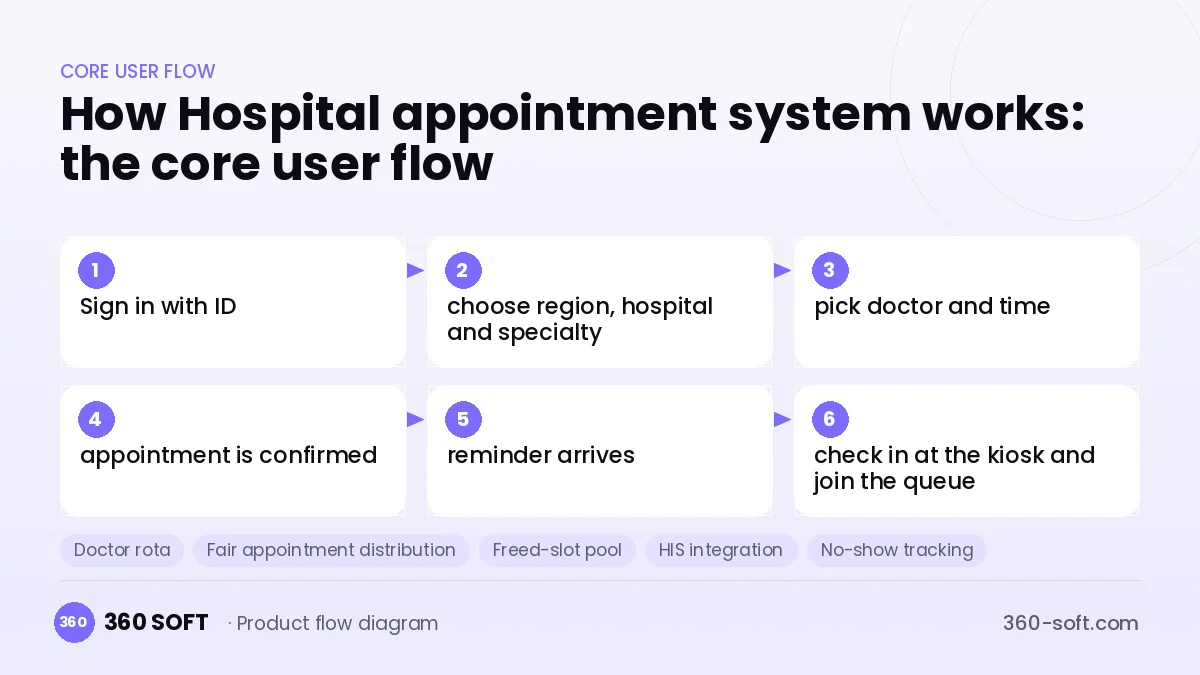
Building something similar takes a patient mobile app and website, a hospital and clinic management panel, a doctor rota module and two-way integration with the hospital information system (HIS). Identity verification, sudden traffic at peak times, rules for cancelling and redistributing appointments, and links to kiosks and queue-number systems are the core parts of the architecture.
How Hospital appointment system works: the core user flow
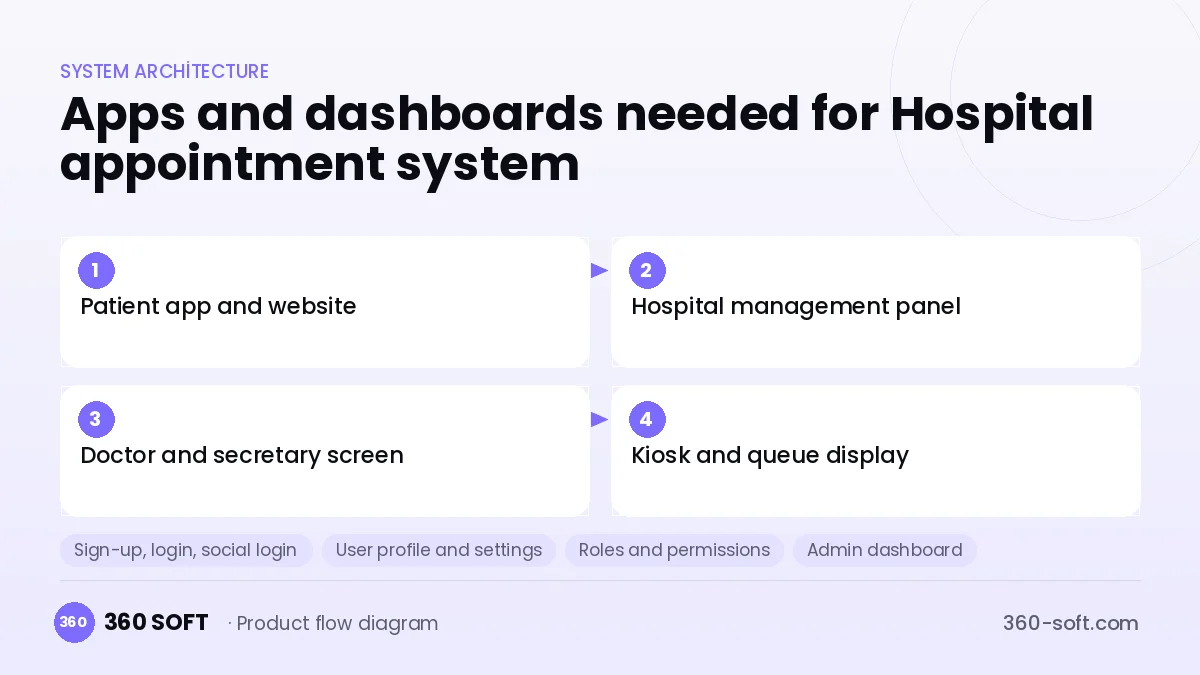
How many apps and dashboards do you need?
Patient app and website
The interface where patients search for, book and cancel appointments and see their past visits.
Hospital management panel
The admin panel that manages clinic capacities, doctor rotas and booking rules.
Doctor and secretary screen
The screen for tracking the daily patient list, arrival status and consultation queue.
Kiosk and queue display
The waiting-area screens where patients check in on arrival and follow their place in the queue.
Critical features of a product like Hospital appointment system
Doctor rota
Doctors' clinic, surgery and leave days are defined, and appointment slots are generated automatically from the rota.
Fair appointment distribution
Releasing appointments in stages at set times, with per-person limits, prevents bulk grabbing and abuse.
Freed-slot pool
Cancelled or released appointments are offered to waiting patients in turn or by instant notification.
HIS integration
Appointment data is passed to the hospital information system and registration starts automatically when the patient arrives.
No-show tracking
Patients who miss appointments are recorded, and restrictions are applied to repeat cases according to the rules.
Kiosk and queue numbering
Patients check in at the kiosk with their ID and follow their turn on the waiting-area display.
What goes into the first version, what comes later
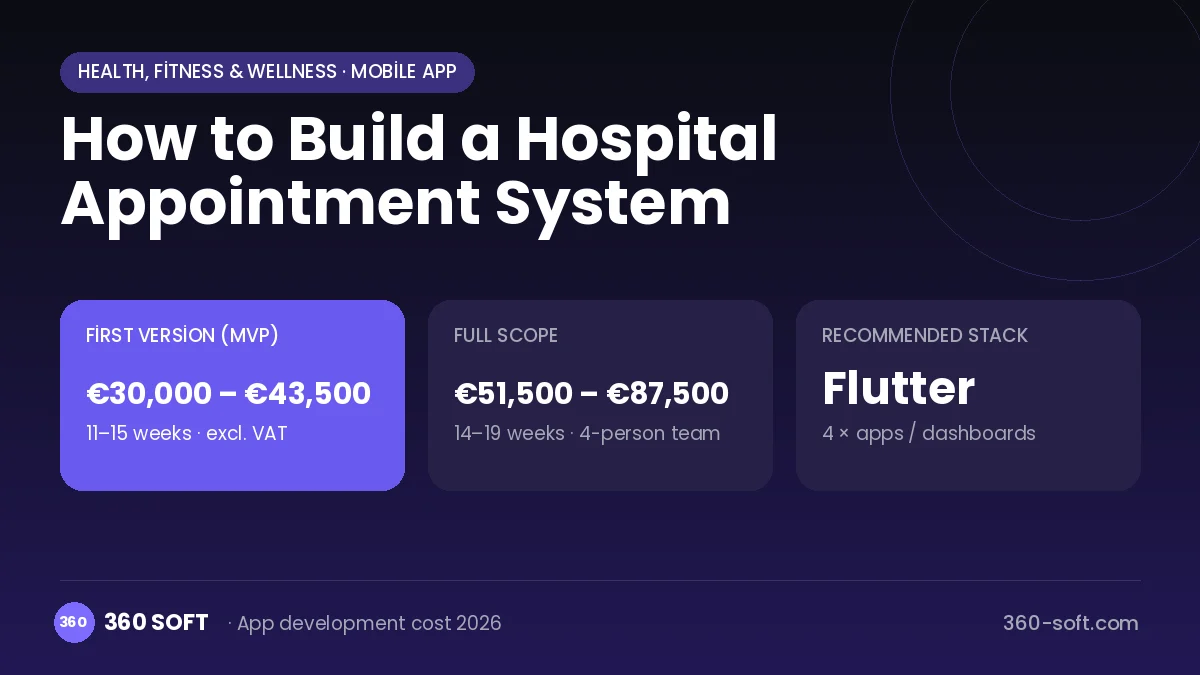
First version (MVP)
- Patient sign-in and identity verification
- Booking by specialty, hospital and doctor
- Doctor rota and slot generation
- SMS and push reminders, cancellation
- Hospital management panel and reports
Later releases
- Two-way integration with the HIS
- Kiosk and queue-number system connection
- Waiting list for freed appointments
- Online consultations and results viewing
Modules and how the budget is calculated
The budget is calculated with 360 SOFT’s pricing model from the modules below, about 30 screens and the project’s complexity: roughly 197 person-days for the full scope and 115 person-days for the first version. Every module you drop lowers the budget directly.
| Module | Phase |
|---|---|
| Sign-up, login, social login | First version |
| User profile and settings | First version |
| Roles and permissions | First version |
| Admin dashboard | First version |
| Booking / reservations | First version |
| Advanced search and filters | First version |
| Push notifications | First version |
| Email / SMS notifications | First version |
| Reporting and analytics | Later release |
| Third-party API integration | First version |
| GDPR and security hardening | First version |
| IoT device and sensor integration | Later release |
| Multi-language | First version |
Hosting, SMS, map APIs, app store accounts and payment-provider fees are separate items. Maintenance and improvements (optional): €650 / month. We send a fixed written price within 24 hours after a free discovery call.
The hard parts
Sudden traffic load
Thousands of people connect at the same moment when appointments are released, so scalable infrastructure and a queueing system are a must.
Variety of integrations
Hospitals run different HIS products, and each needs its own integration and test process.
Public-sector and data security requirements
Public projects come with strict requirements such as health data security, in-region hosting and audit logs.
Business model
Systems like this are usually built as institutional projects: a hospital group or public body buys the software through a licence, a project fee or an annual maintenance contract. When offered as SaaS to private hospital chains, the main revenue lines are a monthly subscription based on branches or doctors, SMS bundles and integration services.
Get a free quote for your project
Let us scope it together and send a fixed written quote within 24 hours. NDA on request; you own the source code.
Choosing a company to build an app like Hospital appointment system
Most people searching “build a hospital appointment system” are really looking for a reliable app development company. When comparing quotes, check four things:
- Can you try similar products they have shipped, in the stores or live?
- Are the source code, design files, servers and store accounts transferred to you by contract?
- Do they show a working demo every two weeks, with written scope and acceptance criteria?
- Are maintenance, scaling and GDPR/security costs written into the quote?
Copyright and trademarks
A business model and features are generally not protected on their own, but the Hospital appointment system name, logo, interface design, content and source code are. That is why we build a product with similar functionality but your own brand, design and code. This is not legal advice; we recommend a trademark search before launch.
Frequently asked questions
How long does it take to build a hospital appointment system?
For a single hospital group, the core booking, rota and patient app can be ready in a few months. Projects covering many institutions and HIS integrations are split into phases and take longer.
How many separate apps are needed?
There is the patient app and website, the hospital management panel, the doctor and secretary screen and the kiosk interface. All of them connect to a shared booking core.
Is HIS integration mandatory?
It is not mandatory, but without it patient registration involves double entry. The first release can transfer data by report, and a later phase can move to HL7 or FHIR-based integration.
What should I look for when choosing a company to build a hospital appointment system?
Ask about experience with high-traffic systems, health data security, GDPR compliance and integration with healthcare standards. Load tests should be part of the acceptance criteria.