Web platformFintech & paymentsOriginal by Kickstarter
Kickstarter lets creative projects collect early backing from a community before any product exists. A designer, game developer or author describes the project, sets rewards by pledge level and receives the funds if the goal is reached in time. The all-or-nothing model protects backers and pushes creators towards a realistic goal. A successful campaign is also proof that the product has demand in the market.
To build one you need a project submission and review process, reward tiers and stock limits, payments pre-authorised and charged only after a goal check at the end of the campaign, backer surveys, shipping address collection and project updates. Reward-based campaigns and equity or lending crowdfunding fall under separate legal regimes (securities regulators oversee the latter); payments must run through a licensed payment institution.

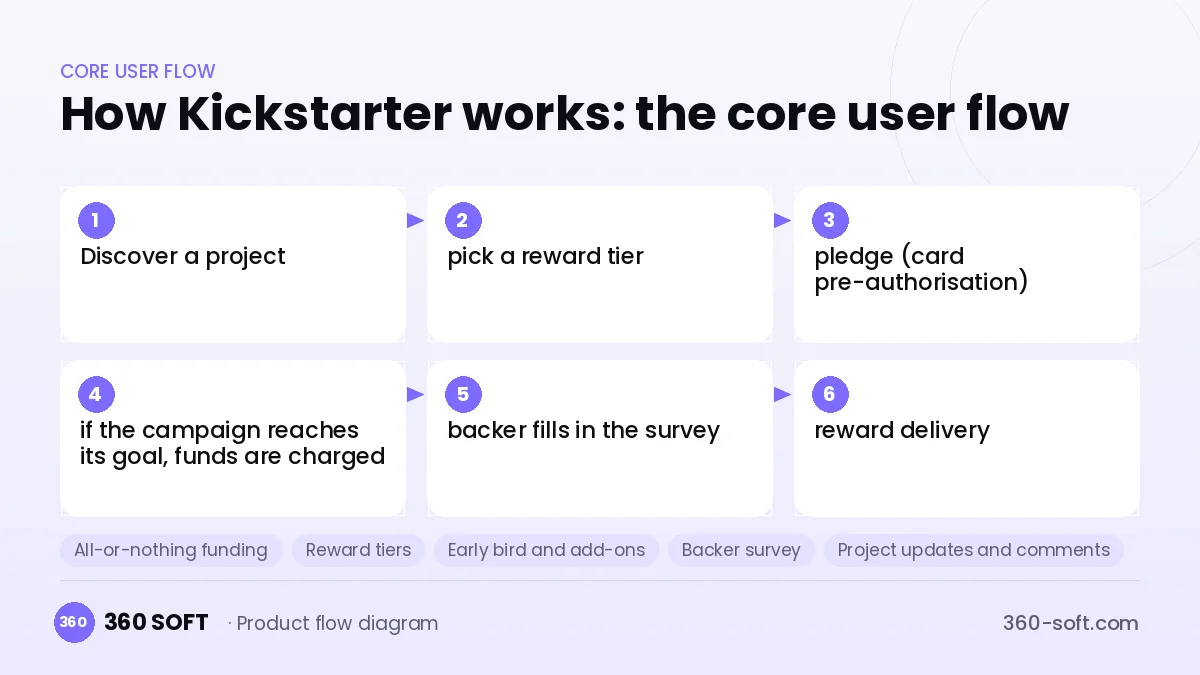
How Kickstarter works: the core user flow
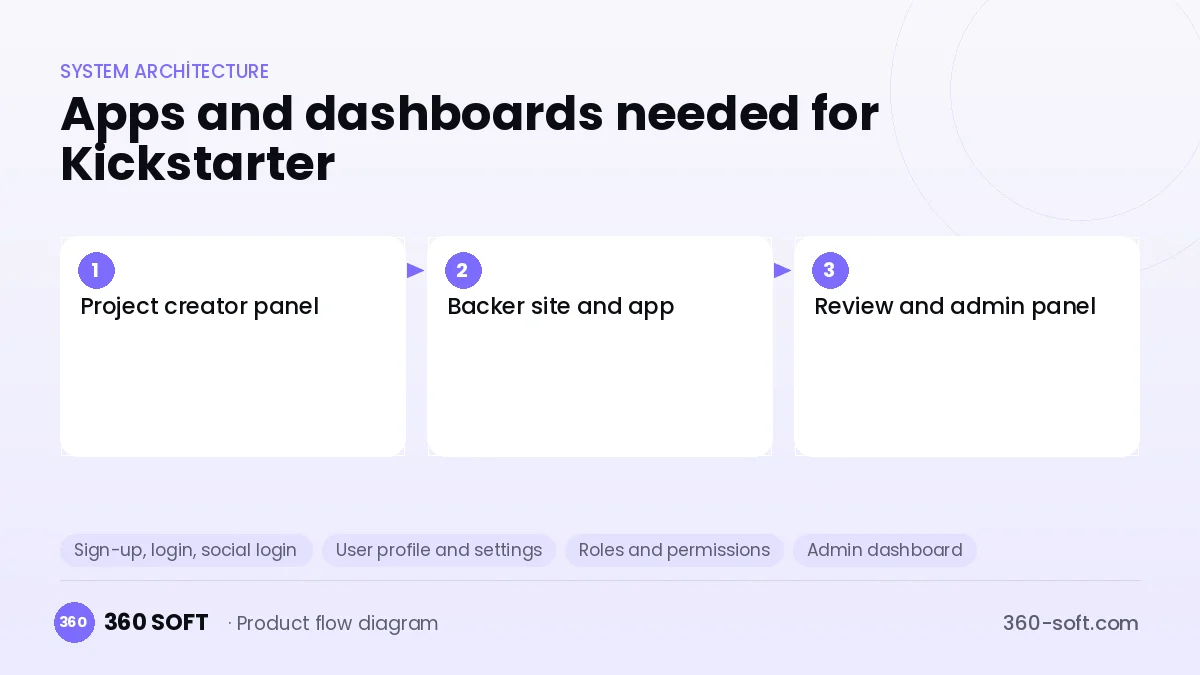
How many apps and dashboards do you need?
Project creator panel
The panel where creators manage their project, reward tiers, updates, backer list and fulfilment.
Backer site and app
The interface where users discover projects, pledge, follow updates and fill in reward details.
Review and admin panel
The team screen that evaluates project submissions, enforces the rules and monitors payment and complaint processes.
Critical features of a product like Kickstarter
All-or-nothing funding
Pledges are held as authorisations during the campaign; they are charged if the goal is reached and never collected if not.
Reward tiers
Each tier's amount, contents, estimated delivery date and limited quantity are defined.
Early bird and add-ons
Discounted tiers for the first backers and options to buy extra items after the campaign are offered.
Backer survey
After funding, details such as size, colour and delivery address are collected through a bulk survey.
Project updates and comments
The creator shares production progress; backers comment and receive notifications.
Discovery and featured projects
Projects are listed by category, popularity and time left, and editor picks are highlighted.
What goes into the first version, what comes later
First version (MVP)
- Project submission and review process
- Project page, reward tiers and progress
- Pre-authorised pledges via a licensed payment institution
- Goal check and charging at the end of the campaign
- Project updates and backer notifications
Later releases
- Backer survey and shipping address collection
- Add-on sales and post-campaign pre-orders
- Analytics and traffic sources for creators
- Mobile app and personal recommendations
Modules and how the budget is calculated
The budget is calculated with 360 SOFT’s pricing model from the modules below, about 26 screens and the project’s complexity: roughly 179 person-days for the full scope and 116 person-days for the first version. Every module you drop lowers the budget directly.
| Module | Phase |
|---|---|
| Sign-up, login, social login | First version |
| User profile and settings | First version |
| Roles and permissions | First version |
| Admin dashboard | First version |
| Online payments (Stripe / PSP) | First version |
| File, photo, video upload | First version |
| Video / voice calls | First version |
| Advanced search and filters | First version |
| Email / SMS notifications | First version |
| Reporting and analytics | Later release |
| GDPR and security hardening | First version |
| Content management / blog | First version |
Hosting, SMS, map APIs, app store accounts and payment-provider fees are separate items. Maintenance and improvements (optional): €600 / month. We send a fixed written price within 24 hours after a free discovery call.
The hard parts
Pre-authorised payment flow
Campaigns run for weeks; time limits on card authorisations and failed charges must be managed carefully.
Projects that fail to deliver
Projects that take the funds but cannot deliver rewards shake backer trust; the rules, communication and complaint process must be clear.
Legal and licensing framework
The reward-based model must be separated from investment crowdfunding that is regulated by securities authorities, and payments must be taken through a licensed institution.
Business model
In this model revenue is the platform commission taken on the amount raised by successfully funded projects only; payment processing fees are passed on separately. Revenue can be diversified by offering project creators paid tools such as campaign preparation consulting, promotion and a post-campaign pre-order shop. Showing the commission rate clearly increases creators' trust.
Get a free quote for your project
Let us scope it together and send a fixed written quote within 24 hours. NDA on request; you own the source code.
Choosing a company to build an app like Kickstarter
Most people searching “website like kickstarter” are really looking for a reliable app development company. When comparing quotes, check four things:
- Can you try similar products they have shipped, in the stores or live?
- Are the source code, design files, servers and store accounts transferred to you by contract?
- Do they show a working demo every two weeks, with written scope and acceptance criteria?
- Are maintenance, scaling and GDPR/security costs written into the quote?
Copyright and trademarks
A business model and features are generally not protected on their own, but the Kickstarter name, logo, interface design, content and source code are. That is why we build a product with similar functionality but your own brand, design and code. This is not legal advice; we recommend a trademark search before launch.
Frequently asked questions
How long does it take to build a site like Kickstarter?
A first version with project pages, reward tiers and pre-authorised payment can be ready in a few months. Testing the authorisation flow with the payment institution and the legal framework take additional time.
Is a securities regulator's approval needed?
Crowdfunding where funds are raised in return for shares or debt is regulated by securities authorities. A model based only on rewards or products is assessed differently; clarify your model with a legal advisor.
Will there be copyright or trademark issues?
The business model and features of reward-based crowdfunding are generally free to use. The name, logo, design, content and code cannot be copied; this is not legal advice.
What should I look for when choosing a software company?
Choose a team with experience in licensed payment institution integration, pre-authorisation and scheduled charging. See in a demo how a campaign that misses its goal is handled.