Mobile appMobility, ride-hailing & carsOriginal by BlaBlaCar
BlaBlaCar lets drivers on intercity trips share their empty seats with passengers heading the same way. The goal is not profit but splitting travel costs, which is what sets it apart from commercial transport. For people about to spend hours on the road with a stranger, verified profiles, reviews and booking guarantees are the platform's real value.
A similar product can run on a single mobile app with both driver and passenger roles plus an admin panel, but search and route matching must also cover stopovers. Bookings, prepayment, cancellation and refund rules, identity verification and in-app messaging are the core pieces. A moderation team enforcing community rules is an inseparable part of operations as well.
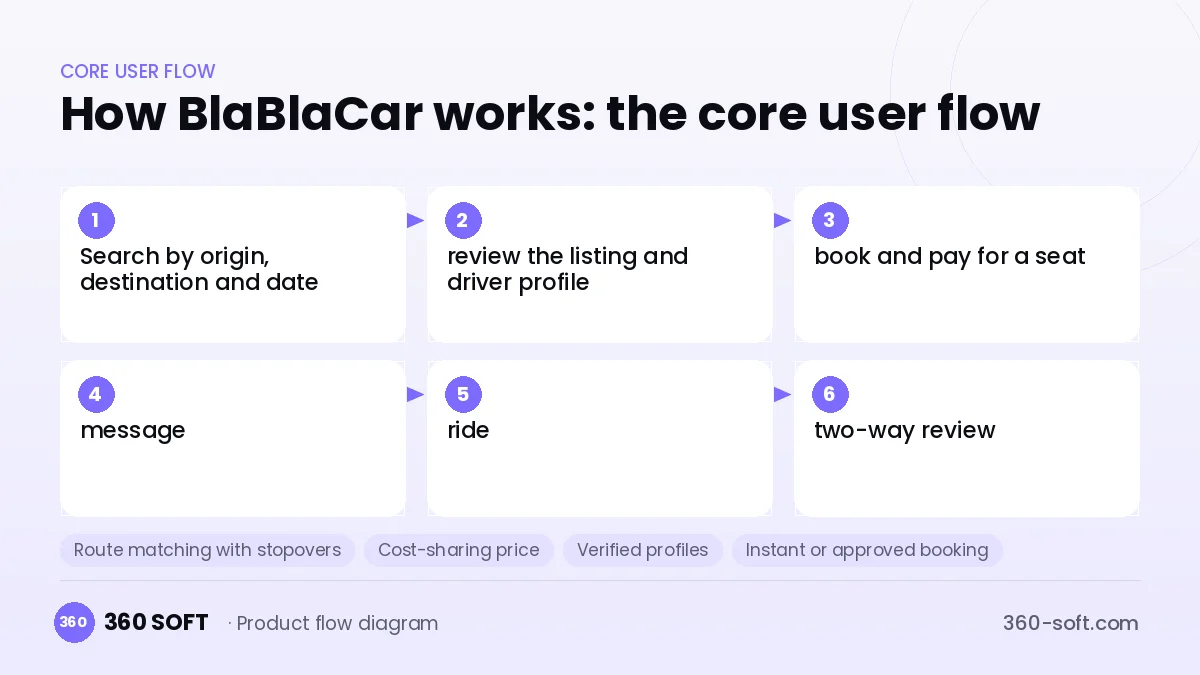
How BlaBlaCar works: the core user flow
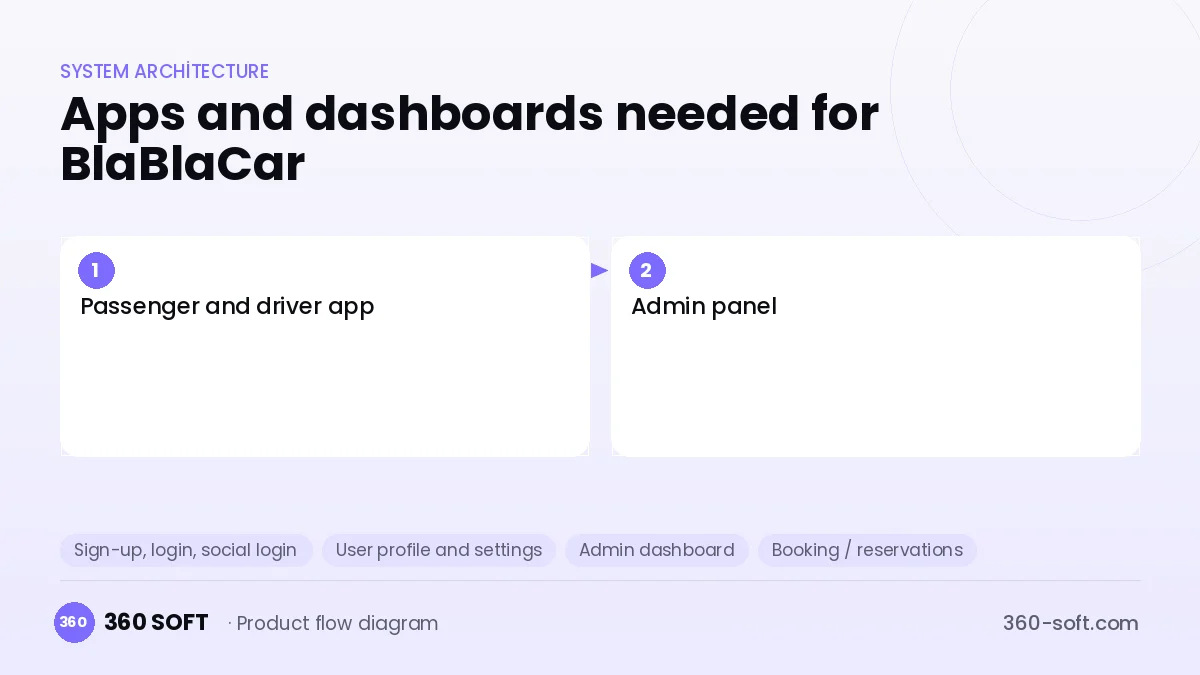
How many apps and dashboards do you need?
Passenger and driver app
One shared experience where drivers publish rides and passengers search and book seats.
Admin panel
The panel for identity verification, complaints, refunds and listings that break community rules.
Critical features of a product like BlaBlaCar
Route matching with stopovers
Matches the towns along a route so that a Paris to Lyon ride is also shown to a passenger boarding in Dijon.
Cost-sharing price
A suggested seat price and upper limit based on distance and fuel cost, which prevents any perception of commercial profit.
Verified profiles
Phone, email and ID verification with a badge system; review history is shown on the profile.
Instant or approved booking
Drivers can either approve requests one by one or let seats fill automatically.
Women-only and ride preferences
Accepting only female passengers and filtering preferences such as smoking or pets.
Cancellation and refund rules
Tiered refunds depending on time left, plus penalties and rating impact for driver-side cancellations.
What goes into the first version, what comes later
First version (MVP)
- Sign-up and profile with phone verification
- Publishing rides and searching by date and city
- Seat booking and in-app messaging
- Online prepayment with cancellation and refund rules
- Two-way post-trip reviews and complaint reporting
Later releases
- Matching via stopovers and along the route
- Advanced verification with ID documents
- Joint ticket sales with coach operators
- Recurring listings for regular commutes
Modules and how the budget is calculated
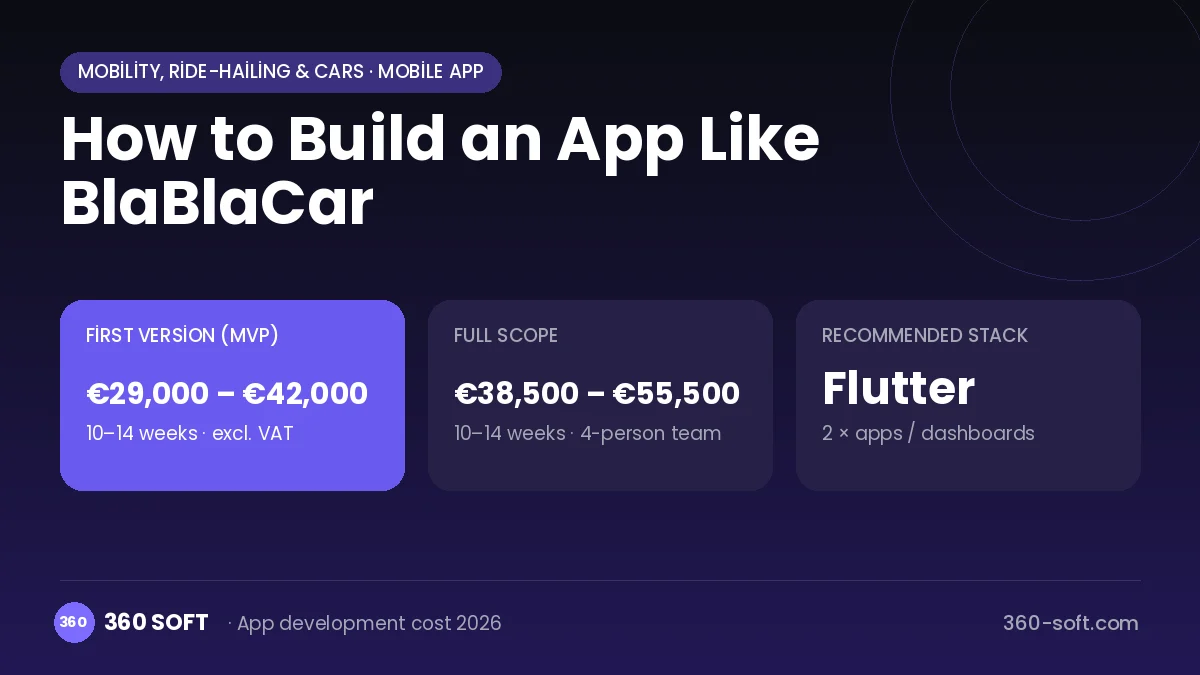
The budget is calculated with 360 SOFT’s pricing model from the modules below, about 24 screens and the project’s complexity: roughly 147 person-days for the full scope and 111 person-days for the first version. Every module you drop lowers the budget directly.
| Module | Phase |
|---|---|
| Sign-up, login, social login | First version |
| User profile and settings | First version |
| Admin dashboard | First version |
| Booking / reservations | First version |
| Online payments (Stripe / PSP) | First version |
| Advanced search and filters | First version |
| Maps, location, routing | First version |
| Real-time messaging | First version |
| Push notifications | First version |
| Ratings and reviews | First version |
| GDPR and security hardening | First version |
Hosting, SMS, map APIs, app store accounts and payment-provider fees are separate items. Maintenance and improvements (optional): €500 / month. We send a fixed written price within 24 hours after a free discovery call.
The hard parts
Building trust
Making long trips with strangers feel safe requires strictly run verification, review and complaint processes.
The commercial transport line
The boundary between cost sharing and paid passenger transport is legally sensitive; a price cap and clear rules protect it.
Density problem
On routes with few listings, users cannot find what they need; the launch should focus on a handful of busy corridors.
Business model
The most common model is a small service fee added to the passenger's prepayment, while the driver receives their full cost share. Beyond booking fees, ticket sales partnerships with coach operators, add-on trip services such as insurance and subscription plans for frequent travellers are ways to diversify income beyond commissions.
Get a free quote for your project
Let us scope it together and send a fixed written quote within 24 hours. NDA on request; you own the source code.
Choosing a company to build an app like BlaBlaCar
Most people searching “build an app like blablacar” are really looking for a reliable app development company. When comparing quotes, check four things:
- Can you try similar products they have shipped, in the stores or live?
- Are the source code, design files, servers and store accounts transferred to you by contract?
- Do they show a working demo every two weeks, with written scope and acceptance criteria?
- Are maintenance, scaling and GDPR/security costs written into the quote?
Copyright and trademarks
A business model and features are generally not protected on their own, but the BlaBlaCar name, logo, interface design, content and source code are. That is why we build a product with similar functionality but your own brand, design and code. This is not legal advice; we recommend a trademark search before launch.
Frequently asked questions
How long does it take to build an app like BlaBlaCar?
A first version with two roles in one app and an admin panel can be built faster than a ride-hailing app. Scheduled bookings instead of real-time matching make the job easier.
Should payments be taken through the app?
Prepayment significantly reduces last-minute cancellations and no-shows. Marketplace solutions from licensed payment providers such as Stripe Connect or Adyen can distribute payouts to drivers.
Are there copyright or trademark issues?
The carpooling model is free to use. The BlaBlaCar name, logo, design and content may not be used; this information is not a substitute for legal advice.
What should I look for in a company that builds an app like BlaBlaCar?
Ask about experience with booking and marketplace payment flows, map-based search and moderation panels. App store publishing and GDPR compliance should also be part of the proposal.