Mobile appMobility, ride-hailing & carsOriginal by Bolt Technology
Bolt is a textbook example of entering the ride-hailing market with low commissions and aggressive pricing to grow the driver side fast. The promise to riders is simple: call a nearby car in a few taps, see the fare upfront and follow the trip on a map. For drivers, it means a bigger share of earnings and flexible hours. Getting both sides to sufficient density at the same time decides the success of the whole platform.
Building something similar is not a single app but a live, interconnected system: a rider app, a driver app and an operations panel. The backend needs a matching service that processes location streams within seconds, a dynamic pricing engine, and a payment and driver payout layer. On top of that come driver document approval, a support team and city-level operational processes.
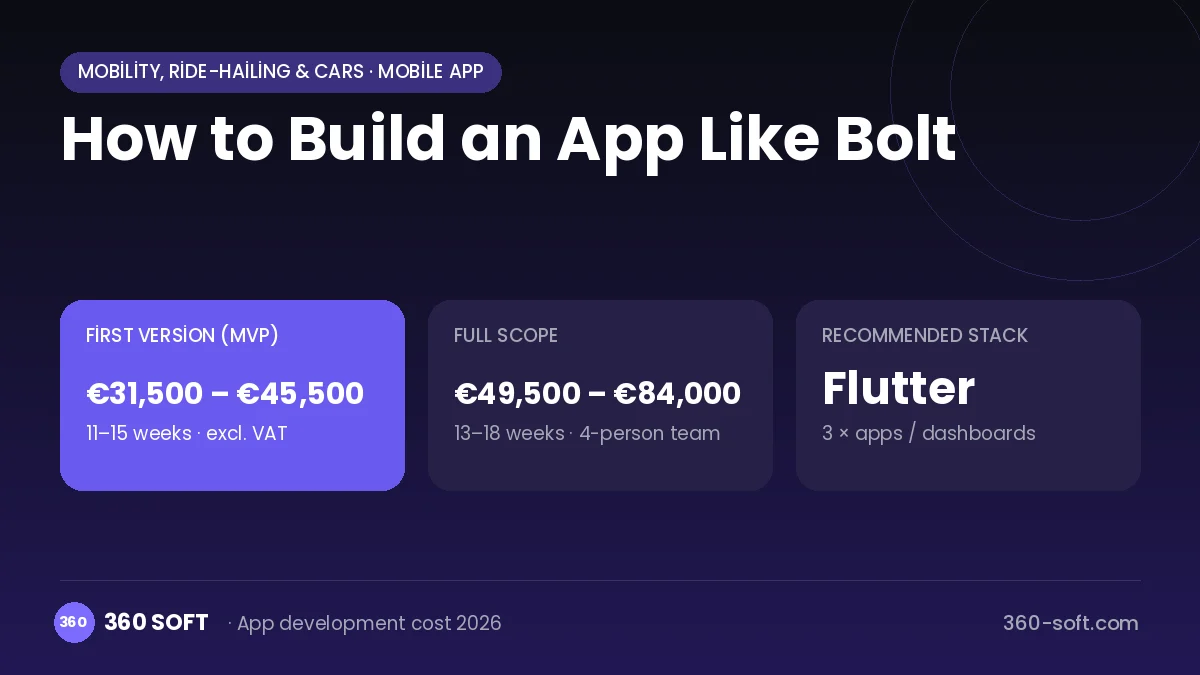
How Bolt works: the core user flow
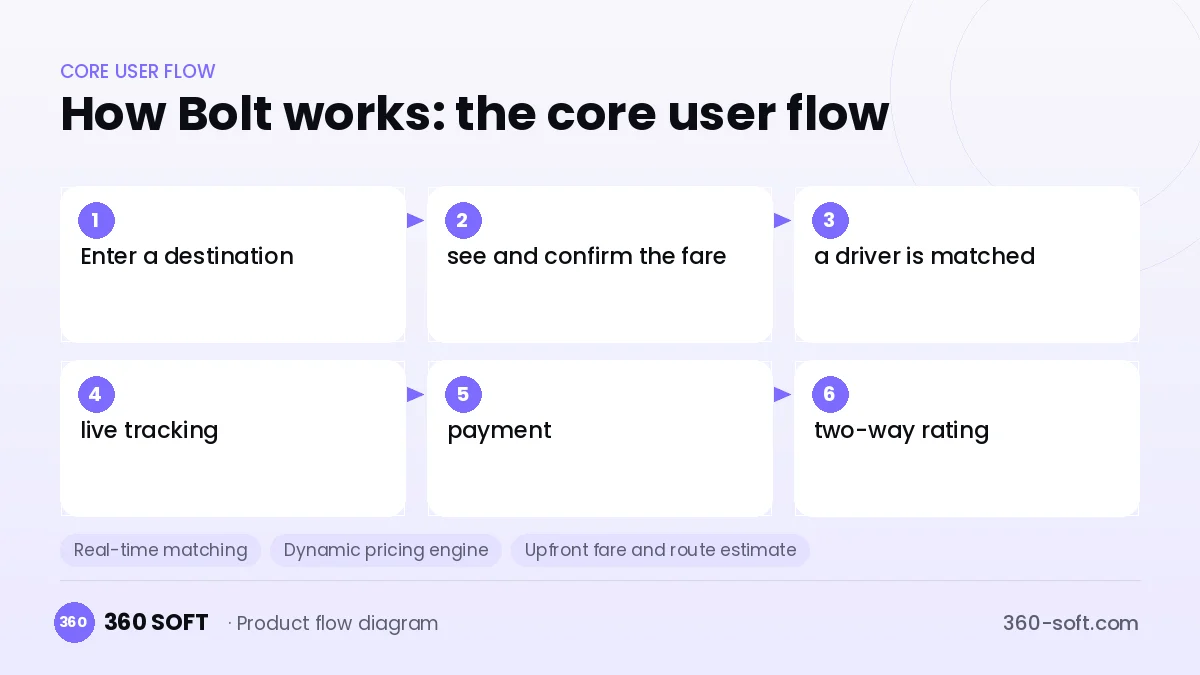
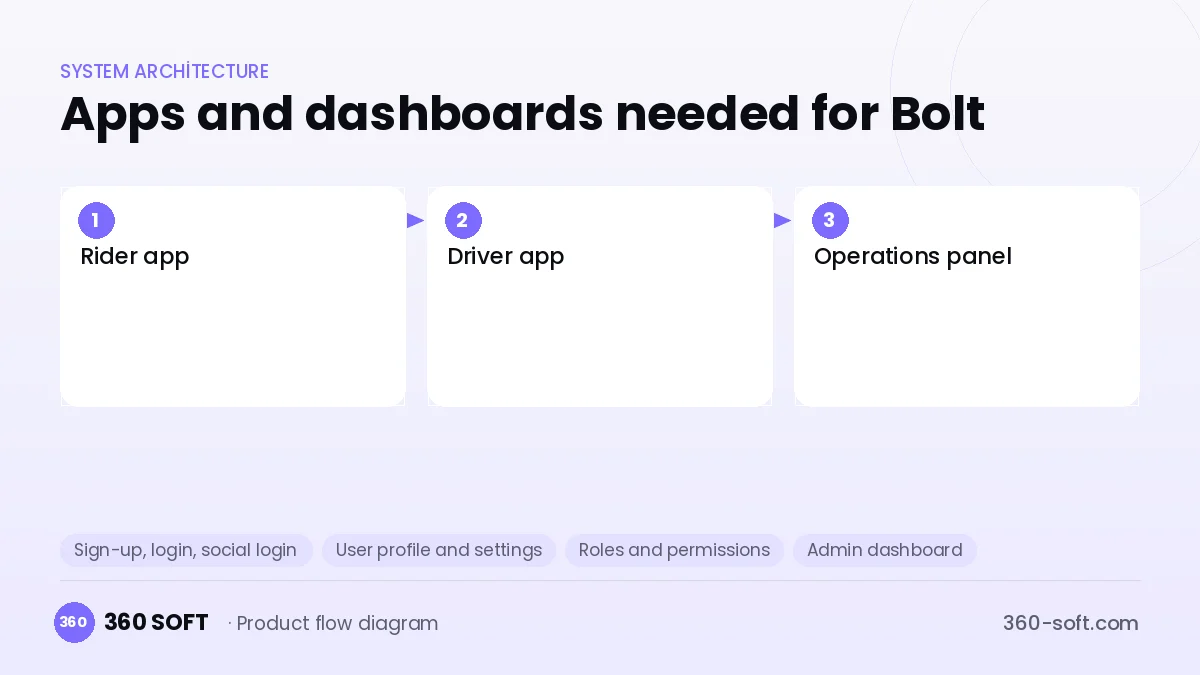
How many apps and dashboards do you need?
Rider app
Riders request a car, see the fare upfront, follow the trip and pay.
Driver app
Drivers go online, accept requests, navigate and track their earnings.
Operations panel
A web panel where the team handles driver approvals, zone pricing, complaints and refunds.
Critical features of a product like Bolt
Real-time matching
Sends each request as a sequential offer to the nearest, best-suited driver; if it is declined, it moves to the next one within seconds.
Dynamic pricing engine
Calculates fares based on distance, duration, zone demand and time of day, and applies a multiplier when demand spikes.
Upfront fare and route estimate
Shows the estimated fare and arrival time before the trip starts; if the route deviates, a rule-based recalculation kicks in.
Driver document and approval flow
Upload, review and expiry tracking for documents such as driving licence, vehicle registration, insurance and criminal record checks.
Safety features
Trip sharing, an emergency button, driver face verification and calls through masked phone numbers.
Driver payout system
Automatic calculation of commission deductions, daily or weekly payouts, bonuses and campaign rules.
What goes into the first version, what comes later
First version (MVP)
- Rider and driver sign-up with phone verification
- Requesting a car from the map and matching the nearest driver
- Live location tracking and estimated arrival time
- Card and cash payments plus post-trip ratings
- Driver document approval and a basic operations panel
Later releases
- Dynamic pricing based on demand density
- Scheduled rides and corporate accounts
- Extra service verticals such as couriers, parcels and scooters
- Heat maps and earnings suggestions for drivers
Modules and how the budget is calculated
The budget is calculated with 360 SOFT’s pricing model from the modules below, about 32 screens and the project’s complexity: roughly 189 person-days for the full scope and 121 person-days for the first version. Every module you drop lowers the budget directly.
| Module | Phase |
|---|---|
| Sign-up, login, social login | First version |
| User profile and settings | First version |
| Roles and permissions | First version |
| Admin dashboard | First version |
| Online payments (Stripe / PSP) | First version |
| Maps, location, routing | First version |
| Push notifications | First version |
| Email / SMS notifications | First version |
| Ratings and reviews | First version |
| Real-time messaging | First version |
| Reporting and analytics | Later release |
| GDPR and security hardening | First version |
Hosting, SMS, map APIs, app store accounts and payment-provider fees are separate items. Maintenance and improvements (optional): €650 / month. We send a fixed written price within 24 hours after a free discovery call.
The hard parts
Processing location data at scale
Handling location updates arriving every second from thousands of drivers with low latency requires geospatial indexing and a caching layer.
Balancing a two-sided market
Too few drivers and riders wait; too few riders and drivers leave. Tuning incentives and pricing rules zone by zone is an ongoing operational job.
Regulation and licensing
Commercial passenger transport is regulated by cities and licensing authorities in most markets; the model has to be built around taxis, private hire operators or licensed fleets.
Business model
The main revenue comes from a commission on every ride; attracting drivers with a low commission and earning on volume is the essence of this model. Surge pricing at peak hours, a small service fee on the rider side, monthly invoicing for corporate accounts and vehicle rental or fuel partnerships for drivers can all become additional revenue streams.
Get a free quote for your project
Let us scope it together and send a fixed written quote within 24 hours. NDA on request; you own the source code.
Choosing a company to build an app like Bolt
Most people searching “build an app like bolt” are really looking for a reliable app development company. When comparing quotes, check four things:
- Can you try similar products they have shipped, in the stores or live?
- Are the source code, design files, servers and store accounts transferred to you by contract?
- Do they show a working demo every two weeks, with written scope and acceptance criteria?
- Are maintenance, scaling and GDPR/security costs written into the quote?
Copyright and trademarks
A business model and features are generally not protected on their own, but the Bolt name, logo, interface design, content and source code are. That is why we build a product with similar functionality but your own brand, design and code. This is not legal advice; we recommend a trademark search before launch.
Frequently asked questions
How long does it take to build an app like Bolt?
A first version consisting of a rider app, a driver app and a panel usually needs a few months of development and testing. Matching and live tracking require the most testing; launching with a pilot city reduces both time and risk.
How many separate applications are needed?
At least three parts: a rider app, a driver app and a web-based operations panel. The mobile apps can be built for iOS and Android from a single codebase.
Are there copyright or trademark issues?
The ride-hailing business model and its features are generally free to use. The Bolt name, logo, design, content and code may not be copied; this information is not a substitute for legal advice.
What should I look for in a company that builds an app like Bolt?
Ask about real-time location and WebSocket experience, payment integrations and multi-sided apps they have actually shipped. Source code handover and post-launch maintenance terms should be spelled out clearly in the contract.