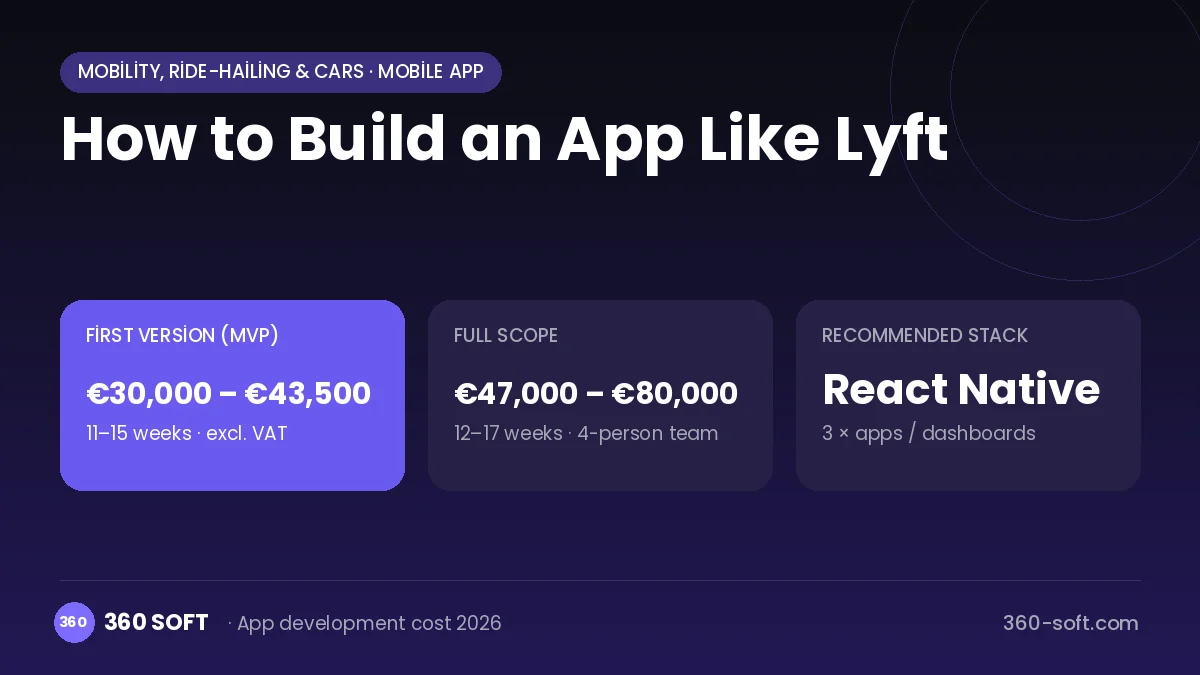
Mobile appMobility, ride-hailing & carsOriginal by Lyft, Inc.
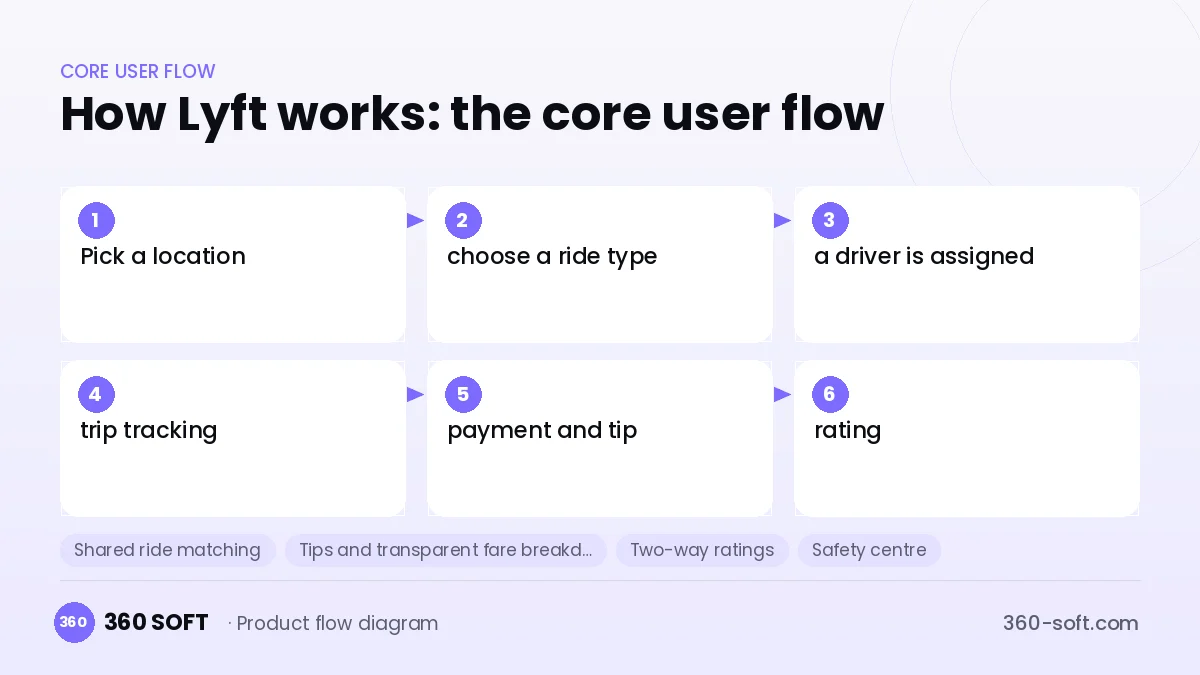
Lyft stood out by positioning ridesharing as a friendly, community-driven experience. Trust between driver and rider, two-way ratings, courteous service and transparent pricing form the foundation of the brand. The shared ride option pools riders heading the same way into one car, which lowers the cost for passengers and raises the driver's hourly yield.
A similar product means building a rider app, a driver app and an admin panel together. If shared rides are on the roadmap, the route-pooling algorithm becomes the hardest part of the job. Driver applications and background checks, the payment and tipping flow, incident reporting and support processes should also be designed from day one.
How Lyft works: the core user flow
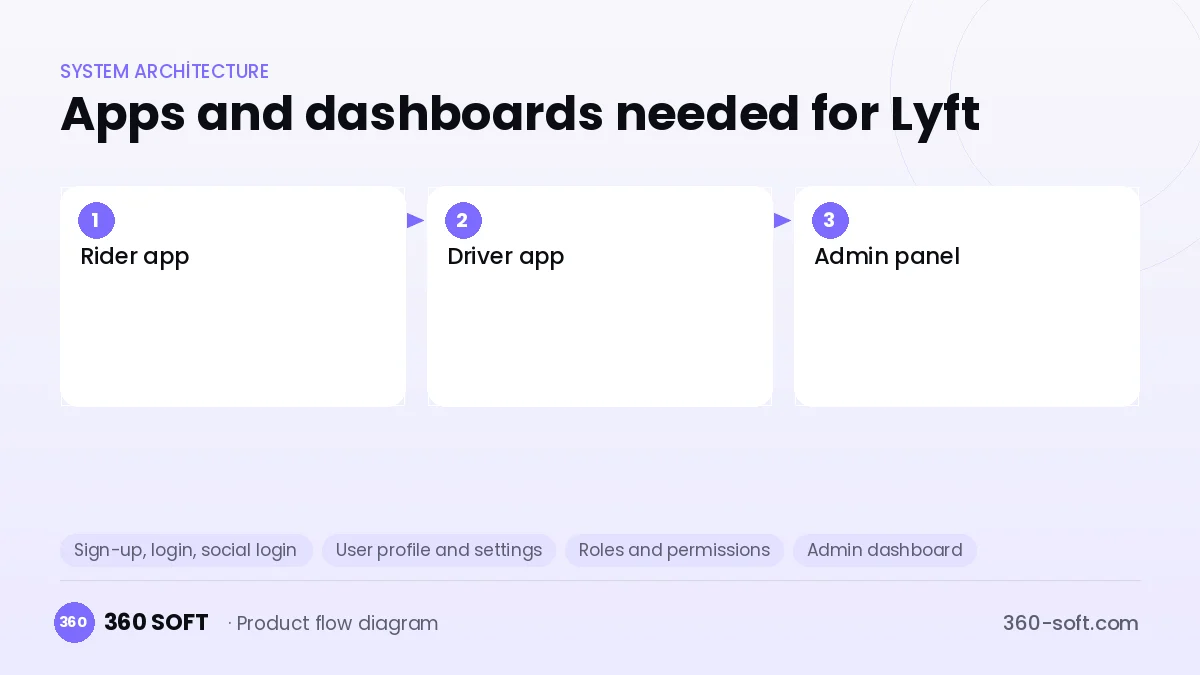
How many apps and dashboards do you need?
Rider app
Riders choose a standard or shared ride, follow their driver and pay.
Driver app
Drivers accept requests, pick up multiple riders in sequence and track their earnings.
Admin panel
The panel for managing driver applications, pricing rules, safety incidents and support tickets.
Critical features of a product like Lyft
Shared ride matching
Combines riders heading in the same direction into one car within a detour limit and splits the fare.
Tips and transparent fare breakdown
Lets riders add a tip after the trip and itemises the fare by distance, time and extra charges.
Two-way ratings
Riders and drivers rate each other; poorly rated pairings are not matched again.
Safety centre
Brings trip sharing, emergency calls, incident reporting and driver identity checks together on one screen.
Driver incentive programme
Automatic tracking of bonuses tied to ride counts or peak-hour targets.
Accessible vehicle options
Filtered requests for special needs such as wheelchair-accessible cars, child seats or larger vehicles.
What goes into the first version, what comes later
First version (MVP)
- Rider and driver sign-up with driver document upload
- Standard ride requests and nearest-driver matching
- Live map tracking and estimated arrival time
- Card payments, tips and ratings
- Support tickets and a basic admin panel
Later releases
- Shared rides and route pooling
- Driver bonus and incentive programme
- Corporate accounts and consolidated invoicing
- Loyalty programme and a subscription discount plan
Modules and how the budget is calculated
The budget is calculated with 360 SOFT’s pricing model from the modules below, about 30 screens and the project’s complexity: roughly 180 person-days for the full scope and 114 person-days for the first version. Every module you drop lowers the budget directly.
| Module | Phase |
|---|---|
| Sign-up, login, social login | First version |
| User profile and settings | First version |
| Roles and permissions | First version |
| Admin dashboard | First version |
| Online payments (Stripe / PSP) | First version |
| Subscriptions and recurring billing | First version |
| Maps, location, routing | First version |
| Push notifications | First version |
| Email / SMS notifications | First version |
| Ratings and reviews | First version |
| Reporting and analytics | Later release |
| GDPR and security hardening | First version |
Hosting, SMS, map APIs, app store accounts and payment-provider fees are separate items. Maintenance and improvements (optional): €600 / month. We send a fixed written price within 24 hours after a free discovery call.
The hard parts
Route-pooling algorithm
Picking up a new rider on a shared trip lengthens the current rider's journey; getting the detour limit and fare balance right is difficult.
Trust and incident management
Lost items, accidents or harassment reports call for a fast-responding support process and a solid logging infrastructure.
Local regulations
Commercial transport rules vary from city to city; the model must be built around licensed drivers and vehicles.
Business model
Revenue comes from the commission on each ride and the service fee charged to riders. Shared rides increase revenue per vehicle. Loyalty plans offering discounted rides for a monthly subscription, management fees from corporate accounts and special tariffs at locations such as airports create additional income and diversify revenue.
Get a free quote for your project
Let us scope it together and send a fixed written quote within 24 hours. NDA on request; you own the source code.
Choosing a company to build an app like Lyft
Most people searching “build an app like lyft” are really looking for a reliable app development company. When comparing quotes, check four things:
- Can you try similar products they have shipped, in the stores or live?
- Are the source code, design files, servers and store accounts transferred to you by contract?
- Do they show a working demo every two weeks, with written scope and acceptance criteria?
- Are maintenance, scaling and GDPR/security costs written into the quote?
Copyright and trademarks
A business model and features are generally not protected on their own, but the Lyft name, logo, interface design, content and source code are. That is why we build a product with similar functionality but your own brand, design and code. This is not legal advice; we recommend a trademark search before launch.
Frequently asked questions
How long does it take to build an app like Lyft?
A first version limited to standard rides can be ready in a few months. Launch comes faster if shared rides and the incentive system are left for later phases.
Ready-made script or custom software?
Ready-made taxi scripts give you a quick start, but customising matching and pricing rules gets hard. For a platform with growth ambitions, custom development is more flexible in the long run.
Are there copyright or trademark issues?
The ridesharing model and general features are free to use. Lyft's name, logo, colours, design and code may not be used; this explanation is not legal advice.
Should shared rides be in the first version?
Usually not; you first need enough driver and rider density. Collecting data with standard rides and adding route pooling later is the safer path.