Mobile appMobility, ride-hailing & carsOriginal by inDrive
What makes inDrive different is that the fare is set by the rider and driver together, not by an algorithm. The rider proposes a price, nearby drivers accept it or make a counteroffer, and the rider chooses based on arrival time, rating and price. In markets where fixed tariffs are not trusted, this approach creates a sense of transparency and gives drivers more say over which jobs they take.
Building something similar requires an offer and counteroffer engine that works differently from a classic taxi app. A rider app, a driver app and an admin panel are the core trio; extra verticals such as intercity rides, freight or courier delivery can be added on the same offer logic. Rules to prevent fake offers and price manipulation should also be planned from the start.
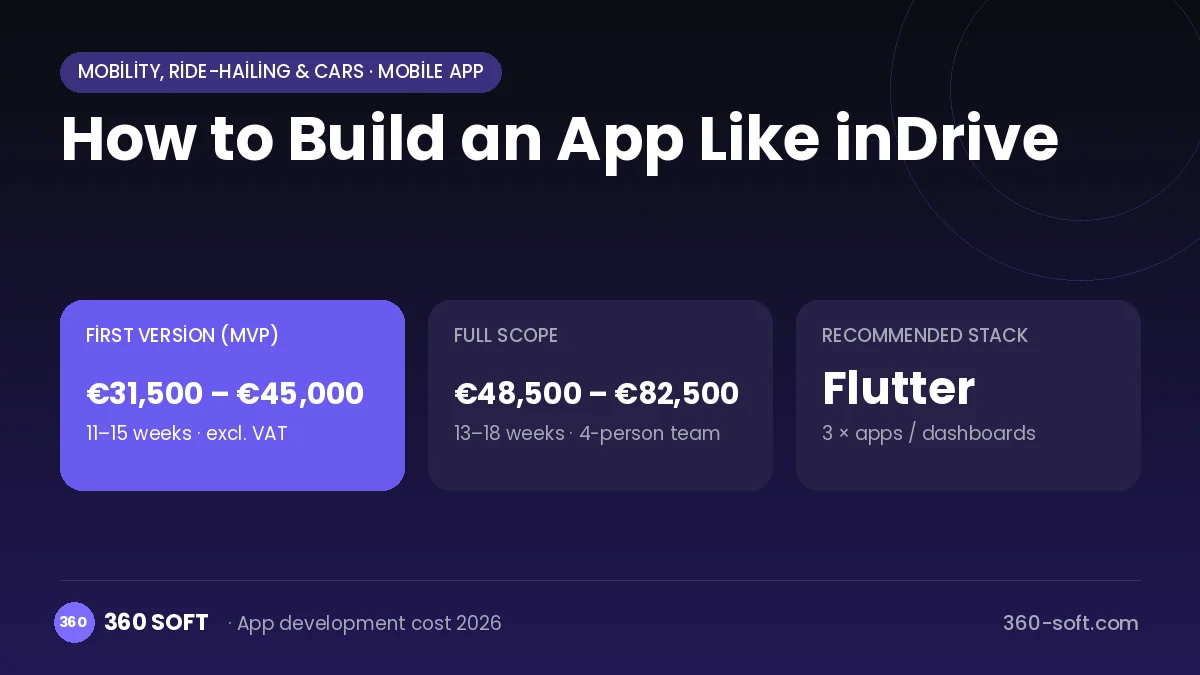
How inDrive works: the core user flow
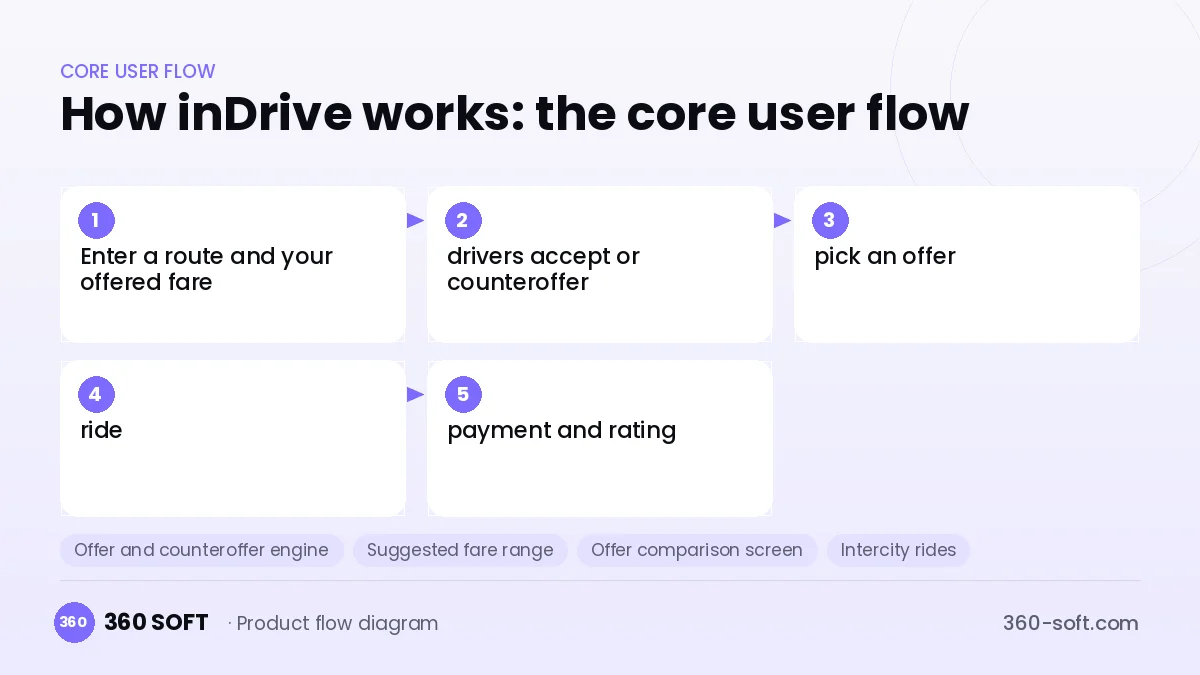
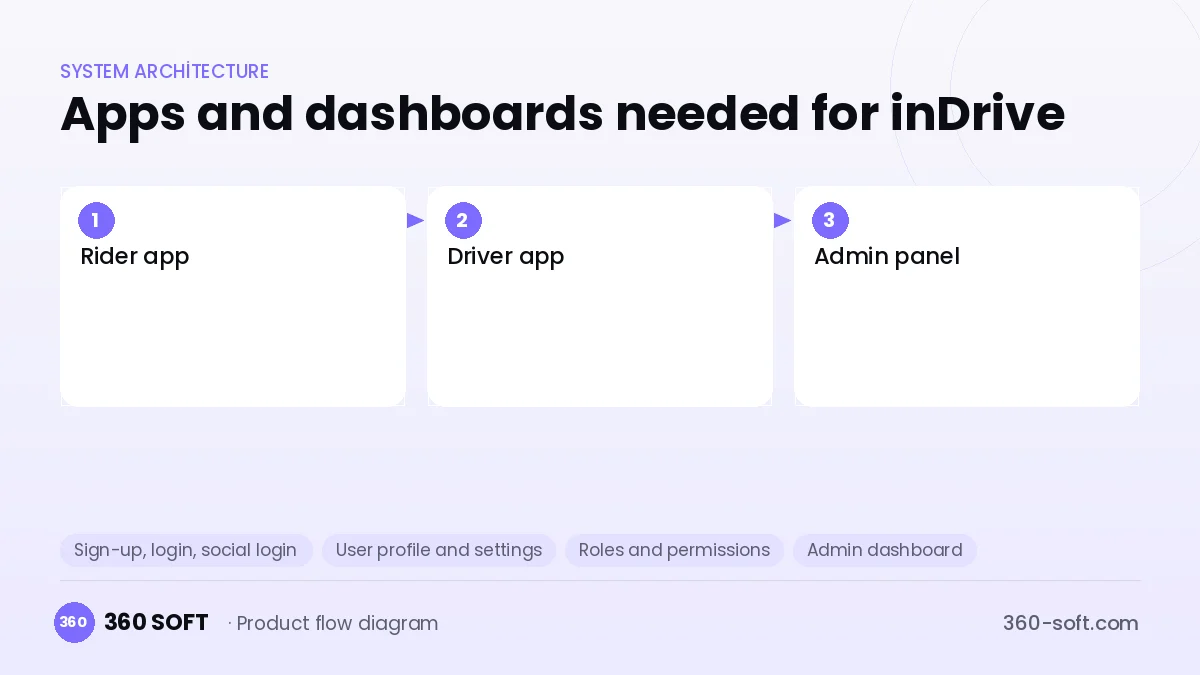
How many apps and dashboards do you need?
Rider app
Riders propose a fare, compare incoming offers and choose a driver.
Driver app
Drivers see nearby requests, accept them or propose their own price.
Admin panel
The panel for managing zone-based minimum fares, commissions, driver approvals and complaints.
Critical features of a product like inDrive
Offer and counteroffer engine
Broadcasts the rider's offer to nearby drivers, collects counteroffers within a time limit and lists them for the rider.
Suggested fare range
Shows a reasonable price range based on distance and zone data, steering riders away from offers that are too low or too high.
Offer comparison screen
Displays incoming offers side by side with driver rating, vehicle details, arrival time and price.
Intercity rides
A separate flow for long distances where riders pick a date and collect offers in advance.
Freight and courier vertical
Creating parcel delivery or moving requests with the same offer logic.
Flat-fee subscription or credit model
An alternative model where drivers buy packages or credits instead of paying a commission per job.
What goes into the first version, what comes later
First version (MVP)
- Rider and driver sign-up with document approval
- Creating ride requests with a fare offer
- Driver acceptance and counteroffers, rider selection
- Live tracking, cash or card payment and ratings
- Admin panel with minimum fare and commission settings
Later releases
- Intercity ride flow
- Freight and moving vertical
- Credit packages and subscriptions for drivers
- Risk scoring to detect abuse
Modules and how the budget is calculated
The budget is calculated with 360 SOFT’s pricing model from the modules below, about 30 screens and the project’s complexity: roughly 186 person-days for the full scope and 119 person-days for the first version. Every module you drop lowers the budget directly.
| Module | Phase |
|---|---|
| Sign-up, login, social login | First version |
| User profile and settings | First version |
| Roles and permissions | First version |
| Admin dashboard | First version |
| Online payments (Stripe / PSP) | First version |
| Maps, location, routing | First version |
| Push notifications | First version |
| Email / SMS notifications | First version |
| Real-time messaging | First version |
| Ratings and reviews | First version |
| Reporting and analytics | Later release |
| GDPR and security hardening | First version |
Hosting, SMS, map APIs, app store accounts and payment-provider fees are separate items. Maintenance and improvements (optional): €650 / month. We send a fixed written price within 24 hours after a free discovery call.
The hard parts
Timing the offer race
If the offer window is too short, drivers miss out; if it is too long, riders wait. Duration and broadcast radius must be tuned per zone.
Price manipulation
Rules are needed to detect behaviour such as drivers colluding to push prices up or fake accounts submitting offers.
Concurrent notifications at scale
Pushing every request to dozens of drivers instantly and collecting their responses requires a robust real-time messaging infrastructure.
Business model
The classic model is a low-rate commission on accepted offers. In some markets, a system where drivers preload credits that are deducted as they take jobs is adopted more easily. Separate rates for verticals such as intercity rides and freight, promoted offers and in-app advertising space bring in additional revenue.
Get a free quote for your project
Let us scope it together and send a fixed written quote within 24 hours. NDA on request; you own the source code.
Choosing a company to build an app like inDrive
Most people searching “build an app like indrive” are really looking for a reliable app development company. When comparing quotes, check four things:
- Can you try similar products they have shipped, in the stores or live?
- Are the source code, design files, servers and store accounts transferred to you by contract?
- Do they show a working demo every two weeks, with written scope and acceptance criteria?
- Are maintenance, scaling and GDPR/security costs written into the quote?
Copyright and trademarks
A business model and features are generally not protected on their own, but the inDrive name, logo, interface design, content and source code are. That is why we build a product with similar functionality but your own brand, design and code. This is not legal advice; we recommend a trademark search before launch.
Frequently asked questions
How long does it take to build an app like inDrive?
Because the offer engine involves more states than classic matching, design and testing take longer. A first version starting with one city and one vertical can go live within a few months.
Does a negotiated-fare model work everywhere?
Technically yes, but commercial passenger transport is subject to local regulation. A setup that works with taxis, shuttle services or licensed transfer companies offers a safer start.
Are there copyright or trademark issues?
The fare-offer ride model can be used freely. inDrive's name, logo, interface design and code may not be copied; this information is not legal advice.
How many separate applications are needed?
Two mobile apps for riders and drivers plus a web admin panel are enough. Verticals such as freight can be added as modules to the existing apps rather than as separate ones.