Mobile appFintech & paymentsOriginal by Coinbase
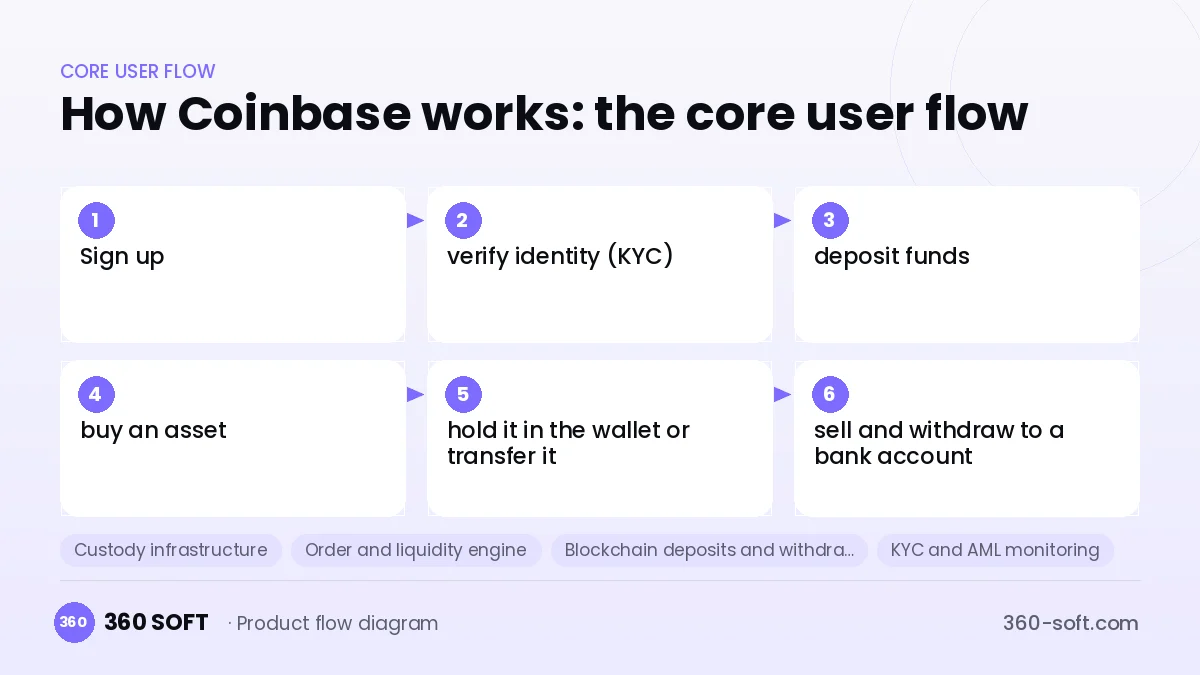
Coinbase's strength is that it makes crypto as simple as a banking app, even for people with no technical background. Users verify their identity, link a bank account and buy assets in a few taps. Trust sits behind that simplicity: most assets are held in cold storage, the business operates in line with regulators, and the fee structure is transparent, which is why the platform is the first stop for many newcomers to crypto.
Building something similar takes more than a mobile app. Alongside the customer app and web interface you need order matching or a liquidity-provider integration, hot and cold wallet infrastructure, blockchain nodes, KYC and suspicious-activity monitoring, an accounting ledger and an admin panel. Crypto asset service providers need a licence almost everywhere (for example MiCA authorisation in the EU or money-transmitter registration in the US) and must meet AML duties, so starting with a licensed infrastructure partner speeds things up.
How Coinbase works: the core user flow
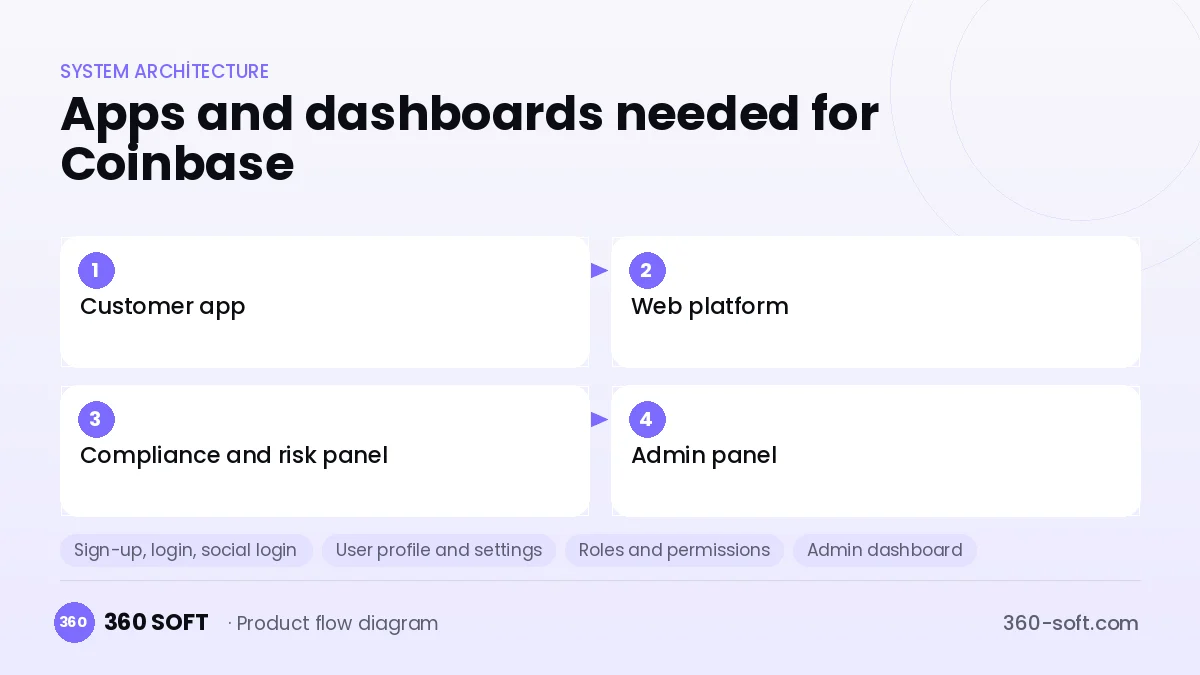
How many apps and dashboards do you need?
Customer app
The iOS and Android app where retail investors follow prices, trade and manage their wallet.
Web platform
A desktop trading interface with advanced charts, order types and account settings.
Compliance and risk panel
A screen for the compliance team to handle KYC applications, suspicious-activity alerts and regulatory reports.
Admin panel
An operations panel for monitoring listed assets, fee rates, liquidity and wallet balances.
Critical features of a product like Coinbase
Custody infrastructure
A small share of assets sits in hot wallets while the bulk is held in cold wallets protected by multisig or MPC.
Order and liquidity engine
Instant buying and selling runs on an internal order book or a liquidity aggregator that pulls prices from external exchanges.
Blockchain deposits and withdrawals
Address generation, confirmation tracking and withdrawal signing run automatically for each network.
KYC and AML monitoring
Beyond ID, liveness and address checks, on-chain analytics flag risky addresses.
Double-entry ledger
An internal ledger tracks every cent and every satoshi, and balances are reconciled continuously against the chain.
Price alerts and recurring buys
Users set notifications for target prices or schedule automatic weekly purchases of a fixed amount.
What goes into the first version, what comes later
First version (MVP)
- Sign-up, KYC and two-factor authentication
- Fiat deposits and withdrawals via bank transfer
- Instant buy and sell for a limited set of assets
- Crypto deposits, withdrawals and wallet view
- Admin panel for compliance and operations
Later releases
- Advanced trading screen and order types
- Staking and yield products
- Recurring buys and portfolio analytics
- Institutional accounts and API access
Modules and how the budget is calculated
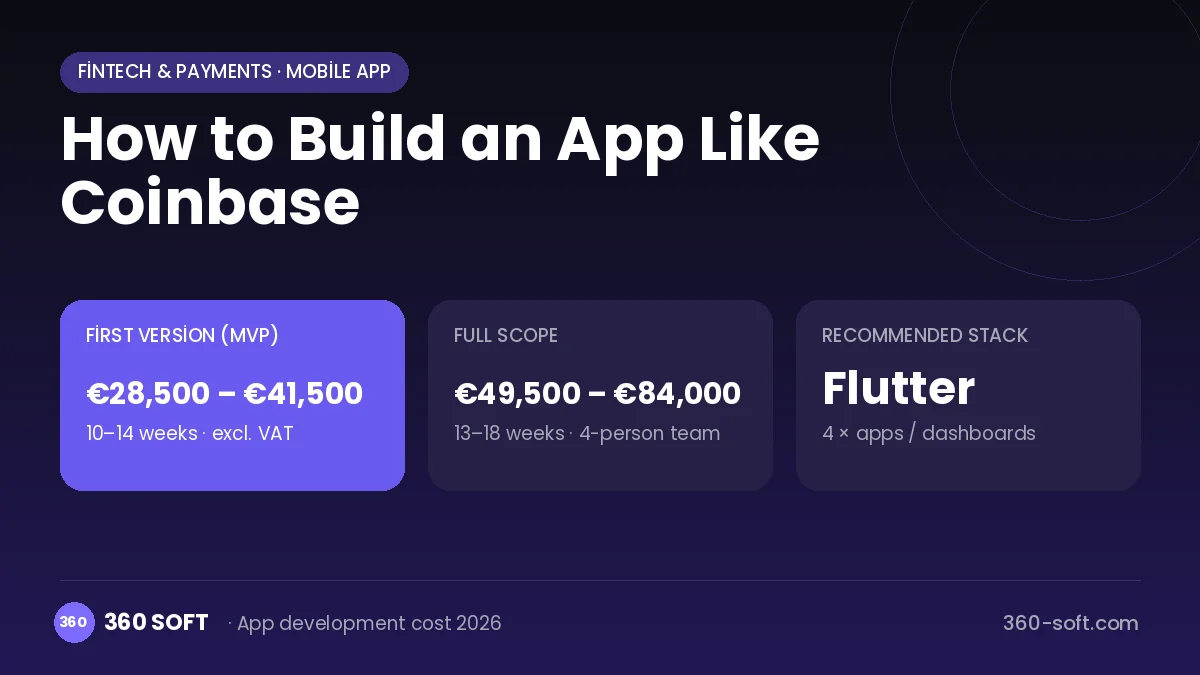
The budget is calculated with 360 SOFT’s pricing model from the modules below, about 34 screens and the project’s complexity: roughly 189 person-days for the full scope and 109 person-days for the first version. Every module you drop lowers the budget directly.
| Module | Phase |
|---|---|
| Sign-up, login, social login | First version |
| User profile and settings | First version |
| Roles and permissions | First version |
| Admin dashboard | First version |
| Online payments (Stripe / PSP) | First version |
| Push notifications | First version |
| Email / SMS notifications | First version |
| Reporting and analytics | Later release |
| GDPR and security hardening | First version |
| Third-party API integration | First version |
| Multi-language | First version |
| In-game economy / LiveOps | Later release |
Hosting, SMS, map APIs, app store accounts and payment-provider fees are separate items. Maintenance and improvements (optional): €650 / month. We send a fixed written price within 24 hours after a free discovery call.
The hard parts
Licensing and compliance
Licences, AML duties and capital requirements take as long as the product itself; involve legal counsel from day one.
Wallet security
A single key-management mistake causes irreversible losses; penetration testing and hardware security modules are essential.
Sudden load spikes
Traffic multiplies when markets move sharply; the order engine and balance services must scale horizontally.
Business model
The main revenue comes from trading commissions and the spread between buy and sell prices. On top of that you can add crypto withdrawal fees, a share of staking rewards, institutional custody services and a premium plan with zero commission for a monthly subscription. A clear fee table directly affects trust, and tiered commission discounts for high-volume users also build loyalty.
Get a free quote for your project
Let us scope it together and send a fixed written quote within 24 hours. NDA on request; you own the source code.
Choosing a company to build an app like Coinbase
Most people searching “build an app like coinbase” are really looking for a reliable app development company. When comparing quotes, check four things:
- Can you try similar products they have shipped, in the stores or live?
- Are the source code, design files, servers and store accounts transferred to you by contract?
- Do they show a working demo every two weeks, with written scope and acceptance criteria?
- Are maintenance, scaling and GDPR/security costs written into the quote?
Copyright and trademarks
A business model and features are generally not protected on their own, but the Coinbase name, logo, interface design, content and source code are. That is why we build a product with similar functionality but your own brand, design and code. This is not legal advice; we recommend a trademark search before launch.
Frequently asked questions
How long does it take to build an app like Coinbase?
A first version built on a licensed liquidity and custody partner can ship within a few months. A platform with its own order engine and wallet infrastructure needs a much longer development and security-testing cycle.
What licences does a crypto platform need?
Crypto asset service providers generally need authorisation from the financial regulator of each market they serve, plus AML compliance. Building on a licensed infrastructure provider is the more realistic route for a first launch.
Are there copyright or trademark issues?
The crypto trading business model and core features are generally free to use, but the name, logo, interface design, copy and code cannot be copied. This information is general in nature and is not a substitute for legal advice.
What should I look for when choosing a crypto app development company?
Look for experience with security testing, double-entry accounting and high concurrency in financial systems. Ask how they design key management and how they keep audit logs.