Mobile appFood, grocery & deliveryOriginal by Domino's
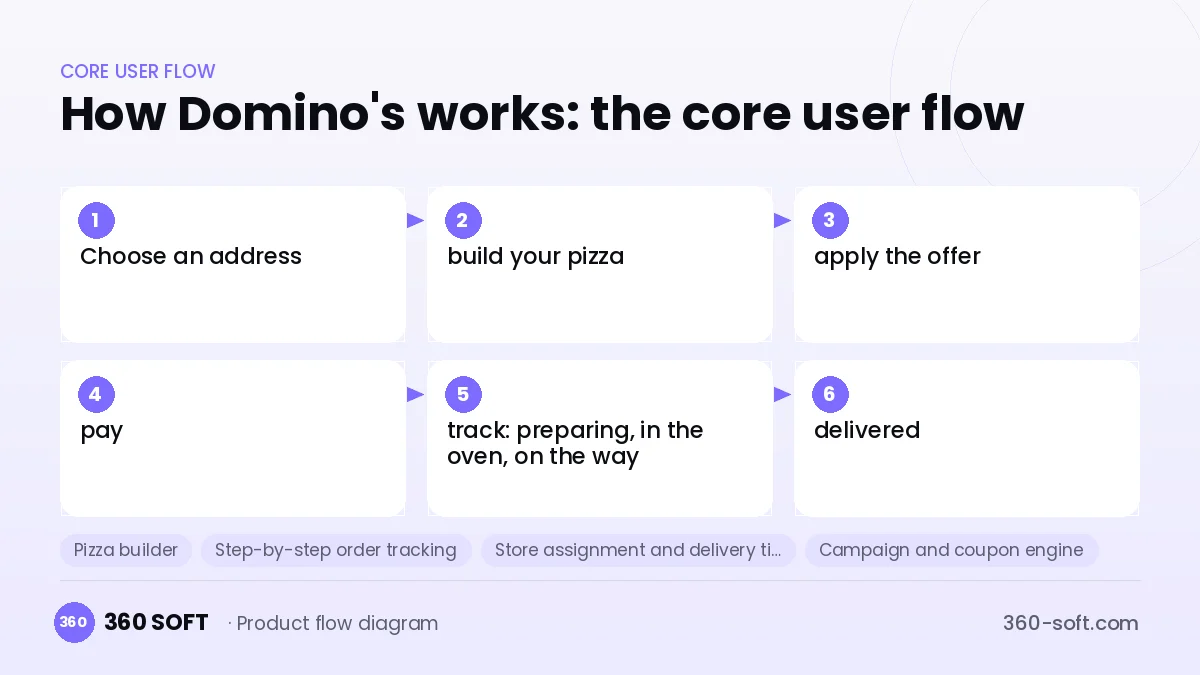
Domino's is known for positioning itself less as a pizza chain than as an ordering technology company. Users build their pizza topping by topping, then watch a tracker show the dough going into the oven and the driver setting off, step by step. That transparency eases waiting anxiety. Saved favourite orders, quick reorders and app-only deals pull customers away from third-party platforms and into the brand's own channel.
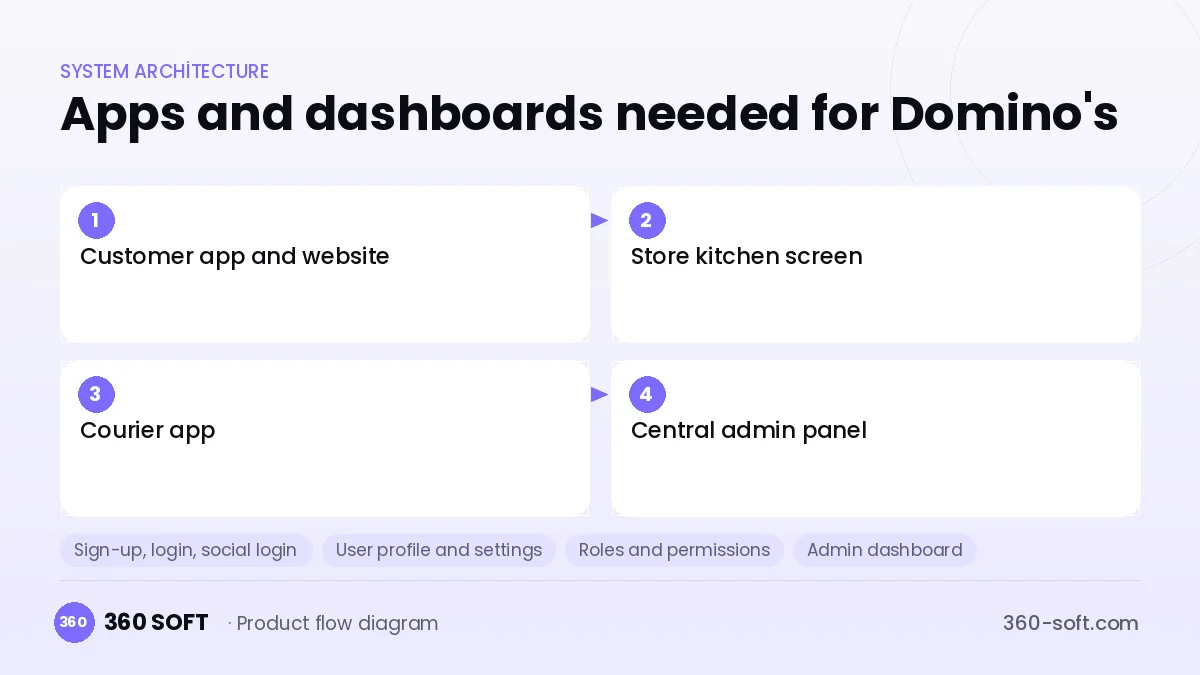
To build something similar you need a customer app and website, a store order and kitchen screen, a courier app that manages the brand's own driver fleet and a central admin panel. Assigning the address to the right store, estimating delivery time from store capacity and having the kitchen really mark each step are preconditions for a tracker customers can trust. The campaign and coupon engine is also the commercial heart of the product.
How Domino's works: the core user flow
How many apps and dashboards do you need?
Customer app and website
The channel for building a pizza, using offers, paying and tracking the order live.
Store kitchen screen
The in-store screen where prep, oven and boxing steps of each order are marked.
Courier app
The app where store drivers receive orders, follow routes and confirm delivery.
Central admin panel
The panel for managing the menu, ingredients, prices, campaigns, store zones and performance reports.
Critical features of a product like Domino's
Pizza builder
Dough, size, sauce and toppings are chosen visually; half-and-half toppings and the price are calculated instantly.
Step-by-step order tracking
Prep, oven, quality check and on-the-way stages are shown in real time from kitchen and courier data.
Store assignment and delivery time
The address is assigned to a store by polygon zones, and delivery time is estimated from store load.
Campaign and coupon engine
Day-based deals, second-pizza discounts and code promotions are applied automatically through cart rules.
Favourites and one-tap ordering
With a saved address, payment method and favourite pizza, an order is completed in seconds.
Courier routes and performance
Driver locations, delivery times and store-level performance are monitored live.
What goes into the first version, what comes later
First version (MVP)
- Address, store assignment and menu
- Pizza builder and cart
- Online payment and a pay-on-delivery option
- Store order screen and status updates
- Basic campaigns and coupons
Later releases
- Courier app and live map tracking
- Loyalty points and personalised offers
- Carside pickup and curbside delivery
- Ordering by voice assistant and smartwatch
Modules and how the budget is calculated
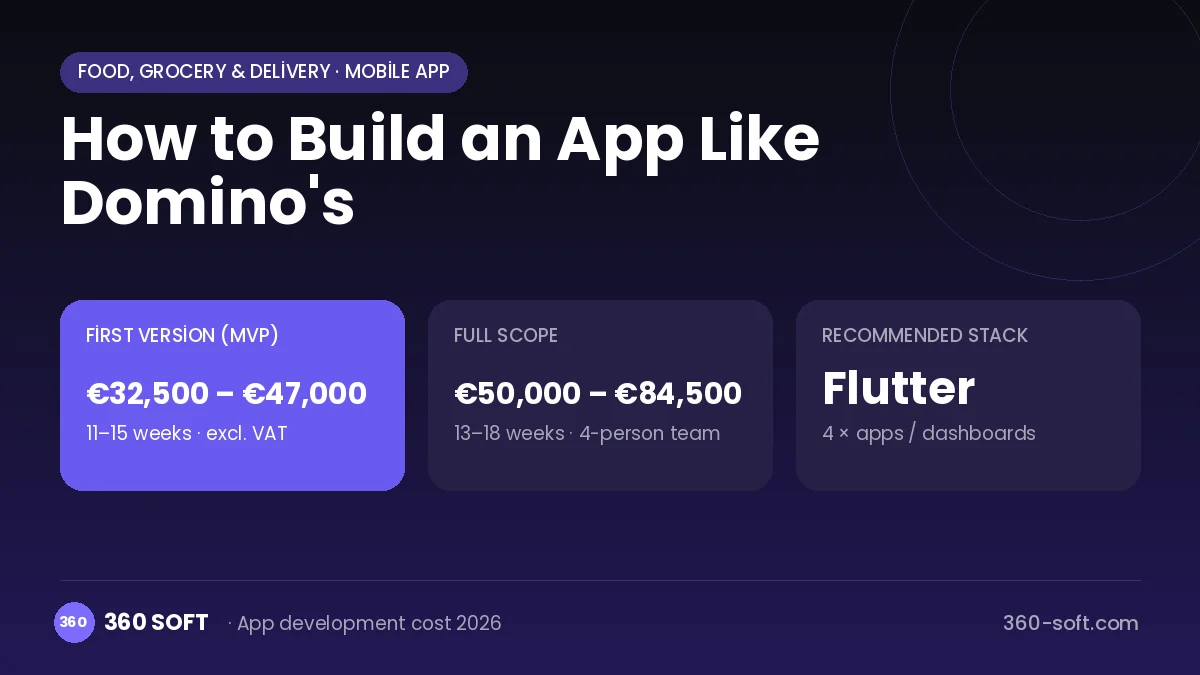
The budget is calculated with 360 SOFT’s pricing model from the modules below, about 30 screens and the project’s complexity: roughly 191 person-days for the full scope and 124 person-days for the first version. Every module you drop lowers the budget directly.
| Module | Phase |
|---|---|
| Sign-up, login, social login | First version |
| User profile and settings | First version |
| Roles and permissions | First version |
| Admin dashboard | First version |
| Product / content catalogue | First version |
| Cart and checkout | First version |
| Online payments (Stripe / PSP) | First version |
| Maps, location, routing | First version |
| Push notifications | First version |
| Email / SMS notifications | First version |
| Reporting and analytics | Later release |
| Third-party API integration | First version |
Hosting, SMS, map APIs, app store accounts and payment-provider fees are separate items. Maintenance and improvements (optional): €650 / month. We send a fixed written price within 24 hours after a free discovery call.
The hard parts
Accuracy of tracking data
If steps are not marked in the kitchen, the tracker loses customer trust; the kitchen screen must be fast and effortless.
Peak-hour capacity
At peaks such as match nights, orders beyond store capacity call for rules that extend delivery times or temporarily close ordering.
Courier operations
Managing shifts, routes and delivery times for an own driver fleet calls for separate operations software.
Business model
The app is the chain's own direct sales channel; because no platform commission is paid, every order is more profitable. Campaigns raise order frequency, and add-on suggestions raise basket size. Delivery fees, minimum basket rules and app-only products are used in revenue management. The data collected also informs decisions about where to open new stores.
Get a free quote for your project
Let us scope it together and send a fixed written quote within 24 hours. NDA on request; you own the source code.
Choosing a company to build an app like Domino's
Most people searching “build an app like domino's” are really looking for a reliable app development company. When comparing quotes, check four things:
- Can you try similar products they have shipped, in the stores or live?
- Are the source code, design files, servers and store accounts transferred to you by contract?
- Do they show a working demo every two weeks, with written scope and acceptance criteria?
- Are maintenance, scaling and GDPR/security costs written into the quote?
Copyright and trademarks
A business model and features are generally not protected on their own, but the Domino's name, logo, interface design, content and source code are. That is why we build a product with similar functionality but your own brand, design and code. This is not legal advice; we recommend a trademark search before launch.
Frequently asked questions
How long does it take to build an app like Domino's?
A first release with the pizza builder, ordering, payment and store screen can go live in a few months. The courier app and live map tracking can be added in a second phase.
How many separate apps are needed?
There are four parts: the customer app and website, the store kitchen screen, the courier app and the central admin panel. For a single-store business these can be simplified.
Will there be copyright or trademark issues?
The pizza ordering and tracking business model is generally free to use; however, the name, logo, the original design of the tracker, images, copy and code cannot be copied. This is general information, not legal advice.
What should I look for when choosing a company to build a delivery app?
Choose a team with experience in real-time tracking, maps and courier apps. Ask how the kitchen screen will be tested by store staff.