Mobile appFood, grocery & deliveryOriginal by Instacart
Instacart brings the shelves of existing supermarket chains online without owning a warehouse. Users choose their favourite store; the platform's personal shopper goes to the store, picks the items and delivers them. Supermarkets gain an online channel without investment, and users reach several stores from one app. Real-time substitution communication during picking is the model's trust factor.
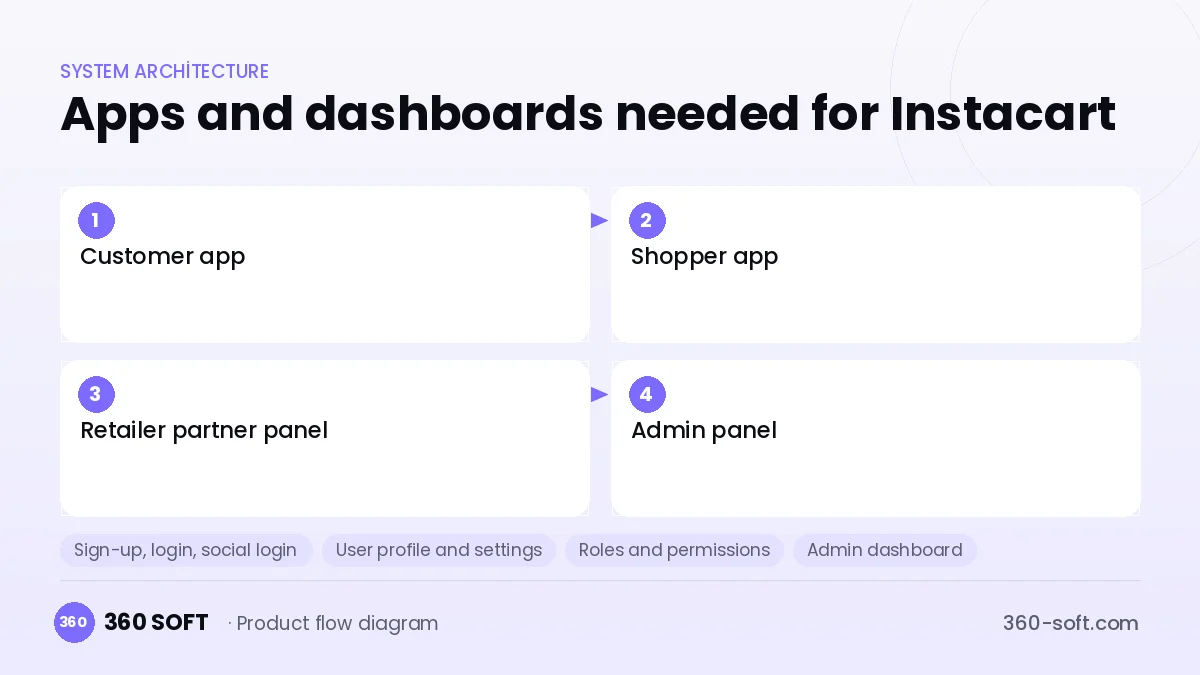
To build something similar you need a customer app, a shopper app, a retailer partner panel and an admin panel. The hardest part is the catalogue: regularly pulling product, price and estimated stock data for every store. The shopper app includes an aisle-based picking list, barcode verification, substitution chat and use of a platform card for payment. Advertising and analytics tools for retailers are also part of the back end.
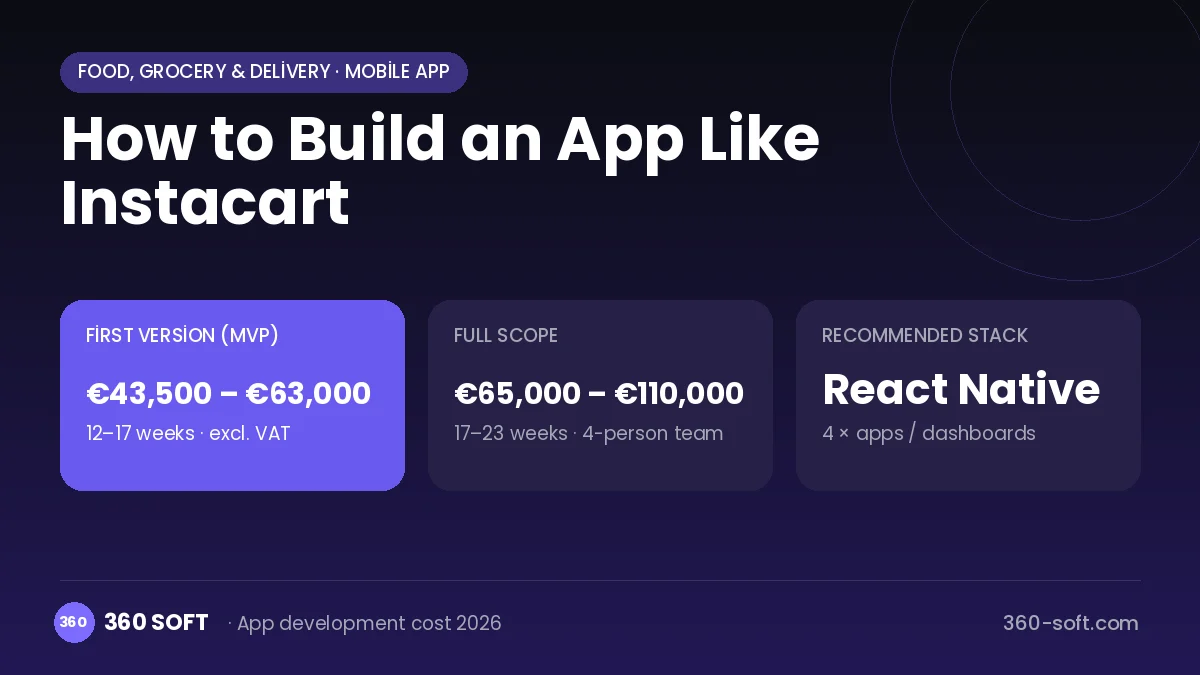
How Instacart works: the core user flow
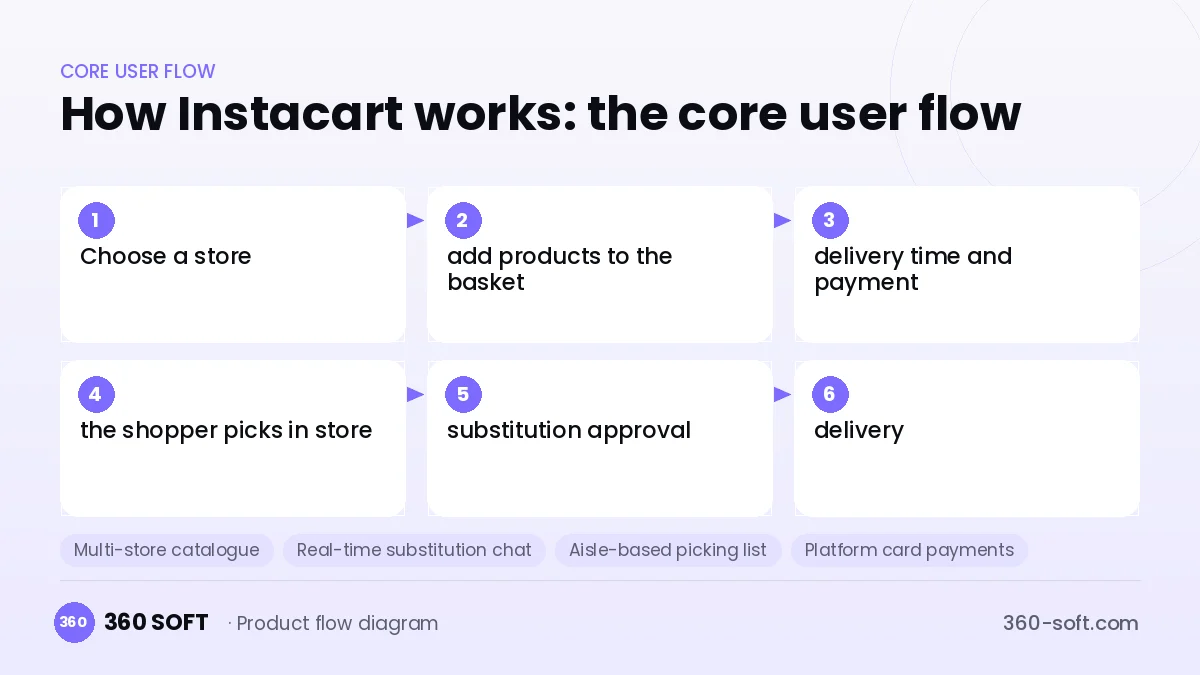
How many apps and dashboards do you need?
Customer app
Users choose a store, build a basket, set substitution preferences and chat with the shopper.
Shopper app
Shoppers pick items in store, verify them by barcode, suggest substitutes and deliver.
Retailer partner panel
Supermarket chains manage their catalogue, prices, promotions and sales reports.
Admin panel
The team manages retailer partners, the shopper network, delivery slots and customer support.
Critical features of a product like Instacart
Multi-store catalogue
Product, price and estimated stock data for every store and branch, updated regularly through integrations or bulk files.
Real-time substitution chat
If an item is out of stock, the shopper suggests an alternative with a photo and the customer approves or rejects it instantly in the app.
Aisle-based picking list
A product list sorted by store layout, with barcode scanning to confirm the right item.
Platform card payments
Shoppers pay at the checkout with the platform's virtual or physical card, and the spend is automatically matched to the order.
Predicted stock model
A model that uses historical picking data to predict whether an item is likely to be on the shelf and warns at the basket stage.
Advertising for brands
Manufacturers can show sponsored products in search results and track campaign performance.
What goes into the first version, what comes later
First version (MVP)
- Customer app and basket with a few partner stores
- Delivery time slot selection and online payment
- Shopper app with picking list and barcode verification
- In-app messaging for substitution approval
- Admin panel for stores, orders and shoppers
Later releases
- Automatic catalogue integration with supermarket chains
- Predicted stock model
- Sponsored product advertising for brands
- Free-delivery subscription programme
Modules and how the budget is calculated
The budget is calculated with 360 SOFT’s pricing model from the modules below, about 38 screens and the project’s complexity: roughly 249 person-days for the full scope and 167 person-days for the first version. Every module you drop lowers the budget directly.
| Module | Phase |
|---|---|
| Sign-up, login, social login | First version |
| User profile and settings | First version |
| Roles and permissions | First version |
| Admin dashboard | First version |
| Product / content catalogue | First version |
| Cart and checkout | First version |
| Advanced search and filters | First version |
| Online payments (Stripe / PSP) | First version |
| Booking / reservations | First version |
| Real-time messaging | First version |
| Barcode / RFID / handheld | First version |
| Maps, location, routing | First version |
| Push notifications | First version |
| Marketplace integration (Amazon, etc.) | Later release |
| Third-party API integration | First version |
Hosting, SMS, map APIs, app store accounts and payment-provider fees are separate items. Maintenance and improvements (optional): €850 / month. We send a fixed written price within 24 hours after a free discovery call.
The hard parts
Catalogue freshness
As price and stock data for hundreds of branches changes, information in the app goes stale; accuracy is very hard without integrations.
Payment reconciliation
The amount charged to the customer and the amount the shopper pays at the checkout can differ; a pre-authorisation and difference refund flow must be designed.
Shopper quality
Picking the right product, choosing fresh fruit and communicating well define the experience; a training, rating and audit system is needed.
Business model
Revenue consists of delivery and service fees from customers and either commission from retailer partners or a margin added to product prices. Sponsored product ads sold to manufacturers are a strong revenue channel. A free-delivery subscription programme and white-label online sales infrastructure offered to supermarkets diversify the model and reduce dependence on a single revenue source.
Get a free quote for your project
Let us scope it together and send a fixed written quote within 24 hours. NDA on request; you own the source code.
Choosing a company to build an app like Instacart
Most people searching “build an app like instacart” are really looking for a reliable app development company. When comparing quotes, check four things:
- Can you try similar products they have shipped, in the stores or live?
- Are the source code, design files, servers and store accounts transferred to you by contract?
- Do they show a working demo every two weeks, with written scope and acceptance criteria?
- Are maintenance, scaling and GDPR/security costs written into the quote?
Copyright and trademarks
A business model and features are generally not protected on their own, but the Instacart name, logo, interface design, content and source code are. That is why we build a product with similar functionality but your own brand, design and code. This is not legal advice; we recommend a trademark search before launch.
Frequently asked questions
How long does it take to build an app like Instacart?
A first version working with a few partner stores takes a few months of development. Automatic integrations with supermarket chains and an advertising system are added in later phases.
Is integration with supermarket chains required?
At the start, uploading the catalogue via bulk files is possible, but API integration is needed in the long run for price and stock accuracy.
How many separate apps are needed?
You need a customer app, a shopper app, a retailer partner panel and an admin panel. The retailer panel can be web-based.
Are there copyright or trademark issues?
The personal shopper and grocery delivery model is generally free to use; names, logos, design, content and code cannot be copied. This is not legal advice.