Mobile appFood, grocery & deliveryOriginal by Yemeksepeti
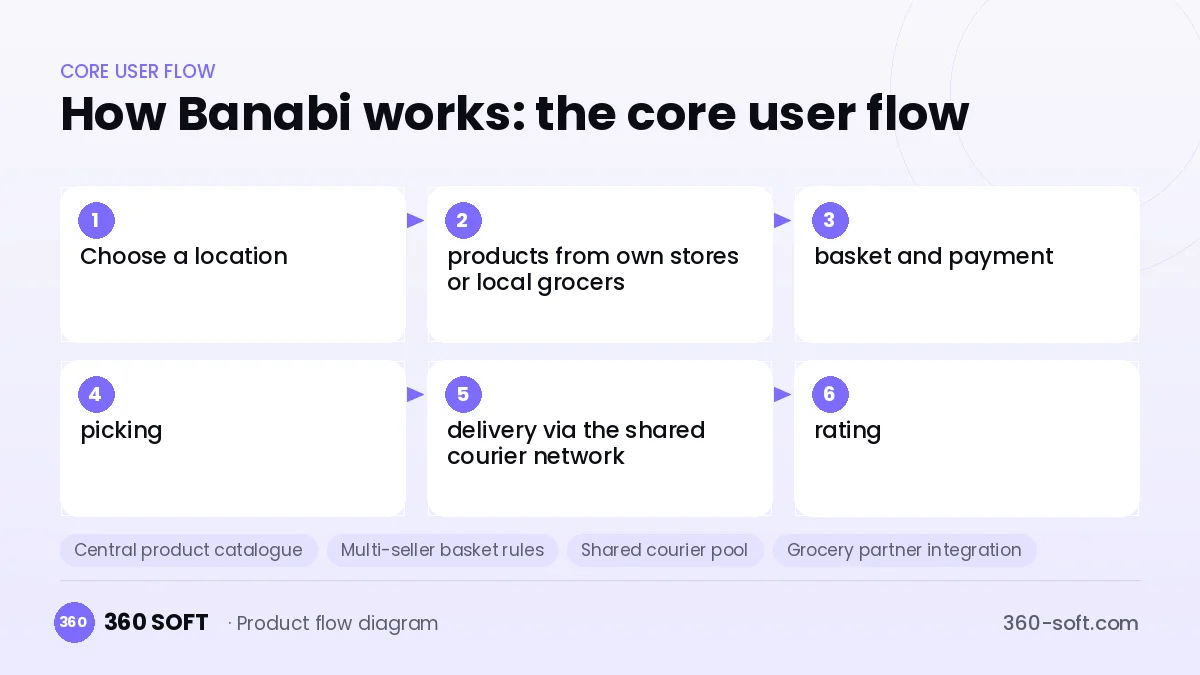
Banabi is the quick grocery service launched in Turkey by the food delivery platform Yemeksepeti, and its model combines rapid grocery delivery with a food ordering platform's existing users and courier network. Alongside sales from its own small dark stores, it brings local neighbourhood grocers onto the platform, expanding both product range and service area. Having the existing courier fleet also carry grocery orders uses idle capacity and lowers unit costs.
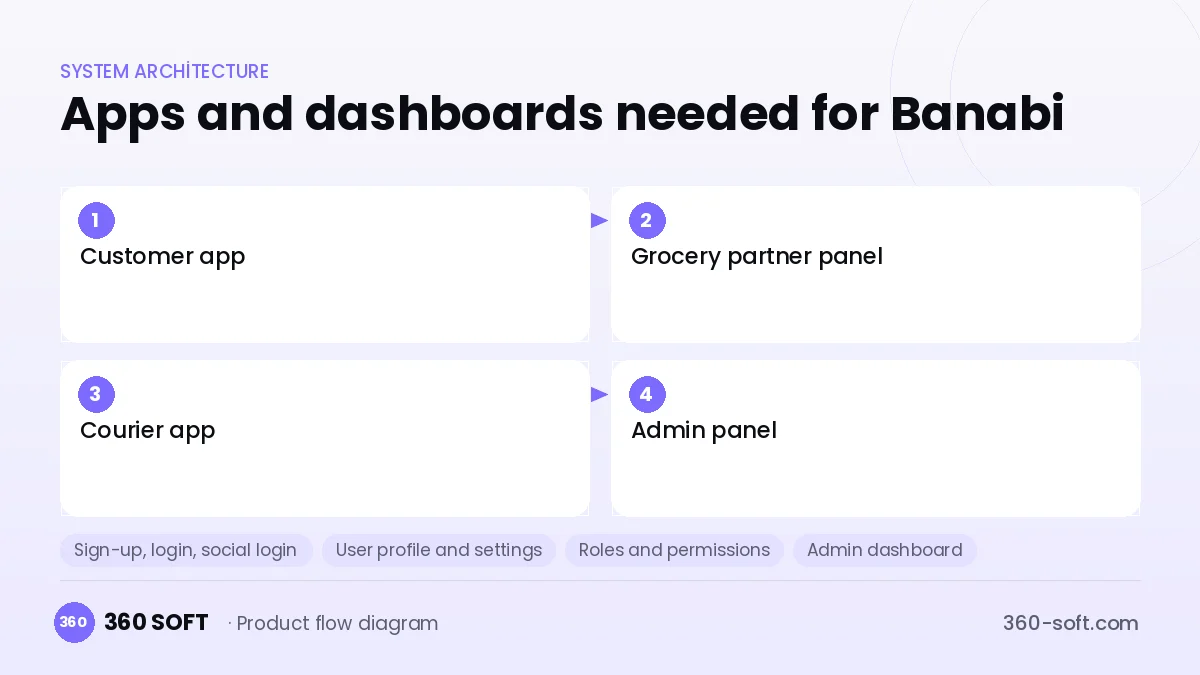
To build something similar you need to manage two different seller types in one system: your own warehouse stock and the catalogues of local grocery partners. The customer app, a grocery partner panel, a store picking screen, a shared courier app and an admin panel work together. Standardising the product catalogue, barcode matching and paying out to partner stores are the most demanding parts of the back end.
How Banabi works: the core user flow
How many apps and dashboards do you need?
Customer app
Users see products from both own stores and local grocers in the same interface, order and track deliveries.
Grocery partner panel
Local grocers accept orders, update stock and prices, and see their payouts.
Courier app
The shared courier fleet receives both food and grocery orders in the same app.
Admin panel
The team manages dark store stock, grocery partners, the catalogue, promotions and payouts.
Critical features of a product like Banabi
Central product catalogue
Standard barcode-based product cards; local grocers define their own prices and stock on top of this catalogue.
Multi-seller basket rules
Basket logic that decides whether own-store and partner products go into separate baskets or a single order.
Shared courier pool
An assignment engine that distributes food and grocery orders to the same courier fleet based on priority and distance.
Grocery partner integration
Options to pull stock and prices from the partner's POS software or upload them in bulk via Excel from the panel.
Separate payout and commission accounting
Revenue from own sales and commission from partner store sales are accounted for separately.
Missing item handling
If a product cannot be found at a partner store, the customer is offered a substitute or a partial refund.
What goes into the first version, what comes later
First version (MVP)
- Customer app and basket with own dark store stock
- Online payment and order tracking screen
- Store picking and courier assignment flow
- Barcode-based central product catalogue
- Admin panel for stock, orders and promotions
Later releases
- Local grocery partner panel and commission model
- Stock integration with POS software
- A shared loyalty programme for food and groceries
- Scheduled delivery option
Modules and how the budget is calculated
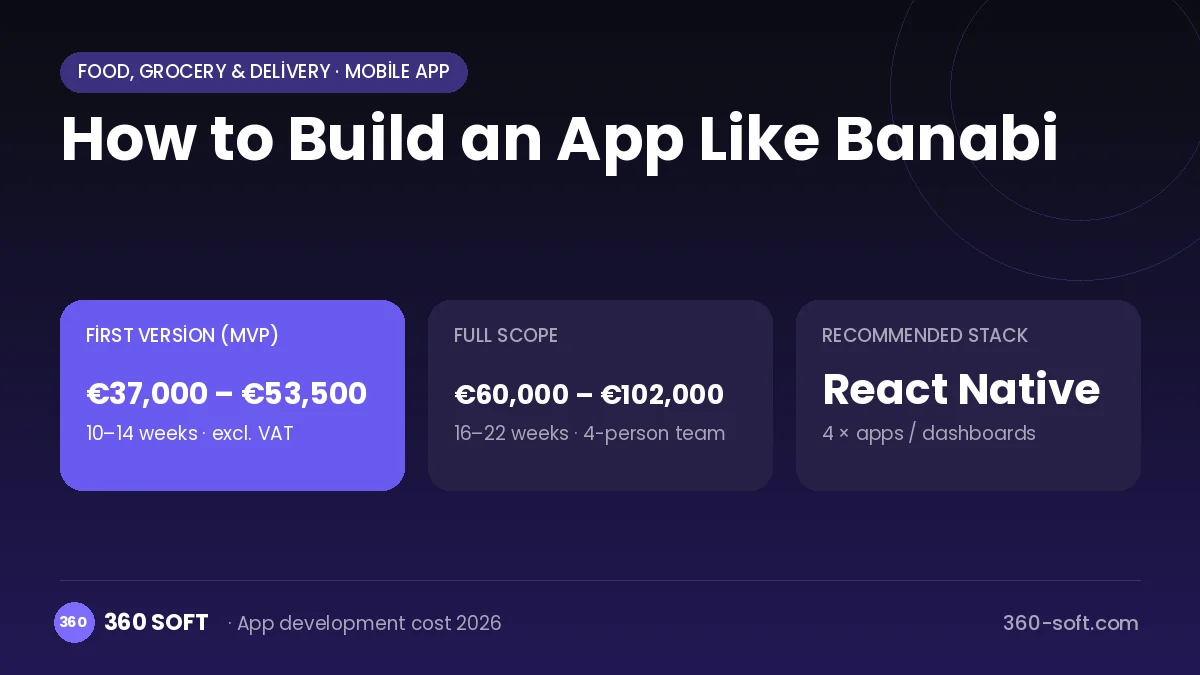
The budget is calculated with 360 SOFT’s pricing model from the modules below, about 34 screens and the project’s complexity: roughly 230 person-days for the full scope and 142 person-days for the first version. Every module you drop lowers the budget directly.
| Module | Phase |
|---|---|
| Sign-up, login, social login | First version |
| User profile and settings | First version |
| Roles and permissions | First version |
| Admin dashboard | First version |
| Product / content catalogue | First version |
| Cart and checkout | First version |
| Advanced search and filters | First version |
| Online payments (Stripe / PSP) | First version |
| Maps, location, routing | First version |
| Push notifications | First version |
| Barcode / RFID / handheld | First version |
| Marketplace integration (Amazon, etc.) | Later release |
| Reporting and analytics | First version |
| ERP / accounting integration | Later release |
Hosting, SMS, map APIs, app store accounts and payment-provider fees are separate items. Maintenance and improvements (optional): €750 / month. We send a fixed written price within 24 hours after a free discovery call.
The hard parts
Catalogue standardisation
Different stores entering the same product under different names breaks search; barcode matching and a content team are needed.
Stock reliability at partner stores
Local grocers' stock data is usually delayed; the missing item rate must be monitored and limited by rules.
Courier prioritisation
Carrying food and grocery orders with the same fleet requires balancing hot food priority against grocery volume.
Business model
Sales from your own stores earn a product margin, while sales by local grocery partners earn a per-order commission. Delivery fees and a surcharge below the minimum basket are the second revenue line. Sharing the existing courier fleet lowers costs, while sponsored product placements with brands and featured placement packages for partner stores bring in extra revenue.
Get a free quote for your project
Let us scope it together and send a fixed written quote within 24 hours. NDA on request; you own the source code.
Choosing a company to build an app like Banabi
Most people searching “build an app like banabi” are really looking for a reliable app development company. When comparing quotes, check four things:
- Can you try similar products they have shipped, in the stores or live?
- Are the source code, design files, servers and store accounts transferred to you by contract?
- Do they show a working demo every two weeks, with written scope and acceptance criteria?
- Are maintenance, scaling and GDPR/security costs written into the quote?
Copyright and trademarks
A business model and features are generally not protected on their own, but the Banabi name, logo, interface design, content and source code are. That is why we build a product with similar functionality but your own brand, design and code. This is not legal advice; we recommend a trademark search before launch.
Frequently asked questions
How long does it take to build an app like Banabi?
A first version working with your own dark store stock can be ready in a few months. When local grocery partners and POS integrations are added in a later phase, the scope grows significantly.
Does it make sense to add local grocers to the platform?
It expands your service area and product range without warehouse investment. However, clear partnership rules are needed for stock reliability and service quality.
How many separate apps are needed?
You need a customer app, a courier app, a grocery partner panel, a store picking screen and an admin panel. The panels can be web-based.
Are there copyright or trademark issues?
The quick grocery and local grocery marketplace model is generally free to use; names, logos, design, content and code cannot be copied. This is not legal advice.