Mobile appFood, grocery & deliveryOriginal by DoorDash
What makes DoorDash strong is that it is not just a food app but logistics infrastructure for local commerce. It built its network by focusing on suburbs and smaller cities that competitors paid less attention to, and it offers delivery not only for restaurants but also for grocery stores, pharmacies and retail shops. Its white-label delivery service, which also carries orders coming from businesses' own websites, turns the courier network into an extra revenue source.
To build something similar you need, alongside the customer, merchant and courier apps, a delivery API: external businesses must be able to request couriers from their own sites. The back end runs a matching engine, zone-based pricing, a subscription programme and a merchant panel. A multi-category catalogue structure must be able to handle different product types, from restaurant menus to grocery items, in the same system.
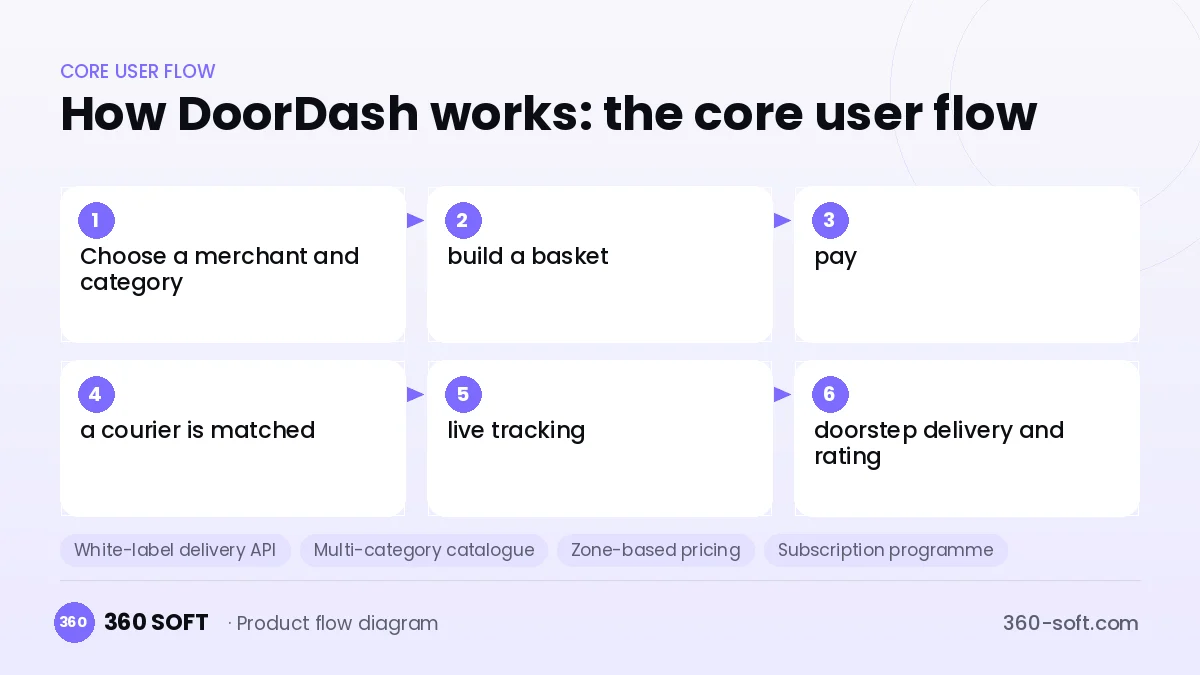
How DoorDash works: the core user flow
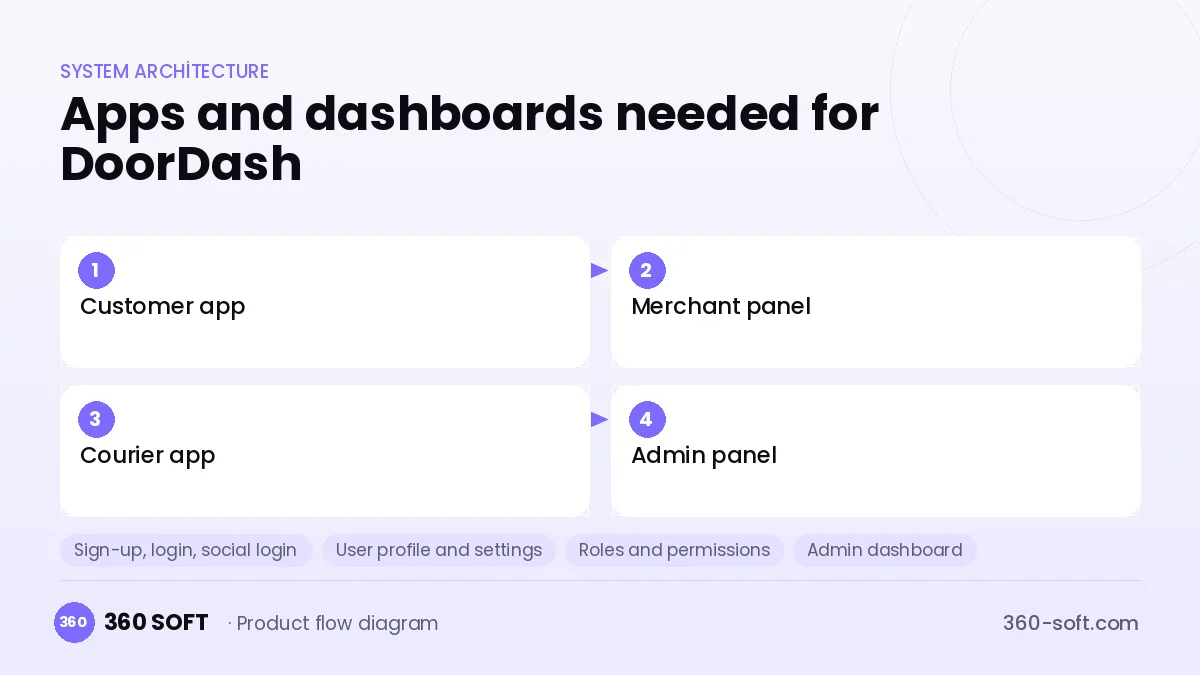
How many apps and dashboards do you need?
Customer app
Users order from restaurants, grocery stores and shops, and get delivery with subscription benefits.
Merchant panel
Merchants manage their menus or products, orders and promotions, and use the delivery API.
Courier app
Couriers accept job offers, complete deliveries and track their earnings.
Admin panel
The team manages zones, pricing, merchants, couriers and support processes.
Critical features of a product like DoorDash
White-label delivery API
Requesting couriers and tracking status via API for orders coming from a merchant's own website or app.
Multi-category catalogue
A structure that manages restaurant menus, grocery items and retail stock cards on the same search and basket infrastructure.
Zone-based pricing
Delivery fees and courier incentives defined separately by demand, distance and zone.
Subscription programme
Free delivery and reduced service fees on orders above a set value for a monthly fee.
Courier wave planning
Planning that offers couriers zone-based incentives before peak hours to increase online capacity.
Proof of delivery
Proof of delivery with a photo, location and timestamp for orders left at the door.
What goes into the first version, what comes later
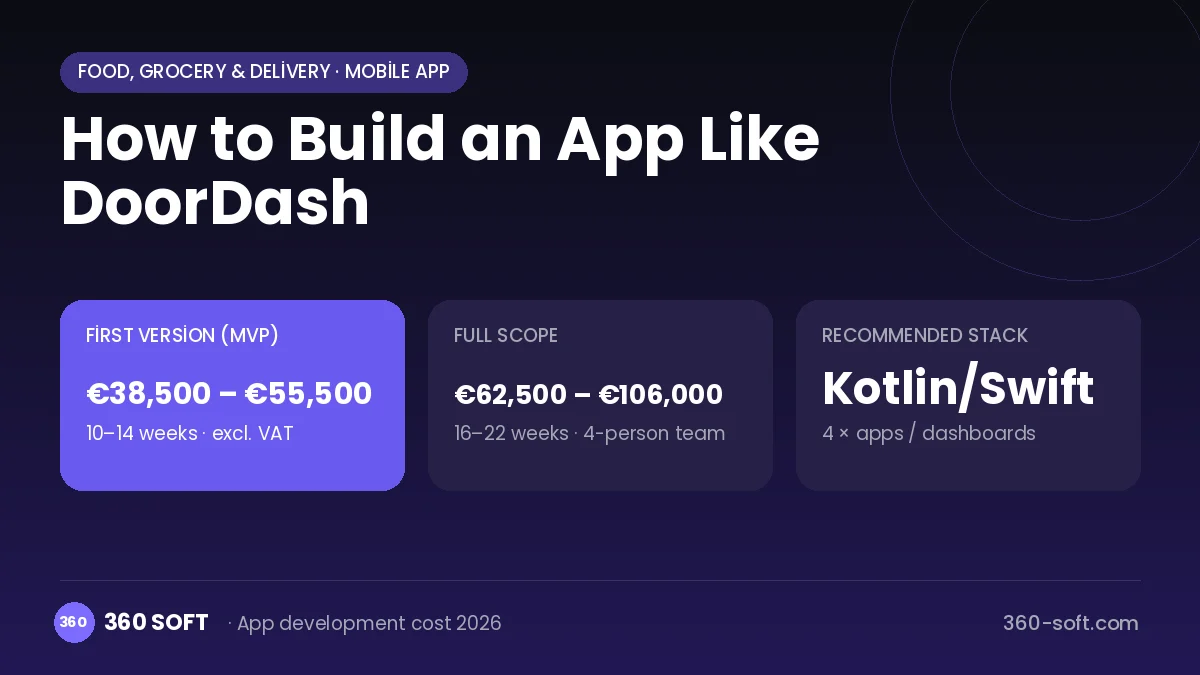
First version (MVP)
- Restaurant-focused customer app and ordering flow
- Merchant panel for order and menu management
- Courier app with matching and live tracking
- Online payment and proof of delivery
- Admin panel for zones, pricing and couriers
Later releases
- Delivery API for external merchants
- Grocery and retail categories
- Free-delivery subscription programme
- Advertising and sponsored placements for merchants
Modules and how the budget is calculated
The budget is calculated with 360 SOFT’s pricing model from the modules below, about 40 screens and the project’s complexity: roughly 239 person-days for the full scope and 147 person-days for the first version. Every module you drop lowers the budget directly.
| Module | Phase |
|---|---|
| Sign-up, login, social login | First version |
| User profile and settings | First version |
| Roles and permissions | First version |
| Admin dashboard | First version |
| Product / content catalogue | First version |
| Cart and checkout | First version |
| Advanced search and filters | First version |
| Online payments (Stripe / PSP) | First version |
| Subscriptions and recurring billing | First version |
| Maps, location, routing | First version |
| Push notifications | First version |
| Marketplace integration (Amazon, etc.) | Later release |
| Third-party API integration | First version |
| Reporting and analytics | Later release |
| File, photo, video upload | First version |
Hosting, SMS, map APIs, app store accounts and payment-provider fees are separate items. Maintenance and improvements (optional): €800 / month. We send a fixed written price within 24 hours after a free discovery call.
The hard parts
Low-density areas
In spread-out areas such as suburbs, delivery distances grow; pricing and courier incentives must be tuned per zone.
API reliability
Because external merchants will depend on the delivery API, high availability, versioning and error handling are essential.
Category diversity
Food and grocery products have different preparation, substitution and refund rules; managing these differences in one system requires careful architecture.
Business model
Revenue consists of order commission from merchants, delivery and service fees from customers, and the subscription programme. Selling courier services to external businesses for a fixed fee per order through the delivery API turns the courier network into a separate revenue channel. Advertising and sponsored placements offered to merchants are also a significant line.
Get a free quote for your project
Let us scope it together and send a fixed written quote within 24 hours. NDA on request; you own the source code.
Choosing a company to build an app like DoorDash
Most people searching “build an app like doordash” are really looking for a reliable app development company. When comparing quotes, check four things:
- Can you try similar products they have shipped, in the stores or live?
- Are the source code, design files, servers and store accounts transferred to you by contract?
- Do they show a working demo every two weeks, with written scope and acceptance criteria?
- Are maintenance, scaling and GDPR/security costs written into the quote?
Copyright and trademarks
A business model and features are generally not protected on their own, but the DoorDash name, logo, interface design, content and source code are. That is why we build a product with similar functionality but your own brand, design and code. This is not legal advice; we recommend a trademark search before launch.
Frequently asked questions
How long does it take to build an app like DoorDash?
A restaurant-focused first version takes a few months of development. As the delivery API, grocery category and subscription are added, the project becomes a multi-phase roadmap.
How many separate apps are needed?
The customer app, merchant panel, courier app and admin panel are the core parts. The delivery API and developer documentation should be treated as a separate product.
Is a courier-service-only model possible?
Yes, a logistics platform that offers courier services to businesses via an API or panel can also be built. In this model, merchant integrations take centre stage instead of a customer app.
Are there copyright or trademark issues?
The delivery platform business model and its features are generally free to use; names, logos, design, content and code cannot be copied. This is not legal advice.