Mobile appFood, grocery & deliveryOriginal by Uber
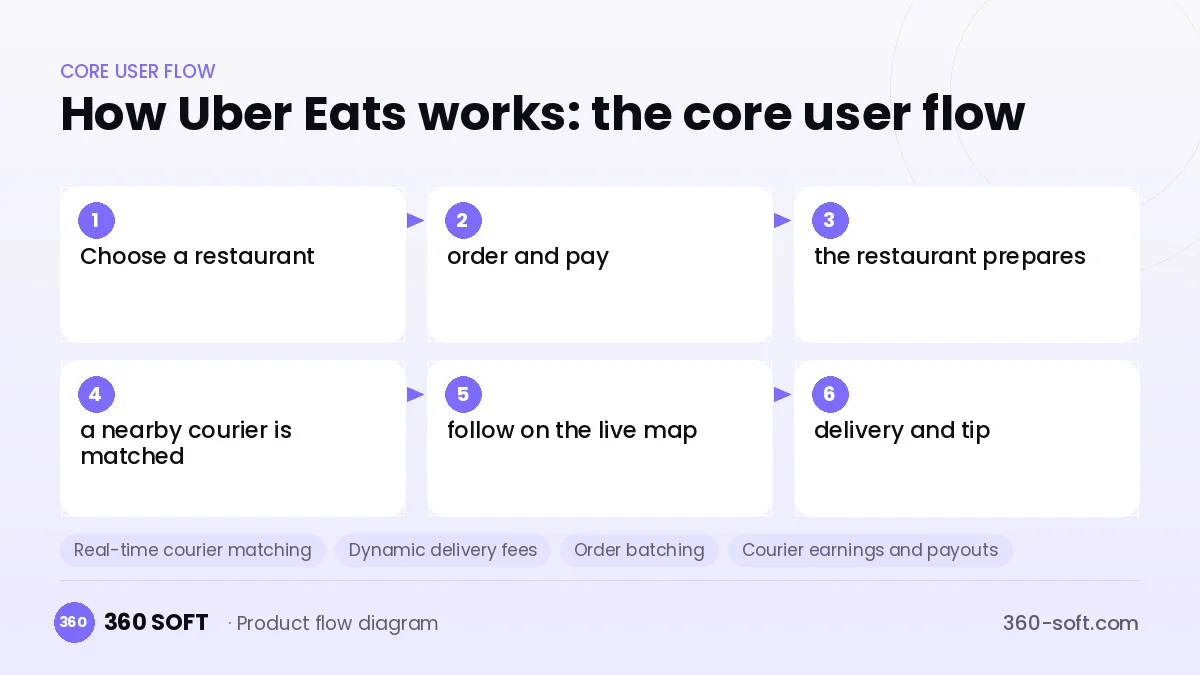
Uber Eats brings the matching and logistics technology developed for ride-hailing to food delivery. Restaurants do not need their own couriers; the best-placed courier among independent gig couriers picks up the order. Real-time location, dynamic delivery fees and accurate estimated arrival times give users transparency and give restaurants sales without the logistics burden.
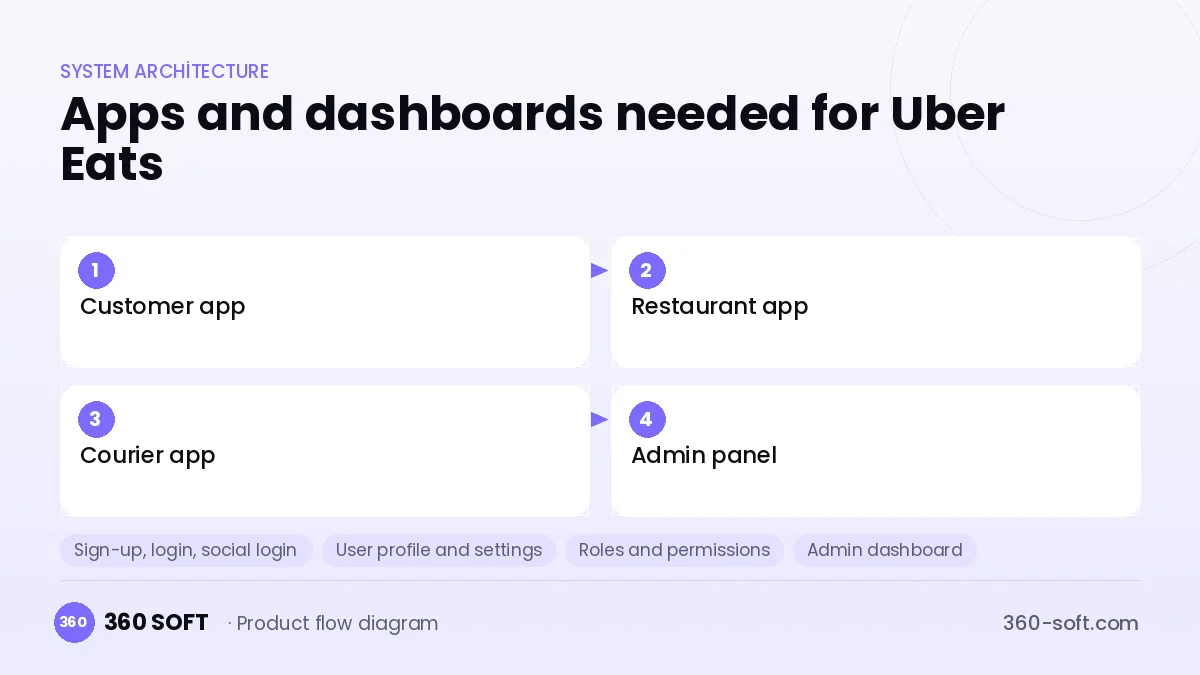
To build something similar you need a customer app, a restaurant tablet app, a courier app and an admin panel. The real complexity is in the back end: a geospatial index tracking couriers' live locations, multi-variable matching between orders and couriers, demand-based pricing and weekly courier payouts. Courier onboarding, document checks and safety processes are also part of the operation.
How Uber Eats works: the core user flow
How many apps and dashboards do you need?
Customer app
Users choose a restaurant, place an order, follow the courier on a live map and can leave a tip.
Restaurant app
Restaurants accept orders, report preparation times and manage their menu.
Courier app
Independent couriers go online, accept offered jobs and track their earnings.
Admin panel
The team manages cities, pricing, courier approvals, restaurants and support requests.
Critical features of a product like Uber Eats
Real-time courier matching
An algorithm that offers each order to the most suitable courier using courier location, restaurant preparation time and route data.
Dynamic delivery fees
Delivery fees and courier incentives that change with distance, demand and conditions such as weather.
Order batching
Batching logic that combines orders from the same restaurant or to nearby addresses into a single courier trip.
Courier earnings and payouts
A courier wallet that transparently shows per-job earnings, tips, bonuses and weekly payouts.
Courier onboarding and document checks
An application process where ID, driving licence and vehicle documents are uploaded, approved and periodically checked.
Accurate arrival time estimates
An estimated arrival time calculated from historical delivery data and live traffic, updated throughout the order.
What goes into the first version, what comes later
First version (MVP)
- Customer app, restaurant list and ordering
- Restaurant tablet app and order acceptance
- Courier app with job offers and navigation
- Distance-based automatic courier matching and live tracking
- Courier earnings report and admin panel
Later releases
- Demand-based dynamic pricing
- Order batching
- Free-delivery subscription programme
- New delivery categories such as groceries and pharmacy
Modules and how the budget is calculated
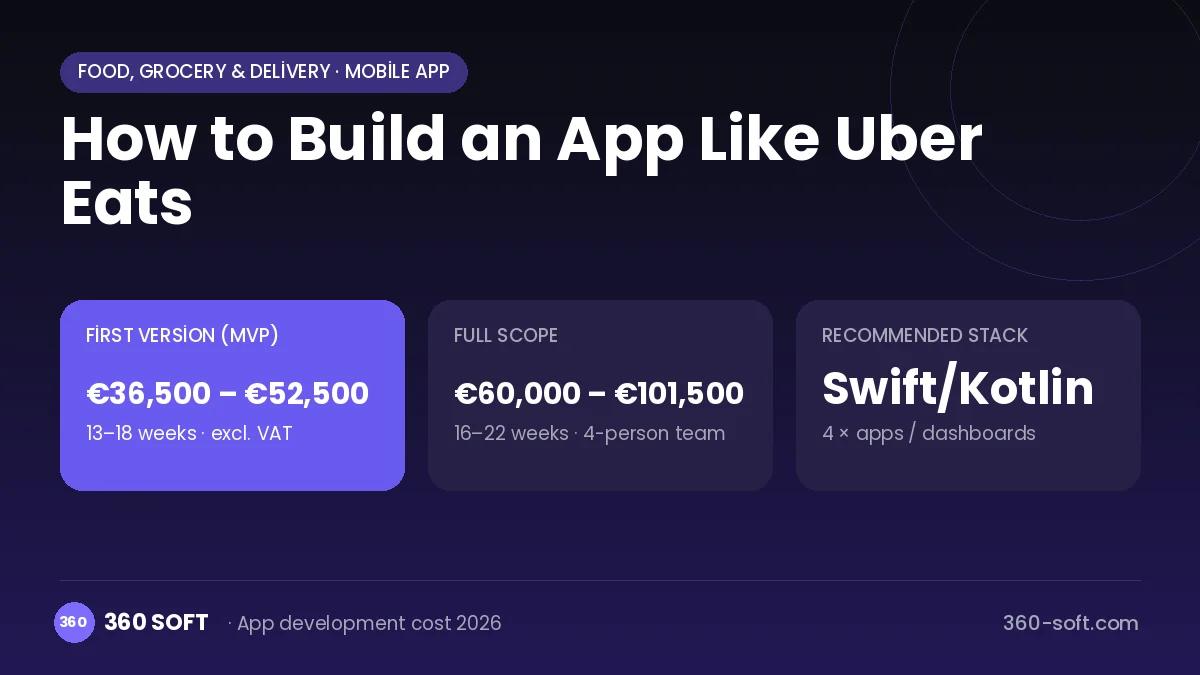
The budget is calculated with 360 SOFT’s pricing model from the modules below, about 40 screens and the project’s complexity: roughly 229 person-days for the full scope and 139 person-days for the first version. Every module you drop lowers the budget directly.
| Module | Phase |
|---|---|
| Sign-up, login, social login | First version |
| User profile and settings | First version |
| Roles and permissions | First version |
| Admin dashboard | First version |
| Product / content catalogue | First version |
| Cart and checkout | First version |
| Advanced search and filters | First version |
| Online payments (Stripe / PSP) | First version |
| Maps, location, routing | First version |
| Push notifications | First version |
| Email / SMS notifications | First version |
| Ratings and reviews | First version |
| Marketplace integration (Amazon, etc.) | Later release |
| Reporting and analytics | Later release |
| Multi-language | First version |
Hosting, SMS, map APIs, app store accounts and payment-provider fees are separate items. Maintenance and improvements (optional): €750 / month. We send a fixed written price within 24 hours after a free discovery call.
The hard parts
Matching algorithm
If preparation time, courier location and traffic are not optimised together, couriers wait at the restaurant or food goes cold.
Location data at scale
Location data sent every few seconds by thousands of couriers requires geospatial indexing and real-time infrastructure.
Gig courier regulations
Couriers' employment status, insurance and tax obligations vary by country; the legal framework must be clarified in advance.
Business model
Commission on the restaurant's order value and delivery and service fees from customers are the core revenue lines. Dynamic delivery fees at peak times, a free-delivery subscription programme and in-app advertising for restaurants expand the revenue model. Because couriers are paid per job, costs scale with order volume.
Get a free quote for your project
Let us scope it together and send a fixed written quote within 24 hours. NDA on request; you own the source code.
Choosing a company to build an app like Uber Eats
Most people searching “build an app like uber eats” are really looking for a reliable app development company. When comparing quotes, check four things:
- Can you try similar products they have shipped, in the stores or live?
- Are the source code, design files, servers and store accounts transferred to you by contract?
- Do they show a working demo every two weeks, with written scope and acceptance criteria?
- Are maintenance, scaling and GDPR/security costs written into the quote?
Copyright and trademarks
A business model and features are generally not protected on their own, but the Uber Eats name, logo, interface design, content and source code are. That is why we build a product with similar functionality but your own brand, design and code. This is not legal advice; we recommend a trademark search before launch.
Frequently asked questions
How long does it take to build an app like Uber Eats?
A first version consisting of the customer, restaurant and courier apps plus the admin panel is a few months of intensive work. Algorithms such as dynamic pricing and batching mature over time.
How many separate apps are needed?
Four parts are needed: the customer app, the restaurant app, the courier app and the admin panel. The restaurant side can be a tablet-friendly web app.
Is the gig courier model viable in my market?
It can be, but couriers' self-employed status, insurance and tax position must be clarified with a lawyer beforehand, as rules differ between the UK, the EU and the US. Some platforms share this burden by working with courier companies.
Are there copyright or trademark issues?
The food delivery and courier matching model is generally free to use; names, logos, design, content and code cannot be copied. This is not legal advice.