Mobile appFintech & paymentsOriginal by Block
The secret of Cash App is that it makes sending money as simple as a username. Instead of a bank account number, a short tag is used to send or request money; the balance can be spent with a free debit card, and salary can be deposited straight into the app. Over time, features such as stock and crypto trading were added, so a single app became the centre of daily finance for users who keep their distance from traditional banking.
To build something similar, the licensing structure has to be clear before anything else: money transfer and balances need a payment or e-money licence, and investment products need a partnership with a regulated broker. Technically you must build username reservation, a social transfer flow, a prepaid card, an IBAN for salary deposits, transaction monitoring, a shared ledger across product modules and a strong fraud layer that protects the user.
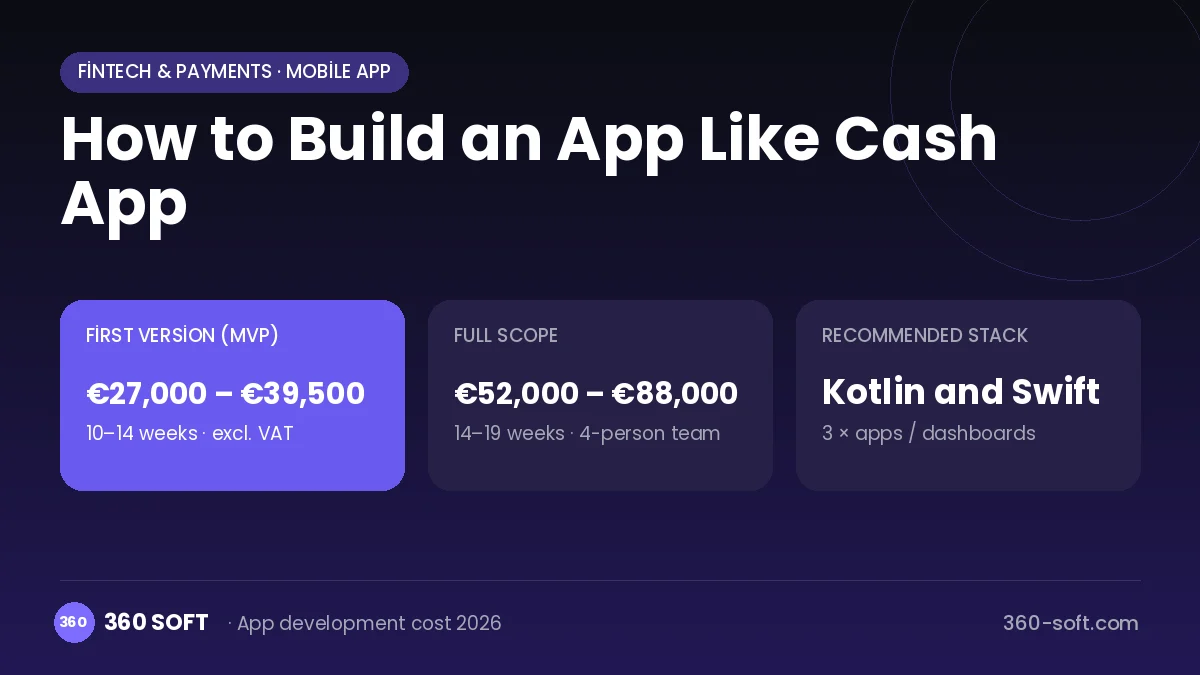
How Cash App works: the core user flow
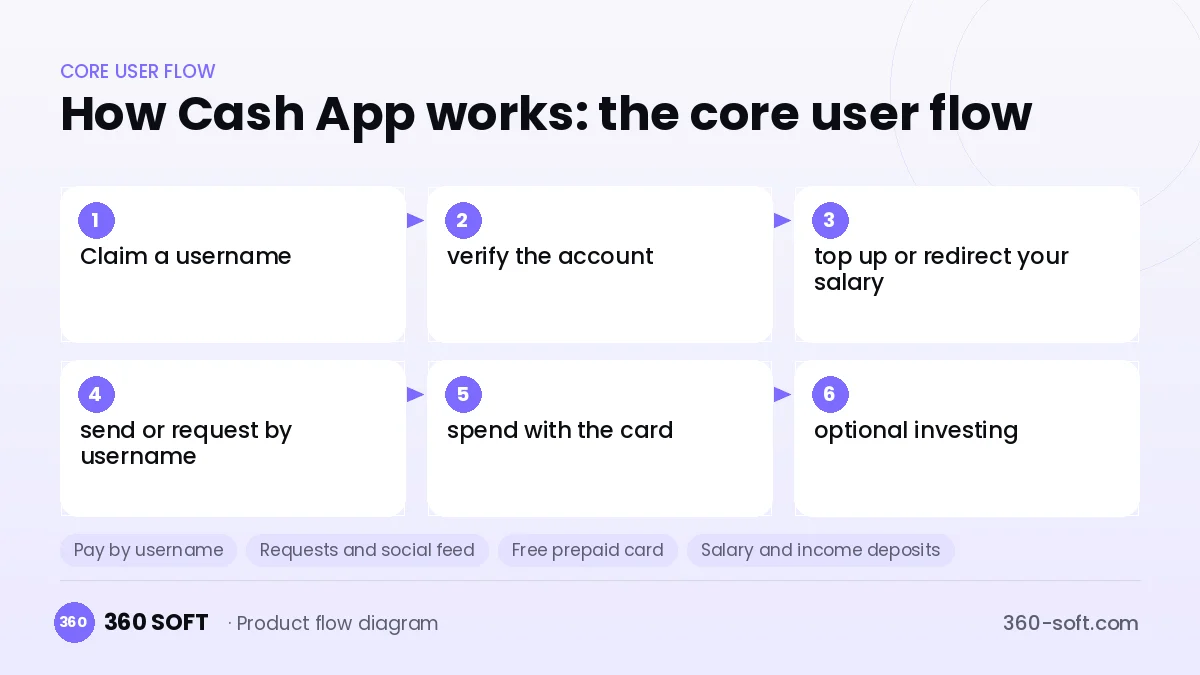
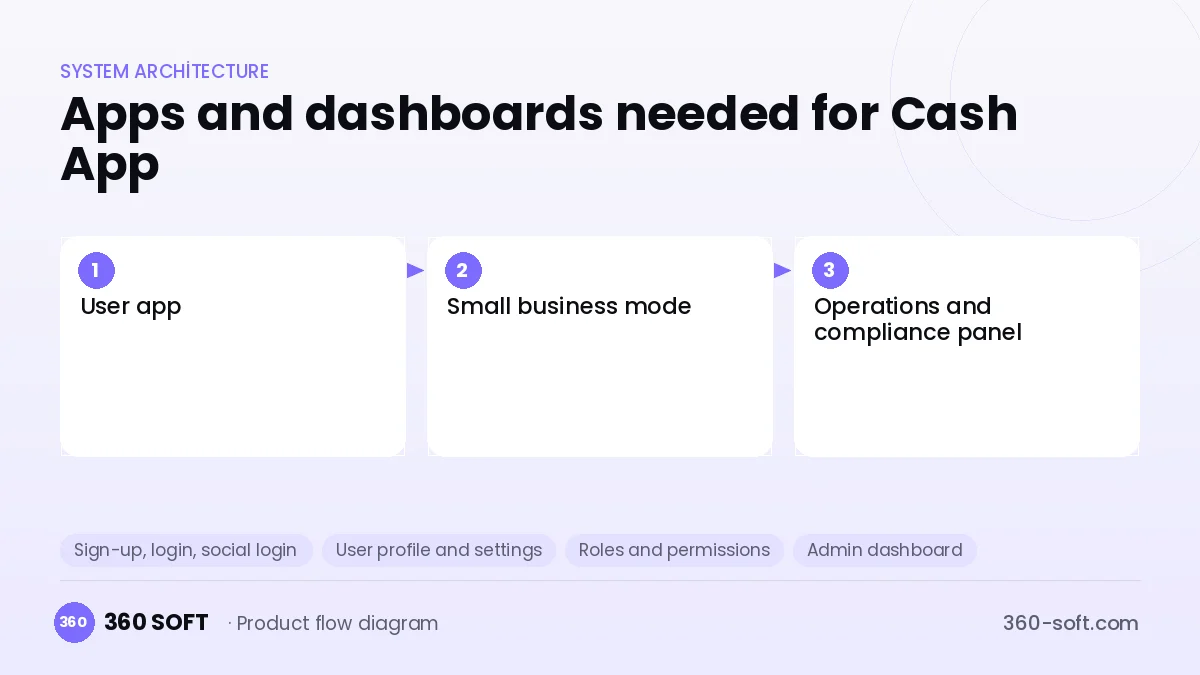
How many apps and dashboards do you need?
User app
Users send and request money by username, manage their card, receive salary and access investment products.
Small business mode
Sole traders and freelancers take payments by username or QR code and see a sales summary.
Operations and compliance panel
The team manages identity checks, suspicious transfers, account freezes and regulatory reporting.
Critical features of a product like Cash App
Pay by username
Every user gets a unique tag; to send money, this tag or a QR code is enough instead of an account number.
Requests and social feed
A user requests money from a friend with an amount and note; transactions appear in a personal timeline.
Free prepaid card
The card linked to the balance is customised in the app, with instant notifications and one-tap freezing.
Salary and income deposits
A personal IBAN lets salary or payments be deposited straight into the balance.
Instant discount offers
A discount picked in the app is applied instantly on purchases with the card at partner brands.
Fraud warnings
Warnings are shown for recipients who are new or look suspicious, and risky transfers are held.
What goes into the first version, what comes later
First version (MVP)
- Username reservation, eKYC and limits
- Balance top-up and transfers by username
- Requesting money and a transaction feed
- A virtual card on licensed infrastructure
- Operations panel and fraud rules
Later releases
- A physical card and card customisation
- A personal IBAN for salary deposits
- Small business payment mode
- Investment products through a regulated broker partnership
Modules and how the budget is calculated
The budget is calculated with 360 SOFT’s pricing model from the modules below, about 32 screens and the project’s complexity: roughly 199 person-days for the full scope and 104 person-days for the first version. Every module you drop lowers the budget directly.
| Module | Phase |
|---|---|
| Sign-up, login, social login | First version |
| User profile and settings | First version |
| Roles and permissions | First version |
| Admin dashboard | First version |
| Online payments (Stripe / PSP) | First version |
| Push notifications | First version |
| Email / SMS notifications | First version |
| Reporting and analytics | Later release |
| GDPR and security hardening | First version |
| Third-party API integration | First version |
| Barcode / RFID / handheld | Later release |
| AI features (LLM, RAG, recommendations) | Later release |
Hosting, SMS, map APIs, app store accounts and payment-provider fees are separate items. Maintenance and improvements (optional): €650 / month. We send a fixed written price within 24 hours after a free discovery call.
The hard parts
Instant, irreversible transfers
Fast transfers expose users to fraud; recipient warnings, delayed transfers and behavioural analysis are needed.
Multi-product regulation
Payments, cards and investment products fall under different licences and regulators; each module must go through its own compliance process.
Username abuse
Impersonation of well-known people or organisations leads to fake accounts; username reservation and a verified-badge policy are needed.
Business model
Basic transfers are free; revenue comes from interchange on card spending, the fee for instant cash-out to a bank account, collection commissions in business mode and fees on card-funded transfers. Transaction revenue shared with the partner institution on investment products and a share of the discount offers from brands complete the model.
Get a free quote for your project
Let us scope it together and send a fixed written quote within 24 hours. NDA on request; you own the source code.
Choosing a company to build an app like Cash App
Most people searching “build an app like cash app” are really looking for a reliable app development company. When comparing quotes, check four things:
- Can you try similar products they have shipped, in the stores or live?
- Are the source code, design files, servers and store accounts transferred to you by contract?
- Do they show a working demo every two weeks, with written scope and acceptance criteria?
- Are maintenance, scaling and GDPR/security costs written into the quote?
Copyright and trademarks
A business model and features are generally not protected on their own, but the Cash App name, logo, interface design, content and source code are. That is why we build a product with similar functionality but your own brand, design and code. This is not legal advice; we recommend a trademark search before launch.
Frequently asked questions
How long does it take to build an app like Cash App?
A first release with username transfers and a card can be ready within months with a licensed infrastructure partner. Extra products such as investing need separate permissions and integration processes.
Which permissions are needed?
Money transfers and holding balances need a payment or e-money institution licence from the national regulator. Investment products such as shares can only be offered through a partnership with a regulated broker.
Will there be copyright or trademark issues?
The model of sending money by username is free to use, but the name, logo, card design, interface and code cannot be copied. This is general information, not legal advice.
What should I look for in a fintech software company?
Choose a team with experience in real-time payment systems, fraud prevention and secure mobile development. Ask about independent security audits and incident response plans.