Mobile appAI productsOriginal by Bending Spoons
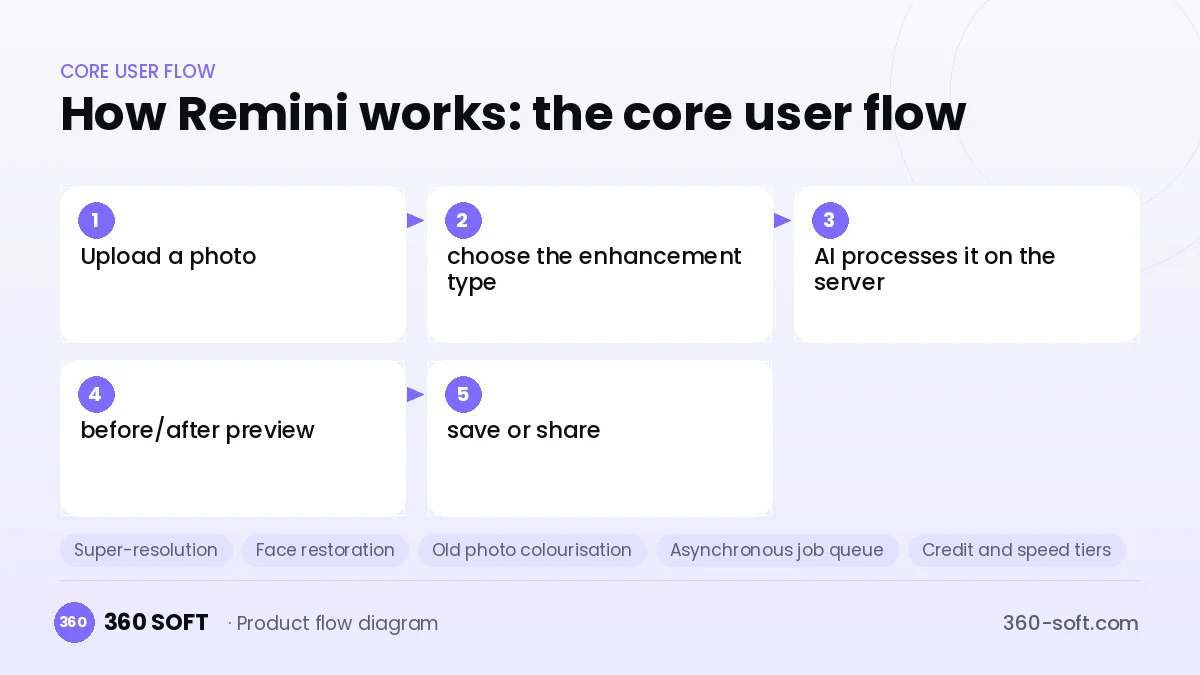
Remini's appeal comes down to a single promise: turn a blurry, low-resolution or old photo into a sharp one within seconds. Faded frames from family albums, selfies taken on old phones and heavily compressed images come back to life with AI. The emotional impact of the result is very high; users share before/after images, and those shares become the product's most effective advertising.
Building something similar depends as much on the super-resolution and face restoration models running on the server as on the mobile app. An uploaded image is queued, processed on a GPU server, the result is written to secure storage and the user gets a notification. That calls for a job queue, an autoscaling GPU pool, credit and subscription management, a retention policy that deletes images after a set time, and an admin panel.

How Remini works: the core user flow
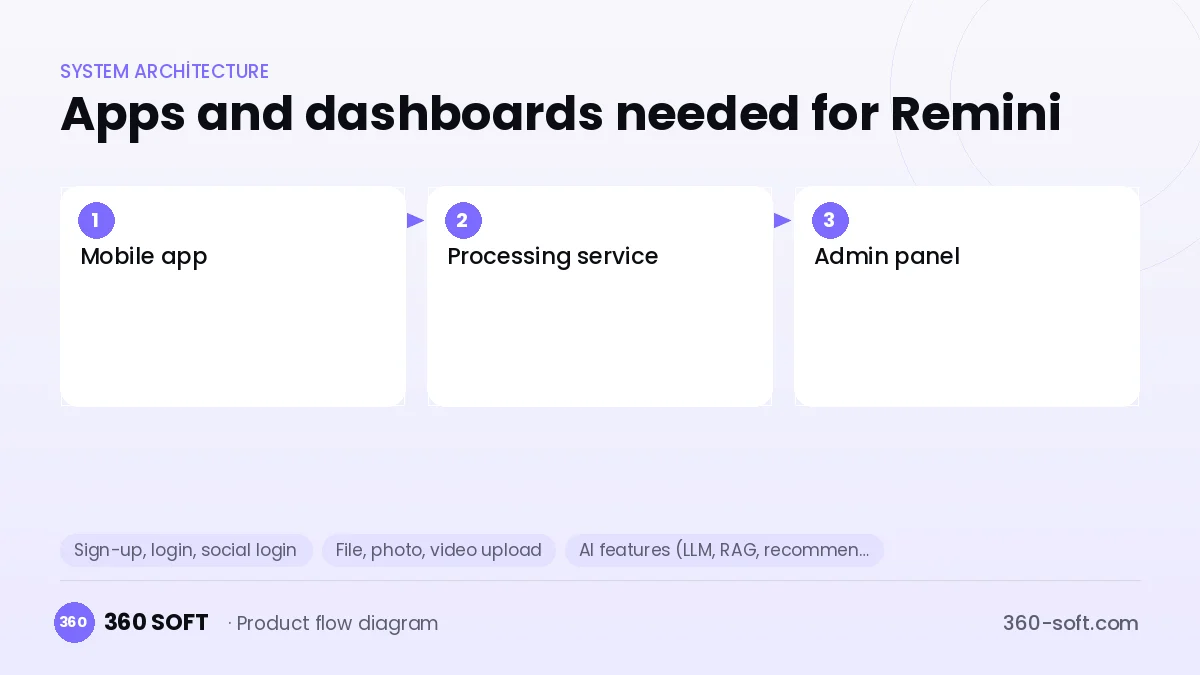
How many apps and dashboards do you need?
Mobile app
The app where users upload photos, view and download enhancement results, and buy subscriptions.
Processing service
The backend system that pulls images from the queue and processes them with AI models on GPUs.
Admin panel
An internal panel for monitoring credits, subscriptions, model versions, queue status and abuse reports.
Critical features of a product like Remini
Super-resolution
Low-resolution images are upscaled 2 to 4 times with AI while details are reconstructed.
Face restoration
Blurry or damaged faces are sharpened with a dedicated model, recovering eye, hair and skin detail.
Old photo colourisation
Black-and-white frames are coloured with natural tones, and scratches and stains are cleaned up.
Asynchronous job queue
During peak hours requests are queued, users see an estimated wait time and get a notification when the job finishes.
Credit and speed tiers
Free users get a limited number of jobs; premium members get a priority queue and high-resolution output.
Automatic data deletion
Uploaded and processed images are deleted from the servers after a set period, giving GDPR-compliant retention.
What goes into the first version, what comes later
First version (MVP)
- Photo upload and a single enhancement type (sharpening)
- Before/after comparison screen
- GPU job queue and notification
- Daily free credits, unlimited use with a subscription
- Automatic image deletion policy
Later releases
- Video enhancement
- Colourisation and scratch repair
- AI avatar and style generation
- Web version and batch processing
Modules and how the budget is calculated
The budget is calculated with 360 SOFT’s pricing model from the modules below, about 16 screens and the project’s complexity: roughly 62 person-days for the full scope and 38 person-days for the first version. Every module you drop lowers the budget directly.
| Module | Phase |
|---|---|
| Sign-up, login, social login | First version |
| File, photo, video upload | First version |
| AI features (LLM, RAG, recommendations) | Later release |
| Subscriptions and recurring billing | First version |
| Online payments (Stripe / PSP) | First version |
| Push notifications | First version |
| Admin dashboard | First version |
| GDPR and security hardening | First version |
| Reporting and analytics | Later release |
| Third-party API integration | First version |
Hosting, SMS, map APIs, app store accounts and payment-provider fees are separate items. Maintenance and improvements (optional): €250 / month. We send a fixed written price within 24 hours after a free discovery call.
The hard parts
GPU cost and scale
A viral wave of shares can fill the queue instantly; plan for an autoscaling GPU pool and cost ceilings.
Model quality and consistency
Face restoration can sometimes make a person unrecognisable; identity-preserving models and an intensity setting should be offered.
Personal data and abuse
Processing other people's photos and handling face data is sensitive under GDPR; explicit consent, short retention and a reporting flow are required.
Business model
AI photo enhancement products typically combine weekly or yearly subscriptions, credit packs and rewarded ads on the free tier. Because every job has a real server cost, free use is capped with a daily quota, and premium members get priority processing, high-resolution output and watermark-free results.
Get a free quote for your project
Let us scope it together and send a fixed written quote within 24 hours. NDA on request; you own the source code.
Choosing a company to build an app like Remini
Most people searching “build an app like remini” are really looking for a reliable app development company. When comparing quotes, check four things:
- Can you try similar products they have shipped, in the stores or live?
- Are the source code, design files, servers and store accounts transferred to you by contract?
- Do they show a working demo every two weeks, with written scope and acceptance criteria?
- Are maintenance, scaling and GDPR/security costs written into the quote?
Copyright and trademarks
A business model and features are generally not protected on their own, but the Remini name, logo, interface design, content and source code are. That is why we build a product with similar functionality but your own brand, design and code. This is not legal advice; we recommend a trademark search before launch.
Frequently asked questions
How long does it take to build an app like Remini?
A single-feature first version running on open-source models can go live within a few months. Training your own model and bringing quality up to competitor level is a longer process.
Should we develop the model ourselves?
At the start you can use open-source models such as Real-ESRGAN, GFPGAN or CodeFormer, as long as their licence terms allow commercial use. To stand out on quality, you will eventually need to fine-tune on your own data.
Are there copyright or trademark issues?
The photo enhancement business model is free to use. The name, logo, interface and promotional content cannot be copied, and you should also check the licences of the models you use. This information is not legal advice.
What should I look for when choosing an AI app development company?
Ask about the company's experience with GPU infrastructure, model serving and cost optimisation. Being able to calculate the server cost per job in advance is a serious plus.