Mobile appAI productsOriginal by Prisma Labs
Lensa grabbed attention by turning a handful of selfies into personalised AI avatars in different art styles. People love seeing themselves as an astronaut, an anime character or an oil-painting portrait, and they share the results on social media straight away. That urge to share creates a loop that spreads the product without ads, while the app's classic retouching tools keep users around after the avatar wave passes.
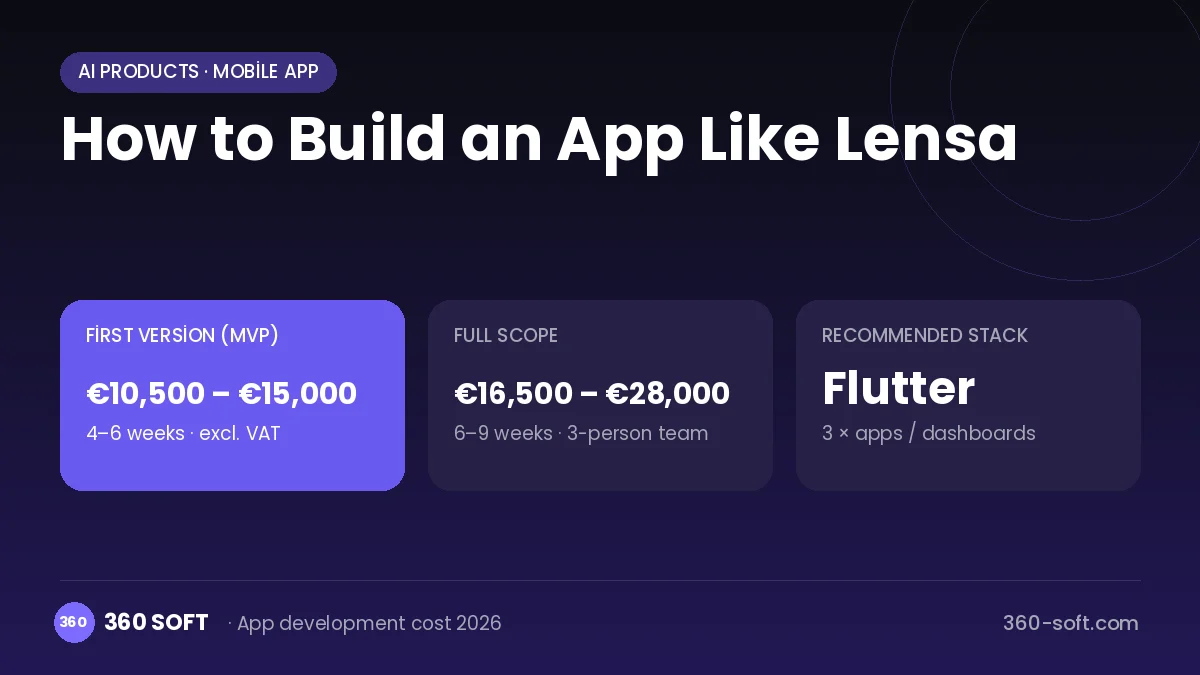
Building something similar requires a GPU pipeline that performs short-lived model fine-tuning for each user (for example with LoRA or DreamBooth methods), style templates, face quality checks and a results gallery. The mobile app collects photos, checks quality rules and sells one-off packs. In the background run a job queue, training and generation servers, content safety filters and a policy that deletes data after processing.
How Lensa works: the core user flow
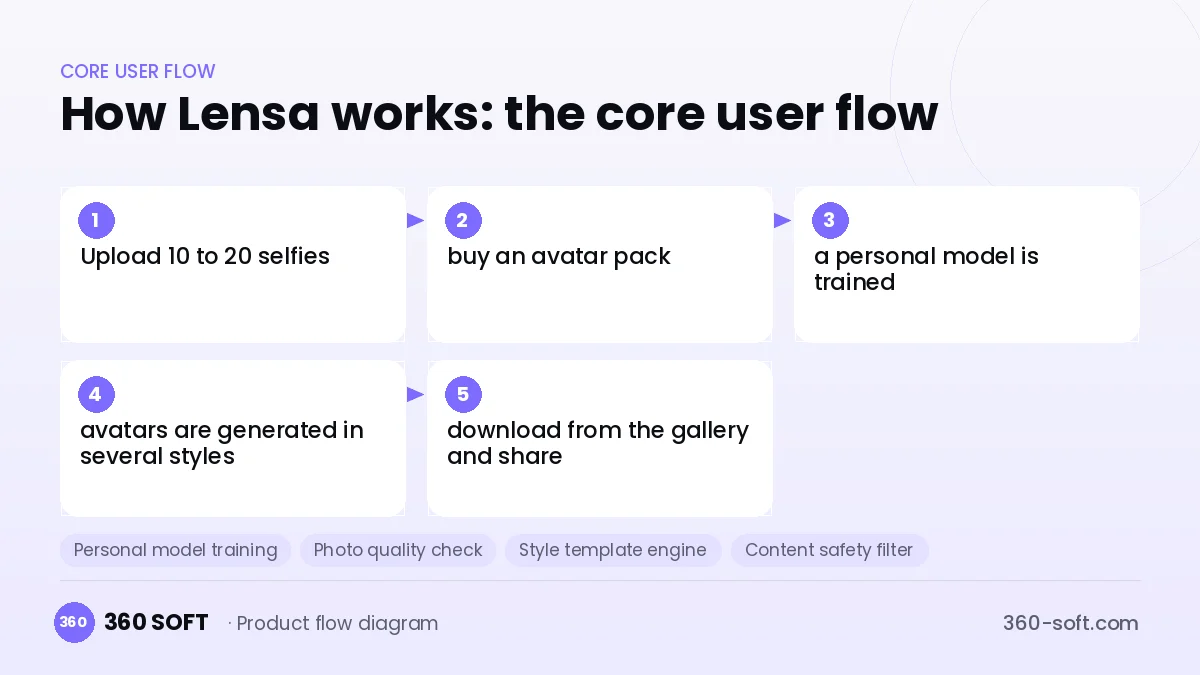
How many apps and dashboards do you need?
Mobile app
The app where users upload selfies, buy avatar packs, view results and use retouching tools.
Training and generation service
A GPU backend that trains a personal model from user photos and generates images in the chosen styles.
Admin panel
A panel for managing style templates, pack prices, queue load and content safety reports.
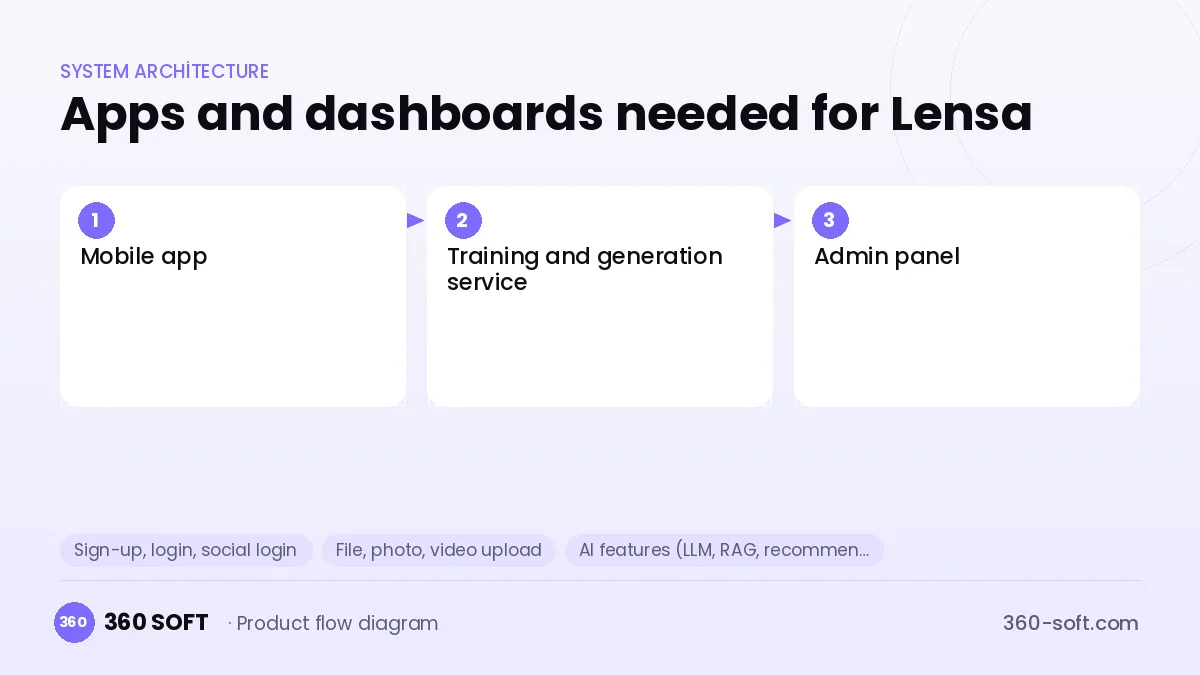
Critical features of a product like Lensa
Personal model training
Fine-tuning on the user's photos takes minutes and yields an identity-preserving model that can adapt to any style.
Photo quality check
Problems in uploaded selfies, such as blur, multiple people, sunglasses or too few angles, are detected automatically.
Style template engine
Prompt sets and parameters prepared for each style can be added and updated from the panel.
Content safety filter
Generated images are screened for inappropriate content and child safety, and photos of minors are rejected.
Pack-based purchases
One-off packs with different numbers of avatars and styles are sold through in-app purchases.
Classic retouching tools
Skin correction, background blur and lighting adjustments support everyday use beyond avatars.
What goes into the first version, what comes later
First version (MVP)
- Selfie upload and quality check
- Avatar generation in 5 to 10 styles
- Avatar packs via in-app purchase
- Results gallery, download and sharing
- Automatic data deletion after processing
Later releases
- Subscription for retouching tools
- Couple and pet avatars
- Video and animated avatars
- Image generation from the user's own prompts
Modules and how the budget is calculated
The budget is calculated with 360 SOFT’s pricing model from the modules below, about 16 screens and the project’s complexity: roughly 62 person-days for the full scope and 38 person-days for the first version. Every module you drop lowers the budget directly.
| Module | Phase |
|---|---|
| Sign-up, login, social login | First version |
| File, photo, video upload | First version |
| AI features (LLM, RAG, recommendations) | Later release |
| Online payments (Stripe / PSP) | First version |
| Subscriptions and recurring billing | First version |
| Push notifications | First version |
| Admin dashboard | First version |
| GDPR and security hardening | First version |
| Reporting and analytics | Later release |
| Third-party API integration | First version |
Hosting, SMS, map APIs, app store accounts and payment-provider fees are separate items. Maintenance and improvements (optional): €250 / month. We send a fixed written price within 24 hours after a free discovery call.
The hard parts
Training cost and time
Training a separate model for every user is expensive; you need to manage the queue under heavy demand and keep GPU capacity flexible.
Ethics and age safety
Preventing the use of other people's or minors' photos, filtering inappropriate outputs and complying with store rules are mandatory.
Quality consistency
Some avatars suffer face distortion or loss of identity; automatic filtering and a regeneration mechanism determine user satisfaction.
Business model
The model that works best for avatar apps is one-off pack sales: users buy a pack with a set number of styles and images, and the cost is covered directly on each job. A subscription can be offered separately for retouching tools; giving subscribers a discount on avatar packs links the two revenue lines together.
Get a free quote for your project
Let us scope it together and send a fixed written quote within 24 hours. NDA on request; you own the source code.
Choosing a company to build an app like Lensa
Most people searching “build an app like lensa” are really looking for a reliable app development company. When comparing quotes, check four things:
- Can you try similar products they have shipped, in the stores or live?
- Are the source code, design files, servers and store accounts transferred to you by contract?
- Do they show a working demo every two weeks, with written scope and acceptance criteria?
- Are maintenance, scaling and GDPR/security costs written into the quote?
Copyright and trademarks
A business model and features are generally not protected on their own, but the Lensa name, logo, interface design, content and source code are. That is why we build a product with similar functionality but your own brand, design and code. This is not legal advice; we recommend a trademark search before launch.
Frequently asked questions
How long does it take to build an app like Lensa?
An avatar generation pipeline built on ready-made open-source models, plus the mobile app, can be prepared in a few months. Allow extra time for quality tuning and content safety testing.
Which AI model is used?
Usually personalised fine-tuning is performed on Stable Diffusion-based models. The commercial-use licence of the model and the style data must always be checked.
Are there copyright or trademark issues?
The AI avatar business model is free to use; the name, logo, interface and promotional visuals cannot be copied. Styles that imitate a specific artist by name can also carry risk. This information is not legal advice.
How are user photos protected?
Photos are stored encrypted, used only for training and deleted once processing finishes. Under GDPR, explicit consent must be obtained and the retention period stated in the privacy notice.