Mobile appAI productsOriginal by FaceApp Technology
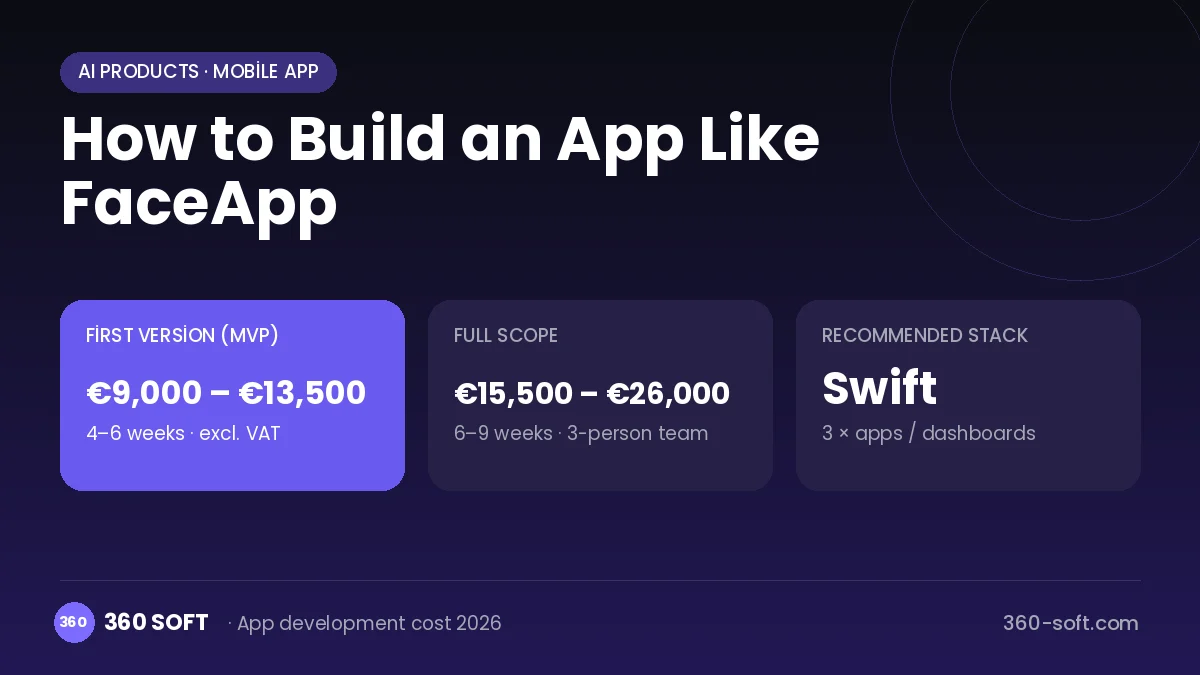
FaceApp went viral by putting a selfie through surprisingly realistic transformations: ageing, de-ageing, adding a smile or changing a hairstyle. What makes the product work is the balance between fun and curiosity: people want to see how they will look in 30 years or with a different hair colour, and they can't resist showing the result to friends. Building something similar requires generative adversarial network (GAN) or diffusion-based models that encode a face into a latent space and modify the desired attribute, plus face alignment and blending the result naturally back into the original photo. The mobile app, scalable inference servers, a filter catalogue, subscription and trial management, and an admin panel that monitors content policies are built together.
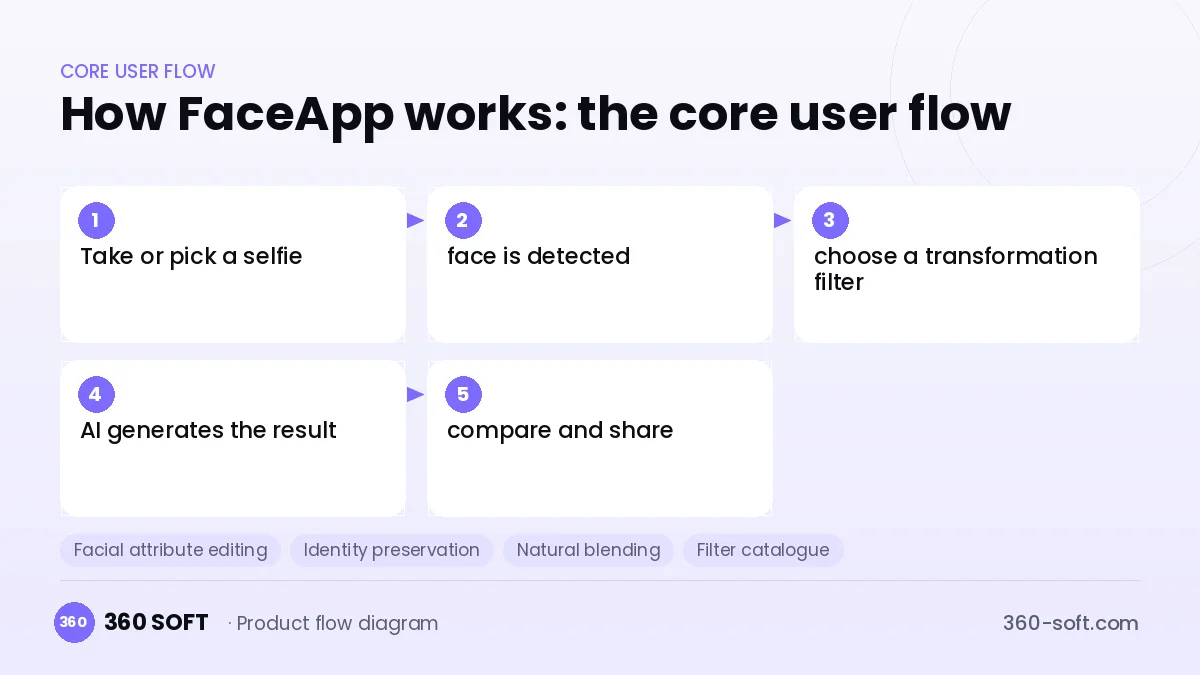
How FaceApp works: the core user flow
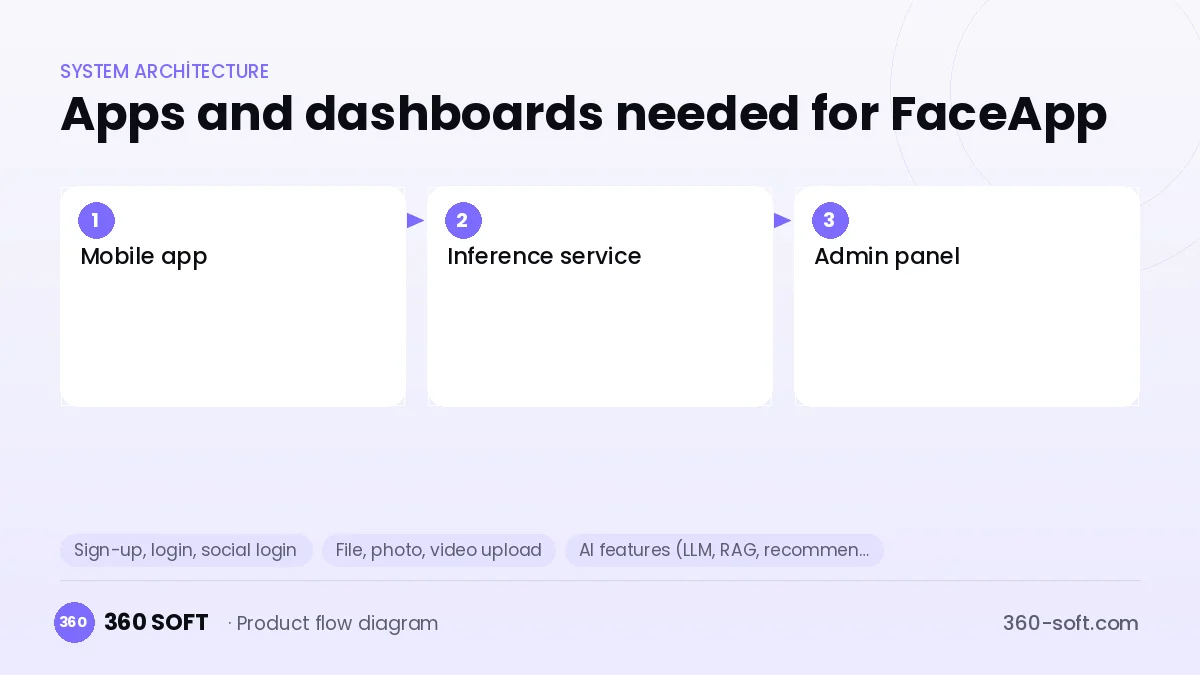
How many apps and dashboards do you need?
Mobile app
The app where users pick a selfie and apply age, hair, expression and makeup filters.
Inference service
A backend that runs face transformation models on GPUs and returns the result quickly.
Admin panel
A panel for managing the filter catalogue, premium locks, model versions and complaints.
Critical features of a product like FaceApp
Facial attribute editing
Attributes such as age, smile, beard, glasses and hair are changed in a controlled way in latent space.
Identity preservation
The person's recognisable features are kept during the transformation, so the result doesn't look like someone else.
Natural blending
The modified face region is placed back into the original photo with matched lighting and colour.
Filter catalogue
New filters are added from the panel without an app update, and seasonal themes can go live on a schedule.
Before/after and collage sharing
The original and the transformed version can be shared side by side or with an animated transition.
Privacy controls
Users can delete their uploaded photos, and copies on the server are cleaned up automatically after a short time.
What goes into the first version, what comes later
First version (MVP)
- Face detection and alignment
- Ageing, de-ageing and smile filters
- Fast GPU inference service
- Before/after sharing
- Subscription with premium filters
Later releases
- Hairstyle and colour changes
- Face transformation on video
- Gender and style transformation filters
- Support for multiple faces and group photos
Modules and how the budget is calculated
The budget is calculated with 360 SOFT’s pricing model from the modules below, about 15 screens and the project’s complexity: roughly 58 person-days for the full scope and 35 person-days for the first version. Every module you drop lowers the budget directly.
| Module | Phase |
|---|---|
| Sign-up, login, social login | First version |
| File, photo, video upload | First version |
| AI features (LLM, RAG, recommendations) | Later release |
| Subscriptions and recurring billing | First version |
| Online payments (Stripe / PSP) | First version |
| Admin dashboard | First version |
| GDPR and security hardening | First version |
| Push notifications | First version |
| Reporting and analytics | Later release |
Hosting, SMS, map APIs, app store accounts and payment-provider fees are separate items. Maintenance and improvements (optional): €200 / month. We send a fixed written price within 24 hours after a free discovery call.
The hard parts
Realism and speed
Getting a result in a few seconds that doesn't look artificial takes model optimisation and servers close to your users.
Data privacy perception
Where face photos are processed is a sensitive topic for users; a transparent privacy policy and GDPR compliance are critical for trust.
Risk of misuse
Filter restrictions, watermarks and a reporting mechanism should be planned against misleading content made with someone else's photo.
Business model
Freemium subscriptions are the standard in face transformation apps: a few basic filters stay free and watermarked, while premium members get all filters, high resolution and watermark-free output. Rewarded ads for unlocking a single filter and seasonal filter packs add useful variety to revenue for free users.
Get a free quote for your project
Let us scope it together and send a fixed written quote within 24 hours. NDA on request; you own the source code.
Choosing a company to build an app like FaceApp
Most people searching “build an app like faceapp” are really looking for a reliable app development company. When comparing quotes, check four things:
- Can you try similar products they have shipped, in the stores or live?
- Are the source code, design files, servers and store accounts transferred to you by contract?
- Do they show a working demo every two weeks, with written scope and acceptance criteria?
- Are maintenance, scaling and GDPR/security costs written into the quote?
Copyright and trademarks
A business model and features are generally not protected on their own, but the FaceApp name, logo, interface design, content and source code are. That is why we build a product with similar functionality but your own brand, design and code. This is not legal advice; we recommend a trademark search before launch.
Frequently asked questions
How long does it take to build an app like FaceApp?
A first version with a few basic filters can be set up on open-source models in a few months. Improving realism requires extra time for model training and data preparation.
Should processing happen on the device or on the server?
Heavy generative models usually run on the server, while simple filters can run on the device. A hybrid approach reduces both cost and privacy concerns.
Are there copyright or trademark issues?
The face transformation business model is free to use; the name, logo, interface and code cannot be copied. Promotions using celebrities' faces also carry personality-rights risk. This information is not legal advice.
What should I look for when choosing an AI app development company?
Look for experience in generative model training, inference optimisation and store privacy processes. It matters that they can present a plan that calculates server cost per user.