Mobile appHealth, fitness & wellness
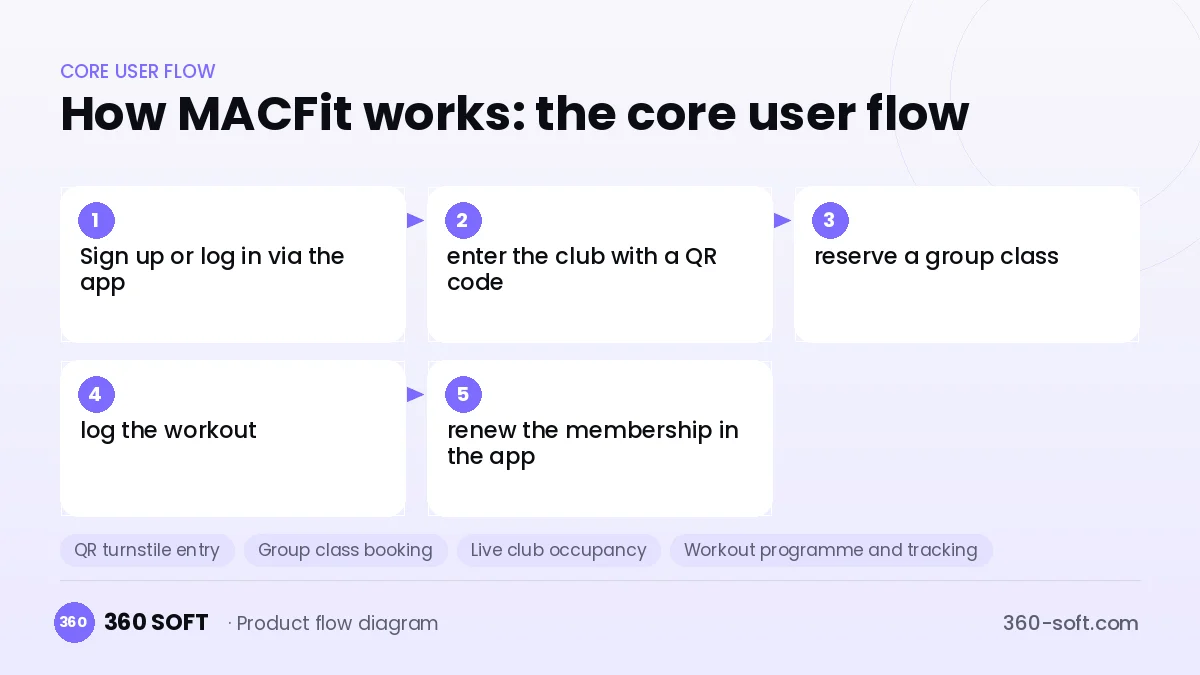
Apps from gym chains such as MACFit, a large Turkish fitness chain, move membership from the club door into the pocket. Members pass the turnstile with a QR code on their phone, reserve group classes, check how busy the club is and track their workouts. For the chain, the app is a channel that increases member loyalty and makes renewal easier, and it opens the door to personal training sales.
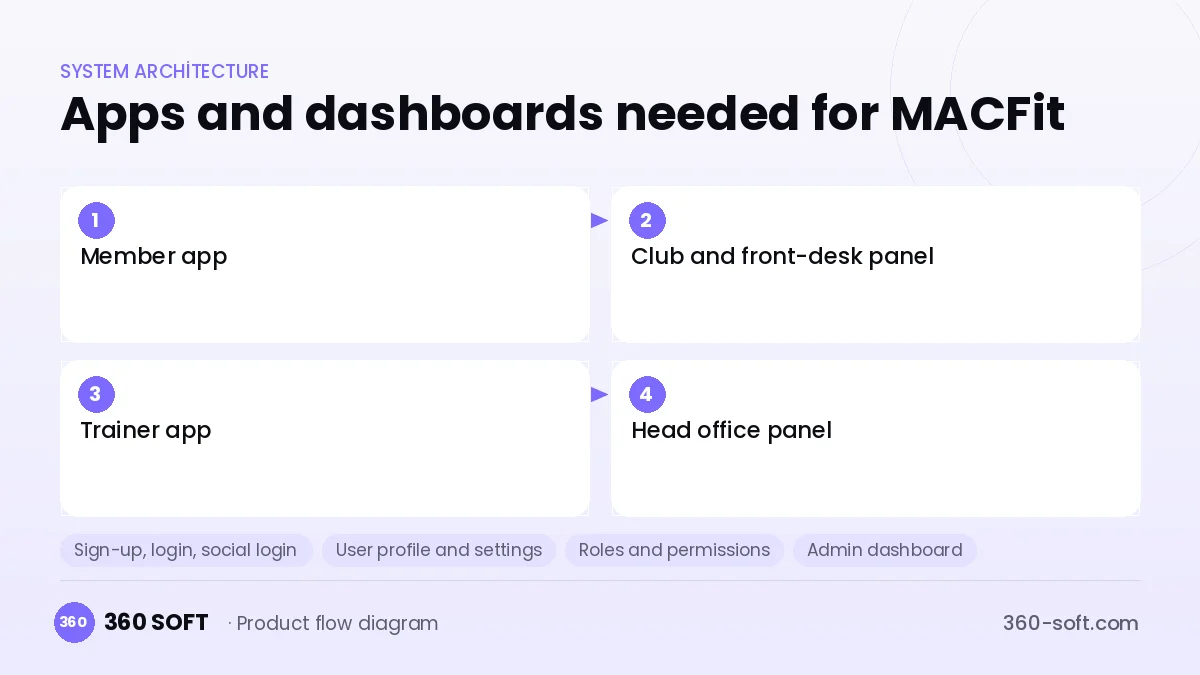
Building something similar takes a member app, a club and front-desk panel, a central membership management system and turnstile integration. A multi-branch structure, branch-level class schedules, capacity limits and live occupancy data are the core modules. For online membership sales and renewal, a payment stack such as Stripe or Adyen should be set up, along with e-invoicing integration for sales.
How MACFit works: the core user flow
How many apps and dashboards do you need?
Member app
The app where members enter by QR, book classes, track their workouts and manage their membership.
Club and front-desk panel
The panel where branch staff manage entries, class capacities, member requests and sales.
Trainer app
The interface where group class instructors and personal trainers manage class lists, attendance and client programmes.
Head office panel
The central panel showing membership, revenue, occupancy and campaign reports for all branches.
Critical features of a product like MACFit
QR turnstile entry
Members pass the turnstile with a dynamic QR code in the app, refreshed at intervals so it cannot be copied.
Group class booking
Spots are reserved from the branch's class schedule, and a waiting list kicks in when a class is full.
Live club occupancy
Entry and exit data shows how busy a branch is, so members can choose a quiet time.
Workout programme and tracking
Programmes assigned by a trainer are shown with exercise videos, and sets and weights are logged.
Online membership sales and renewal
Packages are bought, renewed or upgraded in the app, and freeze requests are made there too.
Body analysis tracking
Measurements from in-club body analysis devices are passed to the member's profile and changes are charted.
What goes into the first version, what comes later
First version (MVP)
- Member sign-in and digital membership card
- QR turnstile entry
- Group class schedule and booking
- Branch information and live occupancy
- Club and front-desk panel
Later releases
- Online membership sales and renewal
- Workout programme and exercise videos
- Personal trainer session sales
- Body analysis device integration
Modules and how the budget is calculated
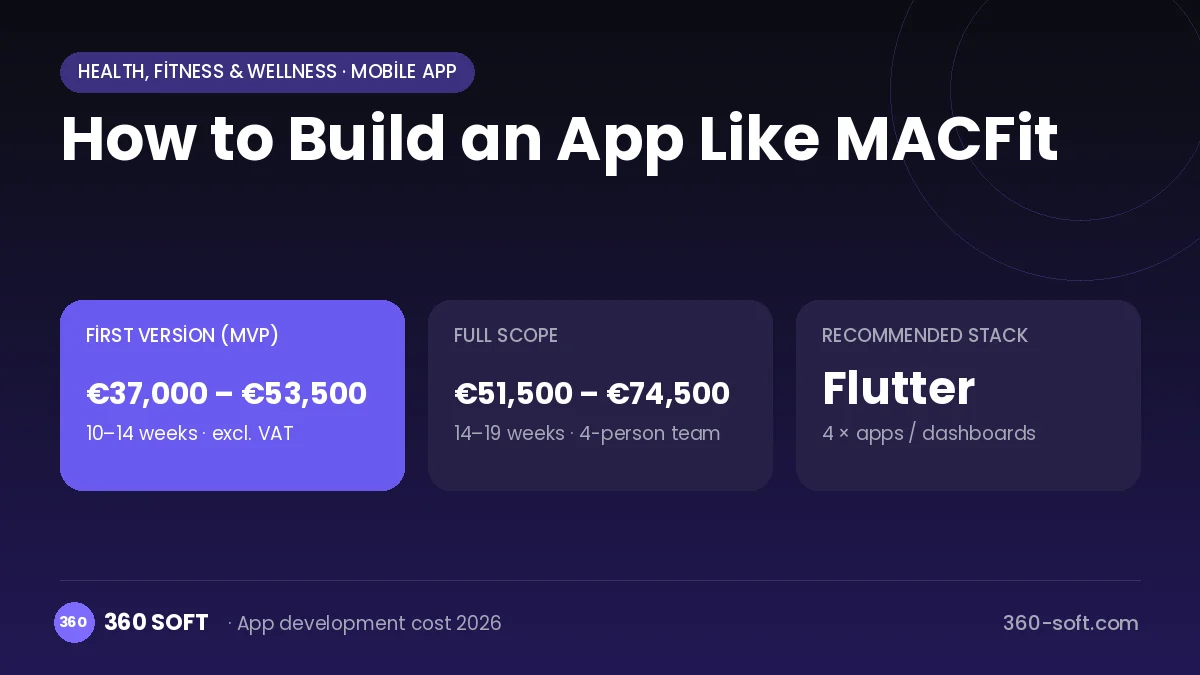
The budget is calculated with 360 SOFT’s pricing model from the modules below, about 30 screens and the project’s complexity: roughly 197 person-days for the full scope and 142 person-days for the first version. Every module you drop lowers the budget directly.
| Module | Phase |
|---|---|
| Sign-up, login, social login | First version |
| User profile and settings | First version |
| Roles and permissions | First version |
| Admin dashboard | First version |
| Subscriptions and recurring billing | First version |
| Online payments (Stripe / PSP) | First version |
| Booking / reservations | First version |
| Barcode / RFID / handheld | First version |
| IoT device and sensor integration | Later release |
| Video / voice calls | First version |
| Push notifications | First version |
| Reporting and analytics | First version |
| E-invoicing | First version |
| Maps, location, routing | First version |
Hosting, SMS, map APIs, app store accounts and payment-provider fees are separate items. Maintenance and improvements (optional): €650 / month. We send a fixed written price within 24 hours after a free discovery call.
The hard parts
Turnstile and hardware integration
The different makes of turnstiles, card readers and analysis devices across branches each need their own integration.
Connecting to the existing membership system
Most chains have a legacy membership system, and two-way operation between the app and that system is critical.
Peak-hour performance
In the evening, thousands of members sign in and book classes at once, and the system must not lag under that load.
Business model
In a chain app the main revenue is membership sales, and the app raises turnover by making online sales, renewals and package upgrades easier. Personal training sessions, group class packs, nutrition programmes and in-club product sales are extra revenue lines. The app can also serve as a campaign channel for sponsor brands.
Get a free quote for your project
Let us scope it together and send a fixed written quote within 24 hours. NDA on request; you own the source code.
Choosing a company to build an app like MACFit
Most people searching “build a gym app like macfit” are really looking for a reliable app development company. When comparing quotes, check four things:
- Can you try similar products they have shipped, in the stores or live?
- Are the source code, design files, servers and store accounts transferred to you by contract?
- Do they show a working demo every two weeks, with written scope and acceptance criteria?
- Are maintenance, scaling and GDPR/security costs written into the quote?
Copyright and trademarks
A business model and features are generally not protected on their own, but the MACFit name, logo, interface design, content and source code are. That is why we build a product with similar functionality but your own brand, design and code. This is not legal advice; we recommend a trademark search before launch.
Frequently asked questions
How long does it take to build an app like MACFit?
A first version with a digital membership card, QR entry and class booking can be ready in a few months. Turnstile and existing membership system integrations can extend the timeline depending on branch infrastructure.
Is it needed for a single gym too?
For one gym, the member app from ready-made gym management software is often enough. For multi-branch chains, a branded custom app offers more flexibility.
Will there be copyright or trademark issues?
The gym member app business model is free to use, but the name, logo, design, content and code cannot be copied. This is not legal advice.
What should I look for when choosing a company to build a gym app?
Ask about turnstile and hardware integration, subscription billing and multi-branch system experience. Peak-hour load tests should be part of the delivery criteria.