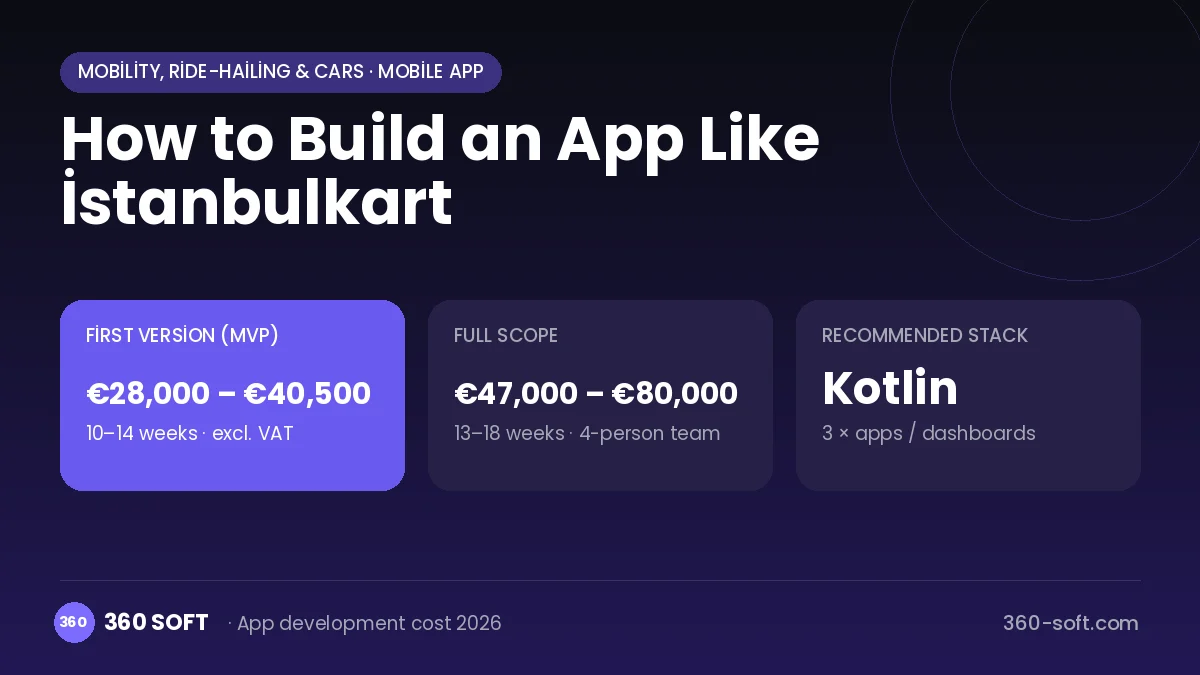
Mobile appMobility, ride-hailing & carsOriginal by BELBİM
İstanbulkart is Istanbul's electronic transit card, and its app turns it into a wallet you can manage from your phone. Users top up their card, see their spending, block a lost card and in some cases board with a QR code. Its value comes from removing ticket office queues in a system handling millions of daily journeys and making urban transport fully cashless, fast and traceable.
A similar transit card app is not a standalone piece of mobile software; it works together with the card system, gate and validator infrastructure and a payment institution. The mobile app, a card management backend, balance reconciliation and an agency admin panel are developed. Because there is an e-money or payment services dimension, licensing requirements from the financial regulator (such as an EMI licence under PSD2 in Europe) or the use of a licensed payment institution's infrastructure must be assessed.
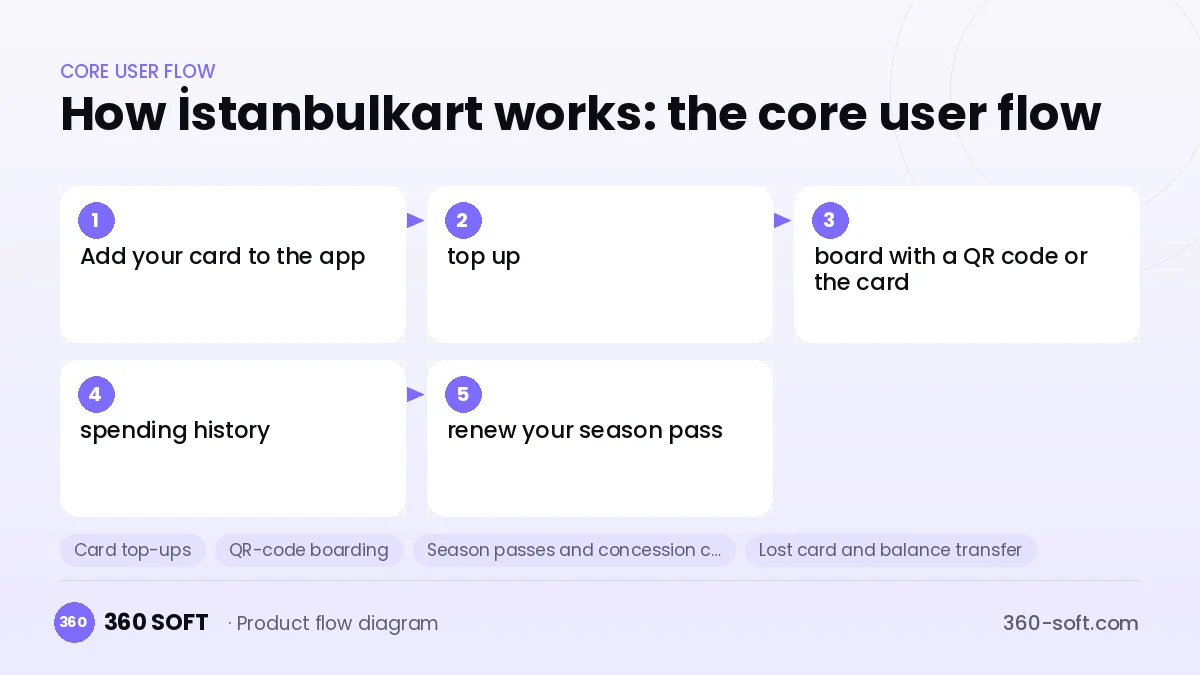
How İstanbulkart works: the core user flow
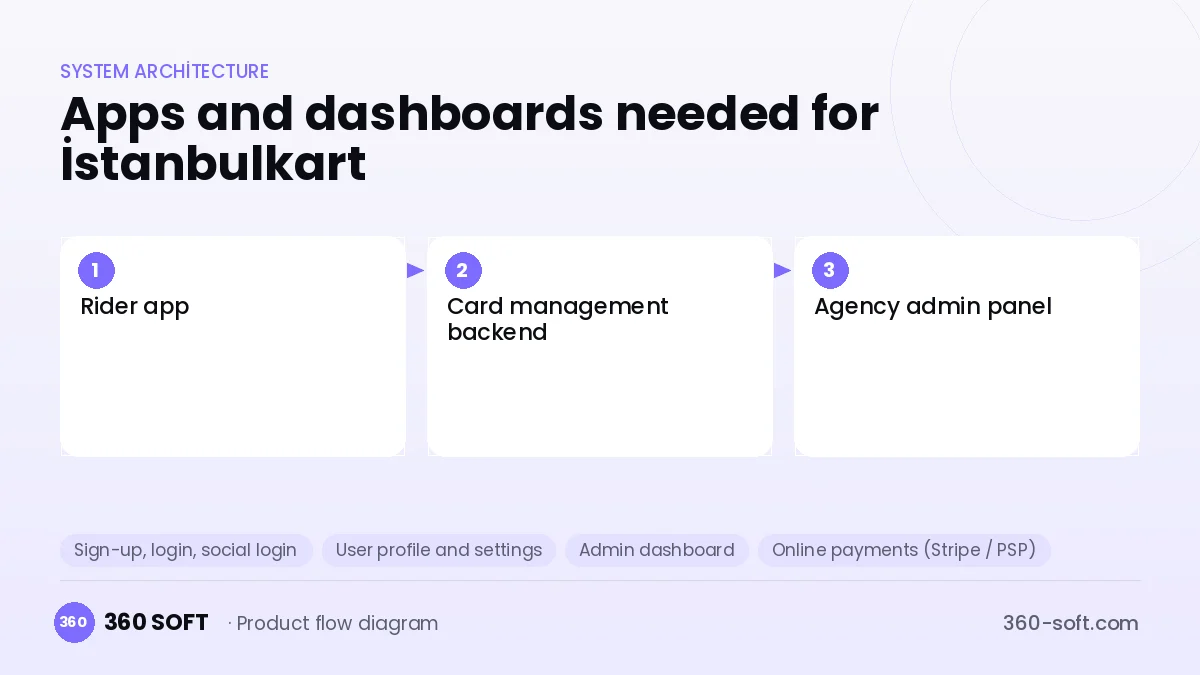
How many apps and dashboards do you need?
Rider app
Users add cards, top up, view their spending history and board with a QR code.
Card management backend
The system that handles card balances, transactions from validators and reconciliation.
Agency admin panel
The panel for managing fares, concession card approvals, complaints and reports.
Critical features of a product like İstanbulkart
Card top-ups
Topping up a saved card, or someone else's card by its number, via card payment.
QR-code boarding
A dynamic, time-limited QR code that validators can read, with secure verification for offline situations.
Season passes and concession cards
Applications for concession cards for students, teachers or seniors, with a document approval process.
Lost card and balance transfer
Blocking a lost card and moving its balance to a new one.
Balance check via NFC
Reading the balance and recent transactions by tapping the card on NFC-enabled phones.
Top-up point map
Shows retailers, top-up machines and service centres on a map.
What goes into the first version, what comes later
First version (MVP)
- User sign-up and adding a card
- Top-ups via card payment
- Viewing balance and spending history
- Reporting and blocking a lost card
- Agency panel and transaction reconciliation reports
Later releases
- Boarding with a dynamic QR code
- Concession card applications and document approval
- Balance reading via NFC
- Payments for other services such as parking, bikes and ferries
Modules and how the budget is calculated
The budget is calculated with 360 SOFT’s pricing model from the modules below, about 24 screens and the project’s complexity: roughly 180 person-days for the full scope and 107 person-days for the first version. Every module you drop lowers the budget directly.
| Module | Phase |
|---|---|
| Sign-up, login, social login | First version |
| User profile and settings | First version |
| Admin dashboard | First version |
| Online payments (Stripe / PSP) | First version |
| Barcode / RFID / handheld | Later release |
| Maps, location, routing | First version |
| Push notifications | First version |
| Email / SMS notifications | First version |
| Offline mode and sync | First version |
| Reporting and analytics | Later release |
| GDPR and security hardening | First version |
| Third-party API integration | First version |
Hosting, SMS, map APIs, app store accounts and payment-provider fees are separate items. Maintenance and improvements (optional): €600 / month. We send a fixed written price within 24 hours after a free discovery call.
The hard parts
Licensing and regulation
Holding balances and providing payment services can fall under e-money regulation; a licence from the financial regulator or a licensed payment institution's infrastructure is required.
Validator integration
Because gates and on-board readers must work offline, delayed synchronisation of balance updates is unavoidable.
Security and fraud
Strong safeguards are needed against QR code copying, top-ups with stolen cards and account takeover attempts.
Business model
Revenue for this kind of system usually comes from the institutional setup: a service fee from the transit operator, small transaction fees on top-ups and payment institution income on stored balances. Partner promotions in the app, wallet services expanding into other city payments and card personalisation fees can also bring in extra revenue.
Get a free quote for your project
Let us scope it together and send a fixed written quote within 24 hours. NDA on request; you own the source code.
Choosing a company to build an app like İstanbulkart
Most people searching “build an app like istanbulkart” are really looking for a reliable app development company. When comparing quotes, check four things:
- Can you try similar products they have shipped, in the stores or live?
- Are the source code, design files, servers and store accounts transferred to you by contract?
- Do they show a working demo every two weeks, with written scope and acceptance criteria?
- Are maintenance, scaling and GDPR/security costs written into the quote?
Copyright and trademarks
A business model and features are generally not protected on their own, but the İstanbulkart name, logo, interface design, content and source code are. That is why we build a product with similar functionality but your own brand, design and code. This is not legal advice; we recommend a trademark search before launch.
Frequently asked questions
How long does it take to build an app like İstanbulkart?
The mobile app itself can be developed in a few months, but integrations with the card system, validators and payment institution, plus security testing, are what really set the timeline.
Is a licence required?
Holding user balances and accepting payments may be subject to e-money and payment services regulation. You need a licence from the financial regulator or must use a licensed payment institution's infrastructure; this information is not legal advice.
Are there copyright or trademark issues?
The idea of a transit card app is free to use; the İstanbulkart name, logo, design and system may not be copied.
Can this be built for closed environments such as campuses or residential complexes?
Yes; a similar card and QR wallet can be built with a leaner scope for closed-loop systems such as campus shuttles, canteens or car parks. Using licensed infrastructure for payments is still recommended.