SaaS / business softwareFintech & paymentsOriginal by Stripe
What made Stripe a developer favourite is that it makes accepting online payments possible in a few lines of code. A clean API, detailed documentation, a realistic test environment and ready-made payment components let a startup begin taking payments the same day. Over time, products such as subscription billing, marketplace payments, fraud prevention and invoicing turned the payment infrastructure into a financial operating system for internet businesses.
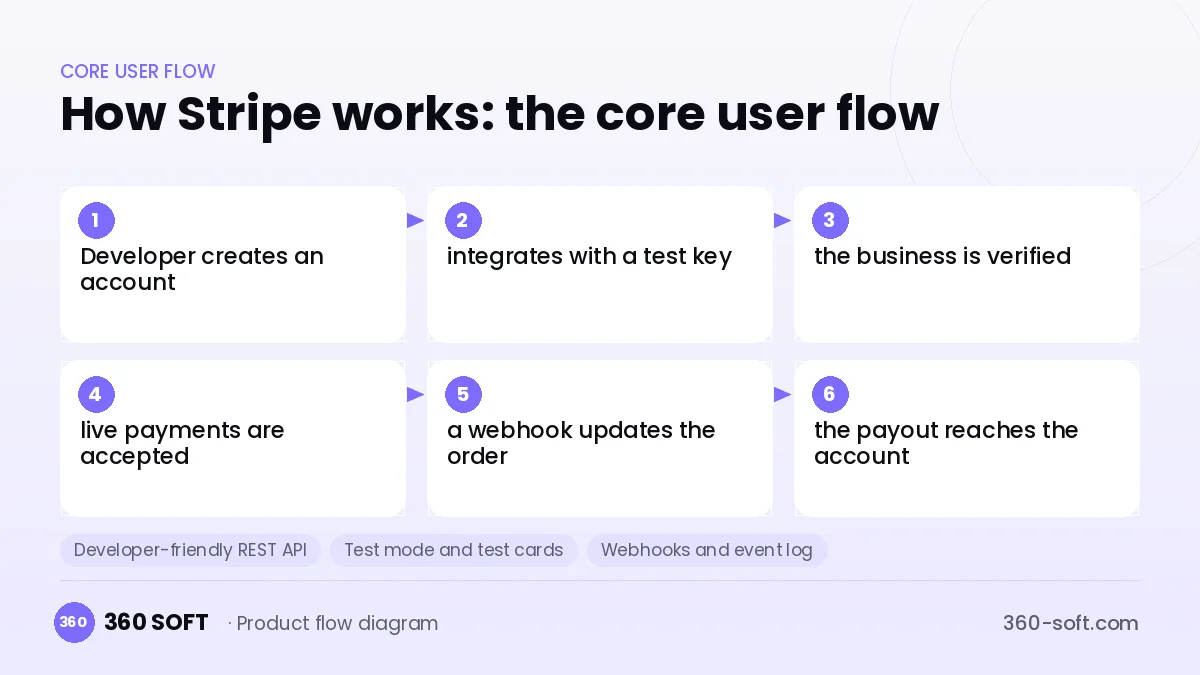
Building something similar means building a payment institution and a developer platform together. Collecting funds on someone else's behalf needs a payment institution licence from the regulator; without one, a value-added software layer can be built on top of a licensed institution. Technically you need a tokenised, PCI DSS-compliant card vault, connections to banks and card schemes, an idempotent REST API, a webhook system, a test mode, subscription and marketplace engines and a comprehensive business dashboard.
How Stripe works: the core user flow
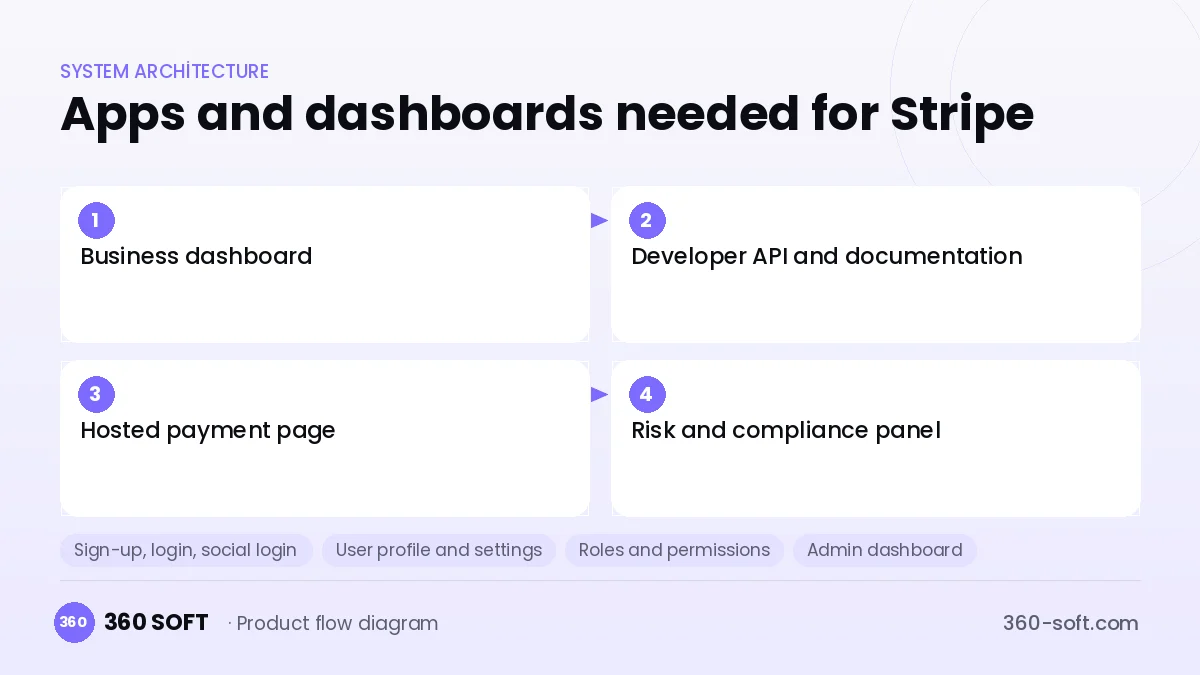
How many apps and dashboards do you need?
Business dashboard
Businesses track payments, refunds, subscriptions, disputes and payouts, and download reports.
Developer API and documentation
Developers integrate with API keys, SDKs, a test environment and webhook logs.
Hosted payment page
Buyers pay securely on a business-branded, mobile-friendly page with 3D Secure support.
Risk and compliance panel
The platform team manages business approvals, risky transactions and legal obligations.
Critical features of a product like Stripe
Developer-friendly REST API
A consistent resource model, idempotency keys and a versioned API keep integration easy and backward compatible.
Test mode and test cards
In a test environment fully separate from live, successful, declined and disputed scenarios are tried with test cards.
Webhooks and event log
Every payment event reaches the business through a signed webhook; failed deliveries are retried automatically and monitored in the dashboard.
Subscriptions and recurring billing
Regular collection and failed-payment recovery are handled with plans, free trials, tiered pricing and proration.
Marketplace payments and split payouts
Platforms split a single payment among several sellers and manage seller onboarding and payouts through the API.
Machine learning risk engine
Each payment is scored instantly using network-wide transaction data, and businesses can add their own rule set.
What goes into the first version, what comes later
First version (MVP)
- Card payment API, tokenisation and 3D Secure
- Test mode, API keys and documentation
- A webhook system and event log
- Business dashboard: payments, refunds, payout report
- Digital business application and risk checks
Later releases
- A subscription and recurring billing product
- Split payments for marketplaces
- Ready-made payment components and e-commerce plugins
- E-invoicing integration and financial reporting
Modules and how the budget is calculated
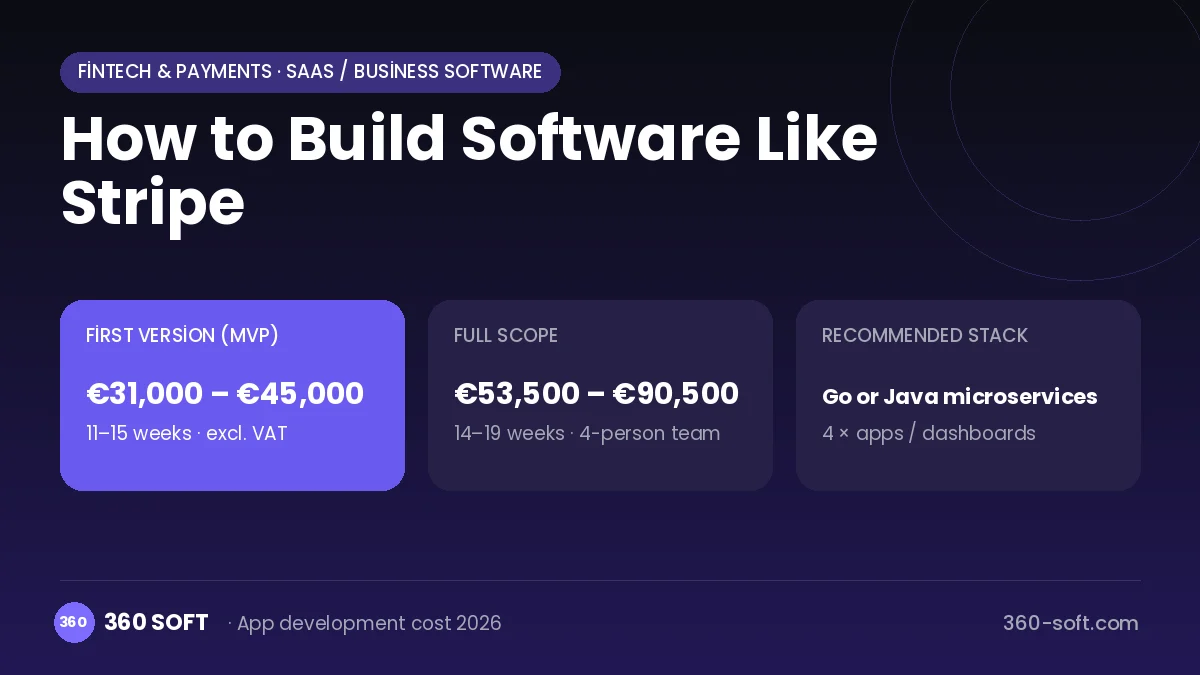
The budget is calculated with 360 SOFT’s pricing model from the modules below, about 36 screens and the project’s complexity: roughly 204 person-days for the full scope and 119 person-days for the first version. Every module you drop lowers the budget directly.
| Module | Phase |
|---|---|
| Sign-up, login, social login | First version |
| User profile and settings | First version |
| Roles and permissions | First version |
| Admin dashboard | First version |
| Online payments (Stripe / PSP) | First version |
| Subscriptions and recurring billing | First version |
| Email / SMS notifications | First version |
| Reporting and analytics | Later release |
| Multi-language | First version |
| GDPR and security hardening | First version |
| Third-party API integration | First version |
| E-invoicing | First version |
| Marketplace integration (Amazon, etc.) | Later release |
| AI features (LLM, RAG, recommendations) | Later release |
Hosting, SMS, map APIs, app store accounts and payment-provider fees are separate items. Maintenance and improvements (optional): €700 / month. We send a fixed written price within 24 hours after a free discovery call.
The hard parts
PCI DSS and card security
A system that processes card data needs top-level security certification; the vault, network segregation, HSMs and the audit process must be designed from the start.
Uninterrupted, consistent processing
A minute of downtime in a payment API harms thousands of businesses; a multi-region setup, idempotency and exact reconciliation are needed.
Licensing and merchant risk
The obligations of a payment institution licence are heavy, and letting malicious businesses into the system endangers the whole network.
Business model
Revenue is a percentage plus a fixed fee on every successful transaction, with custom pricing for enterprise customers by volume. Modules such as subscription billing, marketplace payments, an advanced risk product, invoicing and reporting are sold for an extra transaction fee or a monthly price. Currency conversion, instant payout and dispute handling fees are also revenue lines.
Get a free quote for your project
Let us scope it together and send a fixed written quote within 24 hours. NDA on request; you own the source code.
Choosing a company to build an app like Stripe
Most people searching “build software like stripe” are really looking for a reliable app development company. When comparing quotes, check four things:
- Can you try similar products they have shipped, in the stores or live?
- Are the source code, design files, servers and store accounts transferred to you by contract?
- Do they show a working demo every two weeks, with written scope and acceptance criteria?
- Are maintenance, scaling and GDPR/security costs written into the quote?
Copyright and trademarks
A business model and features are generally not protected on their own, but the Stripe name, logo, interface design, content and source code are. That is why we build a product with similar functionality but your own brand, design and code. This is not legal advice; we recommend a trademark search before launch.
Frequently asked questions
How long does it take to build software like Stripe?
The core of a card payment API, test mode and business dashboard can be developed within months. Security certification, bank connections and licensing processes extend the schedule considerably.
Can a payment platform be built without a licence?
Collecting funds on someone else's behalf requires a licence from the regulator. A company without one can build software layers such as subscriptions, reporting or marketplace management on top of a licensed payment institution.
Will there be copyright or trademark issues?
The model of a developer-focused payment API is free to use, but the name, logo, documentation text, design and code cannot be copied. This is general information, not legal advice.
What should I look for in a company that builds payment infrastructure?
Choose a team that has built PCI DSS-compliant systems and has experience in high availability and API design. Be sure to ask how they handle documentation, SDKs and the test environment.