Mobile appEducation & e-learningOriginal by Quizlet
Quizlet spread by digitising old-fashioned flashcards and turning them into different study modes. A student or teacher creates a set of cards, and the same set can be studied in flip, write, matching game and test modes. The millions of ready-made sets created by users being searchable gives the product a strong network effect: a set someone prepared before an exam helps thousands of other students.
Building something similar requires a card set editor, cards with images and audio, several study modes, spaced repetition and mastery tracking, set search and sharing, and a live in-class game mode. Alongside the mobile and web apps, you set up class management for teachers, content moderation, subscription and ad infrastructure. Automatically generating cards and tests from lecture notes with AI is now a distinguishing feature.

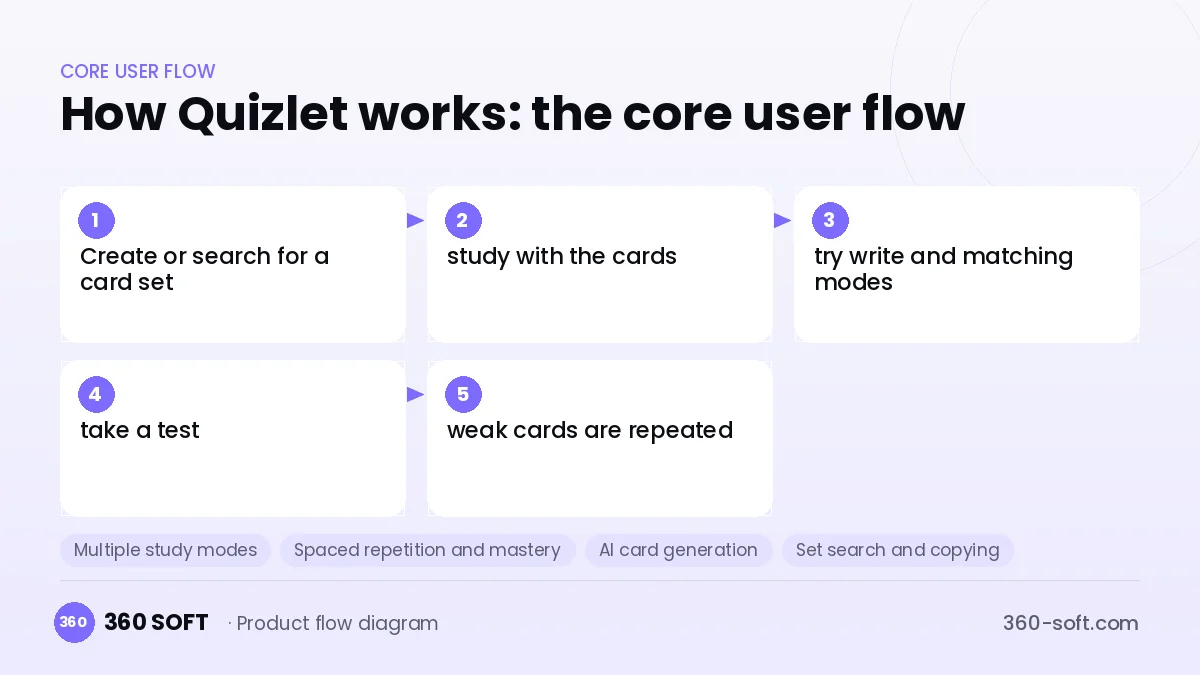
How Quizlet works: the core user flow
How many apps and dashboards do you need?
Learner app (mobile + web)
The app where users create, search for and study card sets in different modes.
Teacher panel
A panel where teachers create classes, share sets, start live games and see progress.
Admin and moderation panel
A panel for managing copyrighted or inappropriate sets, subscriptions and ad settings.

Critical features of a product like Quizlet
Multiple study modes
The same card set can be used automatically in flip, write, matching game and test modes.
Spaced repetition and mastery
How well each card is known is tracked, and cards that cause trouble are shown more often.
AI card generation
Key concepts are extracted from lecture notes, PDFs or photos to build a card set automatically.
Set search and copying
Public sets are searched by topic and school, and users copy sets into their own library.
Live class game
The teacher projects a code on screen, and students compete in teams with the questions in the set.
Image and audio cards
Images, diagrams and text-to-speech pronunciation can be added to cards.
What goes into the first version, what comes later
First version (MVP)
- Creating and editing card sets
- Flip, write and test modes
- Searching and copying public sets
- Basic spaced repetition
- Ad-free premium subscription
Later releases
- Automatic card generation with AI
- Live class game
- Teacher class panel
- Offline study
Modules and how the budget is calculated
The budget is calculated with 360 SOFT’s pricing model from the modules below, about 26 screens and the project’s complexity: roughly 176 person-days for the full scope and 97 person-days for the first version. Every module you drop lowers the budget directly.
| Module | Phase |
|---|---|
| Sign-up, login, social login | First version |
| User profile and settings | First version |
| Roles and permissions | First version |
| Advanced search and filters | First version |
| File, photo, video upload | First version |
| AI features (LLM, RAG, recommendations) | Later release |
| Multiplayer backend (game) | Later release |
| Subscriptions and recurring billing | First version |
| Online payments (Stripe / PSP) | First version |
| Offline mode and sync | First version |
| Reporting and analytics | Later release |
| Admin dashboard | First version |
Hosting, SMS, map APIs, app store accounts and payment-provider fees are separate items. Maintenance and improvements (optional): €600 / month. We send a fixed written price within 24 hours after a free discovery call.
The hard parts
User-generated content moderation
Sets copied from textbooks or leaking exam questions carry copyright and ethical risk; a reporting and takedown process is needed.
Search quality
To surface the highest-quality and most accurate set among millions of similar ones, you need a ranking algorithm.
Synchronisation
Syncing study done offline between mobile and web without conflicts requires careful data design.
Business model
In card-based learning apps, a freemium subscription and ads work together: creating sets and the basic modes are free, while ad-free use, AI features, an advanced test mode and offline access are tied to a premium subscription. A paid plan for teachers and school licences are separate revenue channels.
Get a free quote for your project
Let us scope it together and send a fixed written quote within 24 hours. NDA on request; you own the source code.
Choosing a company to build an app like Quizlet
Most people searching “build an app like quizlet” are really looking for a reliable app development company. When comparing quotes, check four things:
- Can you try similar products they have shipped, in the stores or live?
- Are the source code, design files, servers and store accounts transferred to you by contract?
- Do they show a working demo every two weeks, with written scope and acceptance criteria?
- Are maintenance, scaling and GDPR/security costs written into the quote?
Copyright and trademarks
A business model and features are generally not protected on their own, but the Quizlet name, logo, interface design, content and source code are. That is why we build a product with similar functionality but your own brand, design and code. This is not legal advice; we recommend a trademark search before launch.
Frequently asked questions
How long does it take to build an app like Quizlet?
A first version with a card set editor and basic study modes can be built in a few months. The live game mode and AI card generation are added in later phases.
How many separate applications are needed?
The mobile and web learner apps share the same backend; a teacher panel and an admin panel are added to them.
Are there copyright or trademark issues?
The idea of digital flashcards and study modes is free to use. The name, logo, interface, user sets and code cannot be copied; this information is not legal advice.
What should I look for when choosing an education app development company?
Ask about experience with offline sync, real-time games and search infrastructure. Find out how they plan to moderate user content.