SaaS / business softwareBusiness software & SaaSOriginal by HubSpot
HubSpot turned the inbound approach into software, uniting marketing, sales and customer service around a single customer database. Every touchpoint, from a visitor reading a blog post to filling in a form, from a sales call to a support ticket, shows up on the same record. Entering through a free CRM and buying modules as needs grow is the engine of its growth.
Building something similar means developing several connected products together: a CRM core with contact, company and deal records, a website tracking code, a form and landing page builder, email marketing and automation workflows, a sales pipeline and task management, support tickets, reporting and an integration API. It is critical that they all share one data model.
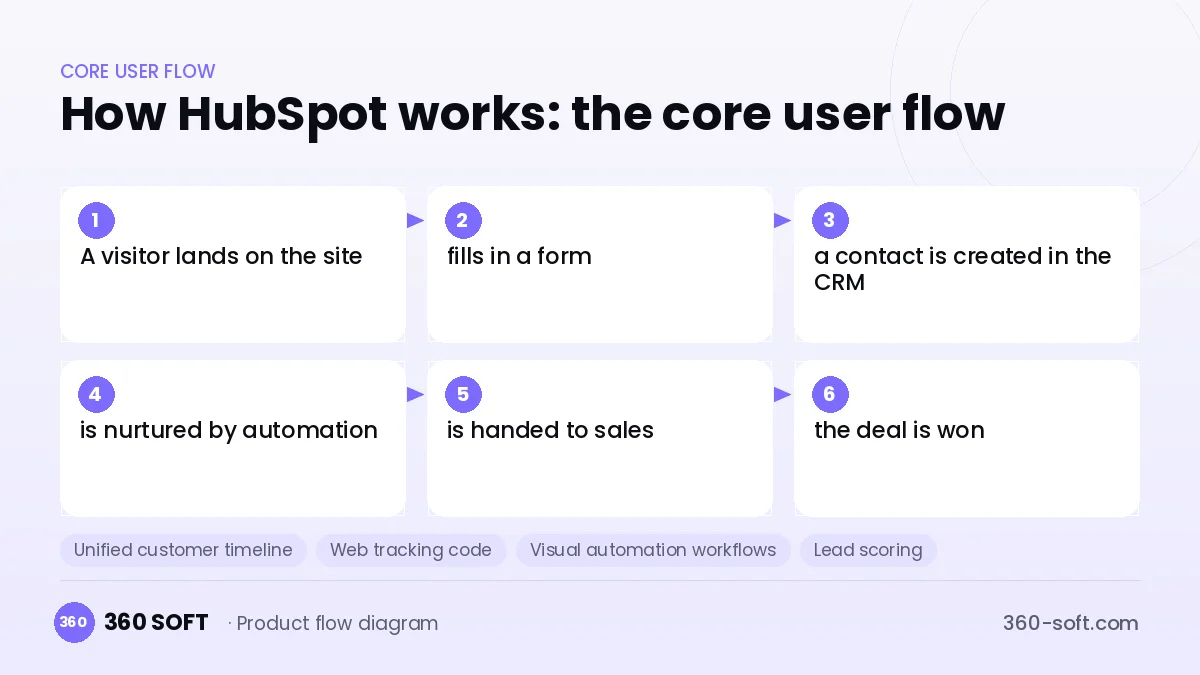
How HubSpot works: the core user flow
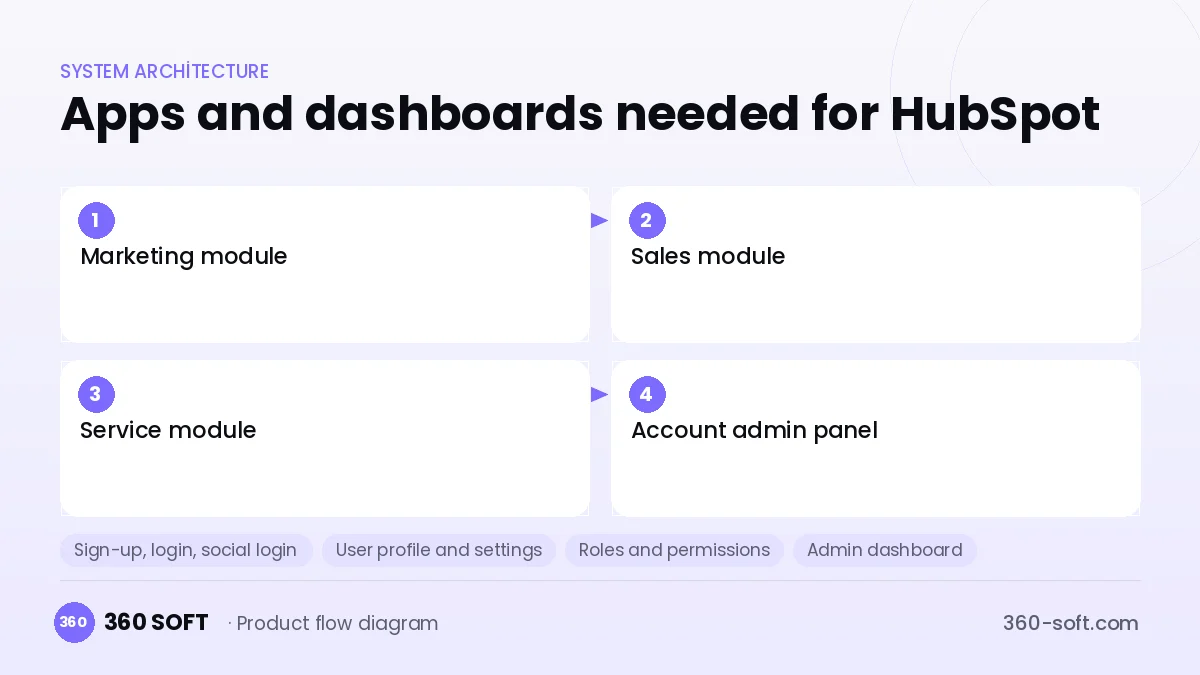
How many apps and dashboards do you need?
Marketing module
The workspace where marketers build forms, landing pages, email campaigns and automation workflows.
Sales module
The screen where a sales rep moves deals along the pipeline and logs calls and tasks.
Service module
The area where the customer service team answers tickets and manages knowledge base articles.
Account admin panel
The place where an admin manages users, seats, integrations and data properties.
Critical features of a product like HubSpot
Unified customer timeline
Every touchpoint, such as page views, email opens, forms, calls and support tickets, appears in chronological order on a single contact record.
Web tracking code
A script added to the site follows anonymous visitors, and when a form is filled in, past sessions are matched to the contact.
Visual automation workflows
Triggers, delays, conditions and branches drive email, task and property-update flows that nurture the contact.
Lead scoring
A score is calculated from demographic data and behaviour, and when a threshold is crossed the record is assigned to the sales team.
Sales pipeline and forecasting
A staged deal board, win probability and an end-of-period revenue forecast report.
Customisable properties
Each business defines its own fields, objects and relationships, and reports are built on them.
What goes into the first version, what comes later
First version (MVP)
- A CRM with contact, company and deal records
- A sales pipeline board and tasks
- Web forms and a website tracking code
- Bulk email sending and basic statistics
- User roles and a dashboard
Later releases
- Visual automation workflows and scoring
- A landing page and blog builder
- Support tickets and a knowledge base
- An integration marketplace, WhatsApp and advanced reporting
Modules and how the budget is calculated
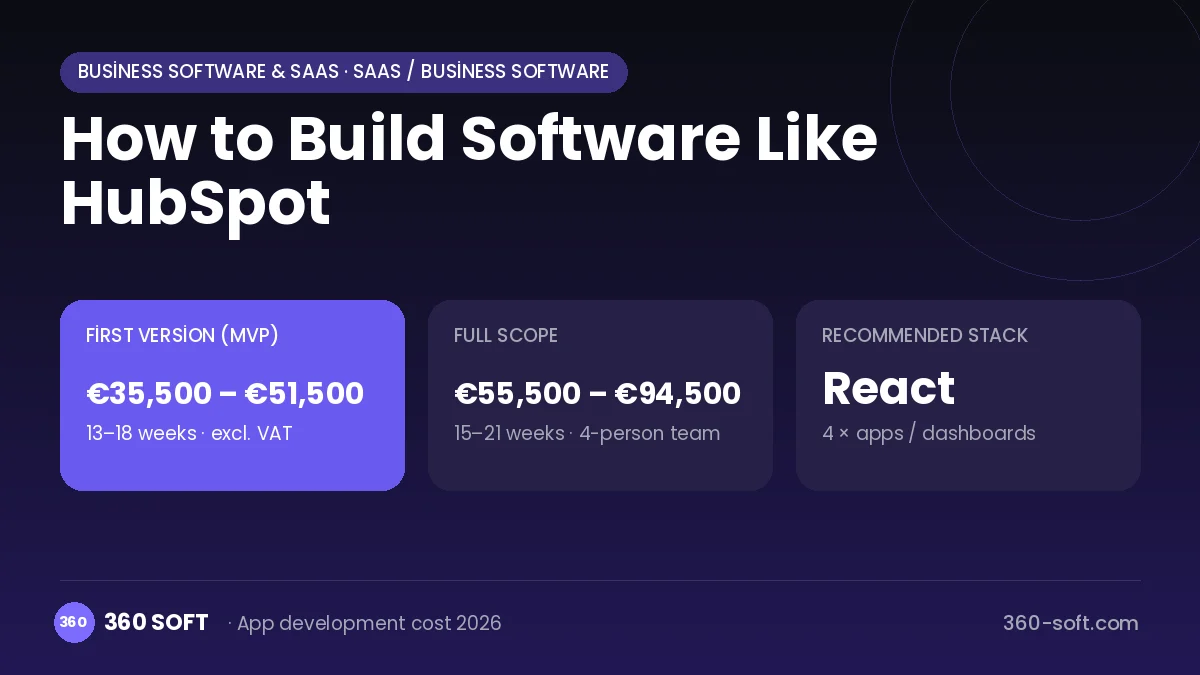
The budget is calculated with 360 SOFT’s pricing model from the modules below, about 38 screens and the project’s complexity: roughly 213 person-days for the full scope and 136 person-days for the first version. Every module you drop lowers the budget directly.
| Module | Phase |
|---|---|
| Sign-up, login, social login | First version |
| User profile and settings | First version |
| Roles and permissions | First version |
| Admin dashboard | First version |
| Subscriptions and recurring billing | First version |
| Reporting and analytics | Later release |
| Email / SMS notifications | First version |
| Advanced search and filters | First version |
| Content management / blog | First version |
| Third-party API integration | First version |
| WhatsApp Business API | First version |
| Real-time messaging | First version |
| AI features (LLM, RAG, recommendations) | Later release |
| GDPR and security hardening | First version |
Hosting, SMS, map APIs, app store accounts and payment-provider fees are separate items. Maintenance and improvements (optional): €700 / month. We send a fixed written price within 24 hours after a free discovery call.
The hard parts
Email deliverability
When thousands of customers send from the same infrastructure, you need reputation management, IP warm-up and spam complaint monitoring.
Event data volume
Web tracking events grow very fast, and matching them to contacts and reporting on them needs a separate analytics data layer.
Consistency across modules
Having the marketing, sales and service modules work on the same object model takes architectural discipline.
Business model
A free CRM wins a broad base; the marketing, sales and service modules are sold separately or as a bundle through tiered subscriptions. In marketing, pricing is mostly tied to the number of marketable contacts, and in sales and service to the number of seats. Onboarding and training services and a partner agency programme create extra revenue.
Get a free quote for your project
Let us scope it together and send a fixed written quote within 24 hours. NDA on request; you own the source code.
Choosing a company to build an app like HubSpot
Most people searching “build software like hubspot” are really looking for a reliable app development company. When comparing quotes, check four things:
- Can you try similar products they have shipped, in the stores or live?
- Are the source code, design files, servers and store accounts transferred to you by contract?
- Do they show a working demo every two weeks, with written scope and acceptance criteria?
- Are maintenance, scaling and GDPR/security costs written into the quote?
Copyright and trademarks
A business model and features are generally not protected on their own, but the HubSpot name, logo, interface design, content and source code are. That is why we build a product with similar functionality but your own brand, design and code. This is not legal advice; we recommend a trademark search before launch.
Frequently asked questions
How long does it take to build software like HubSpot?
A first release with the CRM core, sales pipeline, forms and email sending ships in a few months. Automation, landing pages and the service module should be added in stages.
Should we build all the modules at once?
No. First make one module strong (usually the CRM and sales pipeline) and set up the shared data model soundly. The other modules plug into the same core.
Will there be copyright or trademark problems?
The idea of CRM and marketing automation and the business model are generally free to use; the name, logo, interface design, content and code cannot be copied. This is not legal advice.
What should I look for when choosing a company for this kind of software?
Look for a team with experience in CRM, email infrastructure and analytics data processing. Ask how they will build consent and opt-in handling to meet GDPR and ePrivacy rules.