SaaS / business softwareBooking & travel
A hotel's day is a constant scramble between reservations, check-ins and check-outs, room cleaning, extra charges and invoicing. A good property management system (PMS) brings all of this together on a single room chart screen: reception instantly sees which room is vacant, dirty or out of order, bookings from online channels land without overlaps, and the guest leaves at check-out with one bill summary. To build one you need a front desk and room chart, channel manager integration that syncs availability and rates with OTAs, a housekeeping mobile app, a guest folio, POS and restaurant integration, guest registration reporting where local law requires it, and e-invoicing connections. For multi-property chains, central reporting, revenue management and role-based permissions are also core parts of the SaaS architecture.
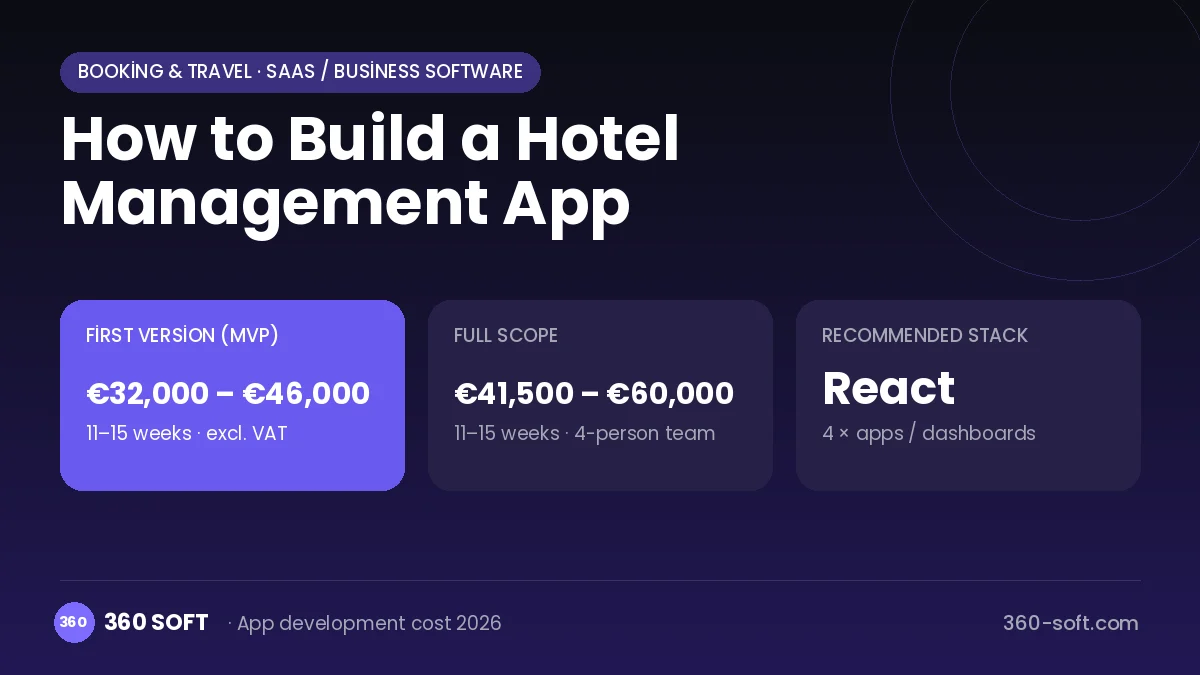
How Hotel management app works: the core user flow
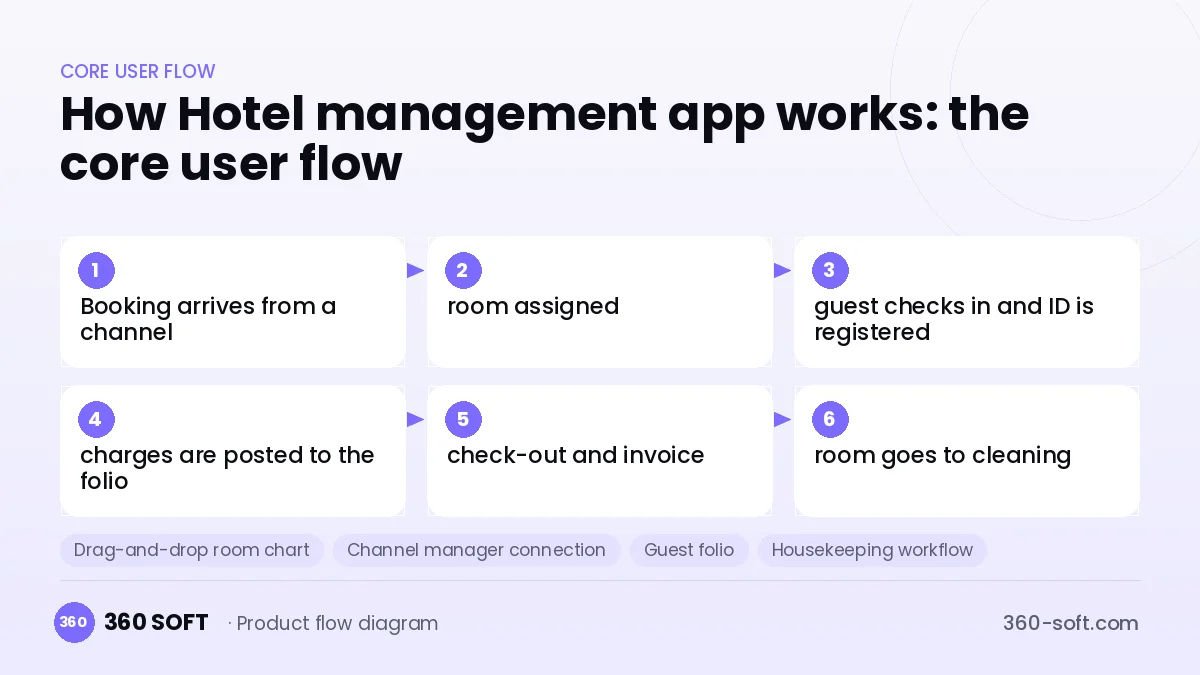
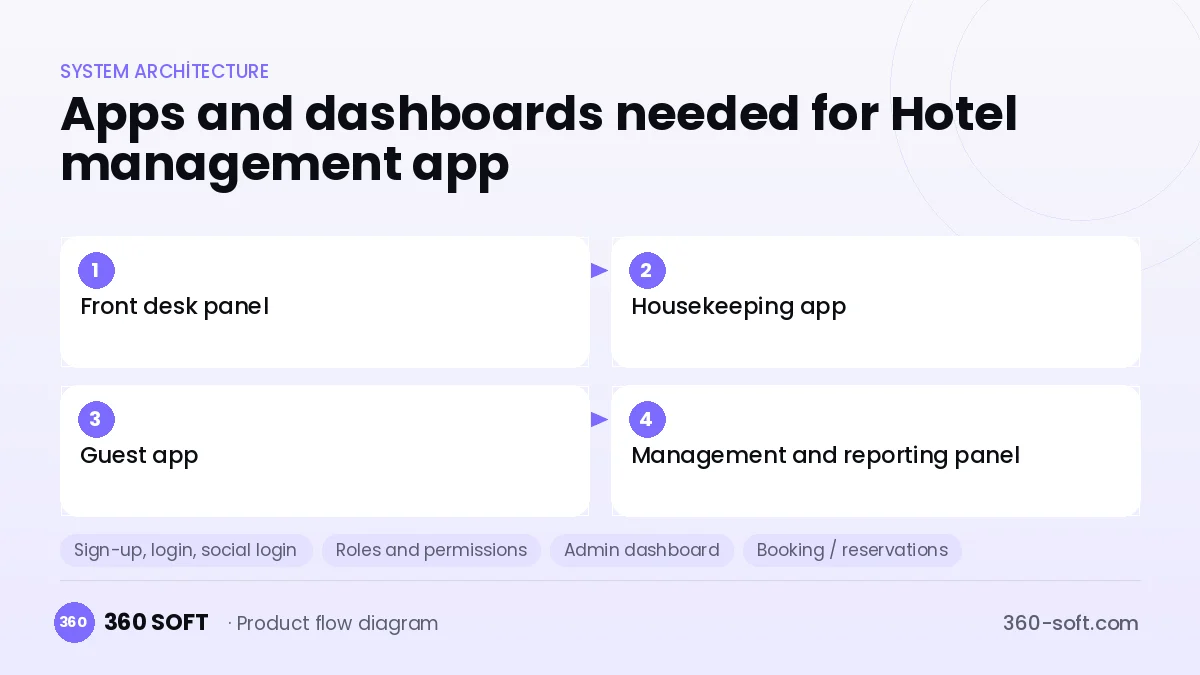
How many apps and dashboards do you need?
Front desk panel
The web application where reception manages the room chart, reservations, check-ins and check-outs, and guest folios.
Housekeeping app
The mobile app where housekeepers see the rooms to clean, update status and report maintenance issues.
Guest app
The web or mobile interface where guests check in online, request room service and see their bill.
Management and reporting panel
The panel that tracks occupancy, average room rate, revenue and staff performance for one or many hotels.
Critical features of a product like Hotel management app
Drag-and-drop room chart
In a calendar view, reservations are moved between rooms and extended, and conflicts are flagged instantly.
Channel manager connection
Availability, rates and restrictions on online travel agencies are updated from one place, and incoming bookings are imported automatically.
Guest folio
Room, minibar, restaurant and spa charges are posted to the room account; split payments and company invoices are supported.
Housekeeping workflow
A checked-out room is automatically marked dirty, assigned to a housekeeper and released for sale after cleaning.
Guest registration and official reporting
Guest ID details are submitted to the authorities where required, and records are stored in line with GDPR rules.
Dynamic pricing and revenue reports
Price suggestions based on occupancy and season are offered, and metrics such as RevPAR and ADR are reported.
What goes into the first version, what comes later
First version (MVP)
- Room type, room and rate definitions
- Room chart and reservation management
- Check-in, check-out and guest folio
- Housekeeping status tracking
- Basic reports and role-based users
Later releases
- Channel manager and OTA integrations
- E-invoicing and guest registration reporting integration
- Restaurant POS and door lock system connection
- Multi-property chain management and dynamic pricing
Modules and how the budget is calculated
The budget is calculated with 360 SOFT’s pricing model from the modules below, about 30 screens and the project’s complexity: roughly 159 person-days for the full scope and 121 person-days for the first version. Every module you drop lowers the budget directly.
| Module | Phase |
|---|---|
| Sign-up, login, social login | First version |
| Roles and permissions | First version |
| Admin dashboard | First version |
| Booking / reservations | First version |
| Online payments (Stripe / PSP) | First version |
| Subscriptions and recurring billing | First version |
| Reporting and analytics | Later release |
| E-invoicing | First version |
| Third-party API integration | First version |
| Email / SMS notifications | First version |
| Offline mode and sync | First version |
| Multi-language | First version |
Hosting, SMS, map APIs, app store accounts and payment-provider fees are separate items. Maintenance and improvements (optional): €550 / month. We send a fixed written price within 24 hours after a free discovery call.
The hard parts
Double-booking risk
If bookings from several channels are not synced within seconds, the same room can be sold twice.
Integration variety
Channel managers, lock systems, POS devices and accounting software each bring their own protocol and maintenance load.
Always-on operation
A hotel is open day and night; an offline mode and a backup plan are needed so reception can keep working even during an internet outage.
Business model
The common model for hotel software is a monthly SaaS subscription priced by number of rooms. A channel manager, an online booking engine, a guest app and advanced reporting can be sold as add-on modules. Setup, data migration and staff training are billed as a one-off service fee, and enterprise licence packages can be prepared for hotel chains.
Get a free quote for your project
Let us scope it together and send a fixed written quote within 24 hours. NDA on request; you own the source code.
Choosing a company to build an app like Hotel management app
Most people searching “build a hotel management app” are really looking for a reliable app development company. When comparing quotes, check four things:
- Can you try similar products they have shipped, in the stores or live?
- Are the source code, design files, servers and store accounts transferred to you by contract?
- Do they show a working demo every two weeks, with written scope and acceptance criteria?
- Are maintenance, scaling and GDPR/security costs written into the quote?
Copyright and trademarks
A business model and features are generally not protected on their own, but the Hotel management app name, logo, interface design, content and source code are. That is why we build a product with similar functionality but your own brand, design and code. This is not legal advice; we recommend a trademark search before launch.
Frequently asked questions
How long does it take to build a hotel management app?
A first version with a room chart, reservations, folio and housekeeping can be developed in a few months. The channel manager and official integrations extend the schedule because each needs its own testing process.
Should it be built for a single hotel or as SaaS?
Custom software for one hotel finishes faster; if you plan to sell to several hotels, a multi-tenant SaaS architecture should be set up from the start.
Off-the-shelf PMS or custom software?
For standard needs, off-the-shelf PMS products give a quick start. Custom development makes sense if you have special workflows, different on-site services or a goal of marketing your own product.
What should I look for when choosing a software company?
Choose a team experienced in booking conflicts, real-time sync and accounting integration. Test how quickly hotel staff can use the panel at peak hours.