Mobile appE-commerce & marketplaces
A successful loyalty programme keeps giving customers the feeling that "the next reward is close". In Starbucks Rewards-style programmes, every purchase earns stars, perks grow as tiers go up, and small surprises such as a birthday treat build a bond. The real gain for the business is turning an anonymous customer into a known one: once you know who buys what and how often, campaigns rest on data instead of guesswork.
To build it you need a customer mobile app, an integration that awards points at the till by QR or barcode, an admin panel with a campaign and rules engine, and optionally a prepaid balance infrastructure. The real work is POS integration; programmes where points are not processed automatically at the till are quickly forgotten. If a prepaid balance or wallet is offered, e-money regulation and cooperation with a licensed provider should be assessed, and GDPR consent flows designed from the start.
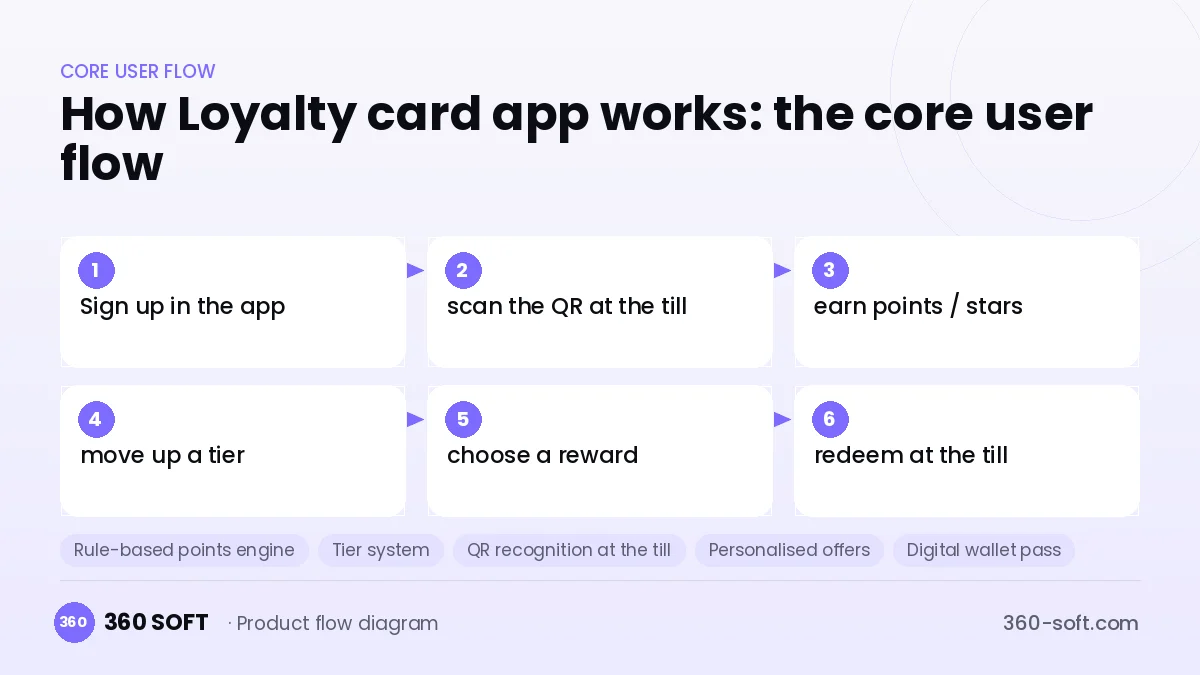
How Loyalty card app works: the core user flow
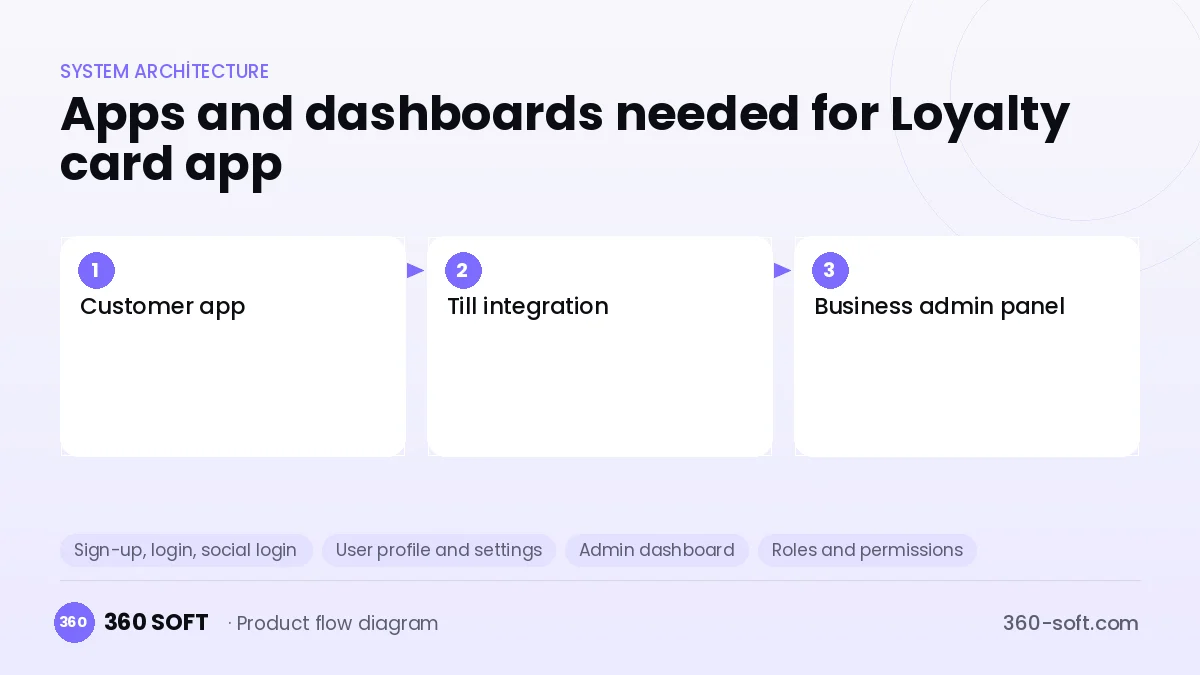
How many apps and dashboards do you need?
Customer app
The app where customers show their digital card and track their points, rewards and campaigns.
Till integration
The POS plug-in or simple cashier screen where the cashier scans the QR to award points and apply rewards.
Business admin panel
The panel where the marketing team manages rules, tiers, campaigns and notifications and follows reports.
Critical features of a product like Loyalty card app
Rule-based points engine
Point multipliers and bonus rules are defined by conditions such as amount, product group, day and time.
Tier system
A customer who reaches a spending threshold moves up a tier; each tier has its own perks and validity period.
QR recognition at the till
A dynamic QR code prevents copying; points are processed and rewards deducted at the till within seconds.
Personalised offers
Segments are built from purchase history, and a win-back offer goes to customers who have not visited for a while.
Digital wallet pass
The loyalty card can be added to Apple Wallet and Google Wallet and shown without opening the app.
Campaign performance analytics
How many visits and how much extra revenue each offer generated is measured against a control group.
What goes into the first version, what comes later
First version (MVP)
- Sign-up, digital card and dynamic QR
- Earning and spending points by amount
- Simple cashier screen or POS plug-in
- Push notifications for campaign announcements
- Admin panel and basic reports
Later releases
- Tier system and personalised offers
- Prepaid balance (on licensed infrastructure)
- Mobile ordering and pickup
- Refer-a-friend and gamified challenges
Modules and how the budget is calculated
The budget is calculated with 360 SOFT’s pricing model from the modules below, about 20 screens and the project’s complexity: roughly 128 person-days for the full scope and 77 person-days for the first version. Every module you drop lowers the budget directly.
| Module | Phase |
|---|---|
| Sign-up, login, social login | First version |
| User profile and settings | First version |
| Admin dashboard | First version |
| Roles and permissions | First version |
| Barcode / RFID / handheld | Later release |
| Push notifications | First version |
| Email / SMS notifications | First version |
| Reporting and analytics | Later release |
| Third-party API integration | First version |
| GDPR and security hardening | First version |
Hosting, SMS, map APIs, app store accounts and payment-provider fees are separate items. Maintenance and improvements (optional): €450 / month. We send a fixed written price within 24 hours after a free discovery call.
The hard parts
POS integration
Every business has different till software; without integration, an extra step for the cashier makes the programme fail.
Fraud and points abuse
Shared accounts, fake receipts and staff-driven point top-ups call for limits and audit rules.
Points liability and regulation
Points issued are a financial liability, and a balance or wallet feature may fall under e-money regulation.
Business model
If you build it for your own brand, the return comes from higher visit frequency and basket size. If you will sell the product to other businesses, a monthly subscription based on locations or active members fits. Extra SMS and notification packs, campaign consultancy and a fee for publishing a branded app are further lines. In shared points programmes, a commission can also be charged to participating brands.
Get a free quote for your project
Let us scope it together and send a fixed written quote within 24 hours. NDA on request; you own the source code.
Choosing a company to build an app like Loyalty card app
Most people searching “build a loyalty card app” are really looking for a reliable app development company. When comparing quotes, check four things:
- Can you try similar products they have shipped, in the stores or live?
- Are the source code, design files, servers and store accounts transferred to you by contract?
- Do they show a working demo every two weeks, with written scope and acceptance criteria?
- Are maintenance, scaling and GDPR/security costs written into the quote?
Copyright and trademarks
A business model and features are generally not protected on their own, but the Loyalty card app name, logo, interface design, content and source code are. That is why we build a product with similar functionality but your own brand, design and code. This is not legal advice; we recommend a trademark search before launch.
Frequently asked questions
How long does it take to build a loyalty card app?
A first release with a digital card, QR points and simple campaigns can go live in a few months. The complexity of POS integration is the biggest factor in the timeline.
How many separate apps are needed?
Three parts are enough: the customer mobile app, a till-side integration or cashier screen, and the business admin panel. If mobile ordering is added, a kitchen display may be needed too.
Do I need a licence to add a prepaid balance?
A wallet where customers load money and spend it can fall under e-money regulation. Using the infrastructure of a licensed payment or e-money institution is the safe route, and legal advice should be sought.
What should I look for when choosing a company to build a loyalty app?
Look for experience with POS and ERP integration, campaign rule engines and GDPR-compliant data handling. Ask how they keep transaction time at the till short.