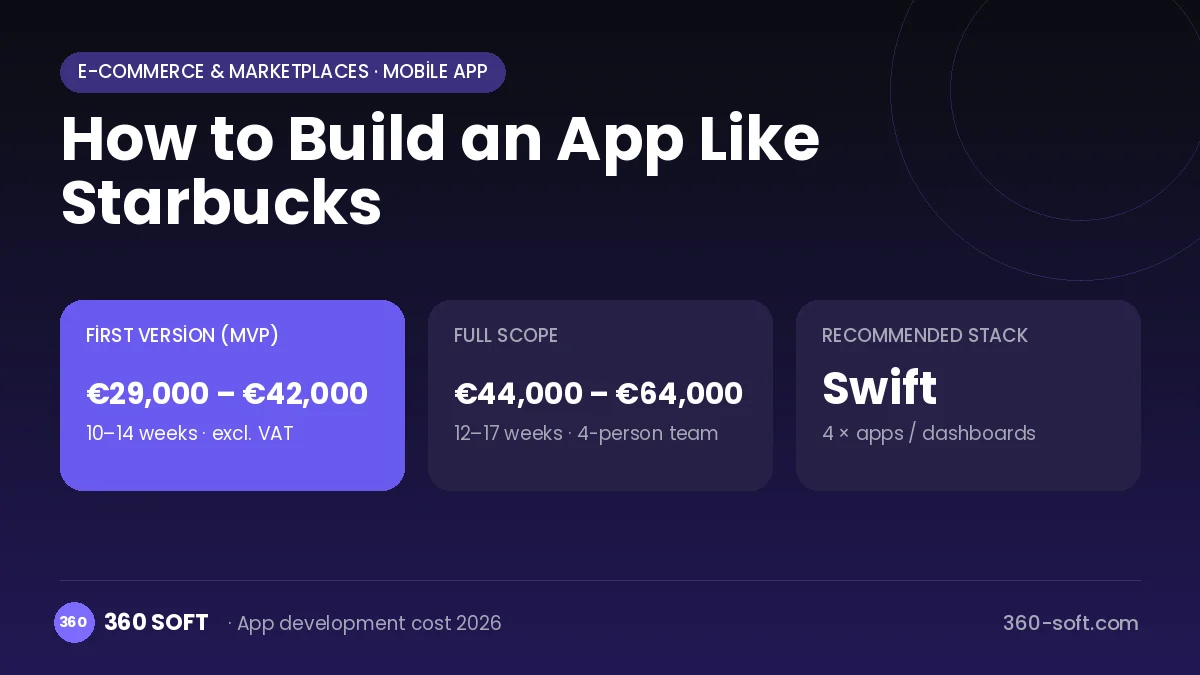
Mobile appE-commerce & marketplacesOriginal by Starbucks
The Starbucks app works less like a coffee chain's digital product and more like a habit machine. Customers order without waiting in line, save their customised drink, pay with their in-app balance and earn stars with every purchase. The closer a reward gets, the more often they visit. A prepaid balance gives the business cash flow, while order data lets campaigns be tailored to each person.
To build something similar you need a customer app, an ordering system integrated with in-store POS and barista screens, a loyalty and campaign engine, a menu service that manages customisation rules and a central admin panel. Getting the order to the right store at the right time and estimating the ready time realistically are the heart of the operation. For the in-app balance, e-money regulation and cooperation with a licensed payment provider should be planned.
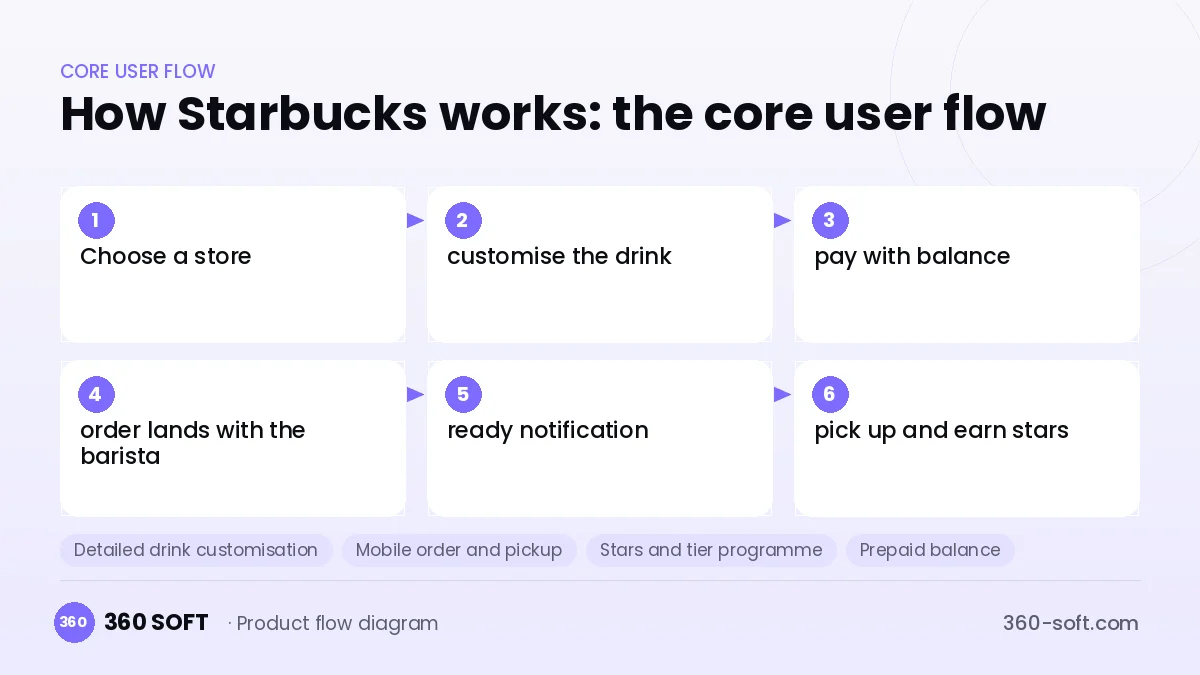
How Starbucks works: the core user flow
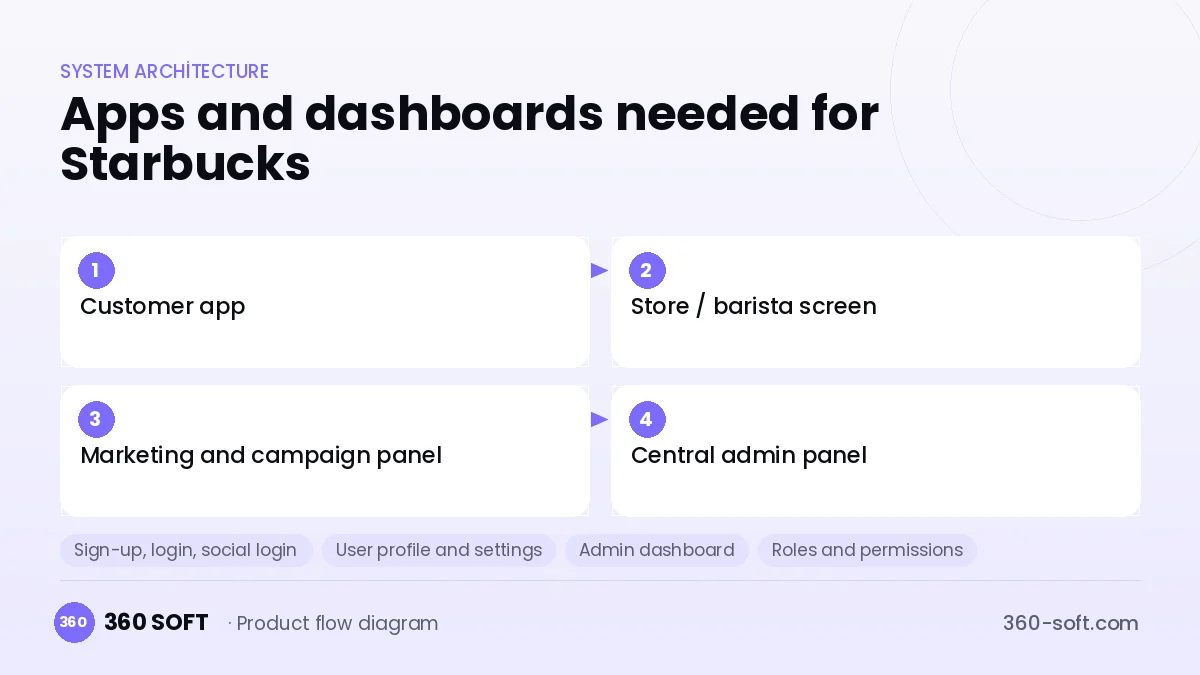
How many apps and dashboards do you need?
Customer app
The app where users browse the menu, customise and order a drink, and manage their balance and stars.
Store / barista screen
The in-store screen where mobile orders queue up and preparation and pickup status are marked.
Marketing and campaign panel
The panel that manages personalised offers, star rules and notification campaigns.
Central admin panel
The panel for managing the menu, prices, store opening hours, sold-out items and reports.
Critical features of a product like Starbucks
Detailed drink customisation
Options such as size, milk type, syrup and shot count are defined by rules, and invalid combinations are blocked.
Mobile order and pickup
The order goes to the selected store, and the ready time is estimated from current load and shown to the user.
Stars and tier programme
Every amount spent earns stars, and stars can be redeemed at different reward levels.
Prepaid balance
Users top up their balance, set up auto-reload and pay with it at the till or in the app.
Personalised offers
Individual challenges such as "visit three times this week for a bonus" are generated from purchase history.
Favourites and reorder
Frequent drinks are saved, and the same order can be placed again at the nearest store with one tap.
What goes into the first version, what comes later
First version (MVP)
- Menu, product customisation and store selection
- Mobile ordering and card payment
- Order queue and ready notification on the store screen
- Earning stars and basic rewards
- Central menu and store management
Later releases
- Prepaid balance and auto-reload
- Personalised challenges and offers
- Sending gift cards
- Drive-through and delivery integration
Modules and how the budget is calculated
The budget is calculated with 360 SOFT’s pricing model from the modules below, about 28 screens and the project’s complexity: roughly 169 person-days for the full scope and 111 person-days for the first version. Every module you drop lowers the budget directly.
| Module | Phase |
|---|---|
| Sign-up, login, social login | First version |
| User profile and settings | First version |
| Admin dashboard | First version |
| Roles and permissions | First version |
| Product / content catalogue | First version |
| Cart and checkout | First version |
| Online payments (Stripe / PSP) | First version |
| Maps, location, routing | First version |
| Push notifications | First version |
| Email / SMS notifications | First version |
| Barcode / RFID / handheld | Later release |
| Reporting and analytics | Later release |
| Third-party API integration | First version |
Hosting, SMS, map APIs, app store accounts and payment-provider fees are separate items. Maintenance and improvements (optional): €550 / month. We send a fixed written price within 24 hours after a free discovery call.
The hard parts
Fit with store operations
Mobile orders compete with the queue at the till; a mechanism is needed to slow order intake when preparation capacity is full.
POS integration
Matching points, balance and order data with the store's till system instantly and without errors is hard.
Balance and regulation
A prepaid balance may be treated as e-money; licensed infrastructure and reconciliation processes are essential.
Business model
The app itself is not a revenue line but a sales channel; the value comes from higher visit frequency, a growing basket and winning back customers who would have given up on the queue. A prepaid balance improves cash flow. Personalised campaigns and add-on suggestions raise the average basket. Gift cards and corporate gifting solutions bring extra sales.
Get a free quote for your project
Let us scope it together and send a fixed written quote within 24 hours. NDA on request; you own the source code.
Choosing a company to build an app like Starbucks
Most people searching “build an app like starbucks” are really looking for a reliable app development company. When comparing quotes, check four things:
- Can you try similar products they have shipped, in the stores or live?
- Are the source code, design files, servers and store accounts transferred to you by contract?
- Do they show a working demo every two weeks, with written scope and acceptance criteria?
- Are maintenance, scaling and GDPR/security costs written into the quote?
Copyright and trademarks
A business model and features are generally not protected on their own, but the Starbucks name, logo, interface design, content and source code are. That is why we build a product with similar functionality but your own brand, design and code. This is not legal advice; we recommend a trademark search before launch.
Frequently asked questions
How long does it take to build an app like Starbucks?
A first release with a menu, customisation, mobile ordering and basic loyalty can go live in a few months. In-store POS integration and the balance feature are what stretch the timeline most.
How many separate apps are needed?
You need a customer app, a barista or order screen in the stores, and a central admin and campaign panel. Integration with the existing till software should be planned as a separate project item.
Will there be copyright or trademark issues?
The mobile ordering and loyalty business model is generally free to use; however, the name, logo, design, product images, copy and code cannot be copied. This is general information, not legal advice.
What should I look for when choosing a company to build an app for a cafe chain?
Look for POS integration, a loyalty engine and experience with high-concurrency ordering. Ask about the pilot process in stores and how the barista screen will be tested.