Web platformEducation & e-learningOriginal by Khan Academy
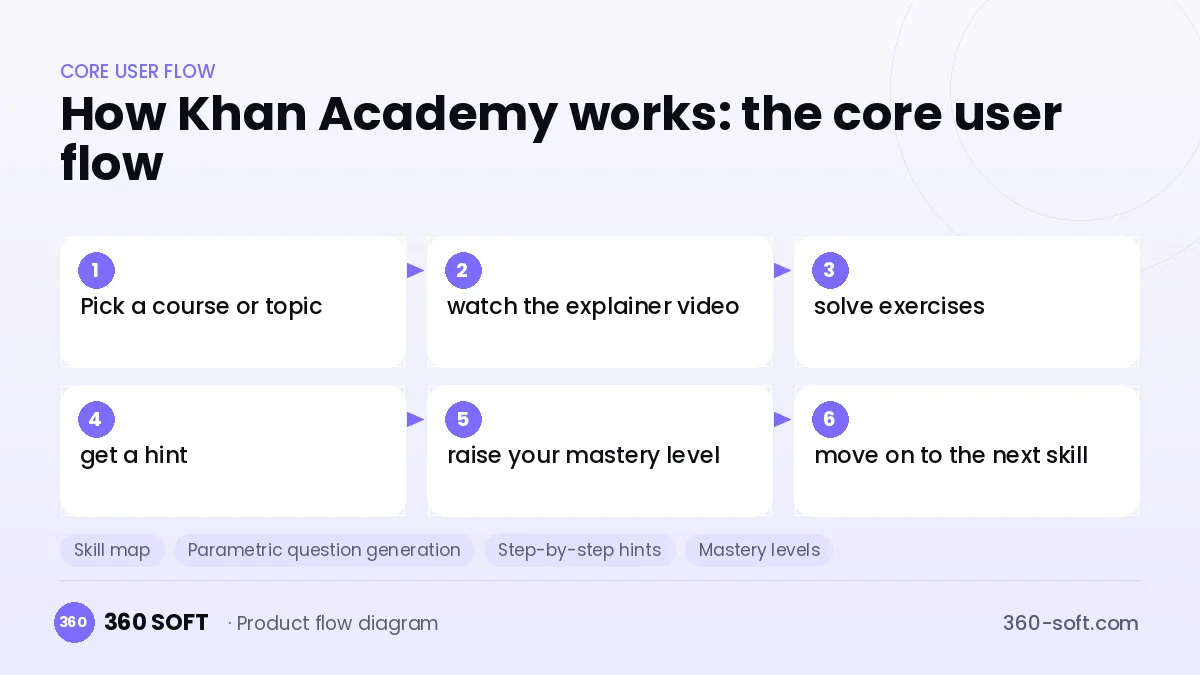
Khan Academy offers a free, personalised learning experience that runs from maths to the sciences. Exercises that follow right after a short explainer video measure whether a student has really learned a topic, and thanks to mastery-based progression, nobody moves on to the next topic with a gap in the foundations. Teacher and parent dashboards make differentiated instruction easier in the classroom.
Building something similar requires a skill map in which topics are linked by prerequisites, an exercise engine that generates parametric questions, hints and step-by-step solutions, a video library, a teacher class dashboard and parent accounts. For child users, parental consent and GDPR-compliant data processing (plus COPPA in the US) must be designed in. Behind the scenes sit an analytics layer that produces reports from progress data and a panel for content authors.
How Khan Academy works: the core user flow
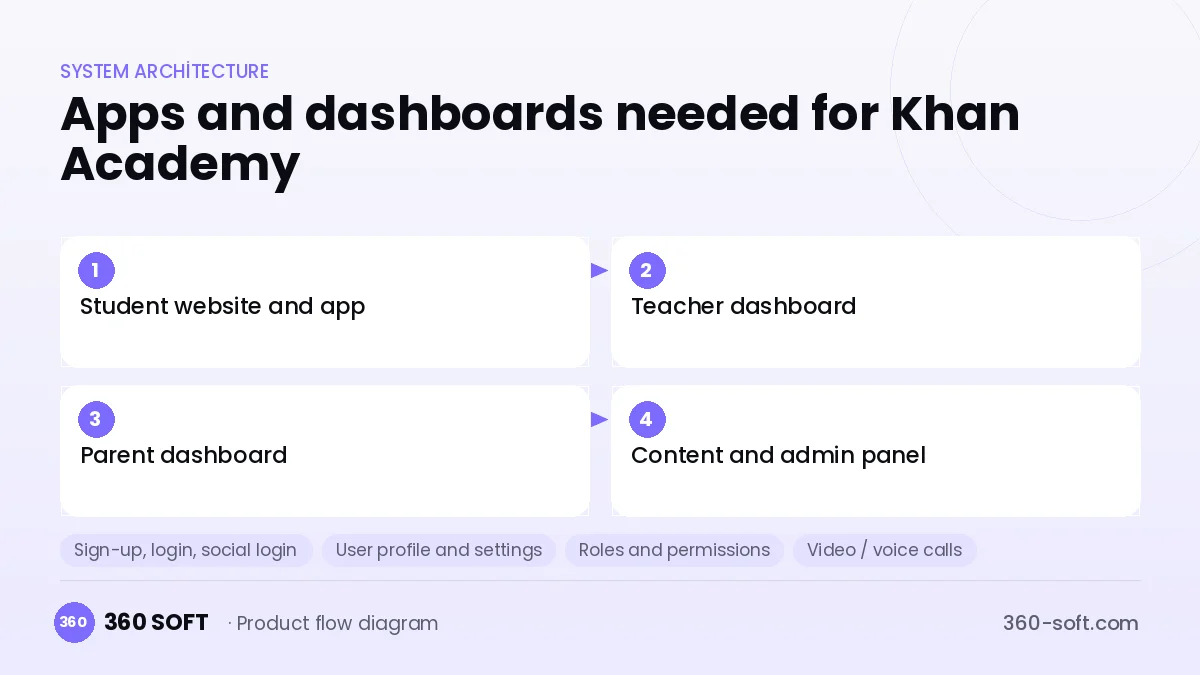
How many apps and dashboards do you need?
Student website and app
The interface where students watch videos, solve exercises and see their mastery progress.
Teacher dashboard
A panel where teachers create classes, assign homework and see which skills students struggle with.
Parent dashboard
A screen where parents follow their child's study time, completed topics and areas of difficulty.
Content and admin panel
A panel for managing question templates, videos, the skill map and platform settings.
Critical features of a product like Khan Academy
Skill map
Topics are linked by prerequisites, and the system redirects students back when they have a gap in the foundations.
Parametric question generation
Unlimited exercises are generated from one question template with different numbers, which prevents memorising.
Step-by-step hints
When a student is stuck, the solution opens step by step, and hint use is reflected in the mastery score.
Mastery levels
Each skill is tracked through levels such as "attempted, proficient, mastered" and reinforced with mixed review quizzes.
Class and homework management
Teachers assign topic-based homework, set due dates and see a class heat map.
AI tutor assistant
A language model guides students with questions instead of giving the answer outright.
What goes into the first version, what comes later
First version (MVP)
- Skill map for a single subject (e.g. maths)
- Video and parametric exercises
- Mastery progress tracking
- Teacher class panel and homework assignment
- Child account with parental consent
Later releases
- Parent dashboard and weekly report email
- AI tutor assistant
- Mobile app and offline practice
- School and district-level administrator reports
Modules and how the budget is calculated
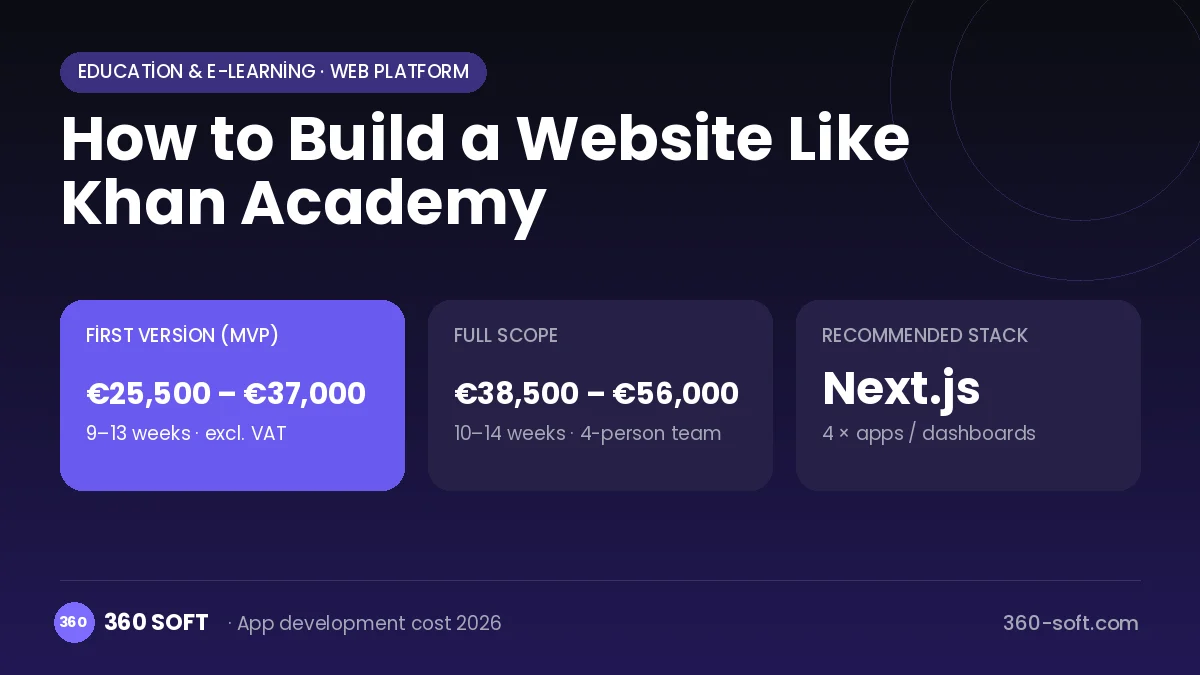
The budget is calculated with 360 SOFT’s pricing model from the modules below, about 30 screens and the project’s complexity: roughly 147 person-days for the full scope and 97 person-days for the first version. Every module you drop lowers the budget directly.
| Module | Phase |
|---|---|
| Sign-up, login, social login | First version |
| User profile and settings | First version |
| Roles and permissions | First version |
| Video / voice calls | First version |
| File, photo, video upload | First version |
| AI features (LLM, RAG, recommendations) | Later release |
| Reporting and analytics | Later release |
| Email / SMS notifications | First version |
| Content management / blog | First version |
| Admin dashboard | First version |
| GDPR and security hardening | First version |
| Subscriptions and recurring billing | First version |
Hosting, SMS, map APIs, app store accounts and payment-provider fees are separate items. Maintenance and improvements (optional): €500 / month. We send a fixed written price within 24 hours after a free discovery call.
The hard parts
Children's data and GDPR
For underage users, parental consent, minimal data collection and an ad-free experience are a legal and ethical requirement.
Producing question content
Writing parametric question templates that are pedagogically sound takes expert teacher effort, so the editor tool is critical.
Maths rendering
Getting formula typesetting, graphs and interactive drawing tools to work correctly on every device is technically laborious.
Business model
Khan Academy runs as a non-profit on donations; in a commercial equivalent, suitable models are offering basic content free to students while selling institutional licences to schools and tutoring centres, and a subscription with premium reports and an AI assistant for parents. Corporate sponsorships and public-sector projects can also be sources of revenue.
Get a free quote for your project
Let us scope it together and send a fixed written quote within 24 hours. NDA on request; you own the source code.
Choosing a company to build an app like Khan Academy
Most people searching “website like khan academy” are really looking for a reliable app development company. When comparing quotes, check four things:
- Can you try similar products they have shipped, in the stores or live?
- Are the source code, design files, servers and store accounts transferred to you by contract?
- Do they show a working demo every two weeks, with written scope and acceptance criteria?
- Are maintenance, scaling and GDPR/security costs written into the quote?
Copyright and trademarks
A business model and features are generally not protected on their own, but the Khan Academy name, logo, interface design, content and source code are. That is why we build a product with similar functionality but your own brand, design and code. This is not legal advice; we recommend a trademark search before launch.
Frequently asked questions
How long does it take to build a website like Khan Academy?
A first version with a skill map, exercise engine and teacher panel for a single subject can be set up in a few months. As the content grows, the authoring process takes longer than development.
How many separate panels are needed?
The student interface, teacher panel and content/admin panel are the core structure. The parent dashboard can start as a simple report screen in the first version.
Are there copyright or trademark issues?
The mastery-based learning model is free to use. The name, logo, design, videos, question content and code cannot be copied; this information is not legal advice.
What should I consider when building a platform for children?
Parental consent, a GDPR privacy notice (and COPPA if you serve the US), an ad-free experience and strict moderation of any chat features are a must. The mobile stores' kids category rules should also be reviewed in advance.