Mobile appMobility, ride-hailing & carsOriginal by Martı
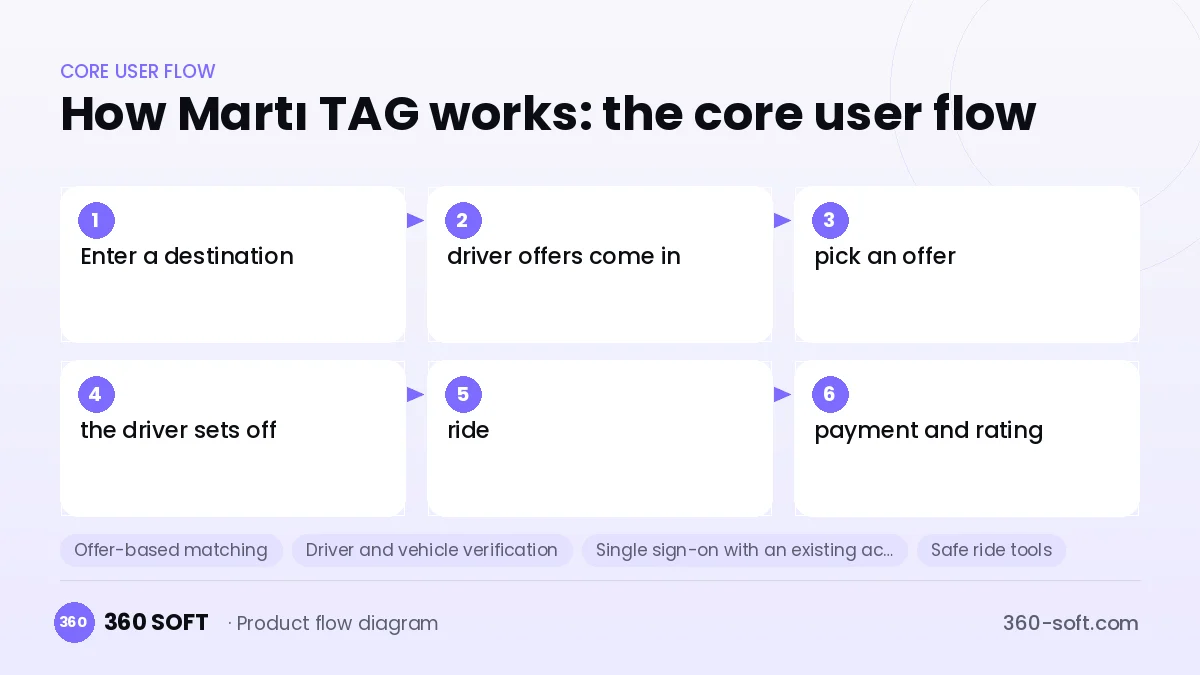
Martı TAG is a ride-matching service from Turkish scooter operator Martı that connects private car owners with passengers heading the same way. The rider enters a destination, drivers submit offers and the rider picks the one that suits them. It shows how brand awareness and an existing user base built in micromobility are a huge advantage for launching a new transport vertical quickly and cheaply.
A similar product needs a mobile app with rider and driver roles plus an operations panel. Offer collection, live location, identity and vehicle verification, ratings and complaint management are the core components. Since the legal framework for this kind of service can be contested in many countries, the business model should be clarified with expert advice and the rules reflected in the app.
How Martı TAG works: the core user flow
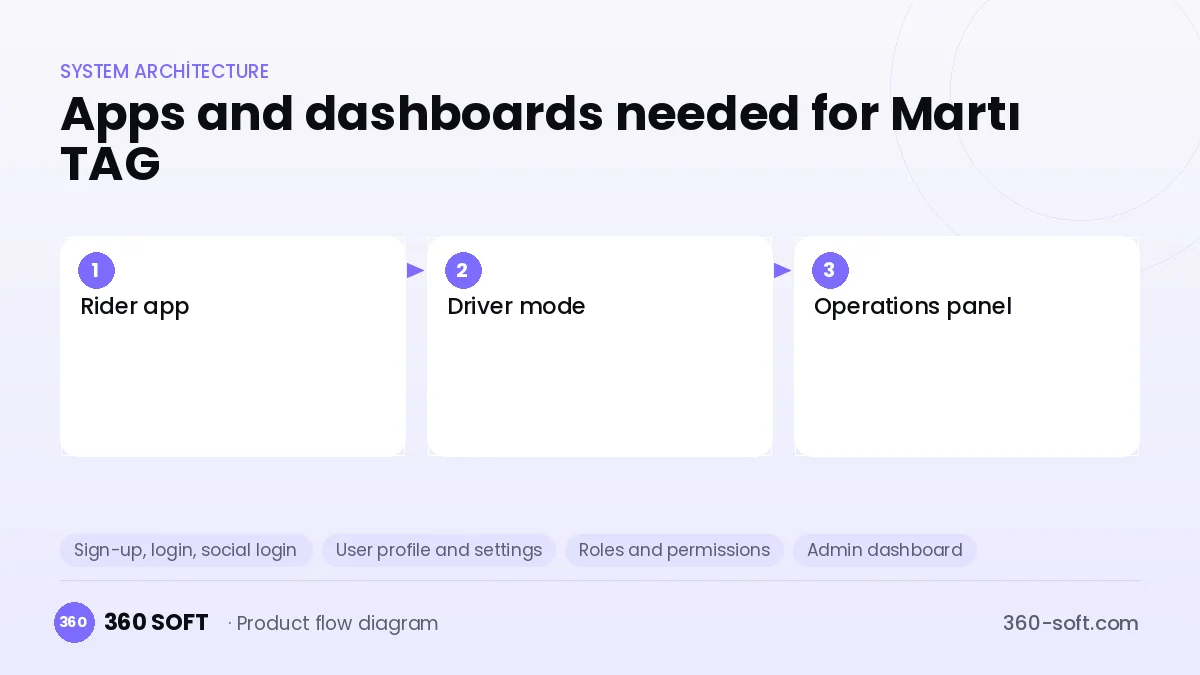
How many apps and dashboards do you need?
Rider app
Riders create trip requests and compare and choose from incoming offers.
Driver mode
The section where car owners go online, see requests, submit offers and manage the trip.
Operations panel
The panel for driver verification, complaints, zone settings and reports.
Critical features of a product like Martı TAG
Offer-based matching
Sends the request to nearby drivers and presents their price offers to the rider within a time limit.
Driver and vehicle verification
Checks driving licence, registration and ID details, with a vehicle photo and number plate match.
Single sign-on with an existing account
Lets users of the brand's other services switch to the new service with one account.
Safe ride tools
Sharing the trip with friends and family, an emergency button and calls with masked numbers.
Rating and complaint loop
Two-way reviews after every ride; automatic suspension after repeated complaints.
Zone-based rollout
Activates the service only in selected districts or cities and enables gradual expansion.
What goes into the first version, what comes later
First version (MVP)
- Sign-up with phone verification and driver applications
- Ride requests and the driver offer flow
- Live location tracking and in-app calling
- Payments and two-way ratings
- Panel for driver approval and complaint management
Later releases
- Shared account and wallet with micromobility services
- Scheduled and intercity rides
- Earnings reports and bonuses for drivers
- Fake account detection with risk scoring
Modules and how the budget is calculated
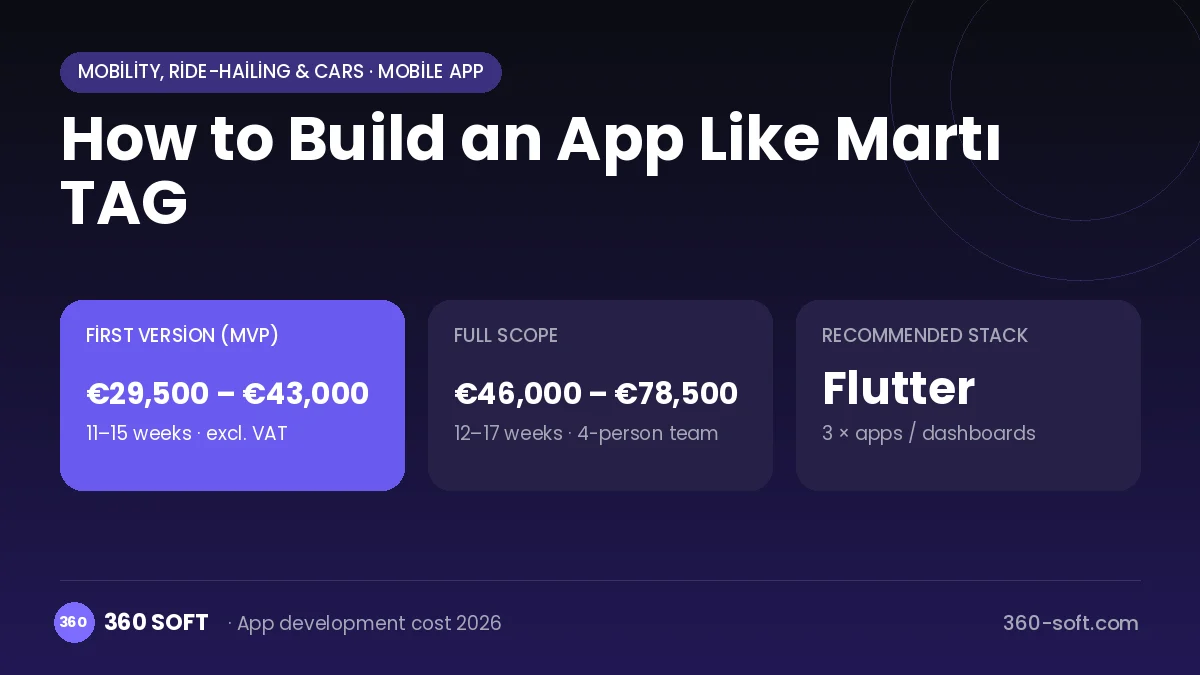
The budget is calculated with 360 SOFT’s pricing model from the modules below, about 28 screens and the project’s complexity: roughly 177 person-days for the full scope and 113 person-days for the first version. Every module you drop lowers the budget directly.
| Module | Phase |
|---|---|
| Sign-up, login, social login | First version |
| User profile and settings | First version |
| Roles and permissions | First version |
| Admin dashboard | First version |
| Online payments (Stripe / PSP) | First version |
| Subscriptions and recurring billing | First version |
| Maps, location, routing | First version |
| Push notifications | First version |
| Email / SMS notifications | First version |
| Ratings and reviews | First version |
| Reporting and analytics | Later release |
| GDPR and security hardening | First version |
Hosting, SMS, map APIs, app store accounts and payment-provider fees are separate items. Maintenance and improvements (optional): €600 / month. We send a fixed written price within 24 hours after a free discovery call.
The hard parts
Legal framework
Paid transport in private cars may be restricted by local law; the business model and terms of use should be designed together with a lawyer.
Trust and safety
When working with non-professional drivers, verification, logging and incident response must work flawlessly.
Instant offer infrastructure
Notifying many drivers per request and collecting their replies demands a strong real-time layer.
Business model
The revenue model can rely on a commission per matched ride or on packages where drivers pay a monthly subscription to submit unlimited offers. The subscription model can be attractive because it frees drivers from per-job deductions. A shared wallet, promotions and brand partnerships are further revenue areas that leverage the existing user base.
Get a free quote for your project
Let us scope it together and send a fixed written quote within 24 hours. NDA on request; you own the source code.
Choosing a company to build an app like Martı TAG
Most people searching “build an app like marti tag” are really looking for a reliable app development company. When comparing quotes, check four things:
- Can you try similar products they have shipped, in the stores or live?
- Are the source code, design files, servers and store accounts transferred to you by contract?
- Do they show a working demo every two weeks, with written scope and acceptance criteria?
- Are maintenance, scaling and GDPR/security costs written into the quote?
Copyright and trademarks
A business model and features are generally not protected on their own, but the Martı TAG name, logo, interface design, content and source code are. That is why we build a product with similar functionality but your own brand, design and code. This is not legal advice; we recommend a trademark search before launch.
Frequently asked questions
How long does it take to build an app like Martı TAG?
A first version limited to the offer-based ride flow can be ready in a few months. Verification processes and drafting the legal texts also take up a significant part of that time.
Is this model legal?
Paid passenger transport in private cars is a sensitive regulatory area and varies by local rules. Always get legal advice before investing; the information here is not a legal opinion.
Are there copyright or trademark issues?
The ride-matching model is generally free to use. The Martı and TAG names, logo, design and code may not be used.
Can this service be added to an existing app?
Yes; if user accounts, payments and map infrastructure already exist, the ride module can be added as a new vertical. This gives a faster start than building a separate app from scratch.