Mobile appUtilities & everyday appsOriginal by Google
Google Maps is not just a directions app; it is the world's digital guide, with business profiles, opening hours, reviews, photos and public transport information. When a user looks for a restaurant, the same screen shows its rating, busy times, menu and the route. Behind this coverage lie years of map data and an ecosystem in which millions of businesses keep their own details up to date.
Copying this scale one to one is not realistic; the right approach is to build a map product focused on a specific city, sector or use case. That requires a map layer, a place (POI) database and search engine, a panel where business owners manage their profiles, a review and photo system, and a routing integration. Choosing an open or commercial provider for map data determines the architecture from the start.
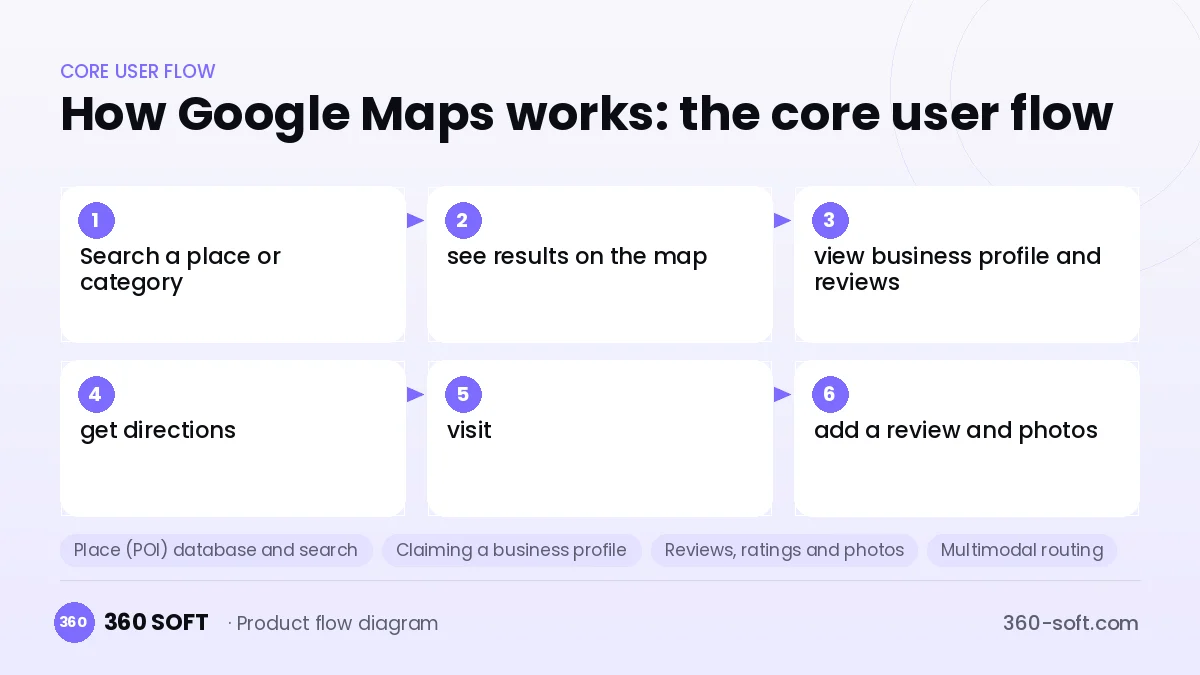
How Google Maps works: the core user flow
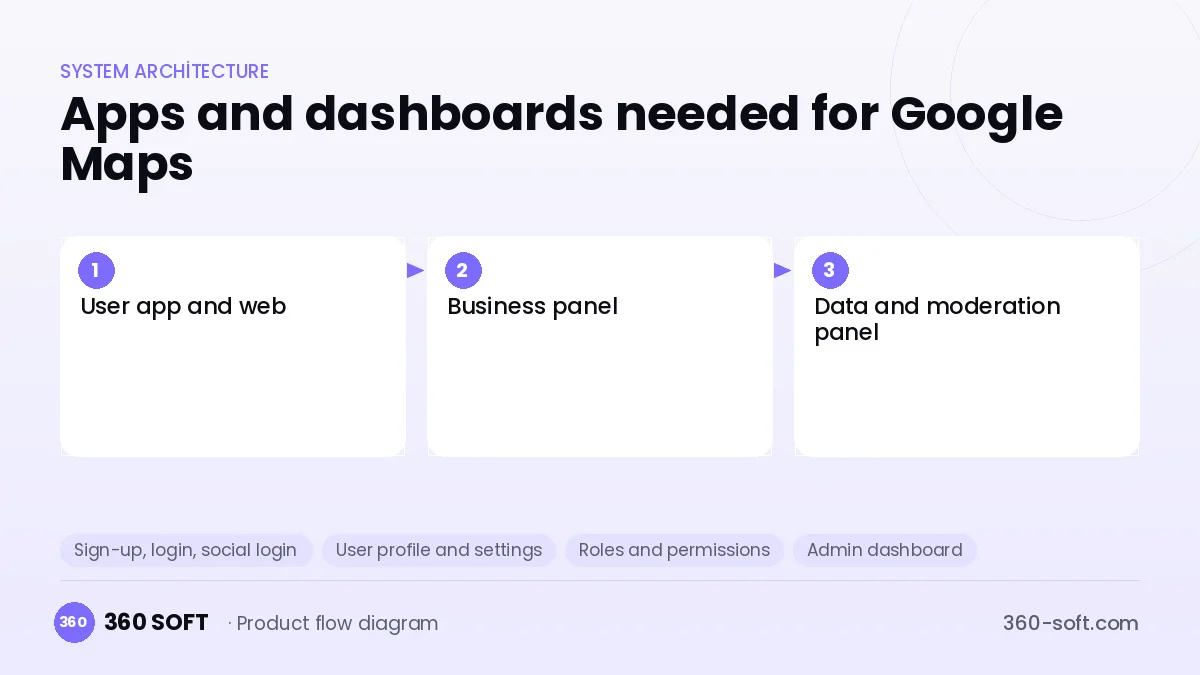
How many apps and dashboards do you need?
User app and web
Users search for places, view profiles, get routes and leave reviews.
Business panel
Business owners claim their profiles and update hours, photos, menus and promotions.
Data and moderation panel
Editors verify place data and moderate reviews and photos.
Critical features of a product like Google Maps
Place (POI) database and search
Fast search by category, location and keyword, using a geographic search engine that tolerates typos.
Claiming a business profile
The business owner claims the profile through phone or postcard verification and manages the details themselves.
Reviews, ratings and photos
Users rate places they visited and add photos, and businesses reply to reviews.
Multimodal routing
Routes and estimated times are shown for driving, walking and public transport.
Saved places and lists
Users save favourite places in lists and share them with friends.
User correction suggestions
Wrong addresses, closed businesses or missing road information are reported by users and approved by editors.
What goes into the first version, what comes later
First version (MVP)
- Place search on a ready-made map layer
- Business listings by category and profile pages
- Adding reviews, ratings and photos
- Directions through an external routing service
- Panel for claiming and updating a business profile
Later releases
- Public transport routes and line information
- Offline map downloads
- Paid promotion and ads for businesses
- Busy times and live occupancy estimates
Modules and how the budget is calculated
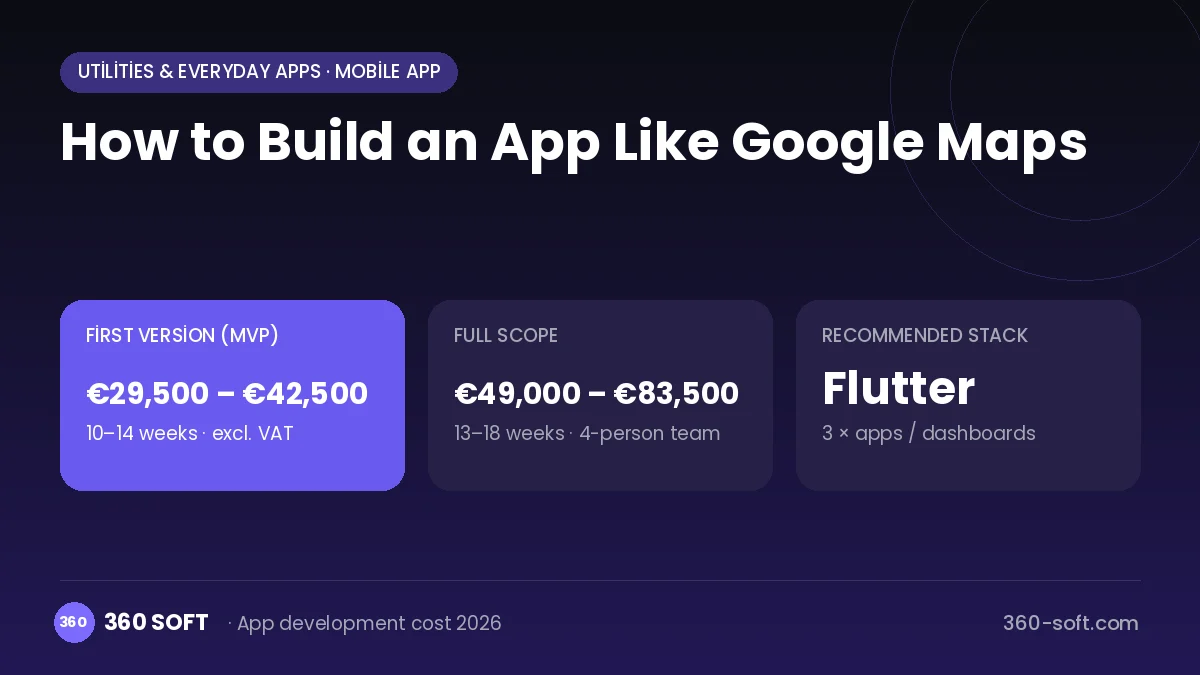
The budget is calculated with 360 SOFT’s pricing model from the modules below, about 30 screens and the project’s complexity: roughly 188 person-days for the full scope and 112 person-days for the first version. Every module you drop lowers the budget directly.
| Module | Phase |
|---|---|
| Sign-up, login, social login | First version |
| User profile and settings | First version |
| Roles and permissions | First version |
| Admin dashboard | First version |
| Maps, location, routing | First version |
| Advanced search and filters | First version |
| Ratings and reviews | First version |
| File, photo, video upload | First version |
| Offline mode and sync | Later release |
| Push notifications | First version |
| Third-party API integration | First version |
| Reporting and analytics | Later release |
| Multi-language | First version |
Hosting, SMS, map APIs, app store accounts and payment-provider fees are separate items. Maintenance and improvements (optional): €650 / month. We send a fixed written price within 24 hours after a free discovery call.
The hard parts
Freshness of place data
Businesses that close, move or change hours quickly make data stale; a business panel and community corrections are essential.
Fake reviews and spam
Manipulating ratings damages trust; behaviour analysis and moderation processes are needed.
Map licensing costs
Commercial map APIs charge per use; as traffic grows, consider your own tile server to control cost.
Business model
In a focused map and guide product, the main revenue comes from businesses buying prominence in search results and featured pins on the map. Subscription plans for businesses with advanced statistics and campaign tools, commissions from booking and ordering integrations, and corporate use of a location data API create additional income.
Get a free quote for your project
Let us scope it together and send a fixed written quote within 24 hours. NDA on request; you own the source code.
Choosing a company to build an app like Google Maps
Most people searching “build an app like google maps” are really looking for a reliable app development company. When comparing quotes, check four things:
- Can you try similar products they have shipped, in the stores or live?
- Are the source code, design files, servers and store accounts transferred to you by contract?
- Do they show a working demo every two weeks, with written scope and acceptance criteria?
- Are maintenance, scaling and GDPR/security costs written into the quote?
Copyright and trademarks
A business model and features are generally not protected on their own, but the Google Maps name, logo, interface design, content and source code are. That is why we build a product with similar functionality but your own brand, design and code. This is not legal advice; we recommend a trademark search before launch.
Frequently asked questions
How long does it take to build an app like Google Maps?
The first version of a map and guide app focused on a specific city or sector can be ready in a few months. Public transport, offline maps and an ad system are added in later phases.
Should I draw my own map?
No; open data such as OpenStreetMap or commercial map providers are used. The real difference comes from the place data, reviews and niche content you collect yourself.
Ready-made map API or my own server?
A ready-made API is quick and practical at the start. Costs rise with usage; at that point you can consider moving to an open-source map server and routing engine.
What should I look for when choosing a map app developer?
Choose a team experienced in geographic databases, search engines and map performance. Also probe their knowledge of data licensing and GDPR compliance.