Mobile appUtilities & everyday appsOriginal by Hiya
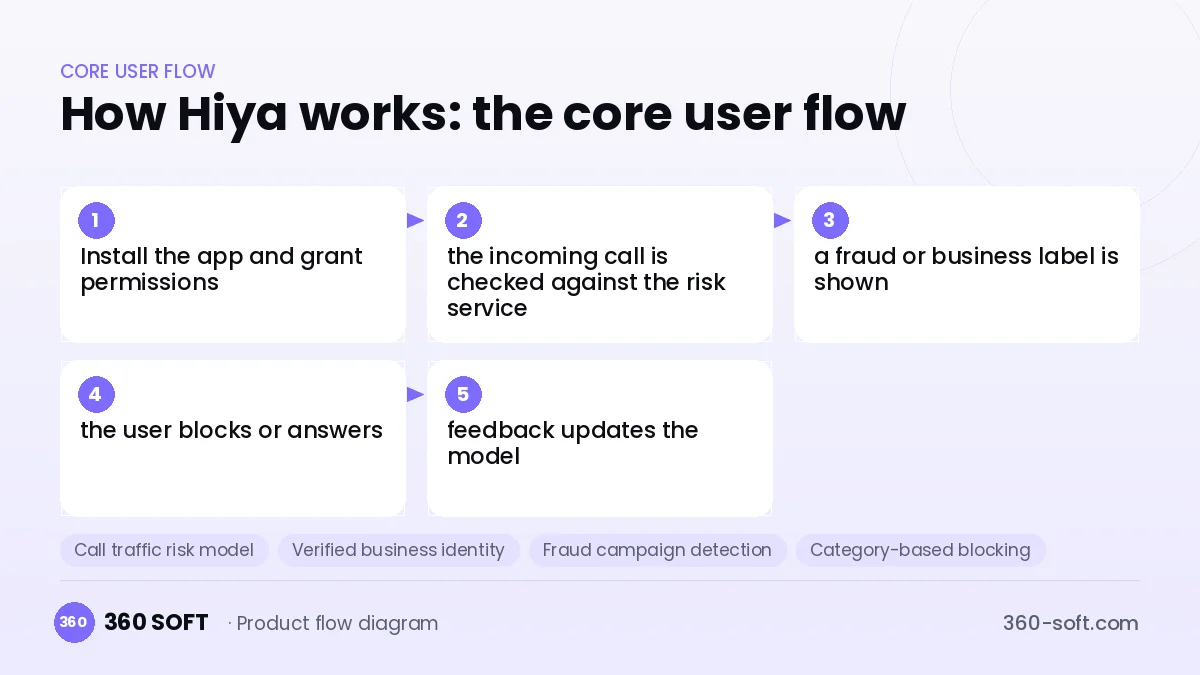
Hiya approaches caller ID with a focus on fraud protection: instead of relying on the user's contact book, it leans mainly on call traffic analysis, carrier partnerships and business registrations. That lets it label an incoming call as "suspected fraud" or "verified business". Its value comes from a two-sided trust layer that protects individual users while also raising the answer rate of legitimate businesses.
To build something similar you need, alongside the consumer app, a business portal where companies register their numbers and define a brand name and logo, an API layer that supplies scores to carriers or phone systems, and an analytics engine that watches call patterns. Because the product serves both end users and B2B customers, authentication, billing and reporting must be designed for two audiences from the start.
How Hiya works: the core user flow
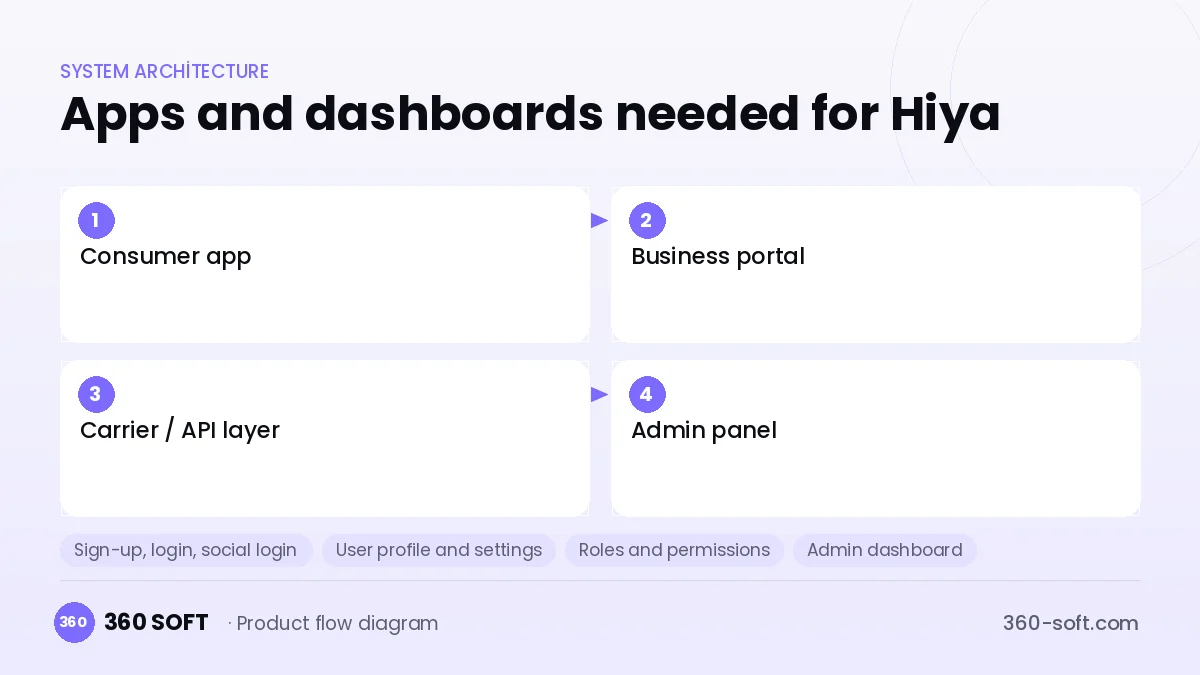
How many apps and dashboards do you need?
Consumer app
Individual users see risk labels on incoming calls, block numbers and report suspicious calls.
Business portal
Companies verify the numbers they call from, define a brand name and logo, and track answer-rate reports.
Carrier / API layer
Telecom carriers and contact centre software query a number's risk score in real time through an API.
Admin panel
The team approves business verifications, reviews false positives and tracks fraud campaigns.
Critical features of a product like Hiya
Call traffic risk model
A number-level risk score is produced from signals such as many calls to many numbers in a short time, low answer rates and number spoofing.
Verified business identity
Businesses verified with documents can show their brand name, logo and call reason on their calls, which makes legitimate calls more likely to be answered.
Fraud campaign detection
Waves of calls using the same script from different numbers are clustered, so a whole campaign can be flagged at once.
Category-based blocking
Users can block or silence categories such as telemarketing, surveys or suspected fraud separately.
Real-time scoring API
A low-latency REST API with quota and key management is offered to carriers and contact centre software.
Business reports
Verified businesses track the answer rate of their labelled calls, complaint counts and number reputation from the dashboard.
What goes into the first version, what comes later
First version (MVP)
- Android and iOS consumer app: risk label and blocking
- A risk score based on user reports and basic traffic signals
- Business portal: number registration and document-based verification
- Category-based blocking and report history
- Admin panel: verification approval and dispute management
Later releases
- A paid API for carrier and contact centre integration
- Rich caller ID showing the brand logo and call reason
- Machine-learning clustering of fraud campaigns
- Enterprise reporting and reputation monitoring dashboard
Modules and how the budget is calculated
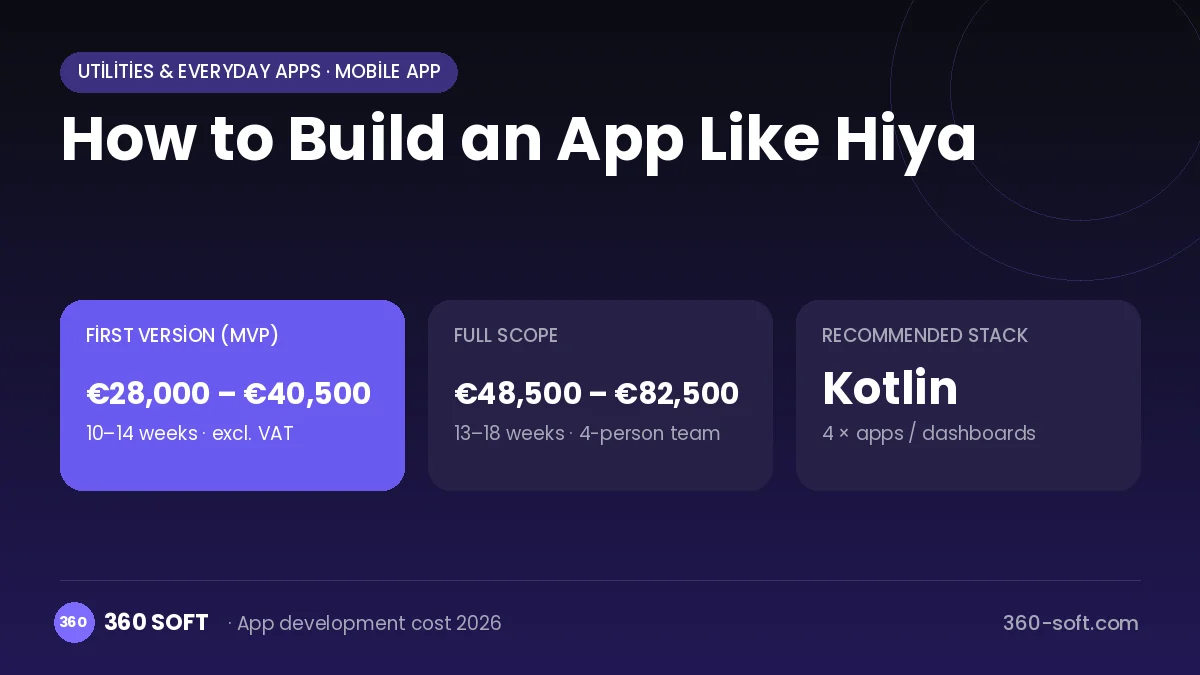
The budget is calculated with 360 SOFT’s pricing model from the modules below, about 26 screens and the project’s complexity: roughly 186 person-days for the full scope and 107 person-days for the first version. Every module you drop lowers the budget directly.
| Module | Phase |
|---|---|
| Sign-up, login, social login | First version |
| User profile and settings | First version |
| Roles and permissions | First version |
| Admin dashboard | First version |
| Push notifications | First version |
| Email / SMS notifications | First version |
| Subscriptions and recurring billing | First version |
| Online payments (Stripe / PSP) | First version |
| Reporting and analytics | Later release |
| GDPR and security hardening | First version |
| AI features (LLM, RAG, recommendations) | Later release |
| Third-party API integration | First version |
Hosting, SMS, map APIs, app store accounts and payment-provider fees are separate items. Maintenance and improvements (optional): €650 / month. We send a fixed written price within 24 hours after a free discovery call.
The hard parts
False positives
Marking a legitimate hospital or courier call as fraud does serious damage; score thresholds and a fast dispute channel need careful tuning.
Number spoofing
Because scammers can fake the calling number, looking at the number alone is not enough; carrier-side verification signals and timing patterns must be used together.
B2B trust and verification
If the business verification process is weak, fake companies obtain a "verified" label and abuse the trust; document checks and periodic re-verification are needed.
Business model
A significant share of revenue comes from the B2B side: businesses pay a subscription for verified caller ID and logo display, while carriers and contact centre software vendors pay per query or volume-based API fees. On the consumer side, advanced protection features can be offered through a premium subscription; as the user base grows, the resulting data quality also increases the value of the B2B product.
Get a free quote for your project
Let us scope it together and send a fixed written quote within 24 hours. NDA on request; you own the source code.
Choosing a company to build an app like Hiya
Most people searching “build an app like hiya” are really looking for a reliable app development company. When comparing quotes, check four things:
- Can you try similar products they have shipped, in the stores or live?
- Are the source code, design files, servers and store accounts transferred to you by contract?
- Do they show a working demo every two weeks, with written scope and acceptance criteria?
- Are maintenance, scaling and GDPR/security costs written into the quote?
Copyright and trademarks
A business model and features are generally not protected on their own, but the Hiya name, logo, interface design, content and source code are. That is why we build a product with similar functionality but your own brand, design and code. This is not legal advice; we recommend a trademark search before launch.
Frequently asked questions
How long does it take to build an app like Hiya?
A first version made up of the consumer app, a business portal and a basic scoring engine can be ready in a few months. Carrier integrations and the advanced risk model progress in stages, depending on partnerships.
What is the difference between the Truecaller and Hiya models?
Truecaller relies more on community and contact book data, whereas the Hiya model emphasises traffic analysis, carrier cooperation and business verification. Under the GDPR, the second approach generally requires less personal data.
Could there be copyright or trademark problems?
The spam protection and business caller ID business model is free to implement. The name, logo, interface design, content and code cannot be copied; this information is general and is not legal advice.
What should I look for when choosing a company to build an app like Hiya?
Choose a team that has built high-volume, low-latency API and data processing pipelines. Be sure to ask about their telecom integration experience and their approach to security testing.