Mobile appMobility, ride-hailing & carsOriginal by Google
What makes Waze different is that it turns navigation into a community of drivers. Drivers report incidents such as accidents, police checks, stopped vehicles or potholes with a single tap, and others change their route instantly with that information. Every new person using the app makes the map a little fresher; this network effect turns Waze from a plain map app into a live traffic radio.
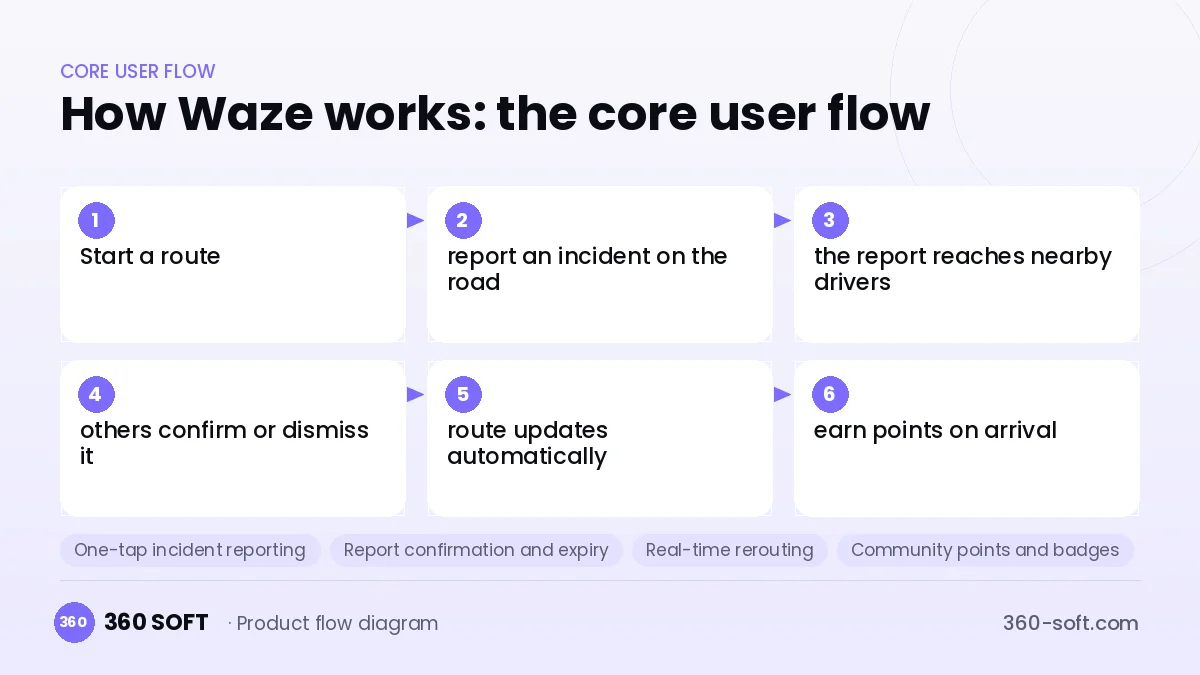
To build something similar, besides the navigation engine you need real-time incident reporting, logic to confirm reports and let them expire, community motivation through a points and badge system, and editing tools for volunteer map editors. Designing an interface with large buttons and voice command support for safe use while driving is also important.
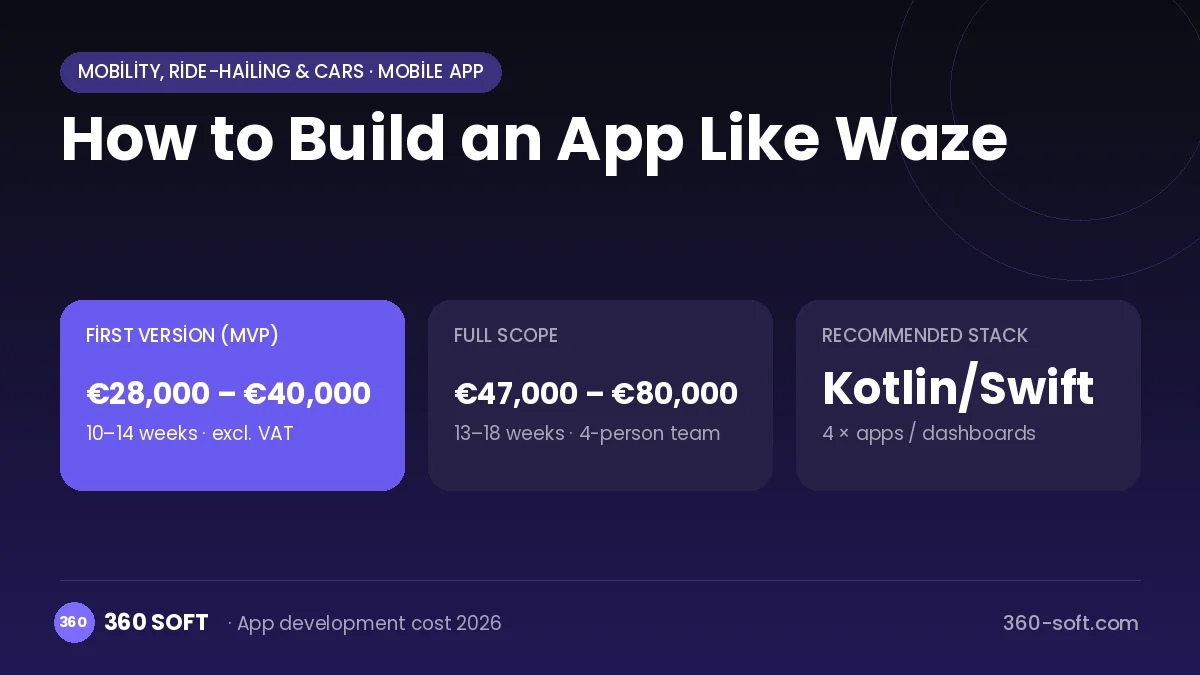
How Waze works: the core user flow
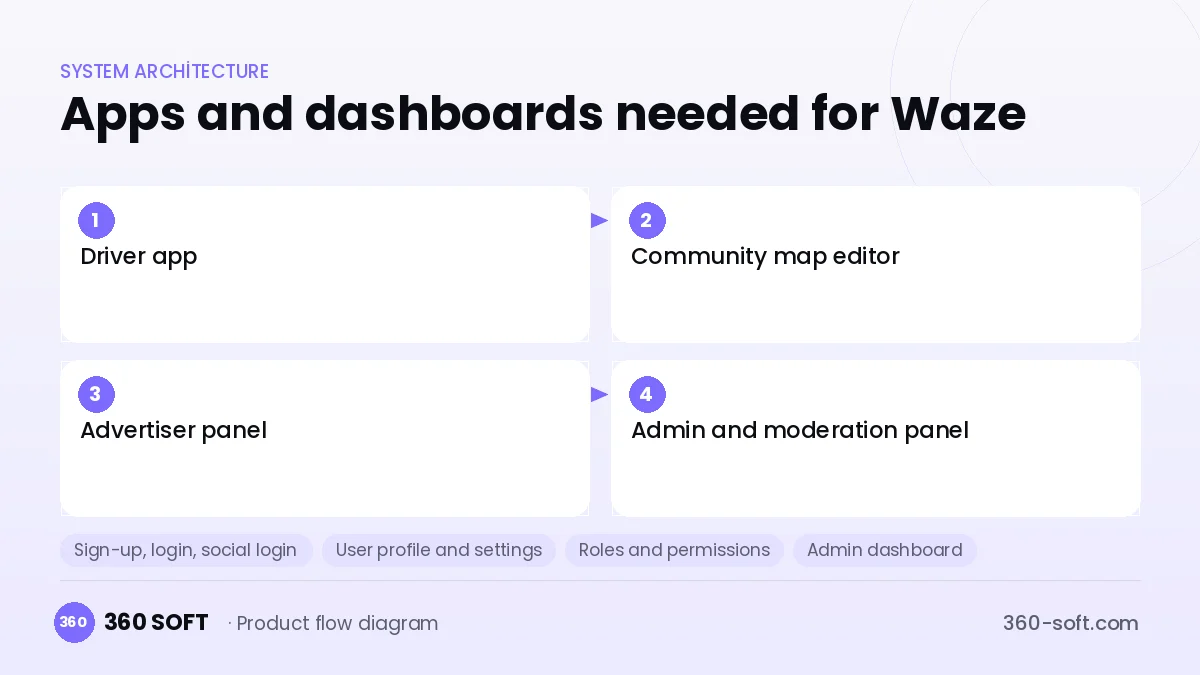
How many apps and dashboards do you need?
Driver app
Users navigate, report incidents, confirm alerts and collect points.
Community map editor
Volunteer editors correct road, direction and closure data from a web interface.
Advertiser panel
Businesses create location-based ads and branded map pin campaigns.
Admin and moderation panel
Spam reports, editor permissions and ad approvals are managed here.
Critical features of a product like Waze
One-tap incident reporting
Accidents, traffic jams, hazards and roadworks are reported with large icons or by voice command.
Report confirmation and expiry
Drivers passing nearby are asked whether the incident is still there, and reports that get no confirmation are removed automatically.
Real-time rerouting
When a new incident or congestion is detected, a faster alternative is suggested during the drive.
Community points and badges
Users who report accurately and fix the map earn points, levels and badges.
Location-based ads
Businesses along the route become visible through ads shown when the car is stopped and through map pins.
Sharing the arrival time
The driver shares their live location and estimated arrival time with friends and family through a single link.
What goes into the first version, what comes later
First version (MVP)
- Navigation with a ready-made map and routing engine
- Incident reporting and display on the map
- Report confirmation and automatic expiry
- Rerouting based on incidents
- A simple points system and user profile
Later releases
- Web-based community map editor
- Location-based advertising platform
- Live location and arrival time sharing
- In-car system support (CarPlay / Android Auto)
Modules and how the budget is calculated
The budget is calculated with 360 SOFT’s pricing model from the modules below, about 28 screens and the project’s complexity: roughly 180 person-days for the full scope and 106 person-days for the first version. Every module you drop lowers the budget directly.
| Module | Phase |
|---|---|
| Sign-up, login, social login | First version |
| User profile and settings | First version |
| Roles and permissions | First version |
| Admin dashboard | First version |
| Maps, location, routing | First version |
| Push notifications | First version |
| Ratings and reviews | First version |
| In-game economy / LiveOps | Later release |
| Third-party API integration | First version |
| GDPR and security hardening | First version |
| Reporting and analytics | Later release |
| File, photo, video upload | First version |
Hosting, SMS, map APIs, app store accounts and payment-provider fees are separate items. Maintenance and improvements (optional): €600 / month. We send a fixed written price within 24 hours after a free discovery call.
The hard parts
Critical mass of users
Community reports create value only when there are enough active drivers in the area; you need a growth strategy that concentrates city by city.
Fake and malicious reports
False reports can disrupt routes; trust scores, multiple confirmations and speed-and-location consistency checks are needed.
Driving safety and store rules
Interaction while driving is risky, so the interface must be voice-led and minimal and comply with app store policies.
Business model
Revenue comes mainly from location-based ads: petrol stations, restaurants and shops along the route pay for map pins, banners shown when the car stops, and prominence in search results. Anonymous traffic data partnerships with cities and media organisations and corporate fleet packages can be additional income sources.
Get a free quote for your project
Let us scope it together and send a fixed written quote within 24 hours. NDA on request; you own the source code.
Choosing a company to build an app like Waze
Most people searching “build an app like waze” are really looking for a reliable app development company. When comparing quotes, check four things:
- Can you try similar products they have shipped, in the stores or live?
- Are the source code, design files, servers and store accounts transferred to you by contract?
- Do they show a working demo every two weeks, with written scope and acceptance criteria?
- Are maintenance, scaling and GDPR/security costs written into the quote?
Copyright and trademarks
A business model and features are generally not protected on their own, but the Waze name, logo, interface design, content and source code are. That is why we build a product with similar functionality but your own brand, design and code. This is not legal advice; we recommend a trademark search before launch.
Frequently asked questions
How long does it take to build an app like Waze?
A first version that adds incident reporting on top of a ready-made map and routing engine can be ready in a few months. The community editor and ad platform are matters for later phases.
Does community reporting work without users?
No, the network effect depends on critical density. That is why it makes sense to start with a single city or a specific group of drivers, such as taxi drivers or couriers.
How many separate apps are needed?
The driver app and an admin panel are the basics. The map editor and advertiser panel are web applications added in the growth stage.
Will there be copyright or trademark problems?
The idea of community-driven navigation and its features are free to use; the name, logo, icon designs, content and code cannot be copied. This is not legal advice.