Mobile appMobility, ride-hailing & carsOriginal by Yandex
In users' eyes, the value of an app like Yandex Navigator (the turn-by-turn navigation app from the Russian tech company Yandex, widely used in Turkey and neighbouring markets) is that it finds the fastest route based on traffic and gives clear voice guidance throughout the drive. Congestion colours, arrival time estimates, lane information and warnings about incidents on the road win the driver's trust. Behind that trust lie constantly updated map data and anonymous speed data collected from a large number of devices.
Building something similar does not mean founding a mapping company from scratch; you build a routing engine on top of OpenStreetMap or commercial map provider data, a traffic data processing layer, voice guidance and offline map packs. Even so, real-time processing of location data, routing servers and GDPR-compliant anonymisation call for serious engineering, so it is wise to begin with a niche use case.
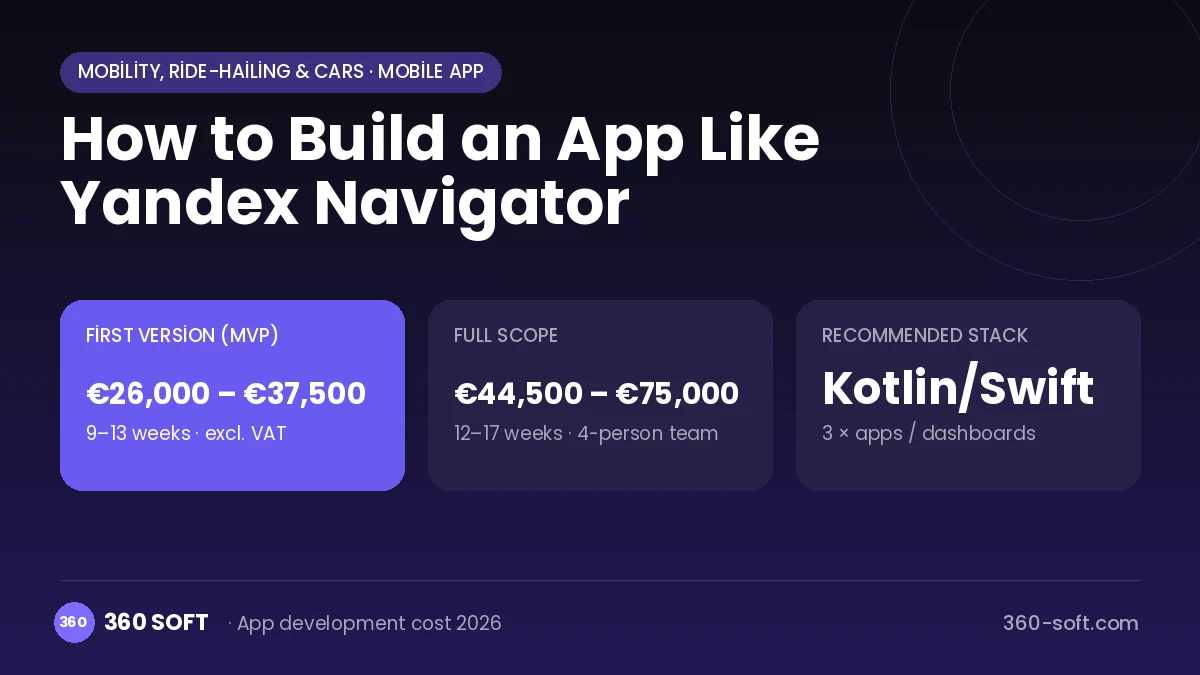
How Yandex Navigator works: the core user flow
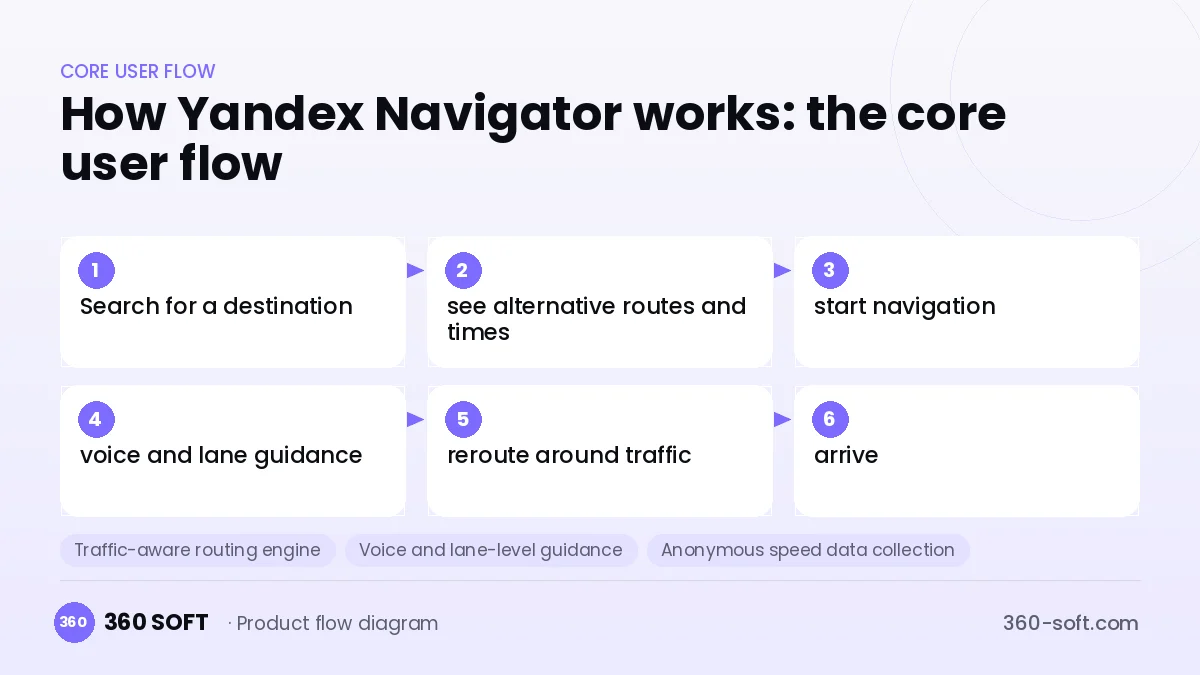
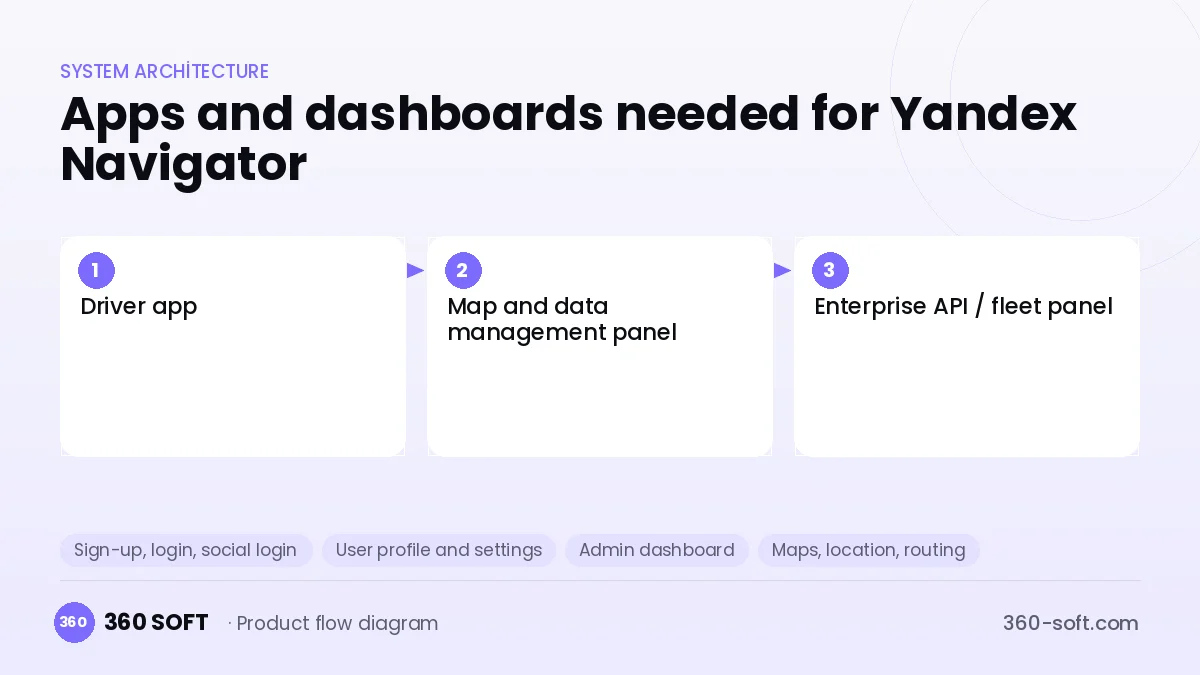
How many apps and dashboards do you need?
Driver app
Users search for addresses, choose a route and travel with voice navigation.
Map and data management panel
Editors manage road closures, POI data and user correction suggestions.
Enterprise API / fleet panel
Logistics companies use routes, arrival estimates and fleet locations through the API and panel.
Critical features of a product like Yandex Navigator
Traffic-aware routing engine
Segment-level travel times are estimated from live and historical speed data, and the fastest and alternative routes are calculated.
Voice and lane-level guidance
Lane suggestions before junctions and natural voice prompts guide the driver without taking their eyes off the road.
Anonymous speed data collection
The traffic map is updated by collecting anonymised location and speed data from devices using the navigation.
Offline map packs
City or region maps can be downloaded so that search and route calculation work without internet.
Incident and roadworks alerts
Accidents, roadworks and closures are added to the map through user reports or editor entry.
Routes by vehicle type
Route restrictions are applied for preferences such as heavy vehicle, motorcycle or avoiding tolls.
What goes into the first version, what comes later
First version (MVP)
- Address and place search (geocoding)
- Route calculation on open map data
- Voice turn-by-turn navigation
- Arrival time estimates with commercial traffic data
- Favourite addresses and recent searches
Later releases
- Traffic data collected from your own users
- Offline map packs
- Lane guidance and junction views
- Enterprise fleet and routing API
Modules and how the budget is calculated
The budget is calculated with 360 SOFT’s pricing model from the modules below, about 26 screens and the project’s complexity: roughly 170 person-days for the full scope and 99 person-days for the first version. Every module you drop lowers the budget directly.
| Module | Phase |
|---|---|
| Sign-up, login, social login | First version |
| User profile and settings | First version |
| Admin dashboard | First version |
| Maps, location, routing | First version |
| Advanced search and filters | First version |
| Offline mode and sync | Later release |
| Push notifications | First version |
| Third-party API integration | First version |
| GDPR and security hardening | First version |
| Reporting and analytics | Later release |
| Multi-language | First version |
Hosting, SMS, map APIs, app store accounts and payment-provider fees are separate items. Maintenance and improvements (optional): €600 / month. We send a fixed written price within 24 hours after a free discovery call.
The hard parts
Map data quality
Missing or wrong road data sends users the wrong way; regular validation and community corrections are needed.
Routing scale
Handling many simultaneous route requests at peak hours needs optimised graph algorithms and powerful servers.
Location data privacy
Movement data is personal data; GDPR-compliant explicit consent, anonymisation and retention policies are mandatory.
Business model
Navigation apps usually do not charge users; revenue comes from location-based ads on the map, featured POI placements for businesses, and a routing and traffic API offered to corporate users. A fleet navigation subscription for logistics companies and an ad-free premium version are also sustainable options. Commissions from in-app services such as fuel and parking payments can be added later.
Get a free quote for your project
Let us scope it together and send a fixed written quote within 24 hours. NDA on request; you own the source code.
Choosing a company to build an app like Yandex Navigator
Most people searching “build an app like yandex navigator” are really looking for a reliable app development company. When comparing quotes, check four things:
- Can you try similar products they have shipped, in the stores or live?
- Are the source code, design files, servers and store accounts transferred to you by contract?
- Do they show a working demo every two weeks, with written scope and acceptance criteria?
- Are maintenance, scaling and GDPR/security costs written into the quote?
Copyright and trademarks
A business model and features are generally not protected on their own, but the Yandex Navigator name, logo, interface design, content and source code are. That is why we build a product with similar functionality but your own brand, design and code. This is not legal advice; we recommend a trademark search before launch.
Frequently asked questions
How long does it take to build an app like Yandex Navigator?
A navigation app using ready-made map and traffic data can reach a first version in a few months. A system that produces its own traffic data and works offline is a much longer project.
Where do I get map data?
OpenStreetMap offers an openly licensed starting point; commercial providers supply fresher address and traffic data. The choice should be made on cost, coverage and licence terms.
Ready-made SDK or my own routing engine?
Ready-made navigation SDKs give a quick start but come with per-use fees and limits. As you scale, running an open-source routing engine on your own servers can be advantageous.
Will there be copyright or trademark problems?
The navigation business model and its features are free to use, but the name, logo, design, map data and code cannot be copied. The licence terms of the map data must also be respected; this is not legal advice.