SaaS / business softwareAI productsOriginal by ElevenLabs
What sets ElevenLabs apart is that speech generated from text sounds remarkably human, with natural emphasis, emotion and breath. Publishers, game studios, e-learning teams and audiobook producers get multilingual voice-over in minutes without renting a studio. Thanks to voice cloning, dubbing and a developer-friendly API, the product is both an end-user tool and an infrastructure layer embedded in other software.
Building something similar takes a web studio, a developer API and an admin panel, but the real work happens on the back end. Speech synthesis models are either trained and served on your own GPU cluster or integrated through a licensed model provider. Queue management, a per-character credit meter, consent verification for voice cloning, abuse detection and storage for generated files should each be designed as separate services.
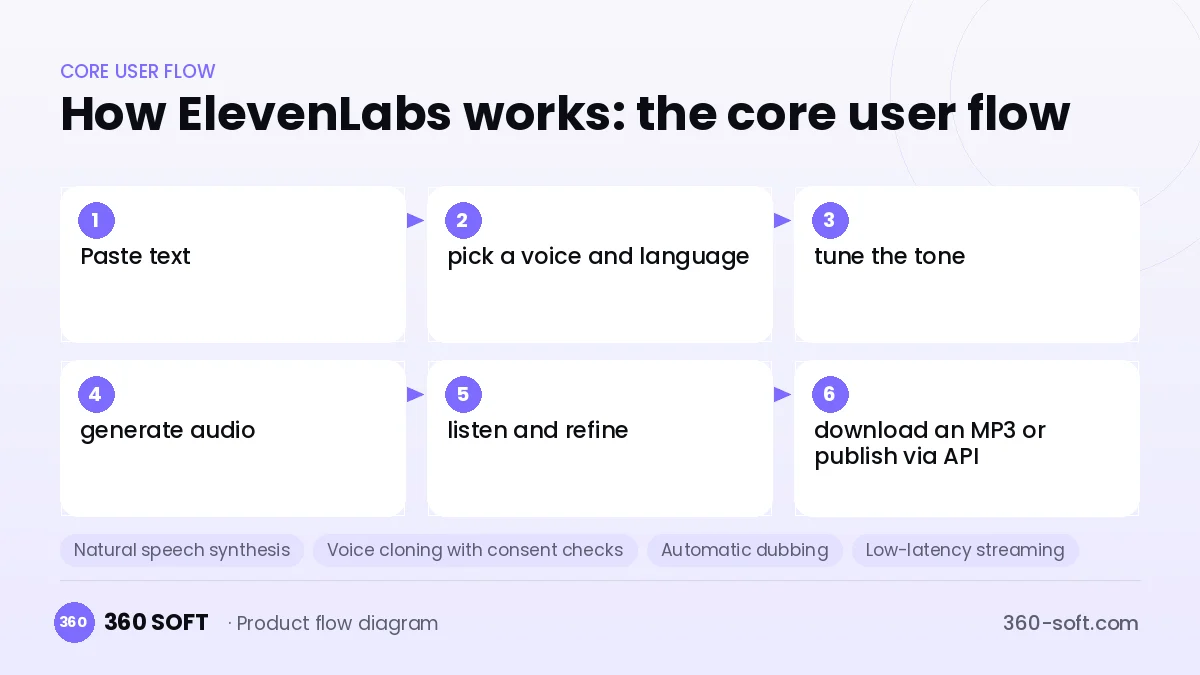
How ElevenLabs works: the core user flow
How many apps and dashboards do you need?
Web studio
The workspace where creators enter text, choose a voice and narrate long projects chapter by chapter.
Developer API
REST and WebSocket endpoints that let apps plug text-to-speech and streaming audio generation into their own products.
Voice library
The section listing voices that users have cloned or shared, offered together with their licence terms.
Admin panel
The operations screen that tracks credit consumption, GPU queues, abuse reports and subscriptions.

Critical features of a product like ElevenLabs
Natural speech synthesis
A model that infers emphasis from punctuation and context can read the same text with different emotion and pace.
Voice cloning with consent checks
A voice copy is created from a short recording, and the owner's approval is verified with a spoken confirmation phrase.
Automatic dubbing
Speech in a video is transcribed, translated into the target language and re-voiced in a tone similar to the original speaker.
Low-latency streaming
For voice assistants and call centre bots, the first audio chunk reaches the client in under a second.
Per-character credit system
Each generation deducts credits by character count, and plan limits and top-up packs are tracked in real time.
Synthetic voice watermarking
An inaudible marker is added to generated audio so the content can later be identified as AI-generated.
What goes into the first version, what comes later
First version (MVP)
- Text-to-speech studio with ready-made voices
- Support for English plus a few other major languages
- Credit meter and monthly subscription plans
- Basic REST API and API key management
- Admin panel with abuse reporting
Later releases
- Voice cloning with consent verification
- Video dubbing and multi-speaker projects
- Real-time audio streaming over WebSocket
- Voice library with revenue sharing for voice owners
Modules and how the budget is calculated
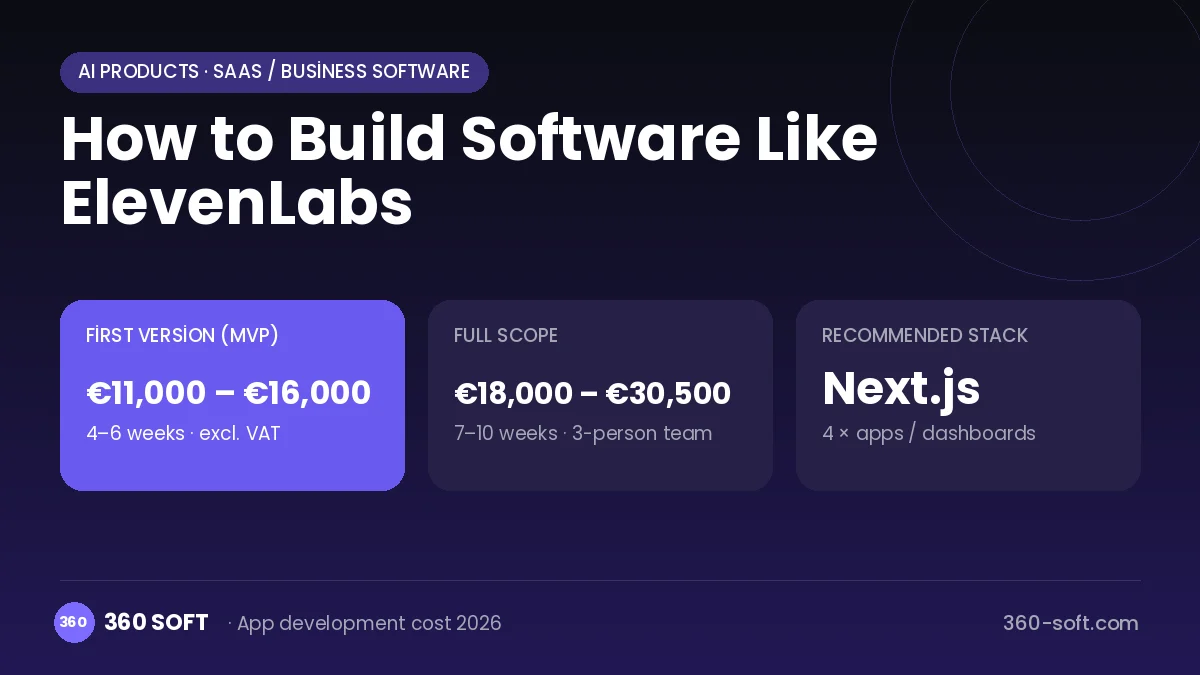
The budget is calculated with 360 SOFT’s pricing model from the modules below, about 22 screens and the project’s complexity: roughly 68 person-days for the full scope and 42 person-days for the first version. Every module you drop lowers the budget directly.
| Module | Phase |
|---|---|
| Sign-up, login, social login | First version |
| User profile and settings | First version |
| Admin dashboard | First version |
| Subscriptions and recurring billing | First version |
| Online payments (Stripe / PSP) | First version |
| AI features (LLM, RAG, recommendations) | Later release |
| File, photo, video upload | First version |
| Third-party API integration | First version |
| Multi-language | First version |
| Reporting and analytics | Later release |
| GDPR and security hardening | First version |
Hosting, SMS, map APIs, app store accounts and payment-provider fees are separate items. Maintenance and improvements (optional): €250 / month. We send a fixed written price within 24 hours after a free discovery call.
The hard parts
GPU cost and queues
Audio generation is expensive to compute; the balance of queueing, caching and model size at peak hours decides profitability.
Fake voices and fraud
Cloned voices can be used for impersonation; proof of consent, a block on celebrity voices and a fast takedown process are essential.
Pronunciation quality across languages
If suffixes, abbreviations and proper names are read wrongly, the product loses trust; language-specific data and lexicon work are needed.
Business model
The best-fit model is a freemium subscription with character quotas: a free tier makes trying it easy, while creator and enterprise plans differ by quota, commercial licence and voice-cloning rights. For developers, pay-as-you-go API pricing, top-up credit packs and revenue sharing with voice owners in the voice library open a second revenue channel.
Get a free quote for your project
Let us scope it together and send a fixed written quote within 24 hours. NDA on request; you own the source code.
Choosing a company to build an app like ElevenLabs
Most people searching “build software like elevenlabs” are really looking for a reliable app development company. When comparing quotes, check four things:
- Can you try similar products they have shipped, in the stores or live?
- Are the source code, design files, servers and store accounts transferred to you by contract?
- Do they show a working demo every two weeks, with written scope and acceptance criteria?
- Are maintenance, scaling and GDPR/security costs written into the quote?
Copyright and trademarks
A business model and features are generally not protected on their own, but the ElevenLabs name, logo, interface design, content and source code are. That is why we build a product with similar functionality but your own brand, design and code. This is not legal advice; we recommend a trademark search before launch.
Frequently asked questions
How long does it take to build software like ElevenLabs?
A studio and API built on a licensed voice model can go live in a few months. A team training its own model needs a much longer schedule for data collection, training and quality testing.
Should we train our own voice model?
Starting with ready-made models through an API is fast and low-risk. Fine-tuning open-source models makes sense once language quality or unit cost becomes a competitive advantage.
Will there be copyright or trademark issues?
The text-to-speech and voice-cloning business model is generally free to use, but the name, logo, interface, content and code cannot be copied. Cloning someone's voice without permission also carries serious legal risk; this is not legal advice.
What should I look for when choosing an AI voice software company?
Look for concrete experience in model serving, GPU cost optimisation and low-latency streaming. How voice data will be stored under GDPR and how consent records will be kept should also be settled from the start.