Web platformEducation & e-learningOriginal by Coursera
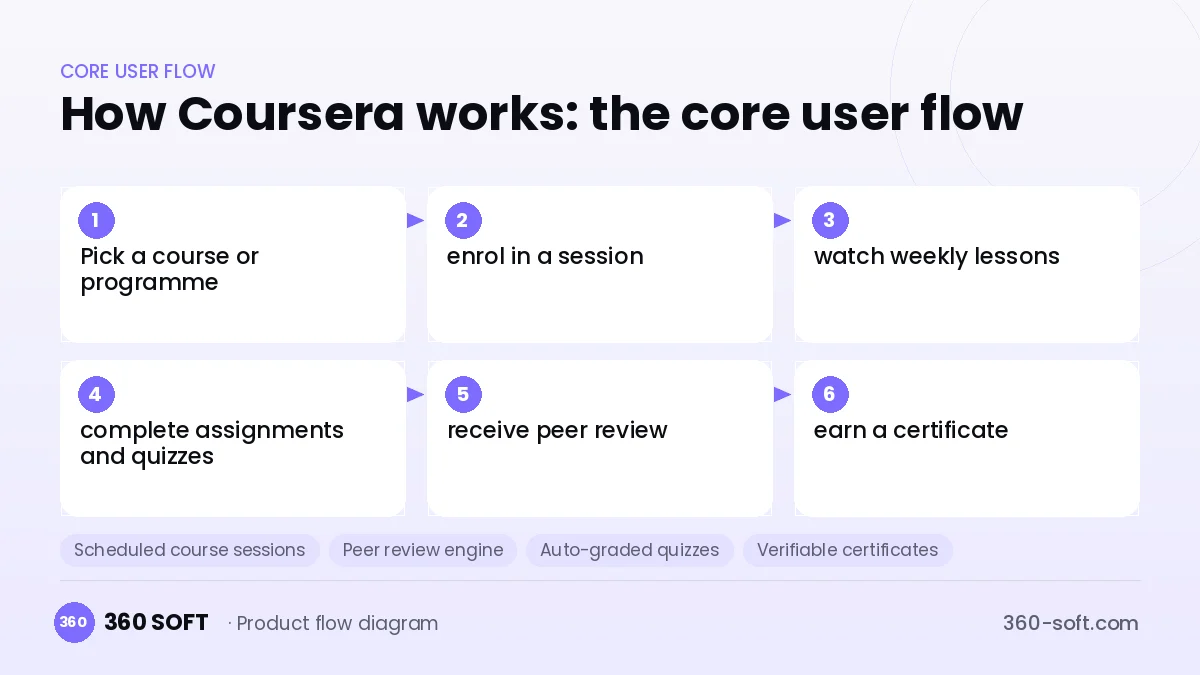
Coursera brought institutional credibility to online learning by partnering with universities and companies. Students follow courses prepared by well-known institutions in scheduled sessions, submit assignments, receive peer review and finally earn a shareable certificate. Instead of random video watching, this structure offers regular learning aimed at a specific programme and career goal.
Building something similar requires a multi-institution learning management system: institution and instructor panels, scheduled sessions, video and reading materials, auto-graded quizzes, a peer review engine, discussion forums, certificate verification and subscription or per-course payments. For corporate customers, team licences and reporting, a mobile app and multi-language support usually also appear on the roadmap.
How Coursera works: the core user flow
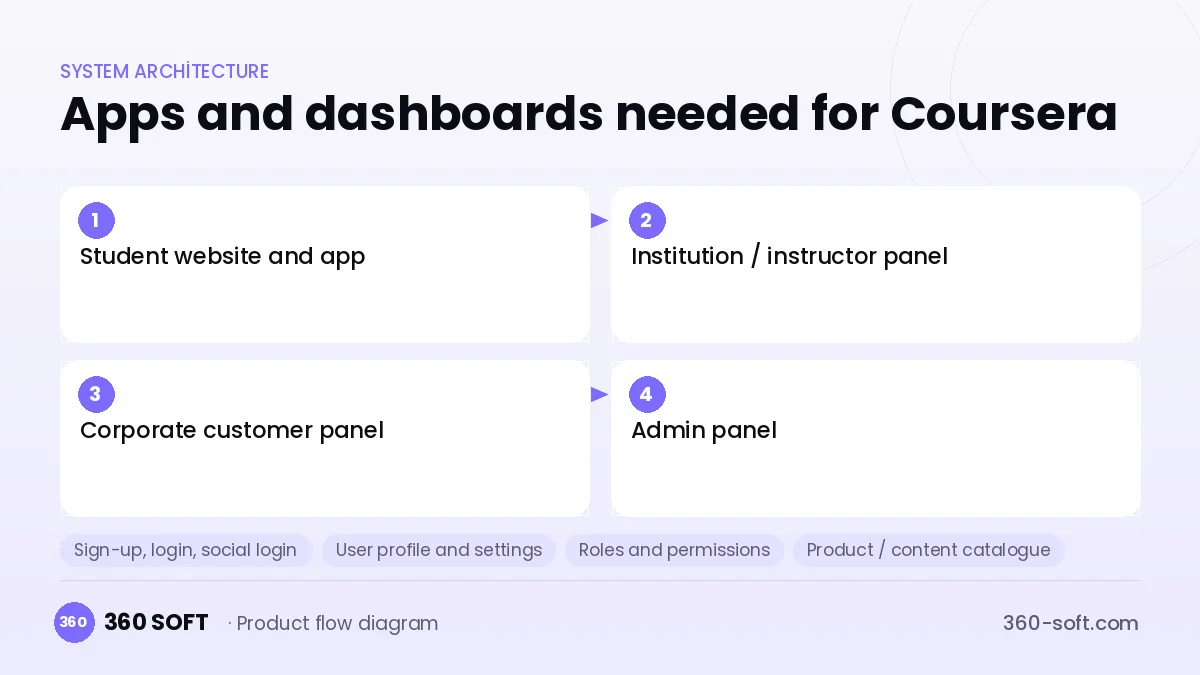
How many apps and dashboards do you need?
Student website and app
The interface for browsing courses, enrolling, watching lessons, submitting assignments and viewing certificates.
Institution / instructor panel
A panel where partner institutions create courses, open sessions and monitor student performance.
Corporate customer panel
A panel where companies assign licences to employees and follow progress reports.
Admin panel
An internal panel for institution contracts, revenue sharing, subscriptions and content oversight.
Critical features of a product like Coursera
Scheduled course sessions
Courses open in sessions with start and end dates, and deadlines and reminders are handled automatically.
Peer review engine
Open-ended assignments are distributed to several students with a rubric, and scores are weighted to produce a grade.
Auto-graded quizzes
Multiple-choice, numeric and coding exercises are graded instantly, with configurable attempt limits.
Verifiable certificates
Certificates are verified through a unique link and can be shared on platforms such as LinkedIn.
Programmes and specialisation paths
Several courses are combined into a specialisation, with sequential progress and a capstone project.
Corporate learning reports
Company managers track employees' completion and skill development from the panel.
What goes into the first version, what comes later
First version (MVP)
- Course creation with institution and instructor panels
- Scheduled sessions, video and reading materials
- Auto-graded quizzes
- Per-course payment and verifiable certificates
- Course discussion forum
Later releases
- Peer review engine
- Subscription with unlimited course access
- Corporate licences and reporting
- Mobile app and offline viewing
Modules and how the budget is calculated
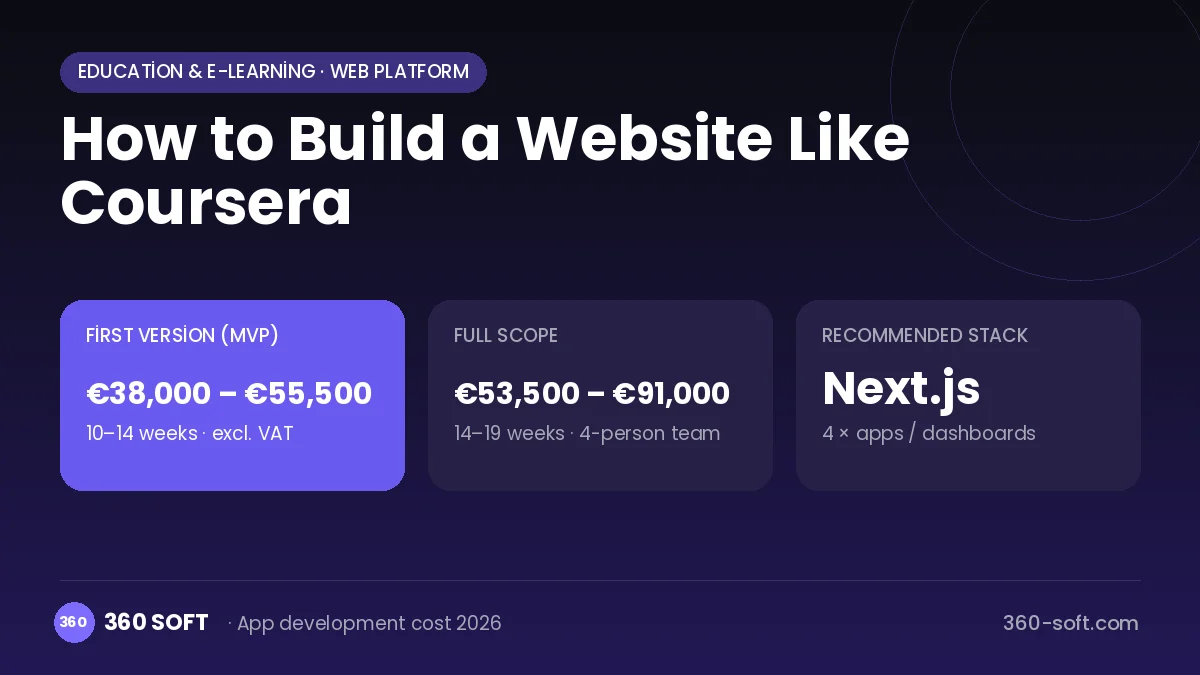
The budget is calculated with 360 SOFT’s pricing model from the modules below, about 36 screens and the project’s complexity: roughly 205 person-days for the full scope and 146 person-days for the first version. Every module you drop lowers the budget directly.
| Module | Phase |
|---|---|
| Sign-up, login, social login | First version |
| User profile and settings | First version |
| Roles and permissions | First version |
| Product / content catalogue | First version |
| Online payments (Stripe / PSP) | First version |
| Subscriptions and recurring billing | First version |
| Advanced search and filters | First version |
| Video / voice calls | First version |
| Real-time messaging | First version |
| Email / SMS notifications | First version |
| Reporting and analytics | Later release |
| Admin dashboard | First version |
| Multi-language | First version |
| Third-party API integration | First version |
Hosting, SMS, map APIs, app store accounts and payment-provider fees are separate items. Maintenance and improvements (optional): €700 / month. We send a fixed written price within 24 hours after a free discovery call.
The hard parts
Multi-institution structure
Each institution has its own brand, instructors, revenue share and reports, so permissions and data separation must be designed carefully.
Peer review fairness
Careless scoring by students distorts grades; calibration assignments and outlier detection are needed.
Assessment at scale
Thousands of students taking quizzes and uploading assignments at the same time demands stability under load.
Business model
On a Coursera-like platform, revenue comes from paid certificates, monthly subscriptions for catalogue access, specialisation programmes and corporate licences. Revenue is shared with the institutions that supply the content. Letting people audit courses for free while keeping certificates and graded assignments paid is the common way to reach a wide audience and still generate revenue.
Get a free quote for your project
Let us scope it together and send a fixed written quote within 24 hours. NDA on request; you own the source code.
Choosing a company to build an app like Coursera
Most people searching “website like coursera” are really looking for a reliable app development company. When comparing quotes, check four things:
- Can you try similar products they have shipped, in the stores or live?
- Are the source code, design files, servers and store accounts transferred to you by contract?
- Do they show a working demo every two weeks, with written scope and acceptance criteria?
- Are maintenance, scaling and GDPR/security costs written into the quote?
Copyright and trademarks
A business model and features are generally not protected on their own, but the Coursera name, logo, interface design, content and source code are. That is why we build a product with similar functionality but your own brand, design and code. This is not legal advice; we recommend a trademark search before launch.
Frequently asked questions
How long does it take to build a website like Coursera?
A first version working with a single institution, with quizzes and certificates, can be built in a few months. A multi-institution structure, peer review and corporate licences call for a longer roadmap.
How many separate panels are needed?
The student interface, institution/instructor panel and admin panel are the core three. If you plan to sell to corporate customers, a company panel is added as a fourth.
Are there copyright or trademark issues?
The online learning model run in partnership with institutions is free to use. The name, logo, design, course content and code cannot be copied, and content licences in institutional partnerships should be set out in the contract. This information is not legal advice.
What should I look for when choosing an education platform development company?
Look for experience with LMS standards (SCORM, LTI), scalable assessment infrastructure and multi-tenant architecture. Ask for examples of certificate verification and reporting.