SaaS / business softwareEducation & e-learningOriginal by Moodle HQ
What made Moodle widespread is that schools and organisations can run their teaching on their own servers and under their own rules. Courses, assignments, quizzes and the gradebook live under one roof, and a plugin architecture lets every institution add new activity types to fit its needs. The role and permission system is flexible enough for the same platform to serve a primary school or a university with thousands of students, and support for open standards keeps content portable.
Building something similar means building a multi-tenant learning management system (LMS): an authoring interface where teachers prepare course content, a student portal that tracks progress, and an admin panel where institution managers handle users, terms and reports. Behind the scenes you need an engine that plays SCORM packages, a question bank, automatic grading, integration with a school information system or student records platform, and infrastructure that can survive peak exam moments.
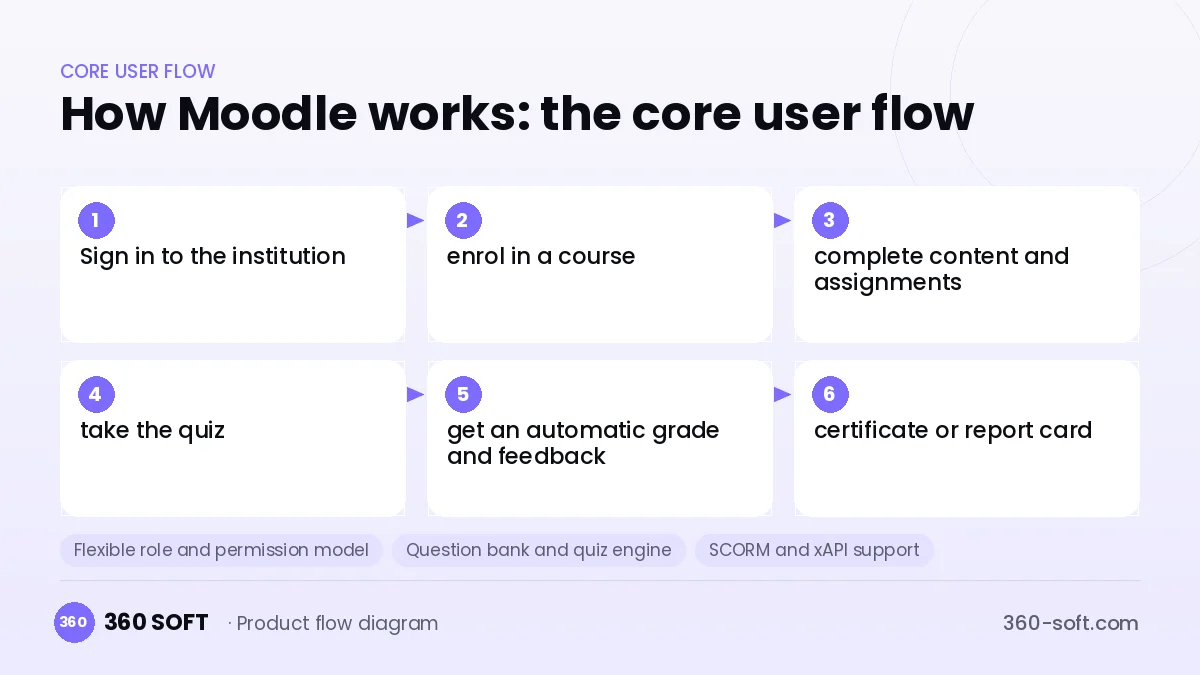
How Moodle works: the core user flow
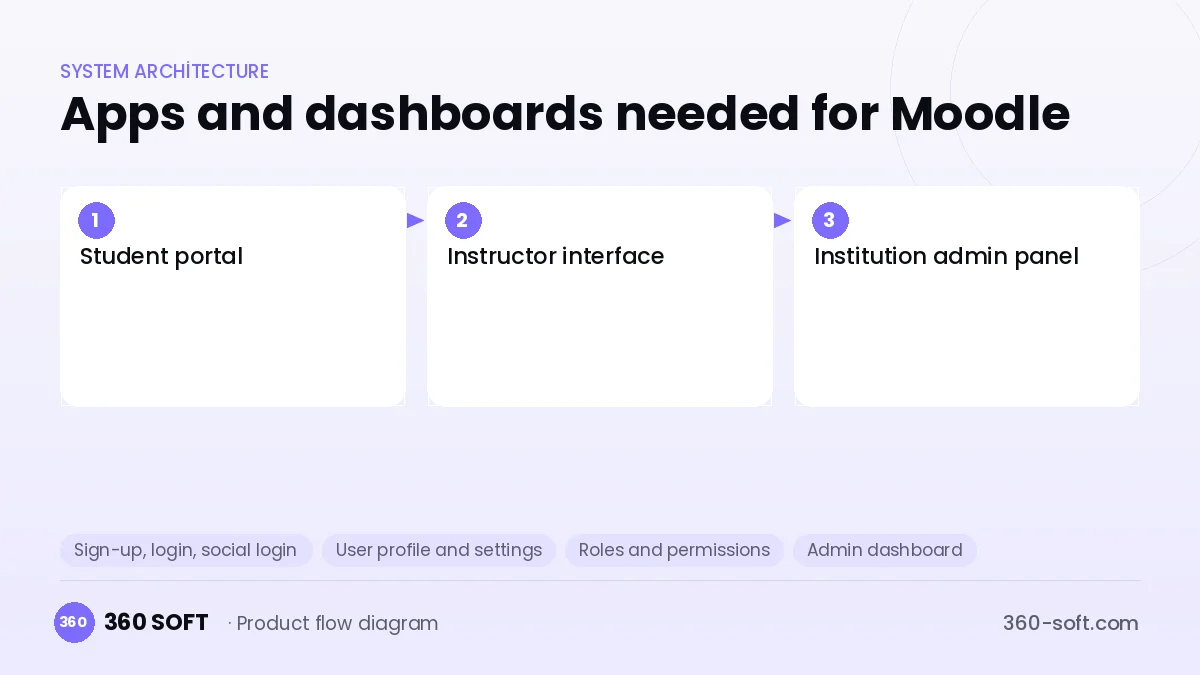
How many apps and dashboards do you need?
Student portal
Students open their courses, complete content, upload assignments, take quizzes and see their grades.
Instructor interface
Teachers build the course structure, prepare question banks, grade assignments and follow class progress.
Institution admin panel
School or company administrators manage users, terms, roles, plugins and reports.
Critical features of a product like Moodle
Flexible role and permission model
Separate permissions are defined at site, category, course and activity level; the same person can be a student in one course and a teaching assistant in another.
Question bank and quiz engine
Multiple-choice, matching, fill-in-the-blank and open-ended questions are drawn at random, with time limits, attempt limits and automatic grading.
SCORM and xAPI support
Ready-made e-learning packages are uploaded and played, and completion and score data flow into the gradebook automatically.
Gradebook and grading criteria
Weighted grade calculations, rubrics and letter-grade scales are configurable, and results can be exported.
Plugin and theme architecture
New activity types, reports and integrations are built as plugins without touching the core.
Conditional access and completion tracking
Content unlocks only once the previous module is finished or a certain grade is reached, and a progress bar guides the learner.
What goes into the first version, what comes later
First version (MVP)
- Institution, category and course structure with student, instructor and admin roles
- Video, document and assignment activities with completion tracking
- Question bank and timed quiz module
- Gradebook and basic progress reports
- Bulk user import and email notifications
Later releases
- SCORM / xAPI player and LTI integration
- Video conferencing integration for live classes
- Plugin marketplace and theme customisation
- AI-assisted question generation and learning analytics
Modules and how the budget is calculated
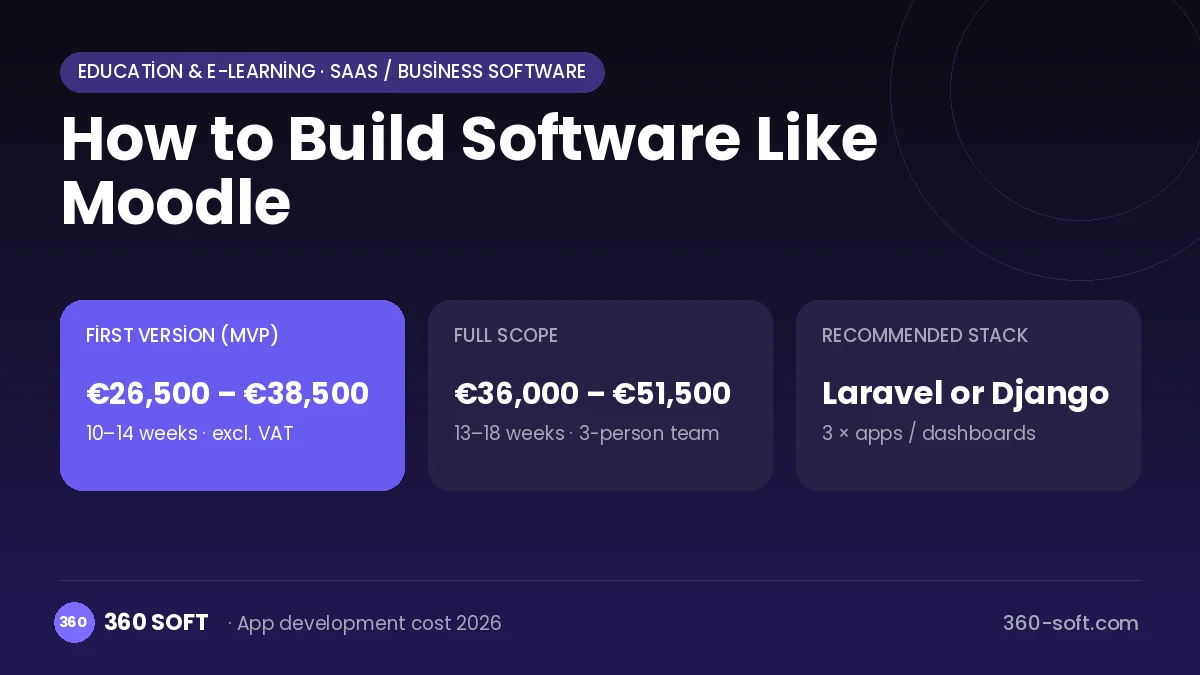
The budget is calculated with 360 SOFT’s pricing model from the modules below, about 30 screens and the project’s complexity: roughly 137 person-days for the full scope and 101 person-days for the first version. Every module you drop lowers the budget directly.
| Module | Phase |
|---|---|
| Sign-up, login, social login | First version |
| User profile and settings | First version |
| Roles and permissions | First version |
| Admin dashboard | First version |
| File, photo, video upload | First version |
| Video / voice calls | First version |
| Email / SMS notifications | First version |
| Reporting and analytics | Later release |
| Multi-language | First version |
| Content management / blog | First version |
| Third-party API integration | First version |
| GDPR and security hardening | First version |
Hosting, SMS, map APIs, app store accounts and payment-provider fees are separate items. Maintenance and improvements (optional): €450 / month. We send a fixed written price within 24 hours after a free discovery call.
The hard parts
Concurrent load at exam time
Hundreds of students starting a quiz in the same minute put sudden pressure on the database; sessions and answer saving must be cached and fault tolerant.
Permission model complexity
A layered role and permission system gives flexibility, but a poor design leads to data leaks and performance problems.
Personal data and minors' data
Student grades and identity details must be stored under GDPR-grade safeguards, with parent and institution access clearly limited.
Business model
Selling an annual licence per student or active user to institutions is the most common model. Cloud hosting, themes tailored to each customer, training and support packages add further revenue. With an open-source approach, the software can stay free while income comes from hosting, installation and enterprise support; paid plugins are another revenue line.
Get a free quote for your project
Let us scope it together and send a fixed written quote within 24 hours. NDA on request; you own the source code.
Choosing a company to build an app like Moodle
Most people searching “build software like moodle” are really looking for a reliable app development company. When comparing quotes, check four things:
- Can you try similar products they have shipped, in the stores or live?
- Are the source code, design files, servers and store accounts transferred to you by contract?
- Do they show a working demo every two weeks, with written scope and acceptance criteria?
- Are maintenance, scaling and GDPR/security costs written into the quote?
Copyright and trademarks
A business model and features are generally not protected on their own, but the Moodle name, logo, interface design, content and source code are. That is why we build a product with similar functionality but your own brand, design and code. This is not legal advice; we recommend a trademark search before launch.
Frequently asked questions
How long does it take to build software like Moodle?
A first release with courses, assignments, quizzes and a gradebook can be ready in a few months. SCORM support, a plugin framework and advanced reporting are added in stages.
Should we customise Moodle or build from scratch?
For a standard LMS need, adapting an open-source system is faster. If you want your own business model, a different user experience or a multi-tenant SaaS, custom development is more sustainable.
Will there be copyright or trademark issues?
The idea of a learning management system and its general features are free to use, but the name, logo, design, content and code cannot be copied in breach of their licences. This is general information, not legal advice.
What should I look for in an LMS development company?
Look at how the company has handled exam load, role management and GDPR compliance in earlier education projects. Command of standards such as SCORM and LTI, and the capacity to support a live system, also matter.