SaaS / business softwareBusiness software & SaaSOriginal by ClickUp
ClickUp promises "one app for everything", bringing tasks, docs, goals, chat and time tracking under one roof. Instead of switching between tools, teams manage all their work in a single hierarchy. Deep customisation, a large number of views and a fast product release pace make it attractive to companies that want to cut down the number of tools they use.
Building something similar needs a layered structure: a workspace, space, folder, list and task hierarchy; sub-tasks, checklists, dependencies and custom fields; rich-text docs; and time tracking and goals modules. It must be developed together with web, desktop and mobile clients, a notification service, an integration API and billing infrastructure.
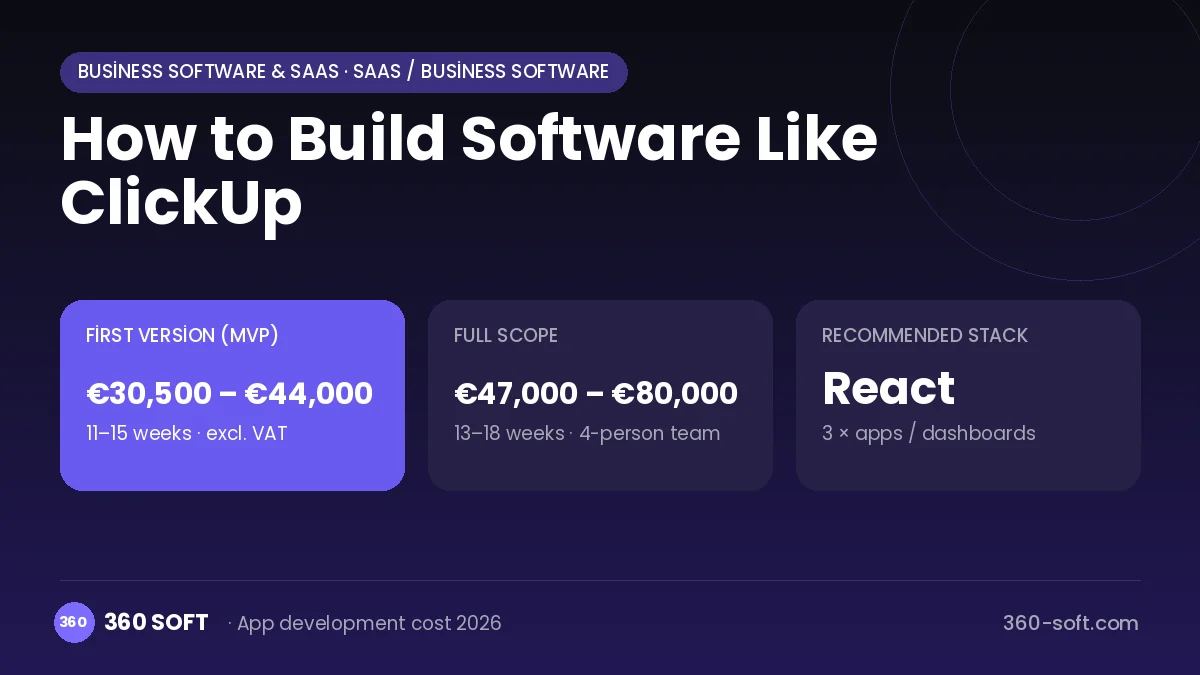
How ClickUp works: the core user flow
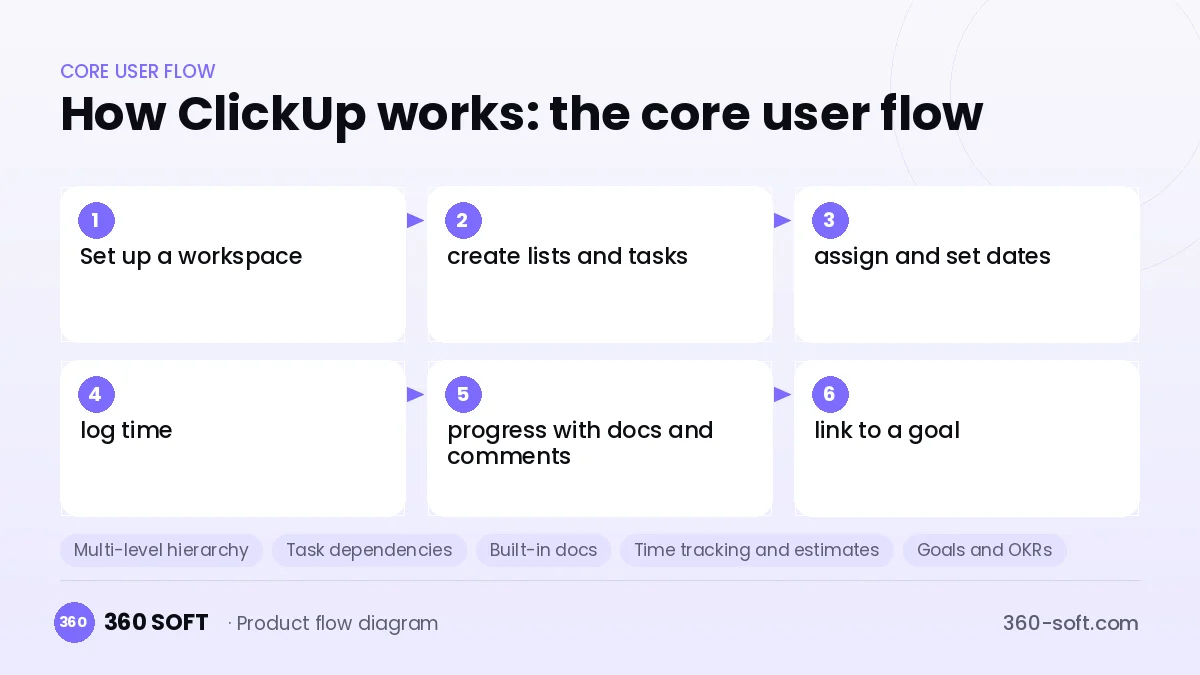
How many apps and dashboards do you need?
Web and desktop app
The full-featured working environment where teams manage tasks, docs and views.
Mobile app
A client used to update tasks, start time tracking and respond to notifications.
Admin panel
The screen where the workspace owner controls members, permissions, integrations and the subscription.
Critical features of a product like ClickUp
Multi-level hierarchy
Space, folder and list layers, where a different set of statuses and custom fields can be defined at each level.
Task dependencies
Waiting-on and blocking relationships show the critical path and date slippage automatically in the Gantt view.
Built-in docs
A rich-text editor with nested pages that can be linked to tasks and edited together.
Time tracking and estimates
Per-task time logging, estimated time, a billable-hours flag and timesheet reports.
Goals and OKRs
Measurable goals that progress with task completion give managers strategic visibility.
Bulk edit and templates
Updating hundreds of tasks at once, plus list, folder and task templates, speeds up repetitive work.
What goes into the first version, what comes later
First version (MVP)
- Workspace, list and task hierarchy
- Sub-tasks, checklists and custom statuses
- List and board views
- Task comments, attachments and notifications
- Time logging and simple reports
Later releases
- Collaboratively edited docs and a wiki
- Gantt, dependencies and a workload view
- Goals, OKRs and executive dashboards
- A desktop app and a broad integration library
Modules and how the budget is calculated
The budget is calculated with 360 SOFT’s pricing model from the modules below, about 34 screens and the project’s complexity: roughly 181 person-days for the full scope and 116 person-days for the first version. Every module you drop lowers the budget directly.
| Module | Phase |
|---|---|
| Sign-up, login, social login | First version |
| User profile and settings | First version |
| Roles and permissions | First version |
| Admin dashboard | First version |
| Subscriptions and recurring billing | First version |
| Email / SMS notifications | First version |
| Push notifications | First version |
| Reporting and analytics | Later release |
| File, photo, video upload | First version |
| Advanced search and filters | First version |
| Third-party API integration | First version |
| Offline mode and sync | Later release |
| Real-time messaging | First version |
Hosting, SMS, map APIs, app store accounts and payment-provider fees are separate items. Maintenance and improvements (optional): €600 / month. We send a fixed written price within 24 hours after a free discovery call.
The hard parts
Feature bloat
Adding many modules hurts performance and usability, so modules need to be switchable on demand.
Offline and sync
Merging changes made offline on mobile and desktop back into the server without conflicts is complicated.
Hierarchical permissions
Making permissions that are inherited and can be overridden at space, folder and list level behave consistently takes careful design.
Business model
A freemium structure with a monthly per-user subscription fits best. The free plan limits storage and some views; paid plans offer unlimited storage, advanced reports, time tracking and an automation quota. The enterprise plan adds SSO, white labelling and dedicated support, while add-ons such as an AI assistant can be sold as a separate paid package.
Get a free quote for your project
Let us scope it together and send a fixed written quote within 24 hours. NDA on request; you own the source code.
Choosing a company to build an app like ClickUp
Most people searching “build software like clickup” are really looking for a reliable app development company. When comparing quotes, check four things:
- Can you try similar products they have shipped, in the stores or live?
- Are the source code, design files, servers and store accounts transferred to you by contract?
- Do they show a working demo every two weeks, with written scope and acceptance criteria?
- Are maintenance, scaling and GDPR/security costs written into the quote?
Copyright and trademarks
A business model and features are generally not protected on their own, but the ClickUp name, logo, interface design, content and source code are. That is why we build a product with similar functionality but your own brand, design and code. This is not legal advice; we recommend a trademark search before launch.
Frequently asked questions
How long does it take to build software like ClickUp?
A first release with a task hierarchy, list and board views and time tracking takes a few months. Modules such as docs, goals and a desktop app should come in later phases.
Should we put everything into the first release?
No. The "everything in one place" vision is a long-term goal. It is healthier to start with a product that does one core job flawlessly, then add modules based on user feedback.
Will there be copyright or trademark problems?
Task management features and the business model are generally free to use; the name, logo, interface design, copy and code cannot be copied. This is not legal advice, and an original design is essential.
What should I look for when choosing a company to build software like ClickUp?
Choose a team that can run web, desktop and mobile on a shared backend and has experience with sync and performance optimisation. Asking for a modular architecture proposal is a good indicator.