SaaS / business softwareFintech & paymentsOriginal by Block
Square rose by letting small merchants accept cards without a bank application or long contracts. A tiny reader plugged into a phone, transparent processing fees and an account opened in minutes made card payments accessible to everyone. POS software, invoicing, inventory, staff management and small-business financing were then added, turning a single payment tool into an ecosystem that runs a business's whole day.
To build something similar you need a mobile POS app, card reader or SoftPOS (contactless payments on the phone) integration, a business dashboard, a risk and fraud monitoring system and fast merchant onboarding. In most markets, collecting payments and acquiring merchants requires a payment institution licence (for example under PSD2 in the EU); those who prefer to start without one build on a licensed provider's infrastructure and focus on the software layer.
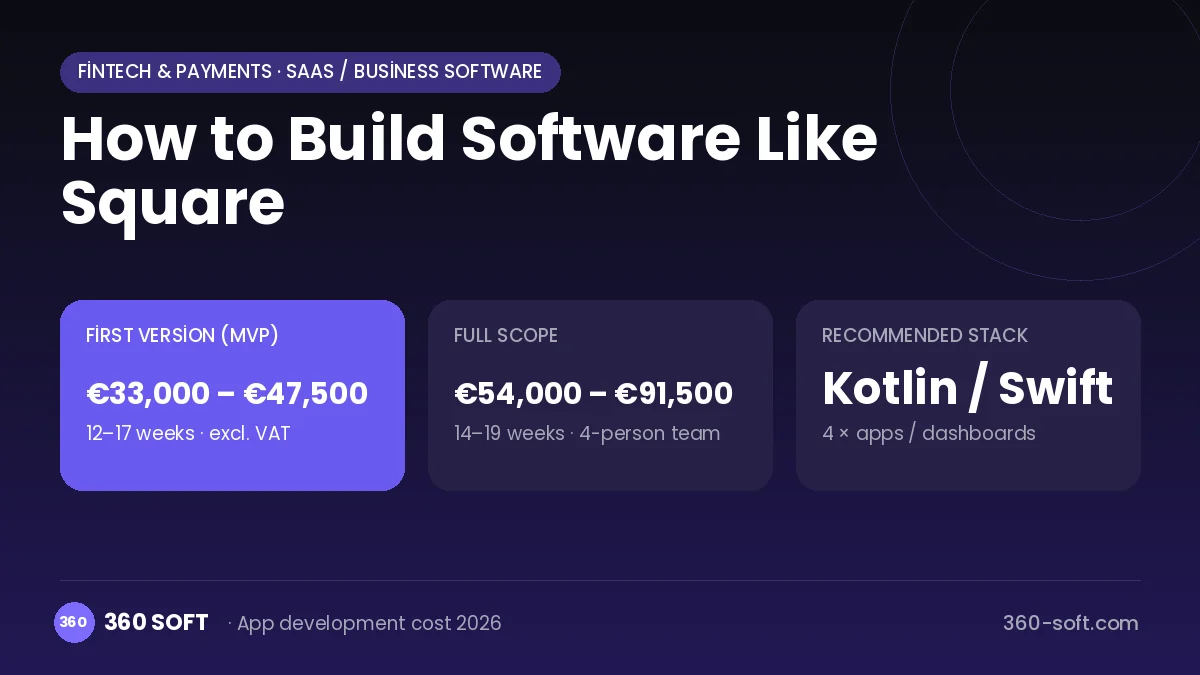
How Square works: the core user flow
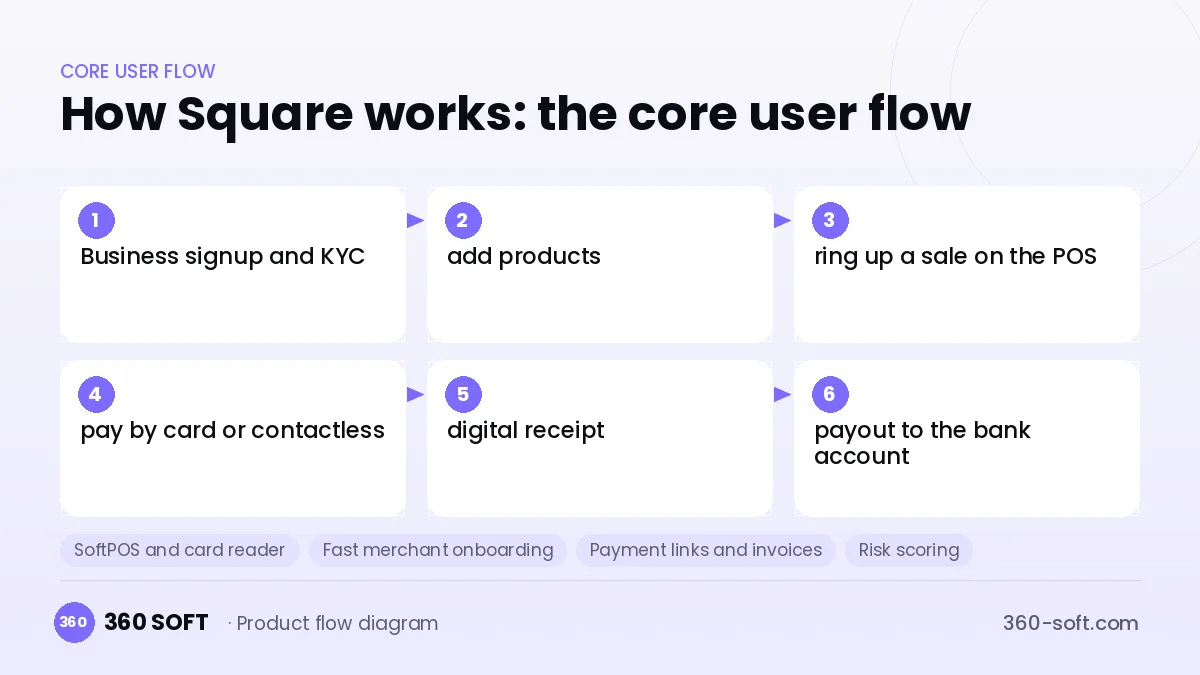
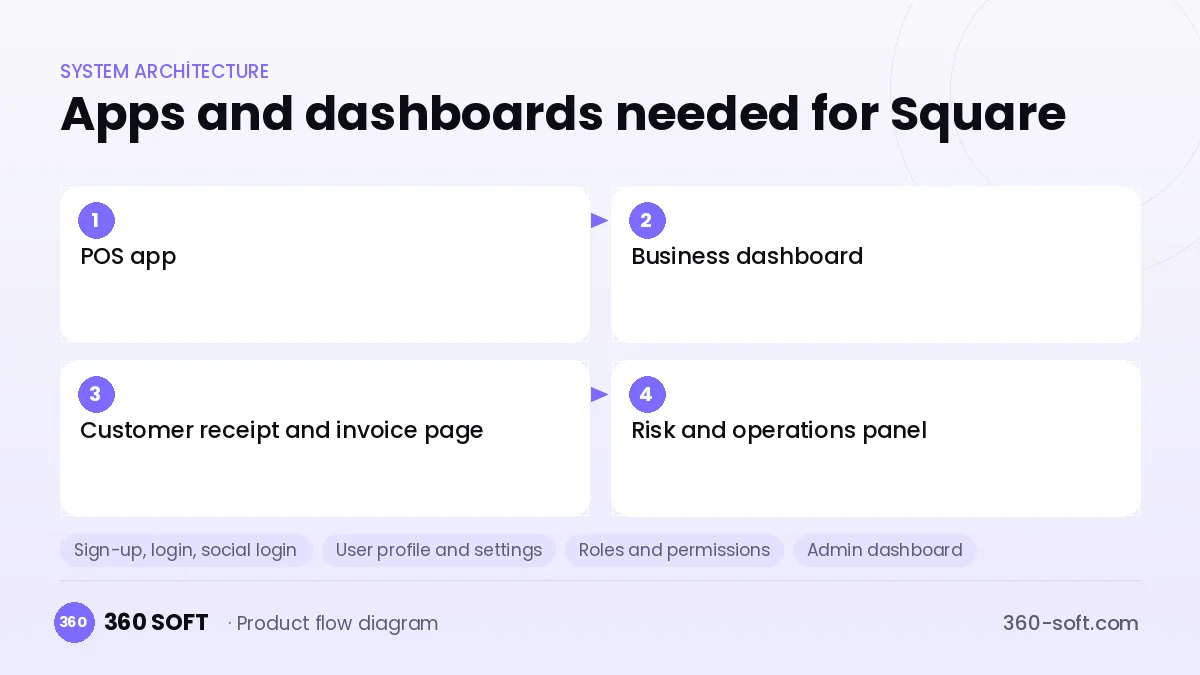
How many apps and dashboards do you need?
POS app
The app where merchants enter sales on a phone or tablet and take card, contactless and QR payments.
Business dashboard
The web dashboard that tracks sales, stock, staff, customers and account activity.
Customer receipt and invoice page
The page where the buyer sees their digital receipt, invoice and online payment link.
Risk and operations panel
The internal panel that manages merchant applications, suspicious transactions, chargebacks and payouts.
Critical features of a product like Square
SoftPOS and card reader
Contactless and chip card payments are taken with the phone's NFC or a small reader; certification processes need to be planned.
Fast merchant onboarding
With tax ID, identity and IBAN verification, a business can start selling within minutes.
Payment links and invoices
A payment link or invoice is sent to remote customers, and the system closes it automatically once paid.
Risk scoring
Suspicious transactions are held or sent for review based on business type, transaction amount and behaviour patterns.
Inventory and product catalogue
Barcode scanning, variants and stock alerts give small retailers simple inventory management.
Reconciliation and payouts
Daily sales, fees and refunds are shown clearly, and the balance is paid out to the IBAN on a set schedule.
What goes into the first version, what comes later
First version (MVP)
- POS app built on a licensed payment institution's infrastructure
- Merchant onboarding, KYC and IBAN verification
- Simple product catalogue and sale entry
- Digital receipts and payment links
- Daily sales and reconciliation report
Later releases
- Contactless phone payments with SoftPOS
- Inventory, staff and multi-location management
- Online store and appointment module
- Business loans and cash advance products (with the relevant licences)
Modules and how the budget is calculated
The budget is calculated with 360 SOFT’s pricing model from the modules below, about 32 screens and the project’s complexity: roughly 206 person-days for the full scope and 125 person-days for the first version. Every module you drop lowers the budget directly.
| Module | Phase |
|---|---|
| Sign-up, login, social login | First version |
| User profile and settings | First version |
| Roles and permissions | First version |
| Admin dashboard | First version |
| Online payments (Stripe / PSP) | First version |
| Subscriptions and recurring billing | First version |
| Product / content catalogue | First version |
| Barcode / RFID / handheld | Later release |
| Email / SMS notifications | First version |
| Reporting and analytics | Later release |
| E-invoicing | First version |
| GDPR and security hardening | First version |
| Third-party API integration | First version |
Hosting, SMS, map APIs, app store accounts and payment-provider fees are separate items. Maintenance and improvements (optional): €700 / month. We send a fixed written price within 24 hours after a free discovery call.
The hard parts
Licensing and regulation
Payment institution licensing, capital requirements, anti-money-laundering obligations and IT system audits are lengthy processes.
Card security
Every component that touches card data falls under PCI DSS; tokenisation and device certification are mandatory.
Fraud and chargebacks
Easy, fast signup also attracts fake businesses; risk models and holding rules limit losses.
Business model
The main revenue is a percentage processing fee on every card transaction. Monthly software subscriptions for advanced POS, inventory and staff modules, reader and register hardware sales, instant-payout fees and business financing offered with licensed partners are additional lines. A tiered rate reduction as volume grows strengthens loyalty.
Get a free quote for your project
Let us scope it together and send a fixed written quote within 24 hours. NDA on request; you own the source code.
Choosing a company to build an app like Square
Most people searching “build software like square” are really looking for a reliable app development company. When comparing quotes, check four things:
- Can you try similar products they have shipped, in the stores or live?
- Are the source code, design files, servers and store accounts transferred to you by contract?
- Do they show a working demo every two weeks, with written scope and acceptance criteria?
- Are maintenance, scaling and GDPR/security costs written into the quote?
Copyright and trademarks
A business model and features are generally not protected on their own, but the Square name, logo, interface design, content and source code are. That is why we build a product with similar functionality but your own brand, design and code. This is not legal advice; we recommend a trademark search before launch.
Frequently asked questions
How long does it take to build software like Square?
A POS app built on a licensed payment institution's infrastructure can go live in a few months. Acquiring merchants under your own licence and obtaining SoftPOS certification is a much longer process.
What licence is needed to accept payments?
Offering payment services and acquiring merchants generally requires a payment institution licence from your financial regulator. Partnering with a licensed institution and starting at the software layer is the faster route.
Will there be copyright or trademark issues?
The mobile POS and payments business model is generally free to use; however, the name, logo, hardware design, interface, copy and code cannot be copied. This is general information, not legal advice.
What should I look for when choosing a company to build payments software?
Look for experience with PCI DSS, tokenisation, payment provider integration and financial reconciliation. Ask how they manage security testing and audit records.