SaaS / business softwareBusiness software & SaaSOriginal by Toast
Toast differs from general-purpose POS systems by being designed specifically for restaurants. Servers take orders on a handheld device, orders land instantly on the kitchen display, and payment is taken at the table; online ordering, delivery, staff scheduling and inventory come together in one system. Delivering hardware, software and payment services from a single vendor gives the owner one point of contact and improves reliability during busy service hours.
To build something similar you need a tablet and handheld POS app, a kitchen display system, a restaurant management dashboard, an online ordering site and a cloud backend that ties them together. An offline mode that keeps working when the internet drops is essential. For payments, unless you hold your own licence, you rely on a licensed payment institution or acquirer and integrate with card terminals; local fiscal-device and tax-receipt rules must be planned separately for each market.
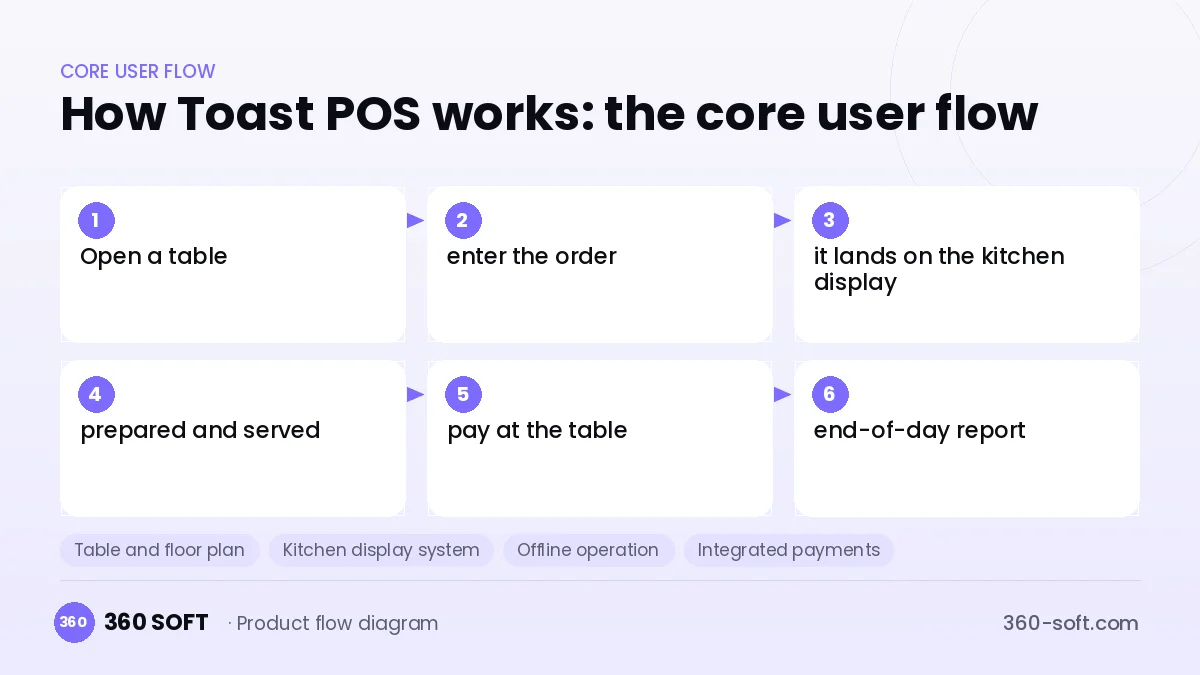
How Toast POS works: the core user flow
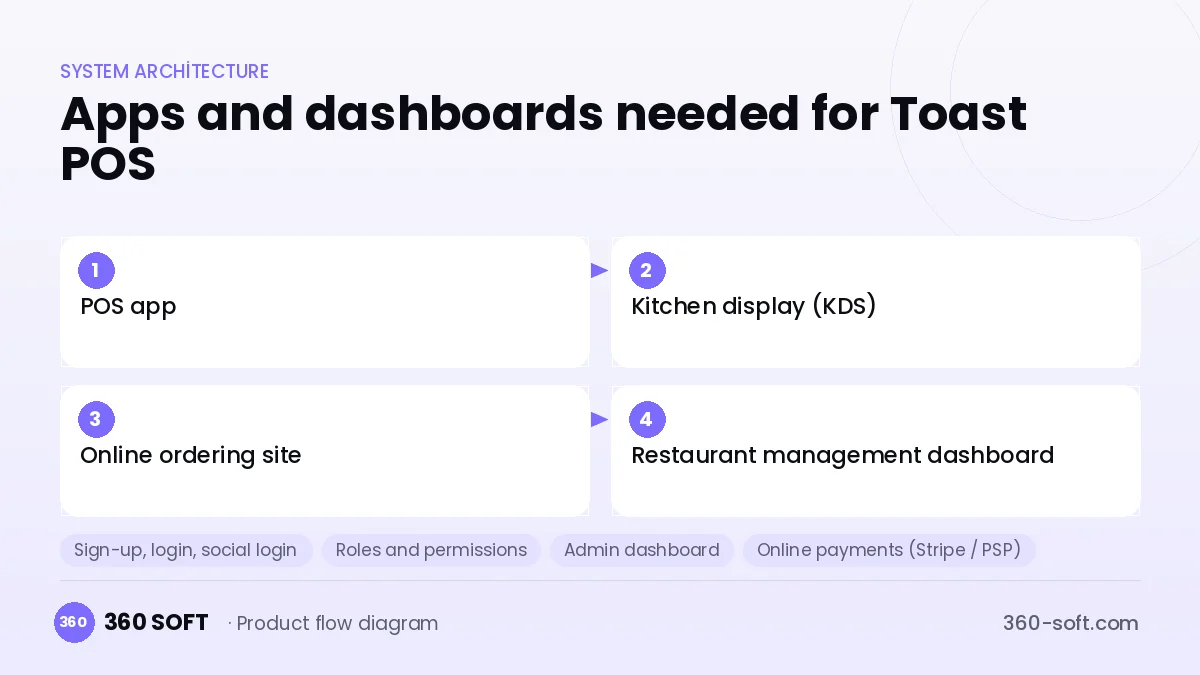
How many apps and dashboards do you need?
POS app
The app where servers and cashiers enter orders and take payment on a tablet or handheld.
Kitchen display (KDS)
The screen where cooks see orders by station and mark them ready.
Online ordering site
The restaurant-specific ordering page where customers place delivery or pickup orders.
Restaurant management dashboard
The cloud dashboard for managing menus, prices, staff, stock, locations and sales reports.
Critical features of a product like Toast POS
Table and floor plan
Tables are opened, merged, moved and bills split from a visual plan of the dining room.
Kitchen display system
Orders are routed to stations such as grill, cold kitchen and bar, and waiting times are flagged with colours.
Offline operation
When the internet drops, orders keep being processed on the local network and sync to the cloud once the connection returns.
Integrated payments
Card, contactless and QR payments are taken at the table; tipping and bill splitting are part of the payment flow.
Menu and modifier management
Cooking temperatures, extra ingredients and combo meals are published from one place to every location and channel.
Inventory and recipe tracking
Every item sold is deducted from stock according to its recipe, producing low-stock and waste reports.
What goes into the first version, what comes later
First version (MVP)
- Tablet POS with table and order management
- Kitchen display or kitchen printer support
- Menu, modifier and price management
- Cash and card payment records, end-of-day report
- Offline mode and cloud sync
Later releases
- Online ordering site and delivery platform integration
- Recipe-based inventory and supplier ordering
- Staff scheduling and payroll preparation
- Multi-location head-office management and a loyalty programme
Modules and how the budget is calculated
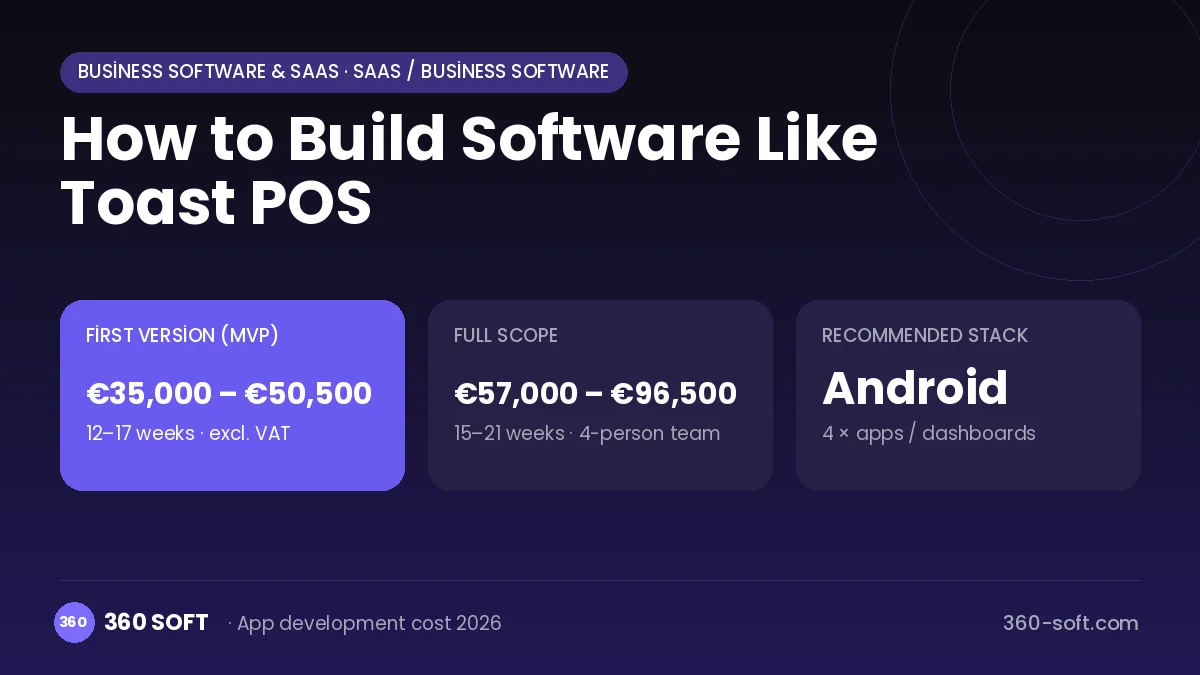
The budget is calculated with 360 SOFT’s pricing model from the modules below, about 30 screens and the project’s complexity: roughly 217 person-days for the full scope and 134 person-days for the first version. Every module you drop lowers the budget directly.
| Module | Phase |
|---|---|
| Sign-up, login, social login | First version |
| Roles and permissions | First version |
| Admin dashboard | First version |
| Online payments (Stripe / PSP) | First version |
| Subscriptions and recurring billing | First version |
| Product / content catalogue | First version |
| Offline mode and sync | First version |
| Barcode / RFID / handheld | Later release |
| Reporting and analytics | First version |
| ERP / accounting integration | Later release |
| E-invoicing | First version |
| IoT device and sensor integration | Later release |
| Third-party API integration | First version |
Hosting, SMS, map APIs, app store accounts and payment-provider fees are separate items. Maintenance and improvements (optional): €750 / month. We send a fixed written price within 24 hours after a free discovery call.
The hard parts
Zero downtime during service
An outage on a Friday night stops the restaurant; offline architecture and a local-network fallback are the foundation of the product.
Hardware diversity
Compatibility with different printers, handhelds, cash drawers and card terminals needs constant testing.
Payments and fiscal compliance
Taking payments requires cooperation with a licensed payment institution, and local fiscal-device and tax-receipt integrations must be built to the regulations.
Business model
Restaurants pay a monthly software subscription, tiered by the number of devices and locations. A share of payment processing can be the strongest revenue line, though it is usually structured as revenue sharing with a licensed payment partner. Hardware sales or rental, an online ordering module, and inventory and staffing add-ons bring extra income.
Get a free quote for your project
Let us scope it together and send a fixed written quote within 24 hours. NDA on request; you own the source code.
Choosing a company to build an app like Toast POS
Most people searching “build software like toast pos” are really looking for a reliable app development company. When comparing quotes, check four things:
- Can you try similar products they have shipped, in the stores or live?
- Are the source code, design files, servers and store accounts transferred to you by contract?
- Do they show a working demo every two weeks, with written scope and acceptance criteria?
- Are maintenance, scaling and GDPR/security costs written into the quote?
Copyright and trademarks
A business model and features are generally not protected on their own, but the Toast POS name, logo, interface design, content and source code are. That is why we build a product with similar functionality but your own brand, design and code. This is not legal advice; we recommend a trademark search before launch.
Frequently asked questions
How long does it take to build software like Toast POS?
A first release covering tables, orders, kitchen display and the end-of-day report can reach the field in a few months. Be sure to add hardware compatibility and pilot use in real restaurants to your plan.
Do I need a licence to take payments in a POS?
Collecting payments in your own name requires a payment institution licence under the rules of your jurisdiction. Most start-ups begin by integrating the POS infrastructure of a licensed payment institution or bank.
Will there be copyright or trademark issues?
The restaurant POS business model and its features are generally free to use; however, the name, logo, interface design, copy and code cannot be copied. This is general information, not legal advice.
What should I look for when choosing a company to build restaurant POS software?
Choose a team with experience in offline-capable apps, hardware integration and payment infrastructure. Ask whether they run pilot tests in real restaurants.