Business process outsourcing in Turkey gives companies in the EU, the UK and North America a nearshore option for customer support, back office, finance operations, e-commerce operations, digital marketing and software teams. 360 Soft runs these teams from Istanbul, together with the software that makes the work measurable: CRM, workflow, automation and reporting. Teams work remotely, on your premises or in a hybrid setup, with service levels written into the contract.
This page is written for operations, finance and procurement leaders who are evaluating Turkey as a delivery location. It covers what can be outsourced, how time zones and languages work in practice, how GDPR and Turkish data protection law fit together, which delivery and pricing models are available, and what to check before you sign with any provider, including us.
Who considers Turkey for BPO and ITO?
- European scale-ups that need multilingual support or operations capacity faster than they can hire locally, and want working-hour overlap rather than an overnight hand-off.
- UK companies looking for an alternative or complement to existing offshore locations, with a shorter flight and a closer working day.
- US companies with European customers that need a team awake during European business hours to cover support, operations or follow-the-sun handovers.
- E-commerce and marketplace sellers expanding into Turkey, the Middle East or Central Asia that need local-language operations.
- Software companies that want engineering and IT capacity next to their operations team, under one partner and one contract.
What can be outsourced
| Service area | Typical tasks | Tools and technology |
|---|---|---|
| Customer support and contact center | Phone, email, live chat and social support; order and delivery queries; complaints; tier-1 technical support | Cloud telephony, omnichannel CRM, knowledge base, chatbots |
| Back office and data processing | Document indexing, data entry and validation, KYC document pre-checks, claims intake, record management | OCR, workflow, document management |
| Finance back office | Invoice processing, three-way matching, collections follow-up, bank and account reconciliation, expense audit, month-end support | ERP, e-invoicing integration, RPA |
| E-commerce and marketplace operations | Product listing and catalog management, price and stock updates, order and returns handling, marketplace Q&A | Marketplace panels, PIM, integrators |
| Digital marketing and content | Performance campaigns, SEO, content production, design, community and review moderation | Ad platforms, marketing automation, analytics |
| Software development and IT | Web and mobile development, QA and test automation, integrations, IT service desk, DevOps | Hire developers in Turkey, offshore development center |
Decisions that carry legal or regulatory accountability stay with you: credit decisions, final AML or suspicious activity decisions, clinical judgement, pricing strategy and payment approvals. The outsourced team prepares, documents and accelerates those decisions; it does not make them for you.
Typical team structure
| Role | Responsibility | Note |
|---|---|---|
| Service delivery manager | Single point of contact; SLA reporting; weekly and monthly reviews | Usually English-speaking, can join your internal meetings |
| Team lead | Shift planning, quality, escalation | Typically one per 8 to 15 agents, depending on complexity |
| Agents / specialists | Day-to-day handling of tickets, calls, documents or transactions | Language and domain skills defined per role |
| Quality analyst | Call and ticket reviews, calibration with your team, coaching | Scores agreed with you in advance |
| Workforce planner | Forecasting, scheduling, real-time adherence | Shared across smaller teams |
| Automation / software engineer | Integrations, RPA, dashboards | Part-time or project-based as needed |
Why Turkey: time zone, languages and proximity
Time zone overlap
Turkey uses Turkey Time (UTC+3) all year and does not switch to daylight saving time. In practice this means the working day in Istanbul is one to two hours ahead of Central European time and two to three hours ahead of the UK, depending on the season. A standard Istanbul shift therefore covers most or all of the European business day, and late shifts can cover European evenings without night premiums in the same way an overnight offshore shift would.
For US companies, Istanbul is roughly seven to eight hours ahead of the East Coast and ten to eleven hours ahead of the West Coast, again depending on the season. Turkish morning and afternoon hours cover European customers, and the end of the Turkish day overlaps with the start of the US East Coast morning, which works well for daily handovers. Teams can also be scheduled on later shifts to extend coverage into US hours where needed.
| Your location | Approximate difference to Istanbul | Practical overlap |
|---|---|---|
| UK and Ireland | Istanbul 2–3 hours ahead | Full UK business day can be covered with standard or slightly late shifts |
| Central Europe (e.g. Germany, Netherlands, France) | Istanbul 1–2 hours ahead | Near-complete overlap |
| Gulf states | Same time or Istanbul 1 hour behind | Full overlap |
| US East Coast | Istanbul 7–8 hours ahead | Shared window in the US morning; late shifts extend coverage |
| US West Coast | Istanbul 10–11 hours ahead | Limited overlap; asynchronous handover or dedicated late shift |
Languages
Istanbul’s labour market includes graduates of English-medium universities and people who grew up or studied in Germany, the Balkans, the Middle East and Central Asia. That makes it practical to staff teams in Turkish and English and, depending on the role and the hiring market at the time, in languages such as German, Arabic, Russian, French and Azerbaijani. Language availability varies by skill level and volume, so we assess it for each project rather than promising a fixed list; for high-volume or less common languages, allow more time for recruitment.
Proximity and culture
Istanbul is a short flight from most European capitals and has direct connections to many US hubs. Workshops, onboarding visits and quarterly reviews can be done in person without much overhead. Many Turkish professionals have worked with European companies or for international brands, which helps with communication style, escalation habits and documentation expectations.
Data protection: GDPR, UK GDPR and Turkish law
Data protection is usually the first question from EU and UK buyers, and rightly so. The summary below is general information; your data protection officer and legal counsel should confirm the approach for your specific processing.
- Turkey and adequacy: Turkey does not have an adequacy decision from the European Commission or the UK. Transfers of personal data from the EU or UK to a provider in Turkey therefore need an appropriate safeguard.
- Standard Contractual Clauses: For EU data, the European Commission’s Standard Contractual Clauses (usually the controller-to-processor module) are the common mechanism. For UK data, the UK International Data Transfer Agreement or the UK Addendum to the EU SCCs is used.
- Transfer impact assessment: Under the Schrems II line of guidance, the exporter should assess the legal environment of the destination country and document supplementary measures, such as encryption, access controls and data minimisation.
- Data processing agreement: An Article 28 GDPR data processing agreement defines instructions, sub-processors, security measures, breach notification and audit rights.
- Turkish Personal Data Protection Law (KVKK, Law No. 6698): KVKK was modelled largely on the earlier EU framework and its cross-border transfer rules were revised in 2024 to move closer to the GDPR approach, including standard contracts. When your data is processed in Turkey, KVKK applies alongside your own obligations.
- Data minimisation by design: In many setups, the team in Turkey works inside your systems through secure remote access, so data stays in your environment and only what is needed for the task is visible.
- Sector rules: Health data, payment card data and financial services data bring additional requirements, for example HIPAA business associate terms for US health data, PCI DSS for card data, and outsourcing guidelines from financial regulators. These are scoped per project.
Delivery models
| Model | How it works | When it fits |
|---|---|---|
| Remote (from Istanbul) | The team works from 360 Soft’s office or remotely and connects to your tools | Support, back office, finance operations, marketing, software: most engagements |
| On-site | Team members work at your location in Turkey | Physical work, local warehouses or stores, regulated environments that require on-premise access |
| Hybrid | Core team remote, with on-site presence for onboarding, peaks or specific tasks | Transitions, multi-site operations, periodic audits |
| Engagement model | What it means | Example |
|---|---|---|
| Dedicated team | A team that works only for you, managed by 360 Soft, with agreed roles and capacity | A multilingual support desk or a dedicated development team |
| Staff augmentation | Specialists added to your existing team under a service agreement | Two QA engineers joining your release cycle |
| Managed service | A full process handed over against SLAs; staffing and tooling are our responsibility | End-to-end invoice processing or tier-1 support |
| Project-based | Fixed scope and timeline | Data migration, catalog clean-up, backlog clearance |
For software-heavy engagements, see also nearshore software development in Turkey. Teams are employed by 360 Soft under Turkish labour law and work under a service contract with you. 360 Soft is not a temporary employment agency, so engagements are structured as service delivery with defined outputs and service levels, not as staff placed under your direct instruction as their employer.
How a transition works
| Step | What happens | Typical duration |
|---|---|---|
| 1. Discovery | Volumes, channels, languages, systems, current KPIs and pain points | 1–2 weeks |
| 2. Solution design | Scope, team structure, SLAs, reporting, security and data transfer approach | 1–2 weeks |
| 3. Contract | Master services agreement, statement of work, DPA and SCCs, NDA | 1–3 weeks |
| 4. Recruitment and training | Hiring or assigning from our pool, product and process training, system access | 2–6 weeks, depending on languages and volume |
| 5. Knowledge transfer and shadowing | Team works alongside your staff with increasing responsibility | 1–3 weeks |
| 6. Go-live and stabilisation | Full handover, daily check-ins, SLA ramp-up | 4–8 weeks |
| 7. Continuous improvement | Monthly reviews, automation opportunities, capacity planning | Ongoing |
SLAs and KPIs
| Area | Typical KPIs | Note |
|---|---|---|
| Customer support | Service level, first response time, first contact resolution, CSAT | Separate targets for peak periods can be agreed |
| Back office | Turnaround time, accuracy rate, backlog age | Verified by sample-based quality checks |
| Finance operations | Invoice cycle time, first-time-right rate, reconciliation completion, days to close support | Aligned to your closing calendar |
| E-commerce | Listing time, marketplace response time, cancellation rate | Aligned to marketplace metrics |
| Software and IT | Sprint delivery, escaped defects, ticket resolution time | Reported per release or per month |
| Governance | Attrition, training completion, security incidents and notification time | Reviewed in quarterly business reviews |
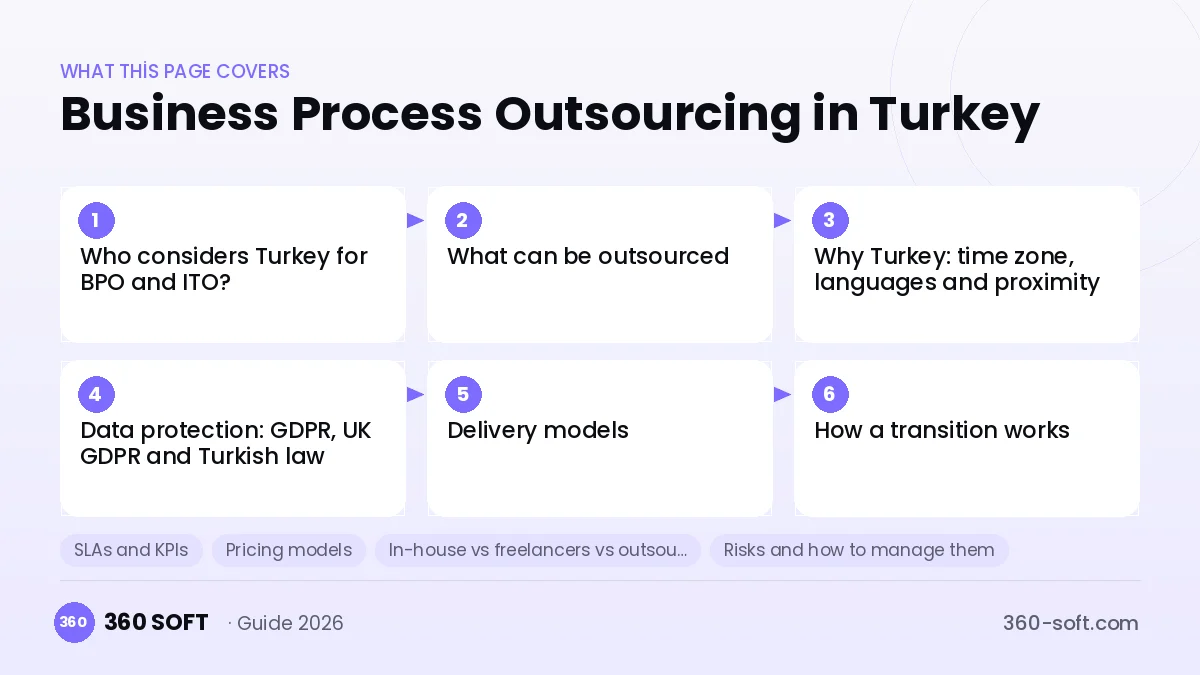
Pricing models
We do not publish a price list, because cost depends on languages, hours, complexity and tooling. These are the models we use:
- FTE per month: A monthly fee per full-time role. Most common for dedicated teams and staff augmentation.
- Hourly: For irregular or low-volume work, such as overflow support or ad-hoc projects.
- Fixed price: For clearly scoped projects such as a migration or backlog clearance.
- Outcome-based: A price per ticket, transaction, document or listing. Works best when volumes are predictable, and should always be paired with quality KPIs.
| Cost driver | Effect |
|---|---|
| Languages | Less common languages cost more and take longer to hire |
| Coverage hours | Evening, weekend and 24/7 coverage increase the number of shifts |
| Complexity and seniority | Tier-2 technical or finance roles cost more than tier-1 roles |
| Security requirements | Dedicated devices, segregated networks or on-site work add cost |
| Tooling | Whether we run on your tools or provide telephony, CRM and reporting |
| Volume volatility | Flexible capacity for peaks is priced differently from fixed capacity |
In-house vs freelancers vs outsourcing to Turkey
| Criterion | In-house team | Freelancers | Outsourcing (360 Soft) |
|---|---|---|---|
| Time to start | Long: hiring, onboarding, equipment | Short, but person-dependent | Planned ramp-up with team and process together |
| Scalability | Slow and costly | Limited | Contractual flexibility for peaks |
| Continuity | Gaps during leave and attrition | Knowledge leaves with the person | Back-up and handover are the provider’s responsibility |
| Management overhead | Fully yours | Task coordination is yours | Day-to-day management by the provider; oversight by you |
| Data protection | Under your direct control | Hard to control and document | DPA, SCCs, access controls and audit rights |
| Measurement | You build it | Usually none | SLA and KPI reporting in the contract |
| Best for | Core, strategic, differentiating work | Short, specialised tasks | Repeatable, measurable and variable-volume work |
Risks and how to manage them
| Risk | Mitigation |
|---|---|
| Quality drop after transition | Shadowing period, calibration sessions, quality scorecards, staged volume increase |
| Attrition | Documented knowledge base, short standard training modules, back-up staff, attrition reported as a KPI |
| Data transfer non-compliance | SCCs or IDTA, transfer impact assessment, data minimisation, remote access into your systems |
| Currency and cost changes | Pricing currency and review mechanism agreed in the contract |
| Vendor lock-in | Documentation kept in your environment, exit plan and handover support in the contract |
| Communication gaps | Named service manager, fixed meeting cadence, shared dashboards, clear escalation path |
| Business continuity | Remote-work capability, alternate site planning, regular continuity tests |
Security, confidentiality and IP
- Access control: Named accounts, multi-factor authentication, least-privilege roles and periodic access reviews.
- Endpoint and network security: Company-managed devices, VPN, restrictions on removable media and personal devices where required.
- Logging: Access and activity logs available for your audits.
- Confidentiality: A mutual NDA with your company and individual confidentiality undertakings from team members.
- Intellectual property: Work product, including code, scripts, templates, reports and automations, is assigned to you under the contract.
- Audit rights: You and, where relevant, your regulators can audit the service as agreed in the contract.
Provider selection checklist
- Can the provider explain how GDPR transfers will be handled (SCCs or IDTA, transfer impact assessment, DPA) in concrete terms?
- Can it staff the languages and coverage hours you need, and how long will hiring take?
- Are SLAs and KPIs measurable, and how often and in what format are they reported?
- Does it offer both operations and the software side (automation, integrations, reporting)?
- Who is the single point of contact, and what is the escalation path?
- How are attrition, training and knowledge retention managed?
- Is there a written exit plan and handover commitment?
- Will it support a pilot or a phased transition before full volume?
- Can it provide verifiable references relevant to your industry? Ask for them and check them.
Illustrative scenario: a German online retailer
Illustrative scenario, not a client case. A German online retailer selling across several EU markets needs German and English customer support, plus marketplace catalog work, without expanding its office. A possible setup: after discovery, a small remote team in Istanbul is hired for German and English support and trained on the retailer’s products and returns policy. The team works inside the retailer’s own helpdesk and marketplace accounts, so customer data stays in the retailer’s systems. A DPA and SCCs cover the transfer, and access is limited to the fields agents need. Support runs during the German business day, with a later shift for evening chat. After a shadowing period, volume is increased in stages, and a monthly report tracks service level, first contact resolution, CSAT and listing turnaround.
Frequently asked questions
What is business process outsourcing in Turkey?
It means handing operational processes such as customer support, back office, finance operations, e-commerce operations or IT to a provider whose team is based in Turkey. The work is delivered remotely or on site under a service contract with agreed SLAs.
Is Turkey nearshore or offshore for European companies?
For most of Europe, Turkey is generally treated as nearshore: it is a short flight away and Istanbul is only one to three hours ahead of UK and Central European time, so the working days largely overlap.
How does the time difference work with the US?
Istanbul is roughly seven to eight hours ahead of the US East Coast and ten to eleven hours ahead of the West Coast. The end of the Turkish working day overlaps with the US East Coast morning, which suits daily handovers, and later shifts can extend coverage.
Is outsourcing to Turkey GDPR compliant?
It can be, with the right safeguards. Turkey has no EU adequacy decision, so transfers typically rely on Standard Contractual Clauses (or the UK IDTA or Addendum for UK data), a transfer impact assessment, a data processing agreement and technical measures such as access control and data minimisation.
Can the team work inside our own systems?
Yes, and this is often the preferred setup. The team connects to your helpdesk, CRM, ERP or marketplace accounts with named, least-privilege accounts, so data stays in your environment.
Which languages can you support?
Turkish and English are the base. Depending on the role and the hiring market, teams can also be staffed in languages such as German, Arabic, Russian, French and Azerbaijani. We confirm availability and hiring time per project.
What delivery models do you offer?
Remote, on-site and hybrid delivery, combined with a dedicated team, staff augmentation, managed service or project-based engagement, depending on how much control and flexibility you need.
How is pricing structured?
We use FTE per month, hourly, fixed price or outcome-based pricing per ticket, transaction or document. Languages, coverage hours, seniority, security requirements and tooling are the main cost drivers.
How long does a transition take?
A typical transition from discovery to stable operation takes around two to four months. Smaller remote scopes can go faster, while rare languages or complex integrations take longer.
Who employs the team?
Team members are employed by 360 Soft under Turkish labour law and deliver the service under a contract with you. 360 Soft is not a temporary employment agency and does not place staff under your direct employment authority.
Who owns the work product and intellectual property?
You do. Code, scripts, templates, reports, automations and documentation produced for you are assigned to you under the contract.
Can we start with a pilot?
Yes. Many engagements start with a limited scope, one channel or one process, and expand after the pilot meets the agreed KPIs.
Related pages
- Hire developers in Turkey
- Offshore development center in Turkey
- Nearshore software development in Turkey
- Dedicated development team
To discuss which processes you want to outsource, call +90 850 335 10 87, email info@360-soft.com or use our contact page. 360 Soft Marketing Yazılım ve Danışmanlık Ltd. Şti. is based at Nidakule Ataşehir, Istanbul. Sharing your volumes, languages and coverage hours helps us prepare a setup plan and a written quote faster.
What would you like to outsource? Tell us the process, volume and languages; we will send a setup plan and a written quote. WhatsApp · info@360-soft.com