Hire Node.js developers in Turkey. Node.js developers build the server side of modern products: REST and GraphQL APIs, microservices, real-time features, integrations and the backends that power web and mobile apps. Our Node.js engineers, most of whom work in TypeScript, join your team or deliver your backend end to end from Istanbul, in a time zone that shares most of the working day with Europe and the Gulf.
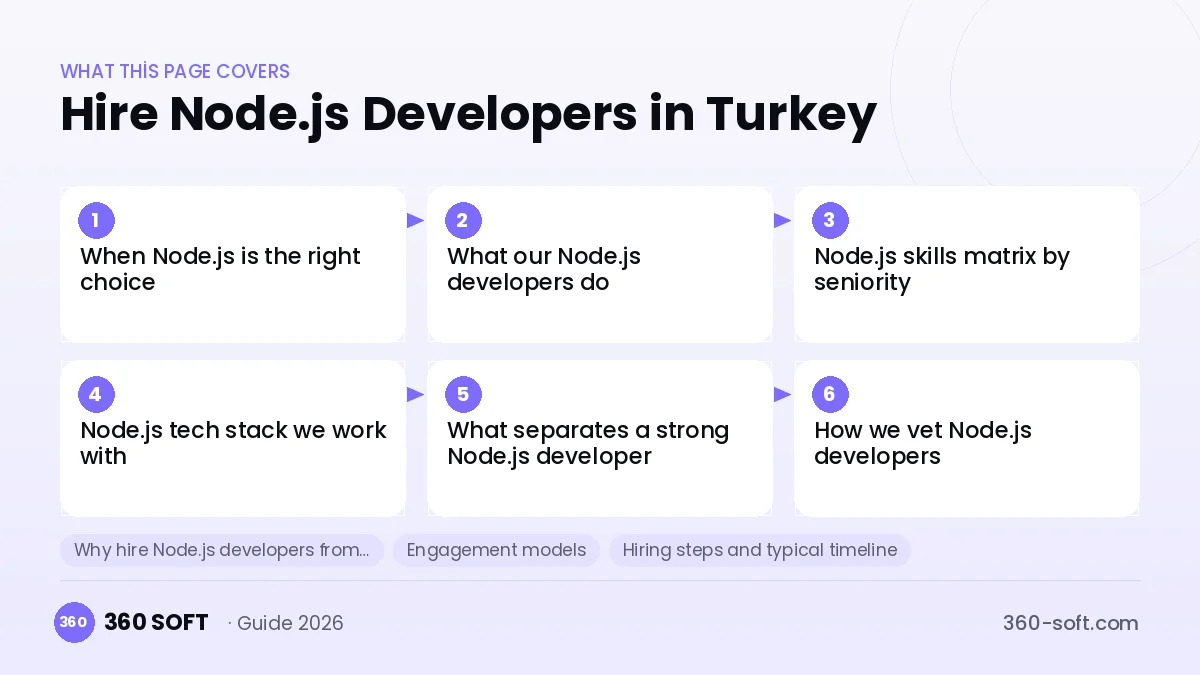
This page explains when Node.js is a good fit, what our developers handle, a seniority skills matrix, the frameworks and infrastructure we work with, vetting, onboarding times, pricing factors and contract terms. For other stacks, see hire developers in Turkey.
When Node.js is the right choice
- Your product is API-driven and serves web and mobile clients, often with a React, Next.js or React Native front end.
- You need real-time features: chat, notifications, live dashboards, collaborative editing, tracking or multiplayer game backends.
- You want one language, TypeScript, across frontend and backend, sharing types, validation schemas and tooling.
- You are building or splitting microservices, serverless functions or a backend-for-frontend (BFF) layer.
- You integrate many third-party services: payments, CRMs, ERPs, messaging, identity providers and webhooks.
Node.js is not the best fit for every workload. Heavy CPU-bound processing, such as large numerical computation or video encoding, is often better placed in worker services written in Go, Rust, Java or Python, with Node.js orchestrating them. A good Node.js lead will say so rather than force everything into one runtime.
Typical Node.js systems
- APIs for mobile apps built with Flutter, React Native, iOS or Android
- SaaS platforms with multi-tenancy, billing and role-based access
- E-commerce backends, order management and marketplace integrations
- Fintech services: onboarding, KYC workflows, ledgers and payment orchestration
- Real-time chat, notification and event-processing services
- Internal integration hubs connecting ERP, CRM and legacy systems
What our Node.js developers do
| Area | Typical tasks |
|---|---|
| API design | REST and GraphQL APIs, OpenAPI specs, versioning, pagination, rate limiting, error handling conventions |
| Architecture | Modular monoliths, microservices, event-driven design, BFFs, serverless functions, domain-driven design where it helps |
| Data | PostgreSQL, MySQL, MongoDB, Redis; schema design, migrations, query optimisation, ORMs such as Prisma, TypeORM and Drizzle |
| Messaging and real time | WebSockets and Socket.IO, Kafka, RabbitMQ, SQS, BullMQ background jobs |
| Security | Authentication with OAuth 2.0/OpenID Connect and JWT, authorisation models, input validation, secrets management, OWASP API Top 10 |
| Quality | Unit and integration tests with Jest or Vitest, contract tests, load tests, linting and strict TypeScript |
| DevOps | Docker, CI/CD pipelines, Kubernetes or serverless deployment, logging, metrics, tracing with OpenTelemetry |
Node.js skills matrix by seniority
| Skill | Mid-level | Senior | Lead |
|---|---|---|---|
| TypeScript and Node.js runtime | Async/await, modules, typing APIs | Event loop internals, streams, worker threads, memory profiling | Sets coding standards and runtime choices |
| Frameworks | Builds endpoints in Express or NestJS | Designs modules, middleware, DI and plugin structure | Chooses frameworks and service boundaries |
| Data | Writes queries and migrations | Schema design, indexing, transactions, caching strategy | Data architecture across services |
| Distributed systems | Calls other services and queues | Idempotency, retries, eventual consistency, event-driven patterns | Overall system design and reliability goals |
| Security | Follows auth patterns in place | Implements OAuth/OIDC flows, threat-models endpoints | Security architecture and review process |
| Testing | Unit tests | Integration, contract and load tests | Test strategy and CI quality gates |
| Operations | Reads logs and fixes bugs | Observability, performance tuning, on-call | SLOs, incident process and capacity planning |
Node.js tech stack we work with
| Category | Tools and technologies |
|---|---|
| Language and runtime | TypeScript, JavaScript, Node.js LTS releases |
| Frameworks | NestJS, Express, Fastify, Koa, Hono, Next.js API routes, Apollo Server, tRPC |
| Databases and ORMs | PostgreSQL, MySQL, MongoDB, Redis, Elasticsearch; Prisma, TypeORM, Drizzle, Mongoose, Knex |
| Messaging | Kafka, RabbitMQ, AWS SQS/SNS, BullMQ, NATS |
| Validation and docs | Zod, class-validator, Joi, OpenAPI/Swagger |
| Testing | Jest, Vitest, Supertest, Pact, k6, Artillery |
| Cloud and DevOps | AWS (Lambda, ECS, EKS, RDS), Azure, Google Cloud, Docker, Kubernetes, Terraform, GitHub Actions, GitLab CI |
| Observability | OpenTelemetry, Prometheus, Grafana, Datadog, Sentry, ELK |
What separates a strong Node.js developer
Writing an endpoint in Node.js is easy; running a backend that stays fast, secure and predictable under real traffic is not. Strong Node.js engineers understand the event loop well enough to know what blocks it, design APIs that are consistent and versioned, handle retries and duplicate events without corrupting data, and leave behind logs and metrics that make the next incident shorter. In interviews we ask candidates to discuss systems they have operated: how they diagnosed a memory leak or a latency spike, how they designed an idempotent payment or order endpoint, how they split a monolith, or how they secured an API exposed to mobile clients. We also look for strict, readable TypeScript and clear communication in English with product owners and frontend teams.
How we vet Node.js developers
- Scorecard with you: framework, databases, cloud, messaging, testing and on-call expectations.
- Screening call on systems built and operated, English and availability.
- Technical interview by a senior backend engineer: event loop and async patterns, API design, database modelling and indexing, authentication, error handling, observability.
- Practical task: a small service with validation, persistence and tests, or a system design session for a realistic feature such as notifications or checkout.
- Your interview and final approval.
- References where allowed.
Why hire Node.js developers from Turkey
Turkey’s tech sector has a large number of high-traffic e-commerce, delivery, fintech, gaming and media companies, and many local backend engineers have worked on systems with demanding peak loads and strict security reviews. They are used to remote-first collaboration in English. Istanbul’s fixed UTC+3 offset gives a large shared working day with the UK and continental Europe and almost full overlap with the Gulf, which matters for backend work: incident calls, API contract discussions and deployment windows all happen in normal hours. More on our why Turkey page.
Hiring through 360 Soft adds one contract instead of many, technical vetting by senior backend engineers, an account manager who checks in regularly on fit and delivery, and a replacement commitment if a developer does not work out. You keep full control over repositories, cloud accounts and the roadmap. We do not publish generic salary benchmarks or savings percentages; we send a written quote for the exact profile, seniority and working hours you need.
Engagement models
| Model | How it works | Typical Node.js use |
|---|---|---|
| Staff augmentation | The developer joins your team, tools and sprints; you lead the work. | Adding backend capacity or a NestJS/TypeScript specialist |
| Dedicated team | Developers, a project manager and QA working only on your product. | A new platform, a microservices migration or a full product backend |
| Project-based delivery | We own a defined scope against agreed acceptance criteria. | An API for a mobile app, an integration hub or a performance overhaul |
| Managed service | We run and maintain backend services against SLAs. | Stable APIs that need monitoring, patching and incident response |
For full squads, see hire a dedicated software development team; for long-term multi-team setups, see our offshore development center in Turkey. If the backend supports a mobile product, our mobile app development team can cover the apps too.
Hiring steps and typical timeline
| Step | What happens | Typical duration |
|---|---|---|
| 1. Needs analysis | Framework, databases, cloud, seniority, duration, time zone and on-call needs | 1–3 days |
| 2. Matching CVs | Pre-screened Node.js profiles | Typically 1–2 weeks |
| 3. Interviews | You interview candidates and can add a task or design session | About 1 week |
| 4. Contract and NDA | B2B service agreement, NDA, IP assignment, DPA if personal data is involved | A few days |
| 5. Start | Repository, cloud and environment access with least privilege, CI/CD and observability tools | Often 1–2 weeks after approval |
| 6. Replace if needed | If the fit is wrong, we replace the developer | As agreed in contract |
A typical first month
- Week 1: local environment and test data running, architecture walkthrough, first small change deployed through your pipeline.
- Week 2: first full feature with tests and documentation; introduction to monitoring dashboards and on-call process.
- Week 3: joins API design and estimation; first suggestions on performance, error handling or test gaps.
- Week 4: owns features and reviews others’ pull requests; check-in with you and our account manager.
Hiring options compared
| Criterion | In-house hire | Freelancer | Node.js developer via 360 Soft |
|---|---|---|---|
| Time to start | Slow for senior backend roles | Fast | Typically a few weeks |
| Vetting | Your process | Varies | Multi-step screening plus your interview |
| Continuity and on-call | High | Hard to guarantee | Dedicated developer, replacement handled by us |
| Overlap with European hours | Full | Varies | Large daily overlap from UTC+3 |
| Access to production data | Under your policies | Hard to control | Least privilege, DPA and SCCs in one contract |
| Cost level | Highest | Variable | Competitive |
Compared with far-offshore regions, a Turkey-based backend developer is online while your European users and your other engineers are, which shortens incident response and review cycles.
What affects the price of a Node.js developer
| Factor | Effect |
|---|---|
| Seniority | Senior and lead engineers who design systems and own reliability cost more |
| Infrastructure depth | Strong Kubernetes, cloud architecture or Kafka experience is scarcer |
| Domain | Payments, high-traffic or regulated systems need more experienced profiles |
| On-call and hours | Out-of-hours support or extended overlap adds cost |
| Engagement length and team size | Longer and larger engagements allow better terms |
| Pricing model | Monthly per developer (man-month), hourly time and materials, fixed price per scope, or outcome-based fees for managed services with SLAs |
For overall project budgets, see our app development cost guide.
Contracting, IP and data protection
You sign a B2B service contract with 360 Soft, which employs the developer in Turkey. All code, infrastructure definitions and documentation are assigned to you, and each developer signs confidentiality and IP undertakings. Backend developers often touch personal data, so we sign a GDPR data processing agreement with Standard Contractual Clauses (or the UK equivalent), follow Turkey’s KVKK, and work with least-privilege access, masked or synthetic data in non-production environments where possible, and audited access to production.
Node.js-specific risks and mitigation
| Risk | Mitigation |
|---|---|
| Event loop blocked by CPU-heavy work | Profiling, worker threads or separate services for heavy jobs |
| Vulnerable npm dependencies | Lockfiles, automated dependency scanning, regular update cadence |
| Inconsistent APIs across services | OpenAPI or GraphQL schemas, shared validation, API review |
| Data corruption from retries and duplicate events | Idempotency keys, transactions, outbox pattern where needed |
| Weak observability | Structured logging, metrics and tracing from the first sprint |
| Knowledge loss | Architecture decision records, runbooks, code review, quick replacement |
Checklist before hiring a Node.js developer
- Which framework (NestJS, Express, Fastify) and ORM do you use?
- Which databases and message brokers are in production?
- Will the developer have production access or on-call duties?
- What cloud and deployment model do you run?
- What test coverage and review rules apply?
- How many overlap hours do you need, and is a DPA in place for personal data?
Node.js developer FAQ
How quickly can I hire a Node.js developer in Turkey?
We typically share pre-screened CVs within one to two weeks, and developers can often start one to two weeks after your approval. Senior or specialist roles can take longer.
Do your Node.js developers use TypeScript?
Yes. Most of our Node.js work is in strict TypeScript, and we can also maintain existing JavaScript codebases and migrate them gradually.
Which frameworks do your developers know?
Mainly NestJS, Express and Fastify, plus GraphQL with Apollo and tRPC. We match candidates to your existing stack.
Can Node.js developers also handle DevOps?
Many are comfortable with Docker, CI/CD and cloud deployment. For Kubernetes, infrastructure as code or SRE work at scale, we recommend a dedicated DevOps engineer.
Can you take over an existing Node.js backend?
Yes. We start with a code, dependency and security review, stabilise tests and monitoring, then continue feature work or refactoring.
How much does a Node.js developer cost?
It depends on seniority, infrastructure depth, domain, on-call needs and engagement length. We send a written quote, usually as a monthly fee per developer.
Will the developer work during my business hours?
Istanbul is on UTC+3 all year, giving a large shared working day with the UK and Europe and near-full overlap with the Gulf. Overlap hours are agreed upfront.
Can your developers access our production systems securely?
Yes, under your policies: least-privilege roles, SSO and MFA, audited access and, where possible, masked data outside production.
Who owns the code and infrastructure definitions?
You do. All work product, including infrastructure as code and documentation, is assigned to you by contract.
Is it GDPR compliant to have backend developers in Turkey?
Where personal data is processed, we sign a data processing agreement with Standard Contractual Clauses or the UK equivalent, supported by a transfer risk assessment, and we follow Turkey’s KVKK.
What if the developer is not the right fit?
We replace them under the terms agreed in the contract.
Can Node.js developers work with our mobile team?
Yes. They often build APIs and BFF layers for Flutter, React Native, iOS and Android apps and agree API contracts directly with mobile developers.
Hire a Node.js developer with 360 Soft
Tell us about your backend, stack and timeline, and we will send matching Node.js profiles and a written quote. Use our contact page, call +90 850 335 10 87 or email info@360-soft.com. For broader needs, see IT outsourcing services.
Need developers? Tell us what you need and we will share matching profiles and a written quote. WhatsApp · +90 850 335 10 87 · info@360-soft.com
Related
Related services
- Hire React Native Developers in TurkeyHire React Native developers in Turkey: vetted TypeScript mobile engineers, Expo and New Architecture skills…
- Hire React Developers in TurkeyHire React developers in Turkey: vetted TypeScript and Next.js engineers, EU time zone overlap, IP assignment…
- Hire Android (Kotlin) Developers in TurkeyHire Android developers in Turkey: vetted Kotlin and Jetpack Compose engineers, EU time zone overlap, skills…
- Hire Flutter Developers in TurkeyHire Flutter developers in Turkey: vetted Dart engineers for iOS and Android apps, EU time zone overlap, IP…
- Hire iOS (Swift) Developers in TurkeyHire iOS developers in Turkey: vetted Swift and SwiftUI engineers with App Store experience, EU time zone…