Hire React developers in Turkey. React developers build the interfaces your customers and staff actually use: product dashboards, SaaS front ends, e-commerce storefronts, internal tools and, with Next.js, fast server-rendered websites. Our React engineers join your team or deliver a front end end to end, working in your repositories, your sprints and your code review process, with a large daily overlap with European working hours.
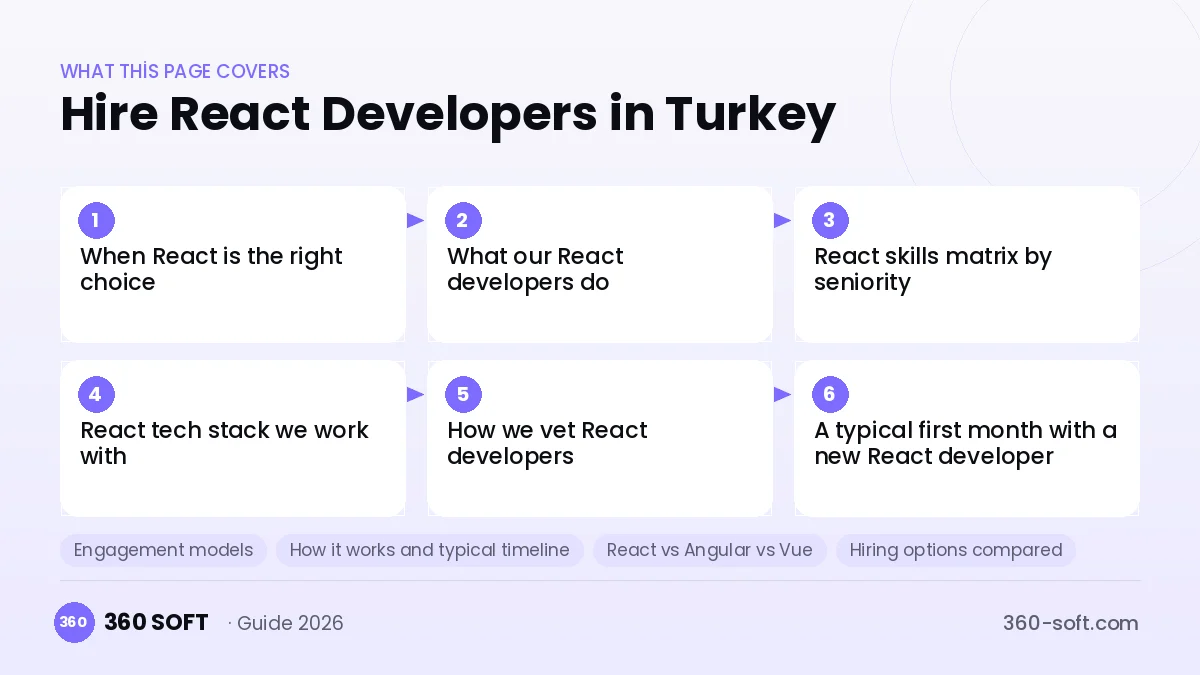
This page covers when React is the right choice, what our React developers typically do, a seniority skills matrix, the libraries we work with, how we vet candidates, what the first month looks like, engagement models and timelines, what drives pricing and how the contract protects your IP and data. For other stacks, go back to hire developers in Turkey.

When React is the right choice
React is a UI library rather than a full framework. That gives teams freedom to choose routing, data fetching and state management, and it has produced the largest ecosystem and talent pool in front-end development. It is a strong choice when:
- You are building a product that will keep evolving. SaaS dashboards, B2B platforms and marketplaces benefit from React’s component model and the depth of its ecosystem.
- SEO and first-load speed matter. Next.js adds server-side rendering, static generation and React Server Components, which suit storefronts, content sites and marketing pages that must rank and load quickly.
- You want to share talent or code with mobile. Teams that also use React Native can move developers and logic between web and mobile.
- You need to hire and scale quickly. The size of the React community makes it easier to add people and to find libraries for most problems.
- You are modernising a legacy front end. React can be introduced page by page into a jQuery, server-rendered or older single-page application.
React is not automatically the best option. Large, form-heavy enterprise applications built by many teams sometimes benefit from Angular’s opinionated structure, and small teams working closely with Laravel often find Vue a natural fit. We are happy to discuss the trade-offs before you commit.
What our React developers do
- Build features and screens in React with TypeScript, from design files to production
- Set up or migrate to Next.js (App Router), choosing per route between server rendering, static generation and client rendering
- Design data fetching and caching with TanStack Query, SWR or server components, and reduce unnecessary network requests
- Introduce or simplify state management with Redux Toolkit, Zustand or React context
- Build and maintain design systems and component libraries with Storybook, Tailwind CSS or CSS-in-JS
- Improve Core Web Vitals: bundle splitting, image optimisation, hydration costs and render performance
- Fix accessibility issues against WCAG guidelines: keyboard navigation, focus management, ARIA and contrast
- Write unit and component tests with Vitest or Jest and React Testing Library, and end-to-end tests with Playwright or Cypress
- Migrate legacy code: class components to hooks, Create React App to Vite or Next.js, JavaScript to TypeScript
React skills matrix by seniority
| Level | Experience | Works independently on | Typically needs support with |
|---|---|---|---|
| Junior | 0–2 years | Building components from designs, simple forms and lists, calling APIs | State architecture, performance, rendering strategy |
| Mid-level | 2–5 years | Feature delivery, hooks, forms and validation, data fetching, component tests | Large refactors, architecture decisions |
| Senior | 5+ years (3+ in React) | Application architecture, Next.js rendering strategy, performance profiling, design system foundations, code review | Product prioritisation |
| Lead / front-end architect | 8+ years | Front-end platform choices, monorepo and micro-frontend strategy, standards across teams, hiring support | Day-to-day feature work usually sits with the team |
For an existing product with growing complexity, the first hire is often most effective at senior level: someone who can untangle state management and set conventions makes every later mid-level hire more productive.
React tech stack we work with
| Area | Common tools | Notes |
|---|---|---|
| Language | TypeScript, modern JavaScript | TypeScript is our default for new work |
| Frameworks | Next.js, Remix / React Router, Vite | Next.js for SEO-sensitive and full-stack apps; Vite for dashboards and internal tools |
| Server state | TanStack Query, SWR, React Server Components, tRPC, GraphQL clients (Apollo, urql) | Most “state management” problems are really server-state caching problems |
| Client state | Redux Toolkit, Zustand, Jotai, React context | Global stores only where they earn their keep |
| Forms | React Hook Form, Zod, Formik (legacy) | Schema-based validation shared with the backend where possible |
| Styling and UI | Tailwind CSS, CSS Modules, styled-components, MUI, Chakra UI, Radix UI, shadcn/ui | We follow your design system first |
| Testing | Vitest, Jest, React Testing Library, Playwright, Cypress, Storybook interaction tests | Critical journeys covered end to end |
| Quality and delivery | ESLint, Prettier, Storybook, Chromatic, GitHub Actions, GitLab CI, Vercel, AWS | Preview deployments per pull request where your platform supports them |
How we vet React developers
Before we put a candidate in front of you, they go through a technical evaluation designed around real project situations rather than trivia. Depending on seniority it covers:
- React fundamentals: rendering and reconciliation, the rules of hooks, useEffect pitfalls, keys, controlled versus uncontrolled inputs.
- State and data: where state should live, server state versus client state, caching and invalidation, avoiding prop drilling without over-engineering.
- Next.js: server and client components, rendering strategies, caching behaviour, route handlers, metadata and SEO.
- Performance: profiling unnecessary re-renders, memoisation used deliberately rather than everywhere, code splitting, image and font loading.
- TypeScript: typing props, generics in reusable components, typing API responses.
- Accessibility: semantic HTML, focus management in modals and menus, testing with keyboard and screen reader.
- Code review exercise: the candidate reviews a flawed component and explains what they would change and in which order.
- Communication: explaining a technical trade-off clearly in English to a non-technical stakeholder.
You then run your own interview. Many clients use a short pairing session on their real codebase, which tells both sides more than any take-home test.
A typical first month with a new React developer
| Period | What usually happens |
|---|---|
| Week 1 | Access to repositories and environments, local setup, walkthrough of architecture and design system, first small pull requests |
| Week 2 | First feature tickets end to end, participation in code review, notes on quick wins and risks |
| Weeks 3–4 | Full sprint velocity on regular work; for senior hires, a short written assessment of performance, testing and state management with proposed improvements |
Engagement models
| Model | How it works | Best for |
|---|---|---|
| Staff augmentation | The developer joins your team and works under your engineering leadership and processes | Adding capacity or a specific skill to an existing team |
| Dedicated team | A stable team assigned to you, for example React developers, a backend developer, QA and a delivery lead | Building or rebuilding a product over many months |
| Managed service | We run maintenance and agreed improvements of an application against SLAs | Keeping a live front end healthy without a full-time in-house team |
| Fixed-scope project | A clearly defined piece of work delivered against milestones | Next.js migrations, accessibility remediation, performance audits |
Developers work remotely from Turkey by default. Hybrid arrangements and on-site visits for kick-offs or workshops can be agreed. Turkey is on UTC+3 all year, which puts it two to three hours ahead of the UK and one to two hours ahead of Central European Time depending on daylight saving, so a full working-day overlap with European teams is normal.
How it works and typical timeline
| Step | What happens | Typical time |
|---|---|---|
| 1. Discovery call | We clarify your stack, seniority, engagement model, time zone and start date | 1–2 business days |
| 2. Shortlist | You receive profiles of evaluated candidates | 3–10 business days |
| 3. Your interviews | Technical interview or pairing session with your team | About a week |
| 4. Contract and access | Service agreement, NDA, DPA where needed, repository and tool access | 2–5 business days |
| 5. Onboarding | Codebase, design system and delivery process | 1–2 weeks |
| 6. Ongoing review | Monthly feedback and adjustments to the team | Ongoing |
Timelines depend on the seniority you need, how quickly interviews can be scheduled and your own security onboarding.
React vs Angular vs Vue
| Criterion | React | Angular | Vue |
|---|---|---|---|
| Type | UI library with a large ecosystem | Full framework with built-in routing, forms, HTTP and DI | Progressive framework with official router and state library |
| Structure | Flexible; conventions come from the team or Next.js | Opinionated and consistent across teams | Between the two; flexible but with clear official patterns |
| Server rendering | Next.js, Remix | Angular SSR | Nuxt |
| Talent pool | Largest | Strong in enterprise environments | Smaller but growing; popular alongside Laravel |
| Typical fit | SaaS products, storefronts, dashboards, content sites | Large, form-heavy enterprise applications | Storefronts, admin panels, Laravel-based products |
If you already have a substantial codebase in one of these, the cost of switching usually outweighs the differences. We recommend changing frameworks only when the current one is genuinely blocking the product.
Hiring options compared
| Criterion | In-house hire | Freelancer | 360 Soft developer |
|---|---|---|---|
| Time to start | Often months for senior React talent | Fast, but quality varies | Days to a few weeks from a pre-vetted pool |
| Quality assurance | Depends on your hiring process | Depends on the individual | Technical vetting plus your own interview |
| Continuity | You carry attrition risk | Can disappear when the project ends | Replacement and handover terms in the contract |
| Cost structure | Salary, benefits, equipment, recruiting fees | Hourly or per project | Single monthly or hourly invoice |
| Scaling | Slow | Limited | Scale up or down with notice |
| Best for | Long-term core team | Small, isolated tasks | Product builds, migrations, peak workloads |
What affects the price of a React developer
| Factor | Effect on price |
|---|---|
| Seniority | Senior and architect profiles cost significantly more than mid-level |
| Next.js and SSR depth | Experience with server components, caching and SEO-critical sites adds value |
| Domain experience | Fintech, healthcare or high-traffic e-commerce experience |
| Additional skills | Node.js backend, React Native, design system or accessibility specialism |
| Engagement length | Longer commitments usually lower the monthly rate |
| Working hours | Extended overlap, on-call or out-of-hours support |
| On-site work | Travel and on-site time are priced separately |
We price per developer per month (full-time), per hour for part-time or variable work, as a fixed price for clearly scoped projects such as a Next.js migration, and in suitable cases with an outcome-based component tied to agreed, measurable targets. We do not publish rate cards because the factors above change the figure considerably; send us your requirements and you will receive a written quote.
Contracting, IP and data protection
You sign a B2B service contract with 360 Soft; the developer is employed by us in Turkey and is not your employee. All code, components, designs implemented and other work product are assigned to you, and every developer signs confidentiality and IP undertakings before starting. Where the application handles personal data, we sign a GDPR data processing agreement with Standard Contractual Clauses (or the UK equivalent) and follow Turkey’s personal data protection law, KVKK. Developers work in your repositories, cloud accounts and deployment platforms with access you control and can revoke at any time; production data is not copied to personal devices, and test environments use masked or synthetic data.
React-specific risks and how we handle them
| Risk | Mitigation |
|---|---|
| State management sprawl | Separate server state from client state, introduce a query cache, remove global stores that are not needed |
| Performance regressions | Performance budgets in CI, Core Web Vitals monitoring, profiling before memoising |
| Hydration errors and caching surprises in Next.js | Clear server/client component boundaries, explicit caching rules, logging on the server |
| Dependency churn | Regular, small upgrades; avoiding abandoned libraries; lockfiles and automated security alerts |
| Accessibility debt | Accessible primitives (for example Radix UI), automated checks with axe, manual keyboard testing |
| Knowledge concentrated in one person | Code review, Storybook documentation, architecture decision records |
Illustrative scenario: moving a SaaS dashboard to Next.js
Illustrative scenario, not a client case. A B2B software company runs its customer dashboard and public marketing site as a single Create React App application. Marketing pages are poorly indexed, the dashboard has become slow as features accumulated, and data is fetched through a large Redux store that few people on the team fully understand. The company adds a senior React developer and a mid-level React developer through a dedicated team arrangement. In the first weeks they measure Core Web Vitals, map the data flows and add end-to-end tests to the sign-up and billing journeys. Marketing pages move first to Next.js with static generation. In the dashboard, server data moves from Redux to TanStack Query, leaving only genuine UI state in a small store. Routes are then migrated one at a time, with each step released to production and monitored before the next begins.
Checklist before you hire a React developer
- Have you written down your React version, framework (Next.js, Vite, other), state management and styling approach?
- Do you need new feature work, a migration, a performance fix or a design system? Seniority should follow from that.
- Can the candidate explain when not to use useEffect, and how they separate server state from client state?
- Have they worked with your rendering model, for example Next.js App Router and server components?
- Do they write tests as a habit, and can they show examples with React Testing Library or Playwright?
- Do they treat accessibility as part of the job rather than an afterthought?
- Is there enough working-hour overlap with your team for reviews and stand-ups?
- Does the contract cover IP assignment, confidentiality, a GDPR DPA where needed and replacement terms?
- Have you agreed how success will be measured in the first three months?
React developer FAQ
How quickly can a React developer start?
Shortlists are usually shared within a few business days to two weeks, depending on seniority. The start date then depends on your interview process and access set-up.
Do your React developers work with Next.js?
Yes. Next.js experience, including the App Router, server components and rendering strategy choices, can be a requirement in your brief and is covered in our vetting.
Can you migrate our Create React App project?
Yes. Depending on your needs we migrate to Vite for a client-side application or to Next.js when server rendering or SEO matters, route by route and with tests protecting key journeys.
Do you use TypeScript?
TypeScript is our default for new work, and we can introduce it gradually into an existing JavaScript codebase.
Which state management library do you use?
We follow your existing choice. For new work we usually keep server state in a query cache such as TanStack Query and use a small client store like Zustand or Redux Toolkit only where needed.
Can the developer also work on our Node.js backend?
Many of our React developers have Node.js experience. For substantial backend work we recommend a dedicated Node.js developer alongside them.
What time zone do your developers work in?
Our developers are based in Turkey (UTC+3), which gives a full working-day overlap with UK and European teams.
Who owns the code?
You do. The contract assigns all code and work product to you, and development happens in your repositories.
How do you handle GDPR?
Where personal data is involved we sign a data processing agreement with Standard Contractual Clauses (or the UK equivalent), limit access to what is needed and follow KVKK in Turkey.
What if the developer is not the right fit?
Tell us and we will propose a replacement within the period set out in the contract, with a planned handover.
Can we hire part-time?
Part-time or hourly arrangements are possible for maintenance, audits and smaller pieces of work.
Can we start with one developer and grow into a team?
Yes. Many clients start with one React developer and later add QA, a backend developer, a designer or a tech lead.
Hire a React developer with 360 Soft
Tell us about your product, your stack and when you need someone, and we will send matching React profiles and a written quote. Use our contact page, call +90 850 335 10 87 or email info@360-soft.com. For broader outsourcing needs, see IT outsourcing services.
Need developers? Tell us what you need and we will share matching profiles and a written quote. WhatsApp · +90 850 335 10 87 · info@360-soft.com
Related
- Hire developers in Turkey: all technologies
- Hire React Native developers
- Hire Node.js developers
- Hire a dedicated software development team
Related services
- Hire Android (Kotlin) Developers in TurkeyHire Android developers in Turkey: vetted Kotlin and Jetpack Compose engineers, EU time zone overlap, skills…
- Hire Flutter Developers in TurkeyHire Flutter developers in Turkey: vetted Dart engineers for iOS and Android apps, EU time zone overlap, IP…
- Hire iOS (Swift) Developers in TurkeyHire iOS developers in Turkey: vetted Swift and SwiftUI engineers with App Store experience, EU time zone…
- Hire Node.js Developers in TurkeyHire Node.js developers in Turkey: vetted TypeScript backend engineers for APIs and microservices, EU time…
- Hire React Native Developers in TurkeyHire React Native developers in Turkey: vetted TypeScript mobile engineers, Expo and New Architecture skills…