Mobile appHealth, fitness & wellnessOriginal by MyFitnessPal
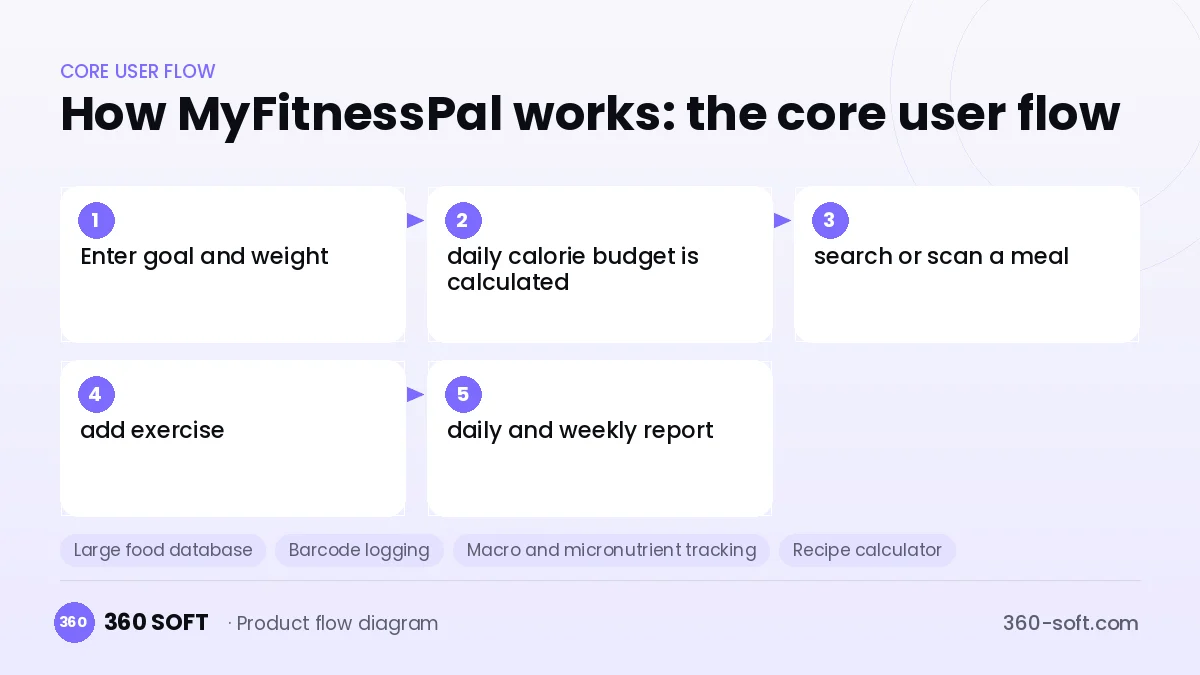
MyFitnessPal's strength comes from a huge food database and tools that speed up meal logging. Users search for what they ate or scan the barcode on a package, and calories, protein, carbohydrates and fat are logged instantly. A daily budget is calculated for goals such as weight loss, muscle gain or healthy eating, and users see where they stand at every meal.
Building something similar takes a mobile app, a food database that covers local products and home cooking, barcode scanning, a recipe calculator and exercise logging. For each market, local content such as regional dishes and supermarket brands is decisive. You also need verification of user-submitted foods, sync with smartwatches and health apps, and a premium subscription infrastructure.
How MyFitnessPal works: the core user flow
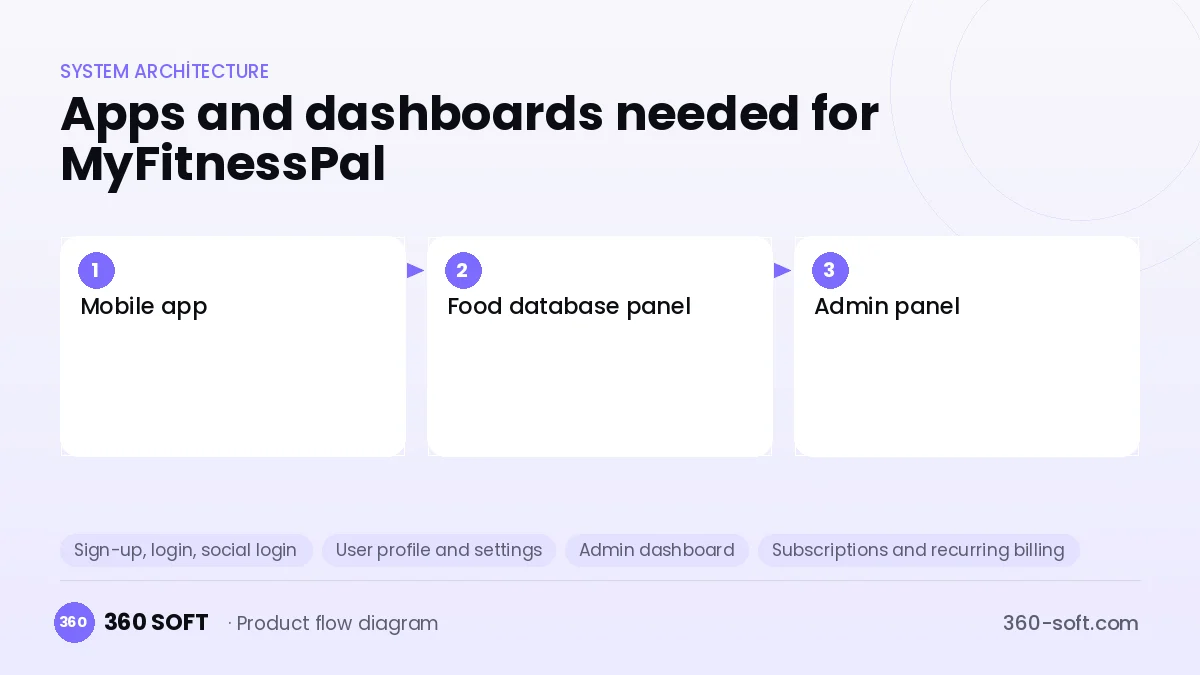
How many apps and dashboards do you need?
Mobile app
The app where users log meals, water, exercise and weight and see their reports.
Food database panel
The content panel where foods and branded products are added and user contributions are verified.
Admin panel
The internal panel that manages subscriptions, campaigns, user support and integrations.
Critical features of a product like MyFitnessPal
Large food database
Generic foods, home-cooked dishes, restaurant menus and supermarket products can be searched with portion options.
Barcode logging
Scanning a packaged product's barcode adds its nutrition values to the diary within seconds.
Macro and micronutrient tracking
Alongside calories, values such as protein, carbs, fat, fibre, sugar and sodium are tracked against goals.
Recipe calculator
Users enter the ingredients of their own recipe, and nutrition values per serving are calculated automatically.
Photo meal recognition
AI estimates the dish and approximate portion from a photo of the plate and asks the user to confirm.
Device and app sync
Steps, exercise and weight data are pulled automatically from smartwatches and health apps.
What goes into the first version, what comes later
First version (MVP)
- Goal setting and calorie budget calculation
- Food search and meal diary
- Barcode scanning
- Water, weight and exercise logging
- Daily and weekly summary reports
Later releases
- AI meal recognition from photos
- Recipe calculator and meal plans
- Smartwatch and health app sync
- Premium subscription and dietitian content
Modules and how the budget is calculated
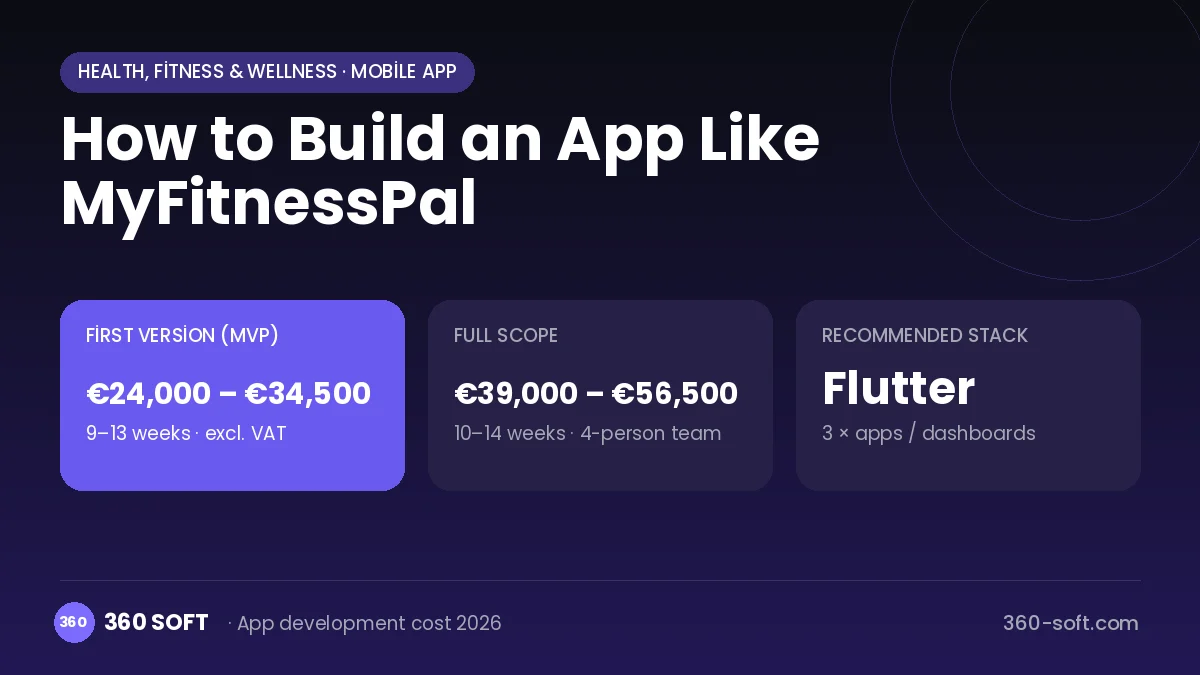
The budget is calculated with 360 SOFT’s pricing model from the modules below, about 24 screens and the project’s complexity: roughly 150 person-days for the full scope and 91 person-days for the first version. Every module you drop lowers the budget directly.
| Module | Phase |
|---|---|
| Sign-up, login, social login | First version |
| User profile and settings | First version |
| Admin dashboard | First version |
| Subscriptions and recurring billing | First version |
| Advanced search and filters | First version |
| Barcode / RFID / handheld | Later release |
| AI features (LLM, RAG, recommendations) | Later release |
| Reporting and analytics | Later release |
| Push notifications | First version |
| Offline mode and sync | First version |
| Third-party API integration | First version |
| Multi-language | First version |
Hosting, SMS, map APIs, app store accounts and payment-provider fees are separate items. Maintenance and improvements (optional): €500 / month. We send a fixed written price within 24 hours after a free discovery call.
The hard parts
Database quality
Incorrect and duplicate values multiply in user-contributed food entries, so verification and merging processes are essential.
Logging fatigue
Entering every meal is a chore, and without shortcuts like quick add, recents and barcodes, users quit.
Health boundaries
Extremely low calorie goals are risky, so the app should set lower limits and show warnings for sensitive groups.
Business model
A freemium subscription model fits: a basic calorie counter is free, while macro goals, advanced reports, meal plans and an ad-free experience come with a premium membership. The free version can show contextual ads that do not rely on health data. Product verification partnerships with food brands and corporate wellness programmes can also bring revenue.
Get a free quote for your project
Let us scope it together and send a fixed written quote within 24 hours. NDA on request; you own the source code.
Choosing a company to build an app like MyFitnessPal
Most people searching “build an app like myfitnesspal” are really looking for a reliable app development company. When comparing quotes, check four things:
- Can you try similar products they have shipped, in the stores or live?
- Are the source code, design files, servers and store accounts transferred to you by contract?
- Do they show a working demo every two weeks, with written scope and acceptance criteria?
- Are maintenance, scaling and GDPR/security costs written into the quote?
Copyright and trademarks
A business model and features are generally not protected on their own, but the MyFitnessPal name, logo, interface design, content and source code are. That is why we build a product with similar functionality but your own brand, design and code. This is not legal advice; we recommend a trademark search before launch.
Frequently asked questions
How long does it take to build an app like MyFitnessPal?
A first version with a meal diary, food search, barcode scanning and reports can be ready in a few months. Enriching the food database continues after launch.
Where do I get a food database?
Open-source food databases and licensable commercial datasets can be used to start. For local products and home cooking, a content team and user contributions are also needed.
Will there be copyright or trademark issues?
The calorie tracking app business model is free to use, but the name, logo, design, database content and code cannot be copied. This is not legal advice.
What should I look for when choosing a company to build an app like MyFitnessPal?
Look at fast search over large datasets, barcode and health platform integrations, and subscription experience. Ask about offline use too.
Costs of similar apps
Who should build it?
360 Soft is a mobile app development company based in Istanbul, Turkey. Our clients include Memorial Healthcare Group, iddaa.com and the Turkish Presidency of Defence Industries (OSTİM cluster). See the app development cost guide, hire a dedicated development team or IT outsourcing services.