Once a company runs dozens of projects at the same time, spreadsheets and disconnected task tools stop working. Management cannot see which projects are late or over budget, resources are double-booked, progress claims are prepared by hand and the numbers in the project tool never match the ERP. An enterprise project management (EPM or PPM) system brings portfolio, schedule, resources, costs, documents and approvals into one place.
360 Soft builds custom enterprise project management software for construction and engineering firms, manufacturers with engineering-to-order projects, IT and consulting companies, holdings and public-sector contractors. We integrate it with your ERP, Jira or MS Project and deliver it with a dedicated team from Istanbul.
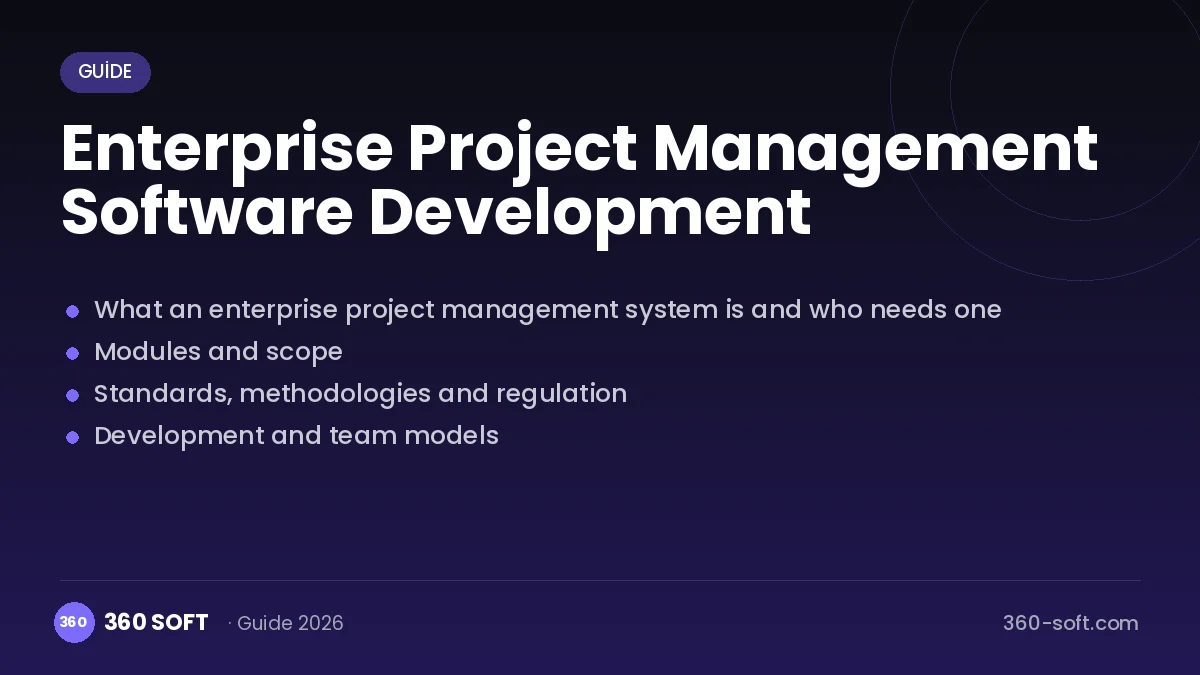
What an enterprise project management system is and who needs one
An EPM system is not just a task board. It connects the portfolio view (which projects, which priorities, which budget) with planning (schedules, milestones, dependencies), execution (tasks, timesheets, site reports), finance (budgets, commitments, actual costs, progress billing) and governance (stage gates, approvals, risk and change logs). Companies typically need one when they run many parallel projects, share resources between them, and have to report reliably to management, clients or investors.
Modules and scope
| Module | Functions |
|---|---|
| Portfolio management | Project register, prioritisation, stage gates, portfolio dashboards |
| Planning and scheduling | WBS, Gantt, dependencies, baselines, critical path, import from MS Project or Primavera |
| Resource management | Capacity, skills, allocation across projects, conflict alerts |
| Cost and budget control | Budgets, commitments, actuals from ERP, forecasts, earned value analysis |
| Progress billing | Progress measurements, client progress claims, subcontractor payments |
| Timesheets and site reports | Web and mobile time entry, daily site logs with photos |
| Risk, issue and change management | Registers, owners, change requests with impact on cost and time |
| Documents and approvals | Versioned documents, approval workflows, audit trail |
Technology approach
We build a web application (React or Angular frontend,.NET or Java backend) with mobile access for the field, a relational database and a BI layer for portfolio reporting. Integration with Jira, Azure DevOps, MS Project, Primavera and ERP systems such as SAP, Logo or Microsoft Dynamics is done through APIs. The system can run in the cloud or on your own servers.
Standards, methodologies and regulation
The system supports the methodologies your teams already use: PMI PMBOK practices, PRINCE2, ISO 21502 guidance, agile and Scrum for software projects, and hybrid models. Earned value management follows established EVM principles. For public works in Türkiye, where our team operates, progress payment rules under the Public Procurement Law (No. 4734) and Public Procurement Contracts Law (No. 4735) can be modelled. Local rules in your country apply, and contract-specific billing rules such as FIDIC-based progress claims can be configured.
Development and team models
- Fixed-scope first release: portfolio, scheduling and cost control for one business unit
- Dedicated team: developers, business analyst and QA working only for you, from 1 to 200+ people, remote, on-site or hybrid
- PMO support: combined with our PMO outsourcing service if you also need project controllers
Project steps and typical durations
| Step | Content | Indicative duration |
|---|---|---|
| Discovery | Project types, processes, reports, systems in use | 2 to 4 weeks |
| Design | Data model, workflows, screens, integration plan | 3 to 4 weeks |
| First release | Portfolio, scheduling, cost control, dashboards | Typically 3 to 5 months |
| Migration | Ongoing projects, baselines and actuals imported | Parallel to first release |
| Rollout | Further modules, units and mobile use | Ongoing releases |
A team can typically start within 1 to 2 weeks of signing; durations depend on scope and integrations.
Success indicators and SLA
| Indicator | What it shows |
|---|---|
| Schedule and cost variance visibility | Share of projects with up-to-date baseline and forecast |
| Reporting effort | Time spent preparing portfolio reports |
| Resource utilisation | Planned versus actual allocation |
| Progress claim cycle time | Time from measurement to approved claim |
| Platform availability and support response | Agreed in the SLA |
Baselines and targets are agreed with you; we do not quote improvement figures as achieved results.
Pricing models
- Fixed price for a defined first release
- Dedicated team on a monthly basis
- Time and materials for open scope
- Support and maintenance retainer
Cost depends on the number of modules, users and business units, integrations, mobile needs, migration of ongoing projects and hosting. We provide a written proposal; we do not publish prices.
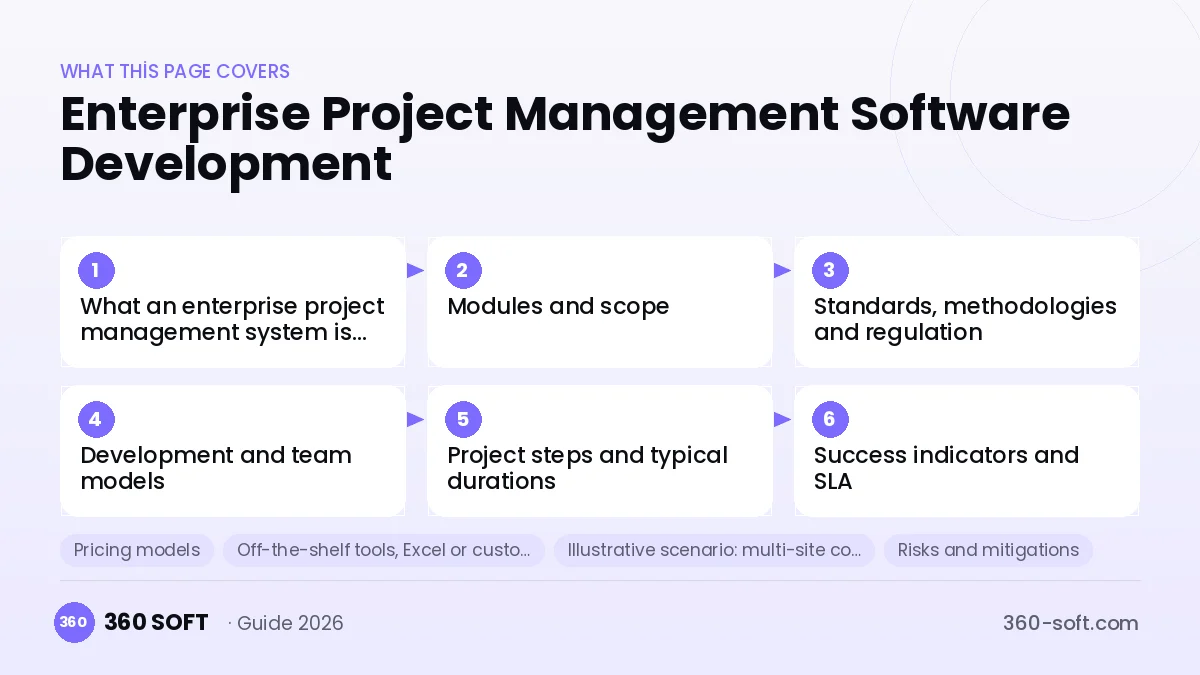
Off-the-shelf tools, Excel or custom development
| Criterion | Excel and email | Off-the-shelf PPM tool | Custom EPM |
|---|---|---|---|
| Start | Immediate | Weeks | First release in months |
| Fit to processes | Flexible but chaotic | You adapt to the tool | Built around your processes |
| Integration with ERP | Manual | Limited connectors | Built to your systems |
| Licence costs | None | Per user, grows with headcount | No per-user licence to us |
| Ownership | Yours | Vendor | You own code and data |
Illustrative scenario: multi-site construction contractor
Illustrative scenario: a contractor runs twelve building sites in parallel. Schedules are kept in MS Project, costs in the ERP and progress claims in Excel. The EPM system imports schedules, pulls committed and actual costs from the ERP, lets site engineers enter progress quantities on tablets and generates client progress claims and subcontractor payment certificates. Management sees earned value and cash-flow forecasts for all sites on one screen. This is an example approach, not a completed client project.
Risks and mitigations
| Risk | Mitigation |
|---|---|
| Low user adoption | Involve project managers early, simple mobile screens, training |
| Inconsistent data from ERP | Agreed cost structure mapping, reconciliation reports |
| Over-engineering | Phased releases, start with the reports management really uses |
| Migration of ongoing projects | Cut-off plan, imported baselines, parallel run |
| Vendor dependence | You own code and documentation |
Security, GDPR/KVKK, NDA and intellectual property
Project data includes contract values, margins and personal data in timesheets. We apply role-based and project-based access, single sign-on, encryption and audit logs, and host where your policy requires.
Contract framework for international buyers: we work under a B2B service agreement with a full IP assignment clause, so source code, data models, configurations and documentation produced for you belong to you on payment. A mutual NDA is signed before any data is shared. Where personal data is processed, we sign a GDPR data processing agreement (DPA) with Standard Contractual Clauses (or the UK IDTA for UK controllers); on the Turkish side the team also complies with KVKK (Law No. 6698). Local rules in your own country apply in addition to these.
Selection checklist
- Portfolio view with stage gates and priorities
- Scheduling with baselines and import from your current tools
- Resource capacity across projects
- Cost control linked to ERP actuals
- Progress billing rules for your contracts
- Mobile use for site or field teams
- Integration with Jira, MS Project or Primavera where used
- Ownership of code and data
Frequently asked questions
Can it integrate with Jira or MS Project?
Yes. Tasks, schedules and progress can be synchronised with Jira, Azure DevOps, MS Project or Primavera so teams keep their familiar tools.
Can budgets be synchronised with our ERP?
Yes. Budgets, commitments and actual costs are exchanged with SAP, Logo, Microsoft Dynamics or other ERP systems.
Do you also provide project managers?
The software project is delivered by our team. If you need project controllers or a PMO, we can provide them through our PMO outsourcing service.
Do you support public works progress payment rules?
Yes. Progress payment rules for public works in Türkiye can be modelled, and contract-specific rules for other markets can be configured.
Is earned value analysis possible?
Yes. Planned value, earned value and actual cost are calculated per project and portfolio, with schedule and cost performance indices.
Can we run the system on our own servers?
Yes. It can be hosted on-premise, in your private cloud or in a public cloud.
Is mobile use from sites possible?
Yes. Site engineers can enter progress, timesheets, photos and daily logs from tablets and phones, including offline use where needed.
Which methodology do you use?
The system supports waterfall, PRINCE2, PMBOK-based, agile and hybrid approaches. We develop the software itself in agile iterations.
How long does the first release take?
Typically a few months. The team can usually start within 1 to 2 weeks.
What happens to our ongoing projects?
We import ongoing projects with their baselines, budgets and actuals at an agreed cut-off date, with a short parallel run.
How is pricing determined?
By modules, users, integrations, migration and hosting. You receive a written proposal; we do not publish prices.
Who owns the source code?
You do. Our B2B agreement includes full IP assignment on payment.
Related pages: PMO outsourcing, construction and real estate outsourcing, SAP consulting, RPA process automation, software outsourcing company in Türkiye.
See your project portfolio on one screen
Tell us how many projects you run and which systems you use, and we will come back with a scoped proposal. Call or WhatsApp us on +90 850 335 10 87, write to info@360-soft.com, message us directly on WhatsApp, or use the contact page. 360 Soft Marketing Yazılım ve Danışmanlık Ltd. Şti., Nidakule Ataşehir Batı, Barbaros Mah. Begonya Sk. No:1 D:2, 34746 Ataşehir/İstanbul.
Türkçe: Türkçe sürüm