Logistics runs on coordination: shipments need to be booked, tracked and documented, customers want status updates, carriers need to be chased, warehouse data has to match reality and every exception needs an owner. Much of this work is office-based and can be done by a well-trained remote team. 360 Soft builds dedicated teams for logistics companies, freight forwarders, 3PLs and shippers, covering control tower and shipment tracking, customer service, documentation, warehouse administration and data work, from 1 to 200+ people, with 7/24 shifts where needed.
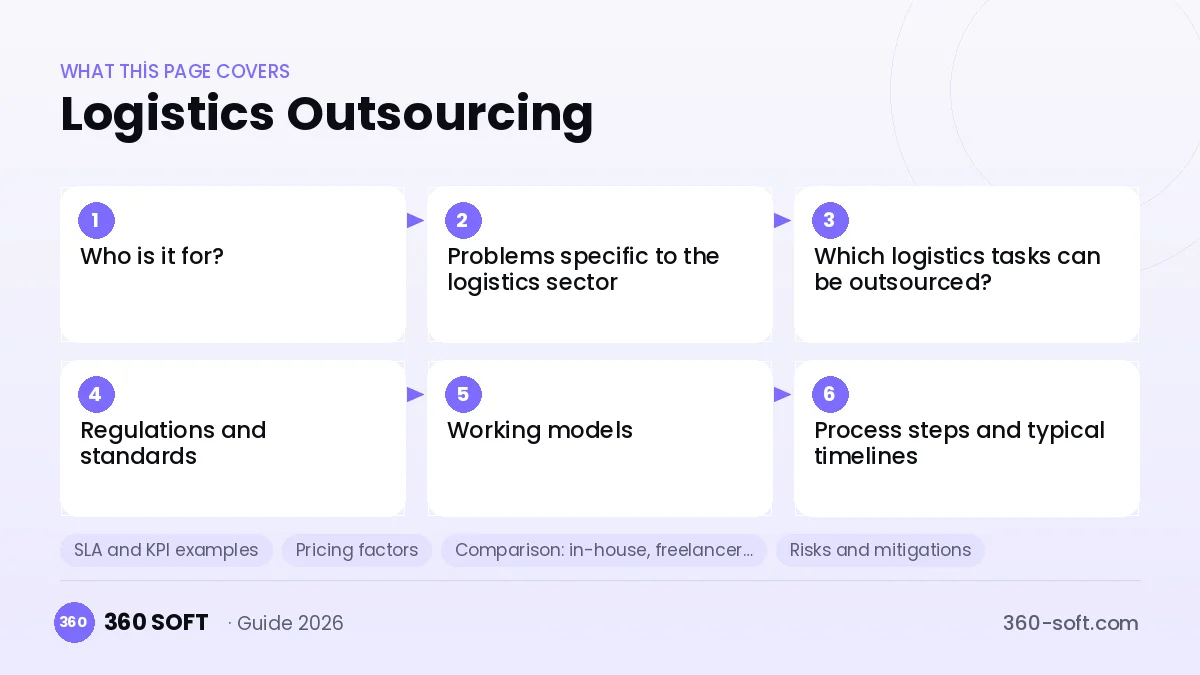
This page explains who the service suits, the problems specific to logistics, which tasks can be outsourced, a typical team structure, the regulations and standards to observe, working and contract models, process steps, KPIs, pricing factors, a comparison, risks and a vendor checklist.
Who is it for?
The service is designed for organisations that move goods and need reliable operational capacity behind their network:
- Freight forwarders handling road, sea and air shipments that need booking, tracking and documentation support.
- 3PL and fulfilment providers that need warehouse administration, inventory data and customer service capacity.
- Carriers and courier companies with high volumes of delivery queries and exception handling.
- Manufacturers and retailers running their own supply chain who want a control tower without building a new department.
- E-commerce businesses coordinating several carriers and return flows.
Problems specific to the logistics sector
Typical issues we hear from logistics teams:
- Shipment status is spread across carrier portals, emails and phone calls, and customers ask for updates before the team knows.
- Exceptions such as delays, damages and missing documents are handled late because nobody owns them.
- Seasonal peaks multiply volumes while permanent hiring is slow.
- Operations run around the clock across time zones, but the office team works day shifts.
- Master data and inventory records drift away from physical reality.
- Experienced operations staff spend time on data entry instead of planning.
Which logistics tasks can be outsourced?
Most office-based logistics tasks can be handed over; physical warehouse work can be supported with on-site staff where agreed.
| Area | Typical tasks | Technology / tools |
|---|---|---|
| Control tower and shipment tracking | Milestone tracking, ETA updates, proactive alerts, exception follow-up | TMS, carrier portals, visibility platforms |
| Customer service | Status queries, delivery appointments, complaints, claims intake | Helpdesk, phone, email, WhatsApp Business |
| Booking and order entry | Transport orders, bookings with carriers, order data entry | TMS, ERP, carrier booking portals |
| Documentation | Shipping documents, CMR, bills of lading, packing lists, customs pre-checks | TMS, document management, customs software via your broker |
| Warehouse administration | Inbound and outbound records, inventory reconciliation, cycle count support | WMS, ERP, handheld exports |
| Freight audit and invoicing support | Carrier invoice checks, cost allocation, billing | ERP, spreadsheets |
| Data and reporting | KPI dashboards, master data clean-up, carrier performance reports | Power BI, Excel, SQL |
Typical team structure by role
| Role | Responsibility | Note |
|---|---|---|
| Control tower specialist | Tracking and exception management | Works in shifts for 7/24 coverage |
| Customer service agent | Shipment queries and appointments | Multilingual options |
| Booking / order entry specialist | Bookings and transport orders | Accuracy-focused role |
| Documentation specialist | Shipping and customs pre-documents | Knows incoterms and document sets |
| Warehouse administrator | WMS records and inventory data | On-site or remote |
| Data analyst | Dashboards and carrier performance | Added as needed |
| Team lead | Shift planning, escalations, reporting | Single point of contact |
Regulations and standards
From Turkey the team works with Customs Law No. 4458 and customs procedures (declarations themselves are filed by licensed customs brokers), Road Transport Law No. 4925 and its authorisation documents, the ADR rules for dangerous goods by road, the Authorised Economic Operator (AEO / YYS) framework, Occupational Health and Safety Law No. 6331 for any warehouse work, and KVKK for personal data of recipients and drivers.
For your shipments the rules of the countries involved apply as well, for example the Union Customs Code and AEO rules in the EU, UK customs and CDS requirements, GCC customs regulations, IATA and IMDG rules for air and sea dangerous goods, and international conventions such as CMR. We work to your procedures and the instructions of your licensed brokers; regulatory responsibility stays with the licensed parties.
Working models
| Model | How it works | When it fits in logistics |
|---|---|---|
| Remote | The team works from our Istanbul office or secure home setups with access to your systems via VPN or VDI | Control tower, customer service, documentation, data work |
| On-site | Team members work at your premises under our supervision | Warehouse administration, cross-dock or hub support |
| Hybrid | Remote day-to-day work with scheduled on-site days | Peak seasons, new warehouse or client onboarding |
| Service model | Definition | Example |
|---|---|---|
| Dedicated team | Named people working only for you, led by our team lead | 7/24 control tower team for a forwarder |
| Managed service | We own an agreed output with SLAs and reporting | All delivery queries answered within agreed times |
| Project | Defined scope, deliverables and deadline | Master data clean-up before a WMS migration |
| Capacity extension | Additional people for a defined period | Extra agents for the pre-holiday peak |
Legal note for staffed engagements
Contract note for international buyers. We work under a B2B service agreement governed by a clear statement of work: the output, the SLA, the reporting cadence and the exit terms are written down before the team starts. The agreement includes an NDA, an IP assignment clause (all work product, templates, data and documentation created for you belong to you), and, wherever personal data is processed, a GDPR data processing agreement (Art. 28) with the EU Standard Contractual Clauses for transfers to Turkey, or the UK IDTA/Addendum for UK controllers. On the Turkish side processing also follows KVKK (Law No. 6698), including its cross-border transfer rules. Physical warehouse staff, if any, work under our employment and occupational safety responsibility with site rules agreed in writing. Our people are employed by 360 Soft in Turkey, so payroll, social security and Turkish labour-law obligations stay with us; you buy a service, not employees.
Under Turkish law (Labour Law No. 4857) a service purchase has to be distinguished from subcontracting of core activities and from temporary agency work. We define the scope as an outcome-based service under our own supervision; for your side, local outsourcing and temporary work rules apply and should be confirmed by your counsel.
Process steps and typical timelines
| Step | Content | Typical duration |
|---|---|---|
| Discovery | Network, volumes, systems, service hours | 1 week |
| Process mapping | Current flows, exception types, escalation matrix | 1–2 weeks |
| Proposal and contract | Scope, SLA, pricing, NDA, DPA | 1 week |
| Team selection | Logistics knowledge tests, interviews | Typically 1–2 weeks |
| Access and training | TMS/WMS roles, SOPs, carrier contacts | 1 week |
| Shadowing and ramp-up | Close review, gradual handover of lanes or clients | 2–4 weeks |
| Steady state | KPI reporting, monthly review | Ongoing |
SLA and KPI examples
| Area | KPI | Note |
|---|---|---|
| Tracking | Share of shipments with up-to-date status | Defined per mode and lane |
| Exceptions | Time to detect and escalate an exception | Per exception type |
| Customer service | First response time, resolution time | Per channel |
| Documentation | Document accuracy, rework rate | Measured on samples |
| Warehouse data | Inventory record accuracy | Shared with site management |
| Coverage | Staffed hours vs. plan | Critical for 7/24 operations |
Targets are agreed after a baseline period on your own data; we do not promise numbers before we have seen your processes.
Pricing factors
We do not publish standard prices. A quote is prepared after a discovery call, usually as a monthly fee per dedicated team member, an output-based fee, a hybrid model or a project fee. These factors drive it:
| Factor | Effect |
|---|---|
| Volume | Shipments, orders, queries per month |
| Service hours | Business hours vs. 7/24 shifts |
| Complexity | Modes, lanes, dangerous goods, customs involvement |
| Languages | English, Arabic, German and other languages |
| Systems | Number of TMS, WMS and carrier portals |
| Work location | Remote, on-site or hybrid |
Comparison: in-house, freelancer, outsourcing
| Criterion | Your own staff | Freelancer | Outsourcing (360 Soft) |
|---|---|---|---|
| Time to start | Weeks to months of recruiting | Fast, availability varies | Typically 1–2 weeks |
| Scaling | Slow, fixed headcount | Possible, uneven quality | From 1 to 200+ people within one structure |
| Continuity | Depends on retention | Single point of failure | Replacement process included |
| Process documentation | Often informal | Rarely | SOPs and playbooks are part of the service |
| Management effort | All yours | High coordination effort | Team lead and reporting included |
| Data protection and control | Your own controls | Hard to enforce | NDA, DPA, access controls, audit trail |
Risks and mitigations
| Risk | Mitigation |
|---|---|
| Missed exceptions | Alert rules, shift handover checklists, escalation matrix |
| Document errors | Templates, four-eyes checks for critical documents |
| Peak overload | Capacity plan agreed before season |
| Data leakage | Role-based access, managed devices, logged activity |
| Knowledge loss | SOPs per client and lane, backup people, replacement process |
| Unclear responsibility | RACI agreed with you and your brokers |
Security, GDPR/KVKK, NDA and intellectual property
Shipment data includes commercial information and personal data of recipients and drivers. Access to TMS, WMS and carrier portals is individual, role-based and logged, the team uses company-managed devices, and access is removed the same day someone leaves. SOPs, reports and data sets produced for you are assigned to you, and confidentiality continues after the contract ends.
Vendor selection checklist
- Can the vendor staff 7/24 shifts with proper handovers?
- Does the team know incoterms, document sets and your transport modes?
- Are responsibilities with licensed brokers clearly defined?
- Is a GDPR DPA with SCCs (or UK IDTA) offered, and is KVKK covered?
- Are SOPs and data assigned to you?
- Are SLAs measurable in your TMS or helpdesk?
- Is there a replacement process?
- Is there a clear exit and handover clause?
Illustrative scenario: pre-season control tower and warehouse support
Illustrative scenario – not a client case. A forwarder expects a strong rise in volumes before the holiday season, and its day-shift operations team cannot cover evening and night milestones. A possible setup: a remote control tower team in three shifts tracks shipments, flags delays and updates customers; two documentation specialists prepare shipping documents for the broker; and an on-site warehouse administrator keeps inventory records in line during the peak. After the season the team is reduced to the core control tower.
Frequently asked questions
Which logistics tasks can be outsourced?
Control tower and tracking, customer service, booking and order entry, documentation, warehouse administration, freight audit support and reporting.
Can we combine several tasks under one contract?
Yes. Tracking, customer service and documentation are often combined under one team lead.
Can you set up a short-term team for peak season?
Yes. Seasonal capacity can be added, ideally on top of a core team that already knows your processes.
Do you offer 7/24 coverage?
Yes. Shift-based teams can cover nights, weekends and holidays.
Do you file customs declarations?
No. Declarations are filed by licensed customs brokers. Our team prepares and checks documents and coordinates with your broker.
Can the team work in our warehouse?
Yes, on-site or hybrid models are possible, with site rules and safety responsibilities agreed in writing.
Which systems do you work with?
Your TMS, WMS, ERP and carrier portals. We select people with matching system experience.
How do you protect shipment data?
Role-based individual access, managed devices, logged activity, NDA and a GDPR DPA where personal data is involved.
How fast can we start?
A typical start is 1–2 weeks after the scope is agreed.
How is pricing calculated?
By volume, hours, complexity, languages, systems and location. We quote after a discovery call.
Plan your logistics team with us
Tell us your modes, volumes, systems and service hours and we will propose roles, shifts, SLAs and a pricing model. Call or WhatsApp us on +90 850 335 10 87, write to info@360-soft.com, message us directly on WhatsApp, or use the form on our contact page. 360 Soft Marketing Yazılım ve Danışmanlık Ltd. Şti., Nidakule Ataşehir Batı, Barbaros Mah. Begonya Sk. No:1 D:2, 34746 Ataşehir/İstanbul.
Related pages
- All outsourcing services (hub)
- E-commerce operations outsourcing
- Content, design and moderation outsourcing
- Finance back office outsourcing
- E-commerce sector outsourcing
- Healthcare outsourcing
- Financial services outsourcing
- IT staff leasing
- Hire developers in Turkey
- Türkçe
Related services
- Manufacturing OutsourcingManufacturing outsourcing: factory IT/OT support, MES and ERP, Industry 4.0 and data, quality documentation…
- Media and Publishing OutsourcingMedia and publishing outsourcing: subtitling, archive metadata, 7/24 moderation, CMS, ad ops, reader support…
- Mobile App Maintenance and Development OutsourcingMobile app maintenance outsourcing: iOS and Android OS compatibility, store policy updates, crash monitoring…
- NOC and Network Monitoring OutsourcingNOC outsourcing: 24/7 monitoring of networks, links, servers and services, first response and carrier…
- Outsourcing for Agencies and Software CompaniesOutsourcing for agencies and software companies: white-label developers, designers, QA and DevOps that work…
- Outsourcing for Crypto Exchanges and Digital Asset PlatformsCrypto exchange outsourcing: KYC/AML operations, transaction monitoring, fraud, SOC and 24/7 support with…