Outsourcing means handing a task or an entire business function to a specialist team, with a written scope and measurable service levels, instead of building that capability on your own payroll. 360 Soft Marketing Yazılım ve Danışmanlık Ltd. Şti., headquartered in Ataşehir, Istanbul, provides outsourcing services across industries and company sizes: from a single specialist to multi-location teams of more than 200 people, and from software developers and SAP consultants to call centre, back office, field and warehouse operations. Teams work remotely from Türkiye, on-site at your location or in a hybrid model.
Quick tools: Service Finder (find the right service in 4 questions) · Team Builder (plan your team role by role) · Outsourcing vs in-house hiring (decision guide and quiz) This page is the hub of our outsourcing services. Below you will find our full catalogue of 95 services, grouped by business function, by 360 Soft expertise, by role and by industry, followed by delivery models, team sizing, the set-up process, SLAs and KPIs, pricing models, the contract framework for international buyers and a checklist for choosing the right provider.
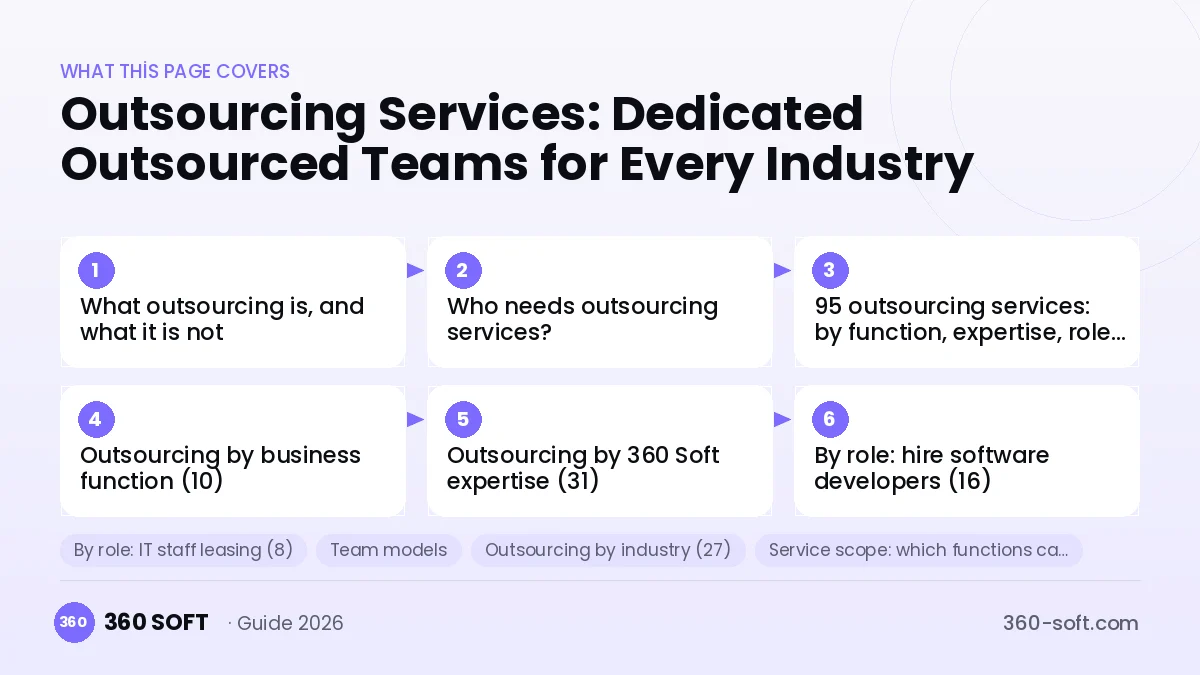
What outsourcing is, and what it is not
Outsourcing transfers the result and the management of a piece of work to a specialist provider. The key point is that you buy a defined service, not just people. The provider selects, trains, manages and backs up the team, and is accountable for performance against indicators written into the contract. You, as the business owner, set priorities, acceptance criteria and the expected output.
Three related models are often confused with outsourcing:
- Staff augmentation / staff leasing: specialists with defined skills join your existing team, and day-to-day direction usually stays with you. See staff augmentation in Türkiye and IT staff leasing.
- Project-based development: a deliverable with a clear start and end, such as a mobile app, is built against a fixed scope, and the team is released when the project ends.
- Consulting: recommendations, analysis and roadmaps are produced, and implementation is usually done by you.
In practice these models are often combined. A software product may start as a project, move into maintenance and support (AMS) as an outsourced service after go-live, and use staff augmentation to add developers in busy periods.
Who needs outsourcing services?
Outsourcing is not only a tool for large corporations. It is a serious option if one of the following describes your situation:
- A specialist role (SAP Basis, security analyst, DevOps engineer) does not have enough workload for a full-time hire, or is hard to recruit.
- Volumes fluctuate by season or campaign, for example in customer service, e-commerce operations or warehousing.
- You need coverage outside office hours, up to 7/24, without building night shifts internally.
- You are entering a new market and need a team quickly, before deciding on a local entity.
- Your internal team should focus on core work while routine operations run under clear SLAs.
95 outsourcing services: by function, expertise, role and industry
The lists below form our complete service catalogue. Services with a linked title already have a dedicated English page; the others are delivered in the same way, and their English pages are being published. If your need is not listed, contact us: in most cases it can be covered by a combination of existing capabilities.
Outsourcing by business function (10)
- Call centre and customer service
- Back office and data entry
- Finance back office
- Sales and telesales
- Digital marketing team
- Content, design and moderation
- E-commerce operations
- Warehouse and logistics operations
- Field and technical service
- HR and payroll operations
Outsourcing by 360 Soft expertise (31)
- SAP outsourcing and SAP AMS support
- ERP support and management
- CRM management
- Mobile app maintenance and development
- Website management and maintenance
- Software maintenance and support (AMS)
- QA and software testing
- DevOps and cloud operations
- NOC and network monitoring
- SOC and cyber security monitoring
- Vulnerability management
- KVKK compliance operations
- KYC / AML operations
- Fraud monitoring
- Data analysis and reporting (BI)
- Data labelling and AI data preparation
- Chatbot and AI assistant management
- RPA and process automation
- RFID and drone-based inventory counting
- UI/UX design
- Technical documentation and translation
- PMO (project management office)
- e-Invoice and integration operations
- Field data collection and audits
- Web accessibility (WCAG) audits
- Carbon and sustainability data management
- Payment operations
- Game testing and live ops
- App store management (ASO)
- CTO as a Service
- White-label software development
By role: hire software developers (16)
Developers join your team or form a dedicated squad. Overview: hire developers.
- Flutter developers
- React Native developers
- iOS developers
- Android developers
- React / Next.js developers
- Node.js developers
- Laravel / PHP developers
- .NET developers
- DevOps engineers
- QA / test engineers
- UI/UX designers
- AI developers
- Unity game developers
- SAP ABAP developers
- Full stack (React + Node.js) developers
- Technical co-founder (CTO)
By role: IT staff leasing (8)
IT specialists for infrastructure, security, data and projects. Overview: IT staff leasing.
- Help desk / IT support specialists
- System and network administrators
- Cyber security specialists
- Data engineers and data analysts
- Project managers / Scrum Masters
- Business analysts
- Database administrators (DBA)
- Cloud architects
Team models
- Large software and IT teams (50–200+ people)
- Staff augmentation: adding specialists to your team
- Dedicated team: a team reserved for you
Outsourcing by industry (27)
- Agencies and software companies
- Banking
- E-commerce
- Education
- Energy and infrastructure
- Finance, fintech and payments
- Food and beverage
- Aviation
- Holdings and corporate groups
- Pharma and medical
- Construction and real estate
- Public sector and municipalities
- SMEs
- Crypto exchanges and digital asset platforms
- Logistics and cargo
- Media and publishing
- Automotive and spare parts
- Gaming
- Retail
- Healthcare and health tourism
- Defence industry
- Insurance
- Startups
- Textile and apparel
- Telecom
- Tourism and hospitality
- Manufacturing and industry
Service scope: which functions can be outsourced?
Software and product development
New development, maintenance and support (AMS), QA and test automation, UI/UX design, DevOps and release management, mobile and web applications. Teams can be built around a technology, see hire developers, or around a product as a dedicated team.
IT infrastructure, cloud and security
Service desk, system and network administration, NOC monitoring, SOC and security monitoring, vulnerability management, cloud operations and database administration.
Enterprise applications
SAP and ERP support, CRM administration, integrations, e-invoicing operations and reporting. See also SAP consulting in Türkiye.
Customer and operations services
Call centre and customer service, back office and data entry, finance back office, KYC/AML and fraud operations, content moderation, HR and payroll operations. For process outsourcing see business process outsourcing in Türkiye.
Field, warehouse and sales
Warehouse and logistics operations, inventory counting, field and technical service, field data collection and audits, sales and telesales teams.
Delivery models: remote, on-site, hybrid
| Model | How it works | Best suited for | What to consider |
|---|---|---|---|
| Remote (offshore/nearshore) | The team works from 360 Soft offices or remote workplaces in Türkiye with secure access to your systems | Software development, support, back office, monitoring, data work | Access rights, VPN, device policy, time-zone overlap |
| On-site | The team works at your location under our employment and management | Physical operations: warehouse, field, desk-side IT support | Workspace, equipment, site rules, travel |
| Hybrid | Part of the team on-site, the rest remote | Transition and analysis phases, then remote steady state | Clear split of which work happens where |
Team models
| Team model | Who manages | What you buy | Typical use |
|---|---|---|---|
| Staff augmentation | You direct daily work | Specialists with defined skills | Quick reinforcement of an existing team |
| Dedicated team | Shared technical leadership | A stable team reserved for you | Product development, continuous delivery |
| Managed service | The provider | A defined outcome under SLA | AMS, service desk, call centre, monitoring |
| Project-based | The provider (project management) | A deliverable with fixed scope | New application, migration, integration |
Team size: from 1 person to 200+
| Scale | Example use (illustrative) | Typical management structure |
|---|---|---|
| 1–3 people | A single SAP Basis specialist or a small support pod | Direct communication, monthly service review |
| 4–20 people | A service desk shift or a product squad | Team lead on our side, weekly reporting |
| 20–50 people | Multi-skill operations across several functions | Service delivery manager, KPI dashboard |
| 50–200+ people | Multi-location or 7/24 operations, an offshore development center | Programme governance, quarterly business reviews |
Set-up process: outsourcing step by step
- Discovery: we review the function, current volumes, tools, pain points and goals.
- Scope and SLA design: tasks, responsibilities (RACI), service levels, KPIs and reporting are agreed in writing.
- Proposal and contract: team structure, delivery model, pricing model and the contract package.
- Team building: sourcing, assessment and your interviews for key roles; a typical start is within 1–2 weeks.
- Transition: knowledge transfer, documentation, access set-up and a parallel run where needed.
- Steady state: operation under SLA with regular reporting and service reviews.
- Continuous improvement: automation, process improvements and scaling up or down as needs change.
SLAs and KPIs: how performance is measured
| Area | Example KPI | Typical functions |
|---|---|---|
| Responsiveness | First response time, answer rate within target time | Service desk, call centre, monitoring |
| Resolution | Resolution time per priority, first contact resolution | Support, AMS, customer service |
| Quality | Error rate, QA score, reopen rate | Back office, data entry, testing |
| Delivery | Planned work completed per sprint or month | Development, projects |
| Availability | Uptime of services, shift coverage | Infrastructure, NOC, 7/24 operations |
| Continuity | Time to provide replacement staff | All services |
Targets are defined per engagement after a review of your baseline data.
Pricing: factors that determine cost
We do not publish prices, because cost depends on scope and model. The main factors are:
| Factor | Effect on cost |
|---|---|
| Roles and seniority | Scarce or senior skills cost more |
| Working hours | Night, weekend and 7/24 shifts increase cost |
| Languages | Additional languages narrow the available pool |
| Delivery model | On-site work may add travel and equipment |
| Team size and duration | Larger, longer engagements allow more efficient structures |
| SLA level | Tighter service levels need more capacity and management |
Common pricing models are a monthly fee per specialist, a team-based monthly fee, a volume or transaction-based fee for operations, and fixed price for well-defined projects.
In-house team, freelancers or outsourcing: comparison
| Criterion | In-house team | Freelancers | Outsourcing with 360 Soft |
|---|---|---|---|
| Time to start | Often months | Fast, variable quality | Typically 1–2 weeks |
| Scalability | Slow | Limited to individuals | From 1 to 200+ people |
| Continuity | Depends on retention | Single points of failure | Replacement process in the contract |
| Management load | Full HR and payroll | Many contracts | One provider, one contract |
| Accountability | Internal | Per task | SLA-based |
Risks and how we manage them
- Knowledge loss: documentation, runbooks and a replacement process keep knowledge with the service.
- Quality drift: KPIs, QA reviews and regular service meetings.
- Data security: least-privilege access, your security controls, NDAs and logged access.
- Dependency on the provider: documented processes and an exit and transition clause in the contract.
Security, GDPR, KVKK and information security practices
Staff sign confidentiality undertakings before access is granted. We work inside your controls where possible, such as your identity provider, VPN or VDI and logging, with role-based access that is revoked on offboarding. Personal data is processed only on your documented instructions.
Contract framework for international buyers
Engagements are set up as a B2B service agreement with 360 Soft as the employer of the team. The contract package typically includes an NDA, an assignment of intellectual property in work results to the client, and a GDPR data processing agreement (DPA). For transfers of personal data from the EU we use the Standard Contractual Clauses (SCCs), and for the UK the International Data Transfer Agreement (IDTA) or the UK Addendum. Processing in Türkiye is also subject to the KVKK (Law No. 6698). Our staff are employed under Turkish labour law, and engagements are structured as service provision; for on-site work in Türkiye, the Turkish rules on subcontracting are considered when designing the scope. Sector regulations in Türkiye apply where the team operates, for example banking outsourcing rules for financial institutions, and local rules in your country apply as well, so we recommend a review by your own legal counsel.
Checklist for choosing an outsourcing provider
- Does the provider employ the team directly and handle payroll and compliance?
- Are scope, SLAs, KPIs and reporting defined in writing?
- Can you interview key people before they start?
- Is there a replacement process and an exit or transition clause?
- Are NDA, IP assignment and a GDPR DPA with SCCs part of the standard package?
- Can the provider scale from one person to large teams and cover shifts?
Why 360 Soft
- One provider for software, IT, enterprise applications and business operations.
- Teams from 1 to 200+ people, remote, on-site or hybrid.
- 7/24 shifts possible for support and monitoring functions.
- A replacement process for every role, so continuity does not depend on one person.
- Typical start within 1–2 weeks once the scope is agreed.
Related guides
- Software outsourcing company in Türkiye
- Nearshore software development in Türkiye
- Why Türkiye for outsourcing
- SAP consulting in Türkiye
Frequently asked questions
What is outsourcing?
Outsourcing means handing a task or business function to a specialist provider under a written scope and measurable service levels, instead of building the capability in-house.
Which functions can be outsourced?
Software development and maintenance, IT support and infrastructure, security monitoring, SAP and ERP support, call centre, back office, finance operations, warehouse, field and sales operations, among others.
What is the difference between outsourcing and staff leasing?
In outsourcing the provider manages the work and is accountable for an outcome under SLA. In staff leasing, specialists join your team and you direct their daily work.
How quickly can a team start?
A typical start is within 1–2 weeks after the scope and profiles are agreed, depending on team size and roles.
What is the smallest and largest team size?
We work with teams from a single specialist up to 200+ people.
Does the team work remotely or on-site?
Both. Teams can work remotely from Türkiye, on-site at your location or in a hybrid model.
How is pricing determined?
By roles, seniority, working hours, languages, delivery model, team size, duration and SLA level. We provide a proposal after a discovery call.
How is performance measured?
With KPIs and SLAs agreed per engagement, such as response and resolution times, quality scores and delivery indicators, reported regularly.
What happens if a team member leaves?
The contract includes a replacement process with a documented handover, so the service continues.
How is our data protected?
Through NDAs, least-privilege access, your security controls, a GDPR data processing agreement with SCCs or the UK IDTA, and compliance with the Turkish KVKK.
How long should the contract be?
It depends on the service. Operations are usually agreed for a minimum term with notice periods; projects follow the project timeline.
How can we switch from our current provider to 360 Soft?
We plan a transition with knowledge transfer, documentation review and, where needed, a parallel run before taking over the service.
Related pages
- Business process outsourcing in Türkiye
- Staff augmentation
- IT staff leasing
- Hire developers
- Offshore development center
- Türkçe: Outsourcing hizmetleri
To see how we have worked with clients in energy, defence, retail, fintech, healthcare and other sectors, read our case studies.
Let’s discuss your outsourcing needs
Tell us which function you want to outsource, the expected volume or team size, the working model (remote, on-site or hybrid) and your target start date. We reply with a proposed team structure, scope, SLAs and an indicative timeline. Call or WhatsApp +90 850 335 10 87, message us on WhatsApp, email info@360-soft.com or use our contact page.
360 Soft Marketing Yazılım ve Danışmanlık Ltd. Şti. · Nidakule Ataşehir Batı, Barbaros Mah. Begonya Sk. No:1 D:2, 34746 Ataşehir/İstanbul, Türkiye.