Public sector and municipal outsourcing means that a public body runs citizen-facing services, IT operations and recurring back-office work with an external team, within a scope, service levels and reporting rules defined by a tender and a contract. Municipalities, provincial administrations, affiliated agencies, municipal companies and state-owned enterprises use this model for contact centres, field work orders, software development, system administration and data entry. 360 Soft, based in Istanbul, builds both the team that does the work and the software that makes it measurable. The team can work remotely, on the institution’s premises or in a hybrid set-up.
This page covers public sector outsourcing end to end: which work can be transferred, how service procurement works under the Turkish Public Procurement Law No. 4734, which service levels belong in the technical specification, pricing models, data protection and information security obligations, risks, and a checklist for selecting a provider. If your organisation is outside Türkiye, the same structure applies, but the procurement and data protection rules of your own country govern the contract.
Why public bodies and municipalities turn to outsourcing
Public institutions face rising citizen expectations with fixed budgets and slow, rule-bound recruitment. Demand is also seasonal: tax and fee deadlines, elections, winter operations, social aid periods and emergencies create peaks that a permanent headcount cannot absorb. Outsourcing lets an institution buy a defined service with defined results instead of adding permanent positions.
- Capacity on demand: teams from 1 to 200+ people that can be scaled for campaigns, peak periods and new services.
- Specialist skills: software developers, system and network administrators, GIS and data specialists that are hard to recruit within public pay scales.
- Measurable service: SLAs, dashboards and monthly reports instead of effort that is difficult to monitor.
- Speed: a typical start within 1–2 weeks after contract signature and access set-up.
- Continuity: a replacement process for staff, documented procedures and knowledge transfer, so service does not depend on individuals.
Work that public bodies can outsource
The table below lists typical areas. Core sovereign functions, decision-making authority and the exercise of public power always stay with the institution; the provider executes defined operational tasks.
| Area | Typical tasks | Notes |
|---|---|---|
| Citizen contact centre / service desk | Phone, WhatsApp, e-mail and web chat requests; complaint and request registration; status updates | Integrated with the institution’s CRM or request system; 7/24 shifts possible |
| Field operations support | Work order creation, dispatch, follow-up and closure for infrastructure, cleaning, parks and technical teams | Mobile apps and photo evidence make performance visible |
| IT operations | Help desk, system and network administration, backup, monitoring, patching | On-site or remote, with institution-controlled access |
| Software development and maintenance | E-municipality portals, mobile apps, internal workflow systems, integrations, reporting | Source code and IP belong to the institution |
| Data entry and digitisation | Archive scanning, indexing, data cleansing, registry updates | Strict confidentiality and audit logging |
| Back office | Document processing, appointment management, social aid application pre-checks, reporting | Final decisions remain with authorised officials |
Regulatory framework: Law No. 4734 and service procurement
In Türkiye, public bodies buy services mainly under the Public Procurement Law No. 4734 and sign contracts under the Public Procurement Contracts Law No. 4735. Depending on the estimated value and the nature of the work, the procedure may be an open tender, a negotiated procedure or, below the thresholds, direct procurement. Municipal companies may follow their own procurement rules. In every case the scope, deliverables, service levels, reporting and penalties must be defined clearly in the technical and administrative specifications, because they become the basis of acceptance and payment.
Data protection is governed by the Personal Data Protection Law No. 6698 (KVKK), and information security by the institution’s own policies and the national Information and Communication Security Guide where applicable. Records management, e-signature and archive rules also apply. For buyers outside Türkiye: the local public procurement, data protection and labour rules of your country apply to your contract, and we align our documentation with them.
Legal note on staff-based services
Turkish law distinguishes between buying a defined service with results and staff-based service procurement, where personnel are effectively placed under the institution’s direction. Public bodies are subject to specific rules for the latter, including the 2017 reforms that moved many such workers into public employment. We therefore recommend outcome-based scopes, with the provider managing its own team and the institution managing the service through SLAs. The exact model should be reviewed by the institution’s legal unit.
Delivery models: remote, on-site, hybrid
| Model | When it fits | Considerations |
|---|---|---|
| Remote (from Istanbul) | Contact centre, software development, data entry, reporting | Secure connection (VPN/VDI), data stays on institution systems |
| On-site | Service desk in municipal buildings, IT support, citizen service counters | Workspace and equipment provided by the institution |
| Hybrid | Field coordination, IT operations, transformation projects | A small on-site core with a remote extended team |
Service models
- Managed service: 360 Soft owns the outcome under SLAs, including staffing, supervision, tools and reporting.
- Dedicated team: a team working only for your institution, managed by our team lead under your priorities.
- Project-based: a fixed scope such as a portal, an app or an archive digitisation programme with milestones.
- Capacity extension: additional specialists for peak periods or temporary programmes.
Process: from needs analysis to live operations
- Needs analysis: current volumes, channels, systems, pain points and legal constraints.
- Scope and specification support: we help translate needs into measurable service definitions, SLAs and reporting requirements (the institution remains responsible for the tender).
- Proposal and contract: team structure, delivery model, KPIs, security annex and data processing terms.
- Set-up: recruitment or assignment of staff, training on the institution’s procedures, access and tool configuration.
- Pilot: controlled launch with a limited service or district, daily reviews.
- Live operations: full scope with weekly and monthly reports, continuous improvement and quarterly reviews.
Service levels (SLA) and performance indicators
The specification should contain a small number of clear, measurable indicators. Targets are set per institution during the analysis; the figures below are typical metrics, not promised results.
| KPI | What it measures | How it is reported |
|---|---|---|
| Service level / answer time | Share of calls or chats answered within a target time | Daily and monthly from the contact centre system |
| First contact resolution | Requests resolved without transfer or callback | Monthly, by request category |
| Work order closure time | Time from citizen request to field closure | By district, team and category |
| Incident response and resolution time | IT incidents handled within agreed priority windows | Ticket system reports |
| Data entry accuracy | Error rate in sampled records | Monthly quality sampling |
| Citizen satisfaction | Post-contact survey score | Monthly trend |
| Staff continuity | Vacancies filled within the agreed replacement time | Monthly HR report |
Pricing models and cost factors
We do not publish prices, because cost depends on scope, volumes and service levels. Common pricing models are a monthly fee per full-time equivalent, a fixed monthly fee for a managed service, a unit price per transaction or work order, and fixed-price project milestones. Factors that influence cost:
| Factor | Effect on cost |
|---|---|
| Service hours (business hours vs 7/24) | Night and weekend shifts increase staffing needs |
| Volume and seasonality | Peaks require extra capacity or flexible models |
| Required skills and languages | Specialists and additional languages cost more |
| Delivery model | On-site work adds travel and coordination |
| SLA targets | Stricter targets require more capacity and supervision |
| Tools and licences | Use of the institution’s systems vs provider tools |
| Security requirements | Background checks, dedicated rooms, VDI |
In-house staff, freelancers or outsourcing
| Criterion | In-house staff | Freelancers | Outsourcing (360 Soft) |
|---|---|---|---|
| Speed of start | Slow, rule-bound recruitment | Fast but unpredictable | Typically 1–2 weeks |
| Scalability | Low | Limited | High, 1 to 200+ people |
| Continuity | Depends on individuals | Low | Replacement process in contract |
| Accountability | Internal management | Individual contracts | SLA-based, single contract |
| Security and compliance | Internal control | Hard to enforce | NDA, KVKK terms, audit logs |
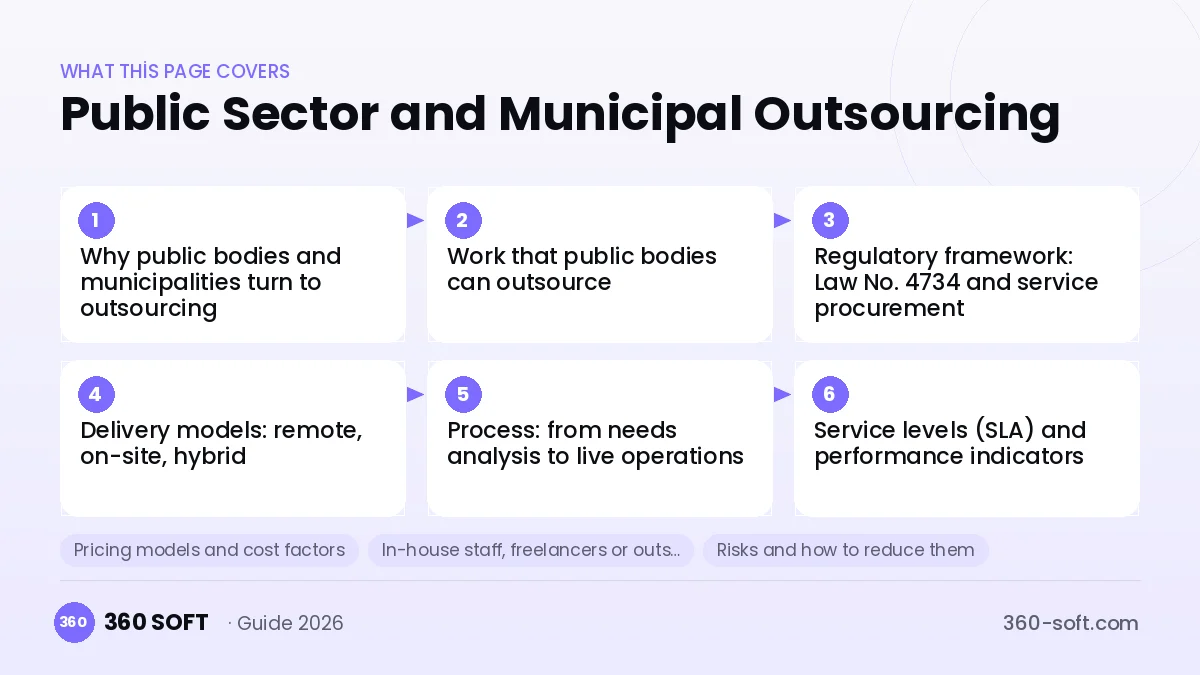
Risks and how to reduce them
- Vague scope: define services, volumes and acceptance criteria in the specification.
- Dependence on the provider: require documentation, knowledge transfer and an exit plan.
- Data leakage: keep data on institution systems, apply least-privilege access and logging.
- Quality drift: monthly KPI reviews, quality sampling and penalty or bonus clauses.
- Legal classification risk: manage the service through outcomes, not by directing individual staff.
Security, data protection, confidentiality and IP
All staff sign confidentiality agreements. Access to citizen data runs through the institution’s systems with multi-factor authentication, role-based permissions and audit logs. We sign a data processing agreement under KVKK, and for international buyers a GDPR data processing agreement with Standard Contractual Clauses (or the UK IDTA where relevant). Source code, documents and other deliverables are assigned to the institution under the contract. The commercial basis is a B2B service agreement with an NDA and IP assignment.
Provider selection checklist
- Experience with public sector processes and citizen-facing services
- Ability to work within tender documents, specifications and acceptance procedures
- Clear SLA proposal with reporting samples
- Data protection: KVKK processing agreement, and GDPR terms where needed
- Security controls: background checks, MFA, logging, data kept on institution systems
- Replacement process and documented knowledge transfer
- Scalability for peaks, emergencies and new services
- Both team and software capability (contact centre, work orders, reporting)
- Exit plan and transfer of all documentation and code
Frequently asked questions
Which work can municipalities outsource?
Operational tasks such as the citizen contact centre, work order coordination, IT help desk and system administration, software development, data entry and archive digitisation. Decisions involving public authority remain with the institution.
Can a public body contract directly with 360 Soft?
Yes, through the procurement procedure that applies to the institution, such as a tender or direct procurement below the thresholds. Municipal companies may follow their own procurement rules.
Do you help with the technical specification?
We can explain how to define measurable services, SLAs and reports. Preparing and running the tender remains the responsibility of the institution.
Is this the same as staff-based service procurement?
No. We recommend outcome-based services where 360 Soft manages its own team and the institution manages the service through SLAs. Your legal unit should review the model.
Can the team work on the institution’s premises?
Yes. Teams can work on-site, remotely from Istanbul or in a hybrid model.
Does public data leave the institution’s systems?
No by default. Our team works on the institution’s systems through secure access, and data stays where the institution keeps it.
How do you comply with KVKK?
We act as a data processor under a written agreement, apply access controls and logging, train staff and support the institution’s data controller obligations.
Can you work for public bodies outside Türkiye?
Yes, for remote services. Local procurement and data protection rules of the buyer’s country apply, and we sign GDPR or other required terms.
How fast can you start?
Typically within 1–2 weeks after the contract and access set-up, depending on team size and security checks.
Can you provide 7/24 service?
Yes. Shift-based 7/24 coverage is possible, for example for citizen hotlines and IT monitoring.
What if a team member leaves?
The contract includes a replacement process with documented procedures, so service continues.
Illustrative scenario
Illustrative scenario: a mid-sized municipality receives citizen requests by phone, WhatsApp and its website, but requests are tracked in spreadsheets and field teams receive them late. A remote contact centre team registers every request in one system, creates work orders for field teams, and sends status updates to citizens. Managers see open requests by district and category on a dashboard. This example shows how the model works; it is not a description of a specific client.
Related pages
- All outsourcing services (hub)
- Call centre and customer service outsourcing
- Field technical service outsourcing
- Back office and data entry outsourcing
- ERP support outsourcing
- DevOps and cloud operations
- IT staff leasing
- Hire developers
Contact
Tell us about your institution, the services you want to improve and your procurement timeline, and we will propose a team, delivery model and SLA structure. Call or WhatsApp us on +90 850 335 10 87, write to info@360-soft.com, message us directly on WhatsApp, or use the form on our contact page. 360 Soft Marketing Yazılım ve Danışmanlık Ltd. Şti., Nidakule Ataşehir Batı, Barbaros Mah. Begonya Sk. No:1 D:2, 34746 Ataşehir/İstanbul.
Türkçe: Türkçe sürüm
Related services
- QA and Software Testing OutsourcingQA and software testing outsourcing from Türkiye: risk-based test strategy, Selenium, Playwright and Appium…
- Retail OutsourcingRetail and store chain outsourcing: customer service, store help desk, field service, pricing, catalogue and…
- RFID and Drone Inventory Counting ServiceInventory counting as a service: counting team, RFID readers, barcode terminals and drones provided, with…
- RPA and Process Automation OutsourcingRPA and process automation outsourcing: process discovery, UiPath and Power Automate bot development, managed…
- Sales and Telesales OutsourcingSales and telesales outsourcing from Istanbul: lead qualification, meeting booking, telesales and renewals in…
- SAP Outsourcing and SAP AMS SupportSAP outsourcing and SAP AMS from Istanbul: S/4HANA, FI/CO, MM/SD, ABAP, Basis and integration teams, from one…