An EV charging network is only as good as the software behind it. A charge point management system (CPMS) connects your chargers over OCPP, controls sessions, prices and payments, balances load across sites, feeds the driver app and handles roaming with other networks. Off-the-shelf platforms are a quick start, but many operators reach a point where licence fees per charger, missing integrations or limited control over the customer experience become a problem.
360 Soft builds custom EV charging management software and driver apps for charge point operators (CPOs), e-mobility service providers (eMSPs), fuel retailers, fleet operators, car parks, hotels and real estate owners. We deliver as a project team or a dedicated team from Istanbul, and we support the platform after go-live.
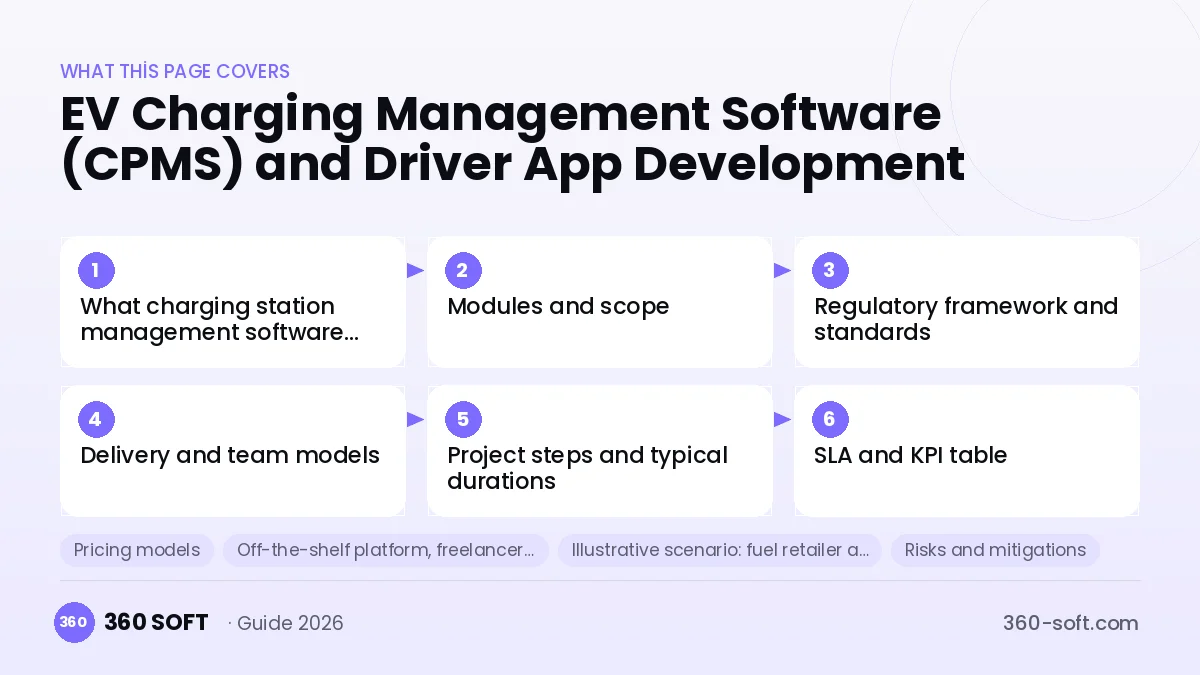
What charging station management software (CPMS) does
A CPMS is the operational core of a charging business. It knows the state of every connector, starts and stops sessions, authorises users by app, RFID card or ad-hoc payment, applies tariffs, records energy and money, and raises alarms when a charger fails. Around it sit the driver app, the operator back office, billing and accounting, and connections to roaming hubs and the energy side.
Modules and scope
| Module | Functions |
|---|---|
| OCPP central system | OCPP 1.6J and 2.0.1, remote start/stop, firmware updates, diagnostics, reservations |
| Driver mobile app | Map, availability, start charging via QR, payment, history, invoices (iOS and Android) |
| Tariffs and billing | Time, kWh, idle fees, subscriptions, B2B fleet billing, e-invoice integration |
| Payments | Card payments through a licensed payment provider, wallets, ad-hoc payment at the charger |
| Load management | Static and dynamic load balancing, site power limits, smart charging profiles |
| Roaming | OCPI connections to roaming hubs and partner networks |
| Operator back office | Sites, chargers, users, RFID cards, alarms, reports, role-based access |
| Monitoring and maintenance | Uptime tracking, fault tickets, field service workflows |
Technology stack
Typical choices are a scalable backend in.NET, Java or Node.js with WebSocket handling for OCPP, PostgreSQL and a time-series store for meter values, React for the back office and Flutter or native code for the mobile app, hosted on AWS, Azure or a local cloud. Architecture is designed for thousands of concurrent connections and for chargers from different manufacturers.
Regulatory framework and standards
In Türkiye, charging services are regulated by the Energy Market Regulatory Authority (EPDK) under the charging service regulation, including licensing of charging network operators and reporting obligations; our team works within this framework. In the EU, the Alternative Fuels Infrastructure Regulation (AFIR, Regulation (EU) 2023/1804) sets rules on ad-hoc payment and price transparency, and the UK has its own public charge point regulations. Local rules in the buyer country always apply, and we design the software so country-specific requirements can be configured.
| Standard | Purpose |
|---|---|
| OCPP 1.6J / 2.0.1 | Communication between charger and CPMS |
| OCPI | Roaming between CPOs and eMSPs |
| ISO 15118 | Plug and Charge, vehicle-to-grid communication |
| OpenADR / OSCP | Demand response and grid-aware charging |
Delivery and team models
- Project delivery: fixed scope for an MVP with defined milestones
- Dedicated team: backend, mobile, QA and DevOps engineers working only for you, from 1 to 200+ people
- Extension of an existing platform: we add modules or integrations to your current CPMS
- Support and operations: monitoring, incident handling and 7/24 shifts where needed
Project steps and typical durations
| Phase | Content | Indicative duration |
|---|---|---|
| Discovery | Business model, charger fleet, payment and roaming needs | 2 to 3 weeks |
| MVP | OCPP core, back office, app with payment, basic tariffs | Typically 3 to 5 months |
| Pilot | Live operation on selected sites, charger certification tests | 4 to 8 weeks |
| Scale-up | Load management, roaming, fleet billing, analytics | Ongoing releases |
| Operation | SLA-based support and continuous development | Ongoing |
Durations depend on scope and the number of charger models. A team can typically start within 1 to 2 weeks.
SLA and KPI table
| KPI | What it measures | Example target to agree |
|---|---|---|
| Platform availability | CPMS and app uptime | Monthly uptime commitment in the contract |
| Charger online rate | Share of chargers connected to the CPMS | Target per network |
| Session success rate | Started sessions that complete without error | Tracked per charger model |
| Critical incident response | Time to respond to outage of the platform | Agreed hours, 7/24 option |
| App store rating and support tickets | Driver experience | Trend-based targets |
Targets above are examples for discussion, not results achieved for a client.
Pricing models
| Model | How it works | Fits when |
|---|---|---|
| Fixed-price project | Fixed scope for MVP or a module | Requirements are clear |
| Dedicated team | Monthly fee per team member | Product will evolve continuously |
| Time and materials | Billed by effort | Scope is still open |
| Support retainer | Monthly support and maintenance | After go-live |
Cost depends on the number of modules, charger models to certify, payment and roaming integrations, platforms (iOS, Android, web) and SLA level. We send a written proposal; we do not publish prices.
Off-the-shelf platform, freelancer or custom development
| Criterion | SaaS CPMS | Freelancer | Custom with 360 Soft |
|---|---|---|---|
| Time to start | Fast | Fast | MVP in months, team starts in 1 to 2 weeks |
| Cost structure | Fee per charger, grows with the network | Low, but high risk | Development plus support; no per-charger licence to us |
| Brand and UX control | Limited | Depends | Full |
| Integrations | What the vendor offers | Limited | Built to your ERP, payment and energy systems |
| Ownership | Vendor | Unclear | You own code and data |
Illustrative scenario: fuel retailer adding fast charging
Illustrative scenario: a fuel station chain plans DC fast chargers at 40 stations with chargers from two manufacturers. Phase one delivers an OCPP central system, a branded app with card payment and loyalty integration, and a back office for station managers. Phase two adds dynamic load management for sites with limited grid connection and OCPI roaming so drivers of partner networks can charge. This scenario describes an approach and is not a completed client project.
Risks and mitigations
| Risk | Mitigation |
|---|---|
| Charger firmware differences | Compatibility test lab, per-model profiles, OCPP compliance testing |
| Payment failures at the charger | Licensed payment provider, retries, clear refund flows |
| Connection loss | Offline authorisation lists, local caching, alarms |
| Scaling problems | Load testing, horizontally scalable WebSocket layer |
| Regulatory change | Configurable reporting and pricing display rules |
Security, GDPR/KVKK, NDA and intellectual property
Charging platforms process driver accounts, location history and payment tokens. We follow security-by-design: TLS for OCPP (security profiles), encrypted storage, tokenised payments through PCI DSS compliant providers (we never store card numbers), role-based access and audit logs.
Contract framework for international buyers: we work under a B2B service agreement with a full IP assignment clause, so source code, data models, configurations and documentation produced for you belong to you on payment. A mutual NDA is signed before any data is shared. Where personal data is processed, we sign a GDPR data processing agreement (DPA) with Standard Contractual Clauses (or the UK IDTA for UK controllers); on the Turkish side the team also complies with KVKK (Law No. 6698). Local rules in your own country apply in addition to these.
Selection checklist
- Supports OCPP 1.6J and 2.0.1, with a plan for ISO 15118
- Proven integration approach for your charger brands
- Payment through a licensed provider, ad-hoc payment where required
- Load management for constrained sites
- OCPI roaming
- Reporting for your regulator
- Clear SLA and support model
- Ownership of source code and data
Frequently asked questions
Which charger brands do you work with?
Any charger that supports OCPP 1.6J or 2.0.1. We test each model in a compatibility phase because firmware behaviour differs between manufacturers.
Can we order only a mobile app?
Yes. We can build a driver app on top of your existing CPMS if it offers an API, or connect it to a new backend later.
Is payment infrastructure included?
We integrate a licensed payment provider for card payments, wallets and ad-hoc payment. We do not act as a payment institution or store card data.
Should we use OCPP 1.6J or 2.0.1?
Most installed chargers speak 1.6J; 2.0.1 adds better security and smart charging. We usually support both so you are not limited by your charger fleet.
Can we migrate from an existing platform?
Yes. Chargers are reconfigured to the new central system step by step, and users, cards and history are migrated.
Is roaming supported?
Yes, through OCPI connections to roaming hubs and partner networks.
Do you cover regulatory reporting requirements?
Yes. We build reporting for EPDK in Türkiye and configure country-specific requirements such as price display and ad-hoc payment rules; local rules in your country apply.
Is load balancing possible?
Yes. Static and dynamic load management keep sites within their power limits and can prioritise vehicles.
How long does an MVP take?
Typically a few months depending on scope and charger models. The team can usually start within 1 to 2 weeks.
Who owns the source code?
You do. Our B2B agreement includes full IP assignment on payment.
Do you provide support after go-live?
Yes. We offer SLA-based support, monitoring and continuous development, including 7/24 shifts if required.
How is pricing determined?
By scope, platforms, integrations, charger models and SLA level. You receive a written proposal; we do not publish fixed prices.
Related pages: software outsourcing company in Türkiye, hire developers, automotive outsourcing, payment operations, software maintenance and support.
Let us talk about your charging network software
Tell us about your chargers, sites and business model and we will come back with a scoped proposal. Call or WhatsApp us on +90 850 335 10 87, write to info@360-soft.com, message us directly on WhatsApp, or use the contact page. 360 Soft Marketing Yazılım ve Danışmanlık Ltd. Şti., Nidakule Ataşehir Batı, Barbaros Mah. Begonya Sk. No:1 D:2, 34746 Ataşehir/İstanbul.
Türkçe: Türkçe sürüm