Selling online across a web shop and several marketplaces creates a lot of repetitive work: updating stock and prices in every channel, importing orders, creating invoices and shipping labels, answering the same customer questions, writing product descriptions and reconciling marketplace payouts. When this is done by hand, errors and overselling grow with every new channel. E-commerce automation connects these systems so that routine work runs by itself and your team handles only the exceptions.
360 Soft designs, builds and runs e-commerce automation for brands, retailers, manufacturers selling direct and marketplace sellers. We connect Shopify, WooCommerce, Magento and other shop platforms with marketplaces such as Amazon, eBay, Etsy, Noon, Trendyol and Hepsiburada, with your ERP, warehouse, carriers, e-invoicing and customer messaging, delivered by a dedicated team from Istanbul.
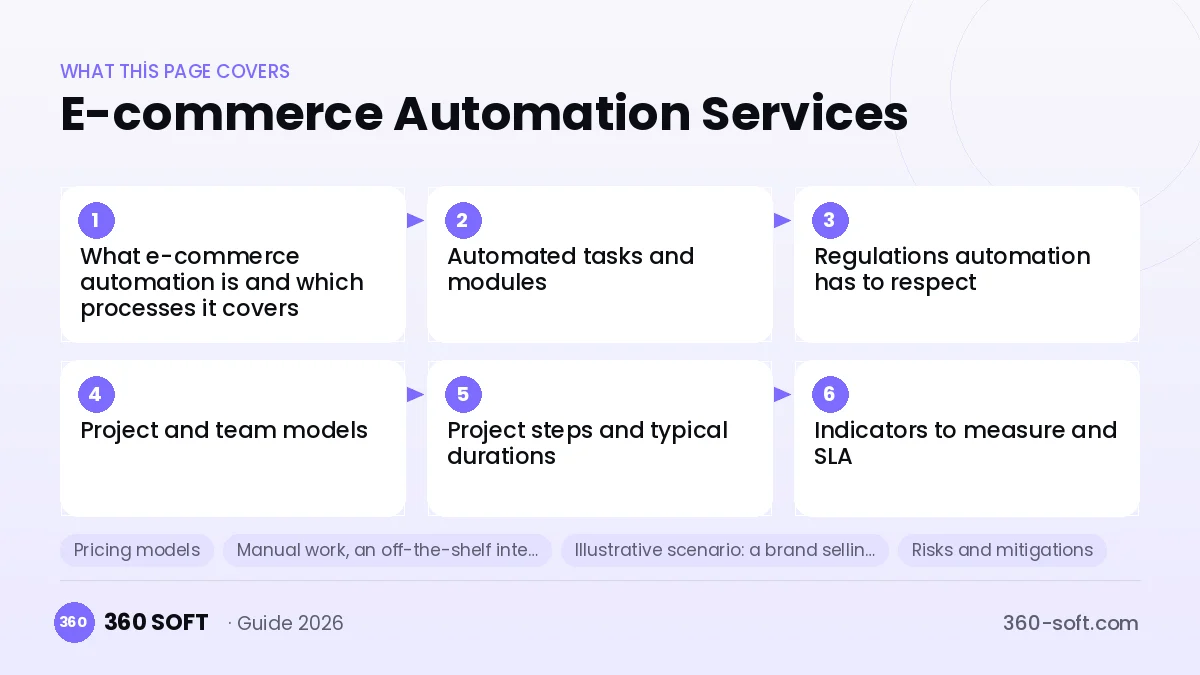
What e-commerce automation is and which processes it covers
Automation means rules and integrations that move data between systems and trigger actions without manual steps: a sale on one marketplace reduces stock everywhere, an order creates an invoice and a shipping label, a delayed shipment triggers a customer message, a competitor price change is checked against your margin rules. It ranges from simple integration flows to AI-assisted content and customer service.
Automated tasks and modules
| Area | What is automated |
|---|---|
| Product and catalogue | Central product data (PIM), variant and attribute mapping per marketplace, image handling, AI-assisted descriptions with human review |
| Stock and price sync | Near real-time stock across channels, buffer rules, price rules with minimum margin checks |
| Order management | Order import from all channels, routing to warehouses, status updates back to channels |
| Invoicing and accounting | E-invoice or e-archive creation, ERP posting, marketplace payout reconciliation |
| Shipping | Carrier label creation, tracking numbers, delivery notifications, returns flows |
| Customer service | Order status answers via chatbot, WhatsApp Business notifications, ticket routing |
| Marketing | Abandoned cart flows, segmentation, consent-aware campaigns |
| Reporting | Channel profitability, stock turnover, returns analysis dashboards |
Technology approach
We use platform and marketplace APIs, a central integration layer (custom microservices or tools such as n8n where suitable), message queues for reliability, and monitoring with alerts for failed flows. AI models can draft descriptions or classify tickets, always with review rules. Existing tools are reused where they work; we do not replace your shop platform unless there is a good reason.
Regulations automation has to respect
In Türkiye, where our team operates, e-commerce is governed by Law No. 6563 on electronic commerce (including ETBIS registration and the IYS system for commercial electronic messages), the distance contracts regulation, e-invoice and e-archive rules of the Revenue Administration, and KVKK. For other markets, local rules apply: in the EU for example GDPR and ePrivacy consent for marketing, consumer rights and price-reduction indication rules, and VAT OSS; in the UK, GDPR and PECR; in the GCC, local e-commerce and data protection laws. Automation rules are built so that consent, invoicing and pricing requirements are applied consistently.
Project and team models
- Fixed-scope automation package: for example stock, price and order sync across defined channels
- Dedicated team: integration developers, QA and an analyst working continuously for you, from 1 to 200+ people
- Managed operation: monitoring of flows, fixing broken integrations after marketplace API changes, 7/24 shifts possible
Project steps and typical durations
| Step | Content | Indicative duration |
|---|---|---|
| Process audit | Channels, systems, manual tasks, error sources | 1 to 2 weeks |
| Prioritisation | Automations ranked by effort saved and risk reduced | 1 week |
| First automation | Typically stock, price and order sync | Typically 3 to 6 weeks |
| Extension | Invoicing, shipping, customer messaging, content | Ongoing sprints |
| Operation | Monitoring, API change handling, improvements | Ongoing |
A team can typically start within 1 to 2 weeks. Durations depend on the number of channels and the state of product data.
Indicators to measure and SLA
| Indicator | What it shows |
|---|---|
| Manual hours per order | Effort remaining after automation |
| Overselling and cancellations | Quality of stock sync |
| Order-to-ship time | Speed of fulfilment flow |
| Failed flow rate and time to fix | Reliability of integrations |
| Customer response time | Effect of automated service messages |
We measure the baseline before automation and agree targets with you; we do not present illustrative numbers as achieved results.
Pricing models
- Fixed price per automation package
- Dedicated team on a monthly basis
- Time and materials for open scope
- Monthly operation and monitoring retainer
Cost depends on the number of channels and systems, order volume, product data quality, AI components and the support level required. You receive a written proposal; we do not publish prices.
Manual work, an off-the-shelf integrator or custom automation
| Criterion | Manual | Off-the-shelf integrator | Custom automation |
|---|---|---|---|
| Start | Now | Fast | First flows in weeks |
| Flexibility | High but slow | Limited to supported flows | Built around your processes |
| Cost structure | Staff time | Monthly fee, often per order | Development plus optional operation |
| ERP and warehouse fit | Manual | Varies | Built to your systems |
| Ownership | Yours | Vendor | You own code and flows |
Many sellers keep an existing integrator for marketplace listing and add custom automation around it for ERP, invoicing, service and reporting.
Illustrative scenario: a brand selling in four channels
Illustrative scenario: a home textiles brand sells on its Shopify store, Amazon, Etsy and a regional marketplace, with stock in one warehouse and accounting in an ERP. Stock and prices are synchronised from the ERP with safety buffers, orders flow into a single queue, invoices and carrier labels are created automatically, and customers receive WhatsApp shipping notifications. Product descriptions for new items are drafted by an AI model and approved by the content team. This describes an approach, not a completed client project.
Risks and mitigations
| Risk | Mitigation |
|---|---|
| Marketplace API changes | Monitoring, alerts, maintenance retainer |
| Wrong automated prices | Minimum and maximum price rules, margin checks, change limits |
| Poor product data | Data cleansing phase, validation before publishing |
| AI content errors | Human approval step, prohibited claim lists |
| Messaging without consent | Consent checks in every marketing flow |
Security, GDPR/KVKK, NDA and intellectual property
E-commerce flows process customer names, addresses and order history. We minimise data, encrypt credentials and API keys, restrict access by role, log processing and never store card data, which remains with your payment provider.
Contract framework for international buyers: we work under a B2B service agreement with a full IP assignment clause, so source code, data models, configurations and documentation produced for you belong to you on payment. A mutual NDA is signed before any data is shared. Where personal data is processed, we sign a GDPR data processing agreement (DPA) with Standard Contractual Clauses (or the UK IDTA for UK controllers); on the Turkish side the team also complies with KVKK (Law No. 6698). Local rules in your own country apply in addition to these.
Selection checklist
- Which channels, platforms and systems must be connected
- Which manual tasks cost the most time or cause the most errors
- How stock and price conflicts are resolved
- How failed flows are monitored and fixed
- How consent and invoicing rules are enforced
- Who maintains integrations after marketplace API changes
- Who owns code, flows and data
Frequently asked questions
Which marketplaces do you work with?
Any marketplace with an API, for example Amazon, eBay, Etsy, Noon, Zalando, Trendyol and Hepsiburada, plus shop platforms such as Shopify, WooCommerce and Magento.
Do we have to change our current infrastructure?
No. We build around your existing shop platform, ERP and tools and only recommend replacing something if it blocks the automation.
Can the warehouse side be automated too?
Yes. Order routing, picking lists, carrier labels, tracking updates and returns can be automated and connected to your warehouse system.
How quickly can the first automation go live?
Typically within a few weeks for a defined flow such as stock and order sync. The team can usually start within 1 to 2 weeks.
We already use an integrator. Can you still help?
Yes. We often keep an existing integrator for listings and automate the processes around it, such as ERP, invoicing, service and reporting.
Is automatic price updating risky?
It can be without controls. We add minimum and maximum prices, margin checks and limits on how much a price may change at once.
Does AI publish product descriptions by itself?
Only if you want it to. By default AI drafts descriptions and a person approves them before publishing.
Can you send automatic WhatsApp messages?
Yes, through the WhatsApp Business Platform using approved templates and only to customers who have given the required consent.
What happens if an integration breaks?
Monitoring detects failed flows, alerts the team and queues data for reprocessing. Under a support agreement we fix the cause.
Where is our data stored?
In your own systems or the hosting you choose. Integrations pass data through and store only what is needed for processing and logs.
How is pricing determined?
By channels, systems, volume and support level. You receive a written proposal; we do not publish prices.
Who owns the source code and flows?
You do. Our B2B agreement includes full IP assignment on payment.
Related pages: RPA process automation, e-invoice integration operations, chatbot management outsourcing, data analytics and BI outsourcing, software maintenance and support.
Let us automate your e-commerce processes together
Tell us your channels, systems and order volume and we will come back with a prioritised automation plan and proposal. Call or WhatsApp us on +90 850 335 10 87, write to info@360-soft.com, message us directly on WhatsApp, or use the contact page. 360 Soft Marketing Yazılım ve Danışmanlık Ltd. Şti., Nidakule Ataşehir Batı, Barbaros Mah. Begonya Sk. No:1 D:2, 34746 Ataşehir/İstanbul.
Türkçe: Türkçe sürüm