SAP is the backbone of finance, supply chain, production and HR in many organisations, and it rarely stands still: new company codes, tax changes, interfaces, upgrades and the move to S/4HANA all compete for the same scarce consultants. 360 Soft builds SAP outsourcing teams in Istanbul, from a single FI/CO or ABAP specialist to a full application management services (SAP AMS) centre with ticket handling, SLAs and continuous improvement. Teams range from 1 to 200+ people, work remotely, on-site or hybrid, and can cover 24/7 shifts where your operations require it.
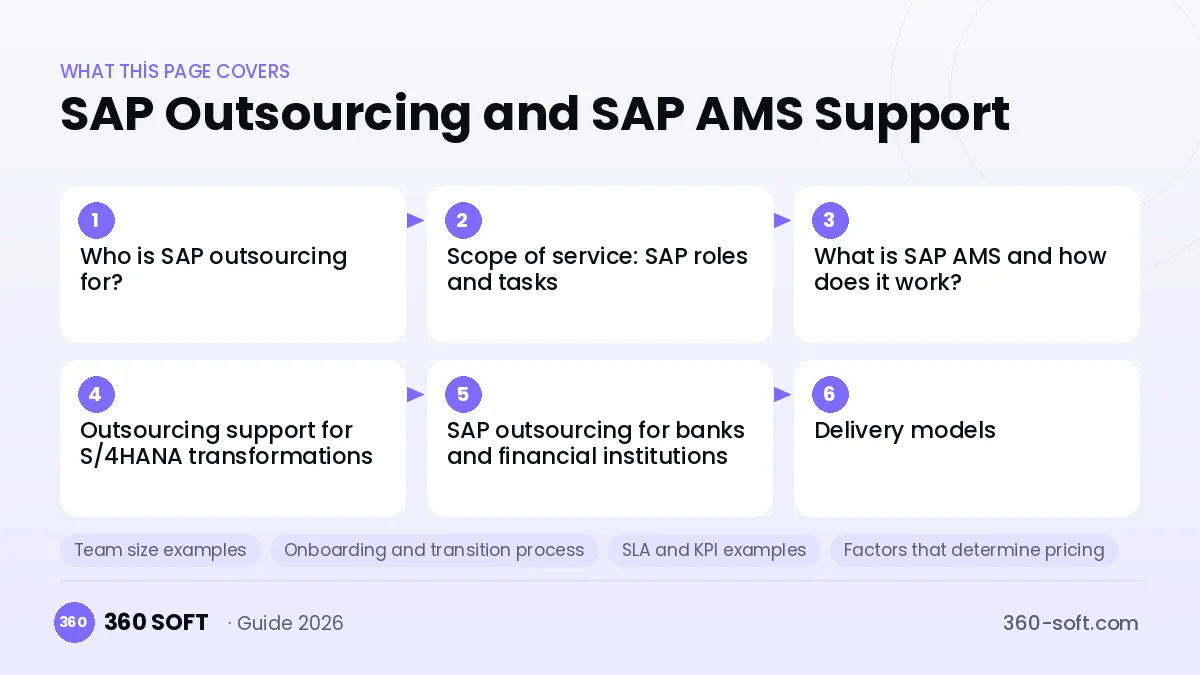
This page explains who SAP outsourcing suits, which roles and modules we cover, how SAP AMS works, support for S/4HANA programmes and for banks, delivery models, team size examples, the onboarding and transition process, SLA and KPI examples, pricing factors, a comparison with in-house and freelance options, risks, legal notes and a vendor checklist.
Who is SAP outsourcing for?
- Mid-sized and large companies running SAP ECC or S/4HANA whose internal team is too small to cover support, change requests and projects at the same time.
- Companies preparing or running an S/4HANA conversion that need extra functional, ABAP and Basis capacity for a defined period.
- Groups with several countries or company codes that want one consistent support desk instead of local freelancers.
- Organisations whose SAP partner contract is ending and who want a structured handover to a new provider.
- Banks and financial institutions using SAP for finance, leasing or HR and needing controlled, auditable support.
Scope of service: SAP roles and tasks
We staff functional consultants, developers and technical roles. The table shows typical tasks per module; the exact scope is agreed in the statement of work.
| Module | Typical tasks |
|---|---|
| FI (Financial Accounting) | Period-end closing support, GL/AP/AR issues, tax and e-document settings, bank integration, asset accounting |
| CO (Controlling) | Cost centre and profit centre accounting, product costing, allocation cycles, CO-PA reporting |
| MM (Materials Management) | Purchasing, inventory management, invoice verification, release strategies, master data |
| SD (Sales and Distribution) | Pricing conditions, order-to-cash, delivery and billing, output determination, credit management |
| PP / QM | Production orders, MRP runs, BOMs and routings, quality inspections |
| WM / EWM | Warehouse structure, putaway and picking strategies, RF processes, handling units |
| HCM / SuccessFactors | Organisational management, time and payroll integration, employee central support |
| PS / PM | Project structures and budgets, maintenance orders, notifications and planning |
Technical roles include ABAP and ABAP on HANA developers (reports, enhancements, BAdIs, CDS views, RAP/OData), Fiori/UI5 developers, Basis administrators (system administration, transports, patches, performance, authorisations) and integration specialists for SAP PI/PO, Cloud Integration and IDoc/API interfaces.
What is SAP AMS and how does it work?
SAP application management services (AMS) means a provider takes ongoing responsibility for running and improving your SAP applications under agreed service levels. Instead of buying hours, you buy an outcome: tickets are handled within response and resolution targets, recurring problems are analysed and removed, and small enhancements are delivered through a controlled change process. A typical AMS is organised in layers:
| Layer | Scope | Example work |
|---|---|---|
| Level 1 (user support) | Ticket intake, triage, password and authorisation requests, how-to questions | User cannot post an invoice; missing role |
| Level 2 (functional support) | Analysis of process and configuration issues per module | Pricing condition not found; MRP run results look wrong |
| Level 3 (technical support) | Code fixes, interfaces, performance, Basis | Short dump in a custom report; IDoc failures |
| Small enhancements | Change requests within an agreed effort band | New field on a form; additional report filter |
| Proactive operations | Monitoring, job checks, problem management, housekeeping | Daily job monitoring; recurring-error root cause analysis |
Work is tracked in your ticketing tool or ours (for example ServiceNow, Jira Service Management or SAP Solution Manager / Cloud ALM), with ITIL-based incident, problem and change processes and a monthly service report.
Outsourcing support for S/4HANA transformations
An S/4HANA move, whether brownfield conversion, greenfield or selective data transition, temporarily doubles the workload: the legacy system still needs support while the project consumes your best people. We help in three ways: by taking over day-to-day ECC support so your core team can focus on the project; by adding functional and ABAP capacity for custom code remediation, simplification items, testing and data migration; and by forming the hypercare and AMS team after go-live, so knowledge built during the project is not lost.
SAP outsourcing for banks and financial institutions
Banks, leasing and insurance companies use SAP for finance, procurement, HR and sometimes for core leasing or banking components. For these clients we design the service around outsourcing and audit requirements: named team members with background checks, access only through your VPN or virtual desktop with MFA, segregation of duties in authorisations, logged changes with approvals, and documentation that supports your internal and regulatory outsourcing assessment. In Türkiye this includes awareness of BDDK rules on support services; abroad, the rules of your own regulator (for example EBA outsourcing guidelines and DORA in the EU) apply and are reflected in the contract.
Delivery models
| Model | How it works | Typical use in SAP |
|---|---|---|
| Remote | Team works from Istanbul via VPN or VDI on your systems | Most AMS, development and Basis work |
| On-site | Consultants work at your premises for agreed periods | Workshops, go-live, hypercare, key-user training |
| Hybrid | Remote base with planned on-site visits | Projects with intensive design phases and remote build |
| Team model | When to choose it |
|---|---|
| Staff augmentation (consultant or developer) | You manage the work and need extra named experts |
| Dedicated SAP team | You want a stable team that knows your system, led by our team lead |
| Managed AMS | You want SLA-based responsibility for support and improvements |
| Project-based | A defined scope such as a rollout, interface or migration |
Team size examples
| Scale | Illustrative structure | Suitable when |
|---|---|---|
| 1 person | One FI/CO consultant or one ABAP developer | A gap in an existing team |
| 3–6 people | FI/CO, MM/SD, ABAP, part-time Basis | Mid-sized single-instance SAP |
| 8–20 people | Module leads, developers, Basis, integration, service manager | Multi-company groups, AMS with extended hours |
| 20–50+ people | Full AMS centre with 24/7 shifts and project pool | Large landscapes or parallel transformation programmes |
Onboarding and transition process
- Discovery (week 1): landscape, modules, custom code volume, ticket history, service hours and SLA expectations.
- Proposal and team design: roles, seniority, model and SLA annex; CVs and interviews with you.
- Start (typically 1–2 weeks after approval): access, tools, communication channels and escalation matrix.
- Knowledge transfer and shadowing: the new team works alongside the outgoing team or your staff, then takes over with reverse shadowing.
- Steady state: SLA measurement, monthly reports, problem management and an improvement backlog.
If a team member leaves or does not fit, our replacement process provides a successor with a handover period, so the service continues without gaps.
SLA and KPI examples
The targets below are examples used to start the discussion; final values depend on hours, priorities and your landscape.
| Priority | Definition | Measured indicators |
|---|---|---|
| P1 – Critical | Production down or a core process blocked for many users | Response time, workaround time, resolution time, 24/7 coverage if agreed |
| P2 – High | Important process impaired, no workaround | Response and resolution time within service hours |
| P3 – Medium | Single user or non-critical issue | Resolution within agreed business days |
| P4 – Low / information request | Questions, minor changes | Backlog age, first-time-right rate |
Further KPIs typically include SLA compliance rate, ticket backlog trend, reopened tickets, share of tickets solved at level 1, recurring-incident reduction, change success rate and user satisfaction after ticket closure. Illustrative scenario: a mid-sized manufacturer runs SAP ECC with FI/CO, MM, SD and PP, supported by two in-house consultants and freelancers. Tickets wait for days during month-end. A team of five (FI/CO, MM/SD, PP, ABAP, part-time Basis) takes over level 2 and 3 support after four weeks of knowledge transfer, while the internal consultants focus on S/4HANA preparation. Success would be measured through SLA compliance, backlog age and month-end closing duration. This is an illustrative scenario, not a client case.
Factors that determine pricing
We do not publish prices because cost depends on scope. Common commercial models are person-month or person-day rates, a monthly AMS fee, an hours bucket, fixed price for defined projects, and optionally an outcome-based component tied to KPIs. The main cost drivers are:
| Factor | Effect |
|---|---|
| Number and scope of modules | More modules require broader skills and more people |
| Custom code density | Heavily customised systems need more ABAP capacity |
| Service hours | Business hours, extended hours or 24/7 change staffing |
| SLA targets | Tighter response and resolution times require more coverage |
| Systems and environments | Number of instances, clients and interfaces |
| Security and compliance requirements | Background checks, VDI, audits and documentation |
| Seniority mix | Ratio of senior architects to mid-level consultants |
| Languages | English, German or Arabic support in addition to Turkish |
In-house team, freelancer or SAP outsourcing?
| Criterion | In-house team | Freelancer | SAP outsourcing |
|---|---|---|---|
| Time to start | Months of recruiting | Fast, if available | Typically 1–2 weeks |
| Continuity | Depends on retention | Risk when the person leaves | Replacement process and documentation |
| Skill breadth | Limited to employees | One person, one skill set | Combined module and technical skills |
| SLA responsibility | Internal | Rarely | Contractual |
| Scaling | Slow | Limited | From 1 to 200+ people |
Risks and mitigations
- Knowledge loss: structured transfer, runbooks and a documented knowledge base owned by you.
- Unauthorised changes: transport approvals, separate roles for development and production, change logs.
- Quality of custom code: code review, ABAP Test Cockpit checks and naming conventions.
- Dependency on one provider: exit clauses, handover obligations and full documentation in your repositories.
- Communication gaps: fixed meetings, a named service manager and an escalation matrix.
Security, data protection and legal notes
Access to SAP systems is granted only through your VPN or virtual desktop, with individual user IDs, MFA and least-privilege authorisations. Production data is not copied to local devices; where test data is needed, we recommend anonymised copies. Every team member signs confidentiality undertakings.
Contract note. International clients normally contract with us under a B2B service agreement with a statement of work and SLA annex. It includes assignment of intellectual property in all deliverables (code, configuration, documentation) to you on payment, a mutual NDA, and a data processing agreement aligned with GDPR, with Standard Contractual Clauses for transfers to Türkiye (or the UK IDTA/Addendum for UK data). Our own processing in Türkiye is also subject to KVKK (Law No. 6698). Team members are employed by 360 Soft under Turkish labour law, so you do not take on employer obligations. Where you are a regulated financial institution, audit and access rights for you and your regulator, sub-outsourcing rules and exit provisions can be included in the agreement. Local rules in your country continue to apply to your SAP data and processes.
Checklist for choosing an SAP outsourcing provider
- Can the provider show CVs with the exact modules and release (ECC, S/4HANA) you use?
- Is there a named service manager and a clear escalation path?
- Are SLA definitions, priorities and reporting written into the contract?
- How is knowledge transfer planned, and who owns the documentation?
- What is the replacement process if a consultant leaves?
- Which security controls apply (VPN/VDI, MFA, background checks, logging)?
- Does the contract include IP assignment, NDA, GDPR DPA and exit support?
- Can the team cover your languages and time zones?
Frequently asked questions
Which SAP modules do you support?
We support FI, CO, MM, SD, PP, QM, WM/EWM, PS, PM and HCM/SuccessFactors, plus ABAP, Fiori/UI5, Basis and integration (PI/PO, Cloud Integration, IDoc and APIs).
Do you support both SAP ECC and S/4HANA?
Yes. We support ECC systems, S/4HANA on-premise and private cloud, and teams for conversion projects between them.
Can we start with one consultant?
Yes. Many clients start with one FI/CO consultant or ABAP developer and expand to a dedicated team or AMS later.
How quickly can a team start?
Typically within 1–2 weeks after approval, depending on the roles and the access process on your side.
What is the difference between staff augmentation and managed AMS?
With staff augmentation you direct named experts. With managed AMS we take responsibility for handling tickets and changes against agreed SLAs and report on them monthly.
Can you provide 24/7 SAP support?
Yes. Shift-based coverage, including 24/7 for critical priorities, can be agreed in the SLA.
Which ticketing tools do you work with?
We work in your tool, for example ServiceNow, Jira Service Management or SAP Solution Manager / Cloud ALM, or we can provide one.
How do you handle knowledge transfer from our current provider?
Through a planned transition with documentation review, shadowing and reverse shadowing before the new team takes over responsibility.
Who owns custom code and documentation?
You do. The contract assigns intellectual property in all deliverables to you and requires documentation to be kept in your repositories.
Is our data protected under GDPR?
Yes. We sign a data processing agreement with Standard Contractual Clauses, work only inside your systems and also comply with KVKK in Türkiye.
Do you work with banks?
Yes. For financial institutions we add audit rights, stricter access controls and documentation that supports your outsourcing assessment.
How is pricing determined?
By modules, custom code, service hours, SLA targets, seniority and languages. We quote after a discovery call.
Plan your SAP team with us
Tell us your SAP release, modules, ticket volume and service hours and we will propose a team structure, delivery model and SLA annex. Call or WhatsApp us on +90 850 335 10 87, write to info@360-soft.com, message us directly on WhatsApp, or use the form on our contact page. 360 Soft Marketing Yazılım ve Danışmanlık Ltd. Şti., Nidakule Ataşehir Batı, Barbaros Mah. Begonya Sk. No:1 D:2, 34746 Ataşehir/İstanbul.
Related pages
- All outsourcing services (hub)
- ERP support outsourcing
- CRM management outsourcing
- Mobile app maintenance outsourcing
- Website management outsourcing
- Software maintenance and support (AMS)
- Public sector and municipality outsourcing
- Hire developers in Türkiye
- IT staff leasing
Related services
- SOC and Security Monitoring OutsourcingSOC outsourcing: 24/7 SIEM and EDR monitoring, alert triage, investigation and incident response by L1-L3…
- Software Maintenance and Support (AMS) OutsourcingApplication management services (AMS) from Istanbul: ITIL-based L1-L3 support, bug fixing, maintenance and…
- Technical Documentation and Translation OutsourcingTechnical documentation and translation outsourcing: user guides, API docs, help centre, software…
- Telecom OutsourcingTelecom outsourcing from Istanbul: 24/7 NOC, OSS/BSS support, billing testing, software development and…
- Textile and Apparel OutsourcingTextile and apparel outsourcing: tech packs, order follow-up, buyer compliance files, marketplaces, content…
- Tourism and Hospitality Sector OutsourcingTourism and hotel outsourcing: multilingual reservation centre, channel management, reputation, night audit…