Robot RFID uses an autonomous mobile robot carrying UHF RFID readers to scan store shelves or warehouse aisles on a schedule, producing item-level stock counts, location data and on-shelf availability reports without staff walking the floor with handhelds. 360 Soft delivers the robot platform integration, readers and antennas, middleware, analytics software and connections to your ERP, WMS or merchandising systems. This page explains how robot RFID works, who it suits, how it compares with handhelds, towers and drones, components and software modules, standards, tagging strategy, delivery models, steps, KPIs, cost drivers and risks. See also our RFID inventory systems overview.
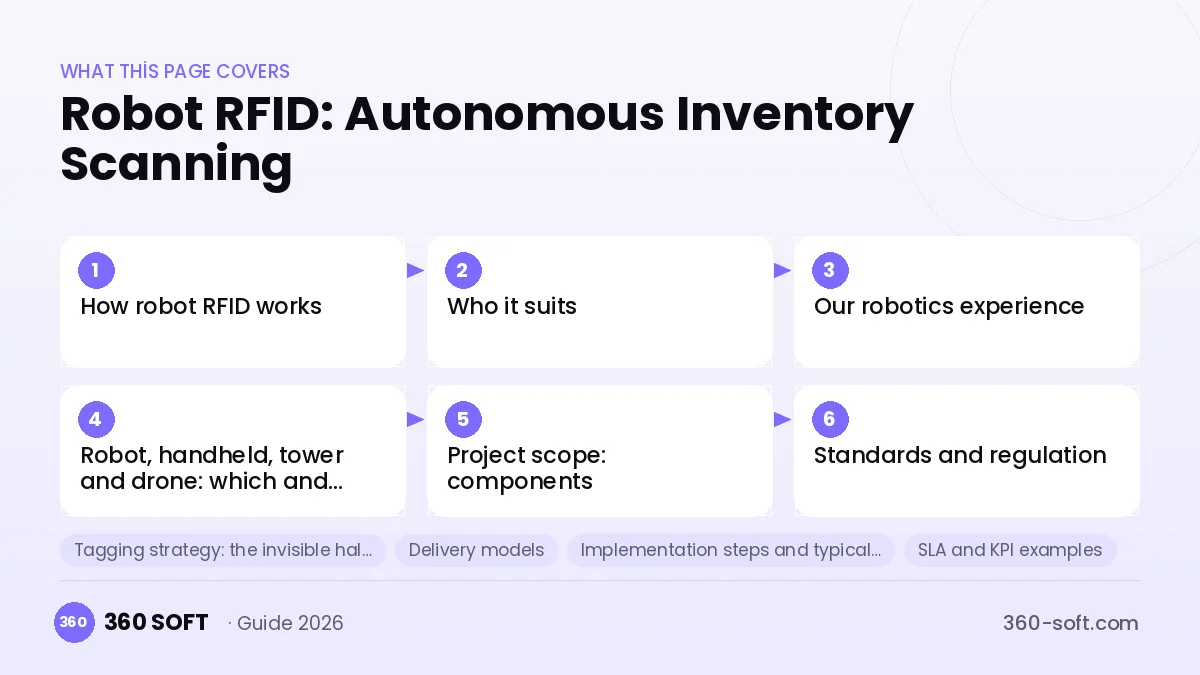
How robot RFID works
- The robot maps the store or warehouse and the areas to be scanned are defined.
- On a schedule, usually outside peak hours, it drives planned routes while its antennas read EPC tags on shelves, rails and racks.
- Reads are linked to the robot’s position, so each item gets an approximate location.
- Middleware filters and de-duplicates reads and compares them with system stock.
- Reports show missing items, misplaced items, items in the backroom but not on the shelf, and count differences.
Who it suits
- Apparel, footwear, sports and electronics retailers with item-level RFID tagging
- Medium and large stores where frequent full counts are too labour-intensive
- Flat-floor warehouses and distribution centres with lower rack heights
- Retailers using RFID for omnichannel fulfilment (click and collect, ship from store) who need accurate store stock
Our robotics experience
In retail, we developed a robotic AI interface for CarrefourSA and MediaMarkt.
Robot, handheld, tower and drone: which and when
| Method | Strength | Limitation | Suitable environment |
|---|---|---|---|
| Handheld | Low initial investment, flexible | Requires staff time, frequency is limited | Small stores, periodic counts |
| Robot RFID | Scheduled, unattended and repeatable scans with location data | Needs flat floors, enough aisle width and network coverage | Medium and large stores, flat-floor warehouses |
| Tower (fixed) RFID | Continuous, near real-time visibility at fixed points | Fixed hardware cost per covered area | Doors, passages, high-value zones |
| Drone RFID | Reaches high racks quickly | Battery time, flight safety procedures | High-bay warehouses |
Project scope: components
| Component | Role |
|---|---|
| Autonomous mobile robot | Navigation, obstacle avoidance, docking and charging |
| RFID reader and antennas | Multiple antennas covering shelf heights |
| Tags | EPC Gen2 item, carton or location tags |
| Middleware | Read filtering, positioning, event building |
| Stock comparison software | Compares reads with ERP/WMS stock |
| Task and dashboard app | Mission planning and results for store and HQ teams |
| Integrations | ERP, WMS, POS, merchandising and replenishment systems |
Software modules
| Module | Function |
|---|---|
| Mission planner | Schedules and routes by store and zone |
| Map and zone management | Sales floor, backroom, fitting rooms, no-go areas |
| Read processing | Filtering, de-duplication, location estimation |
| Variance analysis | Missing, extra and misplaced items |
| On-shelf availability | Items in stock but not on the sales floor |
| Reporting | Store, region and HQ dashboards |
Standards and regulation
The EPC Gen2 air interface (aligned with ISO/IEC 18000-63) and the GS1 EPC Tag Data Standard are the common basis, with SGTIN encoding at item level. Readers must operate within the UHF band and power limits of the country of use (ETSI rules in Europe and Turkey, FCC rules in the US). Robots sharing space with people should follow applicable machinery and mobile-robot safety standards, and our team in Turkey includes them in the occupational health and safety risk assessment under Law No. 6331; local workplace safety rules in your country apply as well.
Tagging strategy: the invisible half of the project
A robot can only count what is tagged and readable. Decide early which categories are tagged, whether tags are applied at source by suppliers or in the distribution centre, and which tag types suit metal, liquids or dense stacks. Encoding rules, tag quality checks at goods receipt and handling of damaged tags determine accuracy more than the robot itself. We help you define this strategy and the supplier requirements.
Delivery models
| Model | When it fits |
|---|---|
| Turnkey project | Robot, readers, software and integration delivered together |
| Pilot project | One or a few stores to measure accuracy and benefits |
| Software as a service | Hosted analytics and dashboards |
| On-premise installation | Data stays in your own environment |
| Managed service | We monitor robots and software and handle support |
| Additional team | Our robotics, backend or data engineers join your team |
Implementation steps and typical timelines
| Step | Content | Typical duration |
|---|---|---|
| 1. Discovery and goals | Use cases, KPIs, store formats | 1–2 weeks |
| 2. Site survey | Floor, aisle width, Wi-Fi, charging spot | 1 week |
| 3. Tag and read testing | Products, fixtures, antenna setup | 1–2 weeks |
| 4. Mapping and routes | Maps, zones, schedules | 1 week |
| 5. Integration | ERP, WMS, POS and replenishment | 2–4 weeks |
| 6. Pilot measurement | Comparison with manual counts | 2–4 weeks |
| 7. Rollout | Further stores, training, support | depends on scale |
SLA and KPI examples
| Indicator | What it shows |
|---|---|
| Read accuracy | Robot count compared with a verified count |
| Route completion | Share of planned routes completed |
| Variance report delivery time | Time from scan to report |
| On-shelf availability rate | Share of stocked items actually on the sales floor |
| System availability | Uptime of robots and software |
| Fault response time | Time to react to failures |
What drives the cost
| Factor | Why it matters |
|---|---|
| Number and size of stores or warehouses | Defines number of robots and routes |
| Robot sourcing model | Purchase, lease or as-a-service |
| Product scope to be tagged | Item-level tagging volume and tag types |
| Integration complexity | Number of systems and data quality |
| Scan frequency | Daily, weekly or per shift |
| Support level | Business hours or extended support |
In-house team, freelancers or outsourcing
| Criterion | In-house | Freelancer | 360 Soft team |
|---|---|---|---|
| Robotics and RFID know-how | Rare in retail teams | Usually one skill only | Covered in one team |
| Field capacity | Limited | Limited | Remote, on-site or hybrid |
| Continuity | Depends on retention | Risky | Replacement process for staff |
| Integration | Possible | Limited | Included |
| Cost | Fixed salaries | Hourly | Project or service fee |
Risks and mitigation
| Risk | Mitigation |
|---|---|
| Products containing metal or liquids | Special tags, placement rules, antenna tuning |
| Reads from neighbouring zones or the backroom | Zone filtering, power settings, location algorithms |
| Untagged or damaged tags | Tag quality checks and tagging procedures |
| Changes in store layout | Easy map updates and route re-planning |
| Wi-Fi dropouts | Local buffering and coverage checks |
| Working in the same space as people | Safety sensors, speed limits, scan windows |
| Staff not trusting the results | Pilot comparisons, transparent reports, training |
Security, data protection, NDA and IP
We work under a B2B service agreement with an NDA and IP assignment of custom software and configurations. Robot cameras and sensors are configured to minimise capture of people; where personal data may be processed we sign a GDPR Data Processing Agreement with SCCs (or the UK IDTA) and comply with KVKK.
Selection checklist
- Has read accuracy been tested on your products and fixtures?
- How does the robot handle crowded aisles and layout changes?
- Which systems are integrated, and how often is data synchronised?
- Who defines and enforces the tagging strategy?
- What does support look like across many stores?
- Can you start with a pilot and measurable targets?
Illustrative scenario: on-shelf availability in a store chain
Illustrative scenario – not a client case.
Situation
A fashion retailer has item-level RFID tags but counts stores only a few times a year with handhelds. Items are often in the backroom while the sales floor shows gaps.
Designed solution
Robots scan sales floors every night. The software compares sales-floor and backroom reads and creates a morning replenishment list for staff, while results feed the ERP and omnichannel stock.
Results to be measured in the project
- Read accuracy compared with verified counts
- On-shelf availability rate
- Time staff spend on counting
- Order cancellations caused by wrong store stock
Frequently asked questions
Does the robot work in the same space as people?
Yes. It uses safety sensors and speed limits, but scans are usually scheduled outside peak hours to avoid congestion.
What data does it produce?
Item counts by zone, approximate locations, missing and misplaced items, backroom versus sales-floor stock and variance reports.
Can it be used outside stores?
Yes, in flat-floor warehouses and distribution centres with suitable aisle widths. For high racks, drones or towers are combined.
Do all products need RFID tags?
The robot counts only tagged items. Many retailers start with the categories where accuracy matters most.
How often does the robot scan?
Typically daily or nightly, but the schedule is configurable per store and zone.
How accurate are the reads?
It depends on tags, products and fixtures. We measure accuracy in a pilot against verified counts and agree targets before rollout.
Which systems can it integrate with?
ERP, WMS, POS, merchandising and replenishment systems via APIs, middleware or file interfaces.
Do we have to buy the robots?
No. Robots can be purchased, leased or provided as part of a service model.
What happens if the store layout changes?
Maps and routes are updated in the software; larger changes may need a new mapping run.
How quickly can a pilot start?
A team can typically start within 1–2 weeks; the pilot timeline depends on hardware availability and tagging status.
Talk to us about robot RFID
Tell us about your stores or warehouses, tagging status and goals, and we will propose a pilot. Call or WhatsApp +90 850 335 10 87, write to info@360-soft.com, message us on WhatsApp or use our contact page. Related: RFID inventory systems · Tower RFID · Drone RFID inventory · Hire a software development team · Türkçe