Digital transformation enables businesses to take the steps needed to increase their competitiveness, and integration with existing systems plays an important role in it. The aim is to bring different technologies together so that workflows become more efficient. Through integration, businesses can reduce costs and improve the customer experience.
The integration process makes data sharing easier and helps speed up decision-making. It strengthens communication between departments and increases collaboration, so businesses can respond quickly to market changes and offer solutions that meet customer demand.
What Is Integration?
Integration is a process that aims to make different software and systems work together. The goal is to simplify data exchange and give businesses the opportunity to optimise their processes. The goal is reached with the new software or technology that has to be integrated into the existing systems.
How the Process Works
The integration process consists of two phases: planning and implementation. In planning, the requirements are analysed; in implementation, the necessary software is put into operation. Both phases must be managed carefully.
- Identifying the requirements
- Reviewing the technical condition of the systems
- Developing suitable strategies
Step-by-Step Process Management
The process moves step by step: it starts with requirements analysis, followed by a system assessment. A strategy is then developed and implementation begins, while training and support services must also be provided.
- Requirements analysis
- System assessment
- Strategy development
- Implementation and testing
- Training and user support
- Continuous monitoring and improvement
Typical Timeline and Cost Range
The integration process typically takes 4–8 weeks. Cost ranges, set according to project complexity, are as follows (Turkish context, Turkish market prices):
- Basic integration: 1,500 TL (TRY)
- Advanced integration: 3,000 TL (TRY)
- Customised solutions: 5,000 TL (TRY)
Prices in this article are Turkish market ranges in Turkish lira (TRY) as stated in the original Turkish article; they are not converted and are not a 360 SOFT quote.
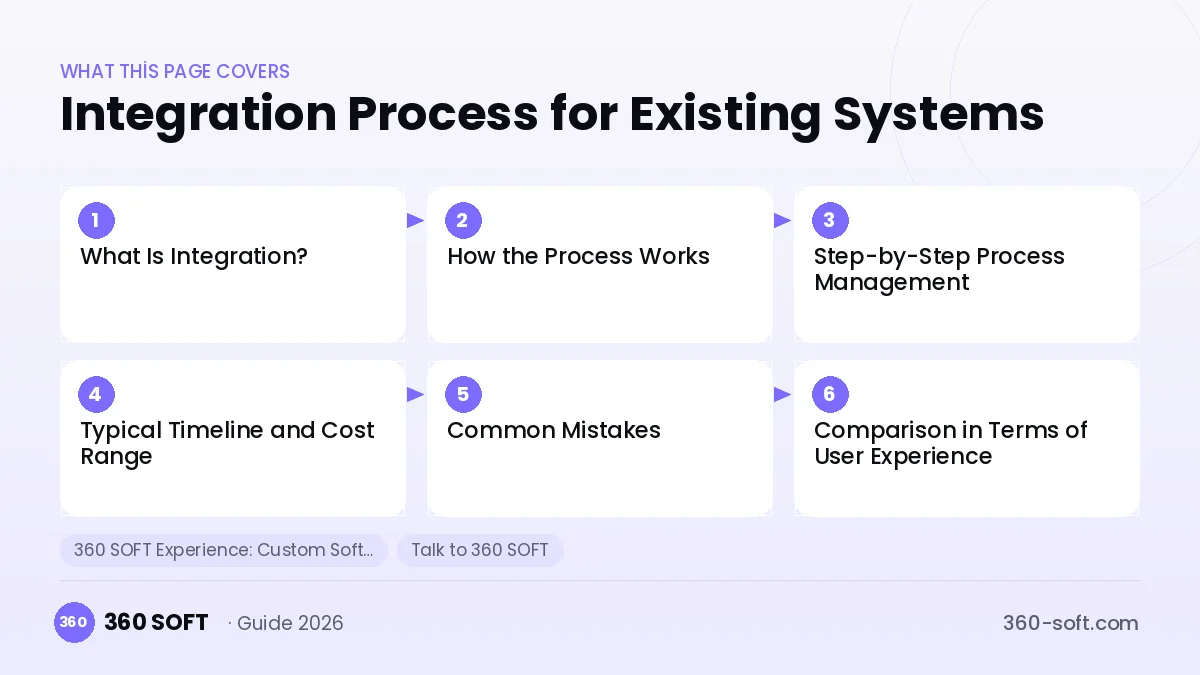
Common Mistakes
Businesses can make some mistakes during integration, usually problems caused by insufficient analysis. Failing to set clear goals or not paying enough attention to user training are common.
- Poor-quality analysis
- Neglecting user training
- Choosing the wrong strategy
Comparison in Terms of User Experience
In terms of user experience, there are big differences between successful and failed integrations: the original Turkish article states that satisfaction rises by 30% in businesses with successful integration, while a 20% drop is observed where integration fails.
Conclusion
In light of these points, integration with existing systems is critical; when managed correctly, it enables effective steps that increase efficiency. Getting professional support is beneficial on a business’s digital transformation journey.
- Thorough requirements analysis: goals must be clearly defined.
- Detailed system assessment: the infrastructure must be reviewed.
- Effective strategy: suitable methods must be chosen.
- Careful implementation: a planned test process must be applied.
- Ongoing support: continuous feedback must be provided for users’ needs.
360 SOFT Experience: Custom Software Development
The topic of this article is directly related to the areas we work in every day. For Necdet Yapı, we built a CRM platform together with a VoIP-based phone system from scratch, bringing customer communication and sales tracking into a single structure.
- Case studies
- Custom software development and outsourcing
- CRM management outsourcing
- E-invoice integration operations
We send a written proposal covering scope, timeline and price to your email address within 24 hours. Request a proposal or call us on +90 850 335 10 87.
Talk to 360 SOFT
Want a scoped estimate for your own project? Contact 360 SOFT in Istanbul: call +90 850 335 10 87, message us on WhatsApp, email info@360-soft.com or use our contact page. Teams from 1 to 200+ people, remote, on-site or hybrid, typically starting in 1–2 weeks.
More articles: Guides & Insights.