DevOps and cloud operations outsourcing gives you an experienced team that runs your CI/CD pipelines, Kubernetes clusters, infrastructure as code, monitoring and on-call rotation, so your developers can focus on the product. You can hand over day-to-day operations completely or add DevOps and SRE engineers to your existing platform team. If you need a single engineer, see hire DevOps engineers.
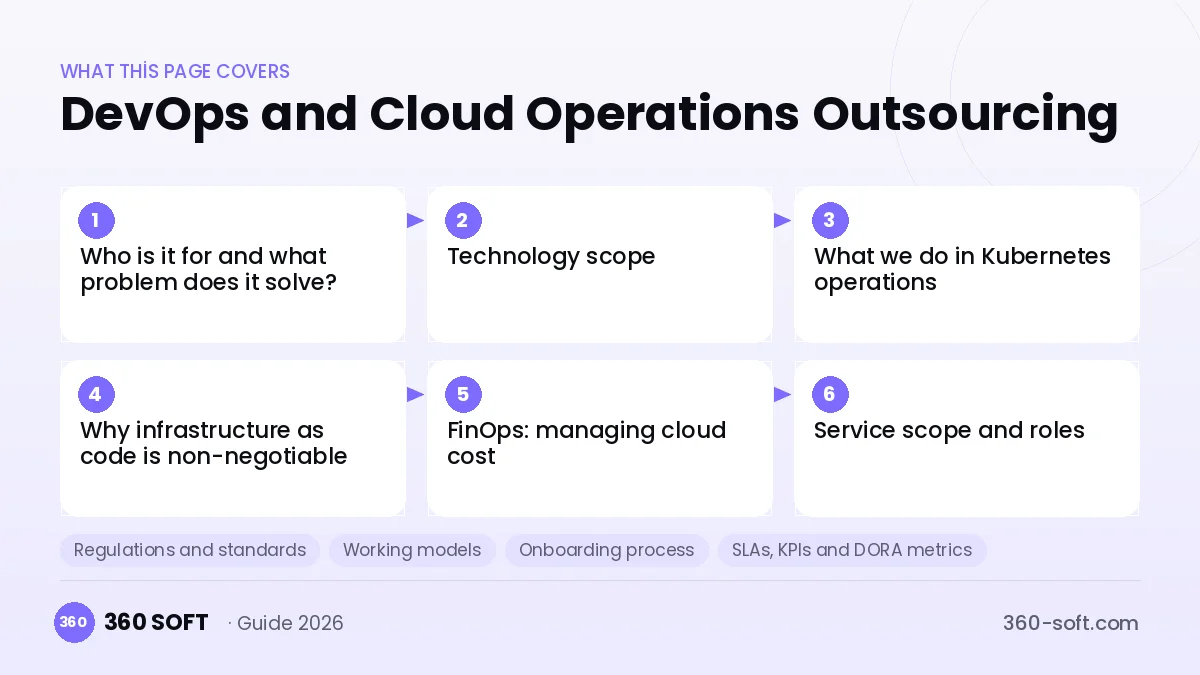
Who is it for and what problem does it solve?
Most companies do not lack cloud services; they lack the people to run them well. Typical symptoms: deployments depend on one person, environments drift apart, nobody knows why the cloud bill grew so much last quarter, alerts are ignored because there are too many, and an incident at 3 a.m. is handled by whoever happens to wake up. A DevOps operations team turns this into repeatable processes: everything defined in code, automated pipelines, documented runbooks and a clear on-call model.
- Product companies whose developers spend too much time on infrastructure
- Scale-ups migrating from VMs to containers and Kubernetes
- Enterprises running hybrid or multi-cloud estates that need 24/7 coverage
- Teams that must show change management and access control evidence to auditors
Technology scope
| Area | Typical technologies |
|---|---|
| Cloud platforms | AWS, Microsoft Azure, Google Cloud, local Turkish cloud providers |
| Containers and orchestration | Docker, Kubernetes (EKS, AKS, GKE, self-managed), Helm, OpenShift |
| Infrastructure as code | Terraform, OpenTofu, Pulumi, Ansible, CloudFormation, Bicep |
| CI/CD | GitHub Actions, GitLab CI, Azure DevOps, Jenkins, Argo CD, Flux |
| Observability | Prometheus, Grafana, Loki, ELK/OpenSearch, Datadog, OpenTelemetry |
| Security and secrets | Vault, cloud KMS, image scanning, policy as code (OPA, Kyverno) |
What we do in Kubernetes operations
- Cluster provisioning and version upgrades with tested rollback plans
- Node pool sizing, autoscaling (HPA, KEDA, Cluster Autoscaler, Karpenter)
- Ingress, service mesh and certificate management
- GitOps deployment with Argo CD or Flux
- Backup and restore of cluster state and persistent volumes
- Resource requests and limits, namespace quotas and cost allocation
Why infrastructure as code is non-negotiable
If an environment can only be rebuilt from someone’s memory, it cannot be audited, reproduced or handed over. With Terraform or a similar tool, every change goes through a pull request, is reviewed and leaves a history. Staging and production stay consistent, disaster recovery becomes a tested procedure rather than a hope, and a new engineer can understand the estate by reading code. When we take over an existing environment, importing it into code is usually one of the first milestones.
FinOps: managing cloud cost
Cloud cost is an engineering problem as much as a finance one. We tag resources by team and product, review idle and oversized resources, plan reserved instances or savings plans with you, move suitable workloads to spot capacity and set budget alerts. Each month you receive a short report showing where the money goes and which optimisations were made or proposed. We do not quote savings percentages in advance; they depend entirely on your starting point.
Service scope and roles
| Role | Responsibility |
|---|---|
| DevOps engineer | Pipelines, IaC, environment automation, developer support |
| Site reliability engineer (SRE) | SLOs, error budgets, incident response, reliability improvements |
| Cloud / platform engineer | Landing zones, networking, IAM, cost structure |
| Kubernetes administrator | Cluster lifecycle, upgrades, workload troubleshooting |
| DevSecOps engineer | Secure pipelines, scanning, secrets, policy as code |
| Operations lead | Reporting, change calendar, escalation, continuous improvement |
Regulations and standards
We follow practices aligned with ISO/IEC 27001 controls, the CIS Benchmarks for cloud and Kubernetes hardening, and ITIL-style change and incident management. In Türkiye, where the team operates, data localisation rules for some sectors (BDDK for banking, the Presidential Information and Communication Security Guide for public and critical sectors) and KVKK influence where data may be stored. In your country, local rules apply as well, for example GDPR, NIS2 or DORA in the EU; we design environments to meet the requirements your compliance team defines.
Working models
| Model | How it works | When it fits |
|---|---|---|
| Managed DevOps service | We operate your platform against agreed SLAs, including on-call | You want outcomes, not headcount management |
| Dedicated DevOps team | A stable team working only on your platform under your roadmap | Ongoing platform work and a steady backlog |
| Staff augmentation | Engineers join your platform team under your lead | You have a lead but lack capacity |
| Project | Fixed-scope work such as a migration, Kubernetes rollout or IaC import | Clear start and end, defined deliverables |
Teams can work remotely from Türkiye, on-site or in a hybrid setup, and 24/7 shift coverage is possible for production operations.
Onboarding process
| Step | Content | Typical duration |
|---|---|---|
| 1. Assessment | Architecture review, access, pain points, quick wins | 1–2 weeks |
| 2. Plan and contract | Scope, SLAs, runbook list, service agreement, NDA, DPA | 1–2 weeks |
| 3. Knowledge transfer | Shadowing your team, documenting the current state | 2–4 weeks |
| 4. Takeover | We take the primary role, your team becomes backup | Gradual, per service |
| 5. Improvement | IaC coverage, pipeline hardening, observability, FinOps | Ongoing |
SLAs, KPIs and DORA metrics
We report the four DORA metrics together with operational KPIs, so you can see both delivery speed and stability.
| Metric | What it shows |
|---|---|
| Deployment frequency | How often changes reach production |
| Lead time for changes | Time from commit to production |
| Change failure rate | Share of deployments causing incidents or rollbacks |
| Time to restore service | How quickly production recovers after an incident |
| Incident response time | Time from alert to an engineer acknowledging it, per severity |
| IaC coverage | Share of infrastructure managed in code |
| Cost per environment | Monthly cloud spend trend per product or team |
Response times per severity are written into the SLA. Target values are set after the assessment, based on your current baseline.
Pricing factors
| Factor | Effect on cost |
|---|---|
| Coverage hours | Business hours vs. 24/7 on-call is the largest single factor |
| Size and complexity of the estate | Number of clusters, accounts, regions and services |
| Team composition | Mix of DevOps, SRE, platform and security engineers |
| Maturity of the current setup | Little automation means more upfront work |
| Compliance requirements | Audit evidence and stricter change control add effort |
| Tooling | Commercial monitoring or security tools are billed separately |
In-house team, freelancer or outsourcing?
| Criterion | In-house | Freelancer | Outsourcing |
|---|---|---|---|
| Time to start | Months of hiring | Fast | Typically 1–2 weeks |
| 24/7 coverage | Needs several hires | Not realistic | Shift model possible |
| Bus factor | Often one key person | One person | Team with documented runbooks |
| Continuity | Depends on retention | Risky | Replacement process included |
Risks and mitigations
| Risk | Mitigation |
|---|---|
| Too much privileged access | Least privilege, just-in-time access, MFA, full audit logs |
| Knowledge locked with the provider | Everything in your repositories, runbooks in your wiki |
| Outage during takeover | Gradual takeover with your team as backup |
| Unplanned cost growth | Budgets, alerts and monthly FinOps reviews |
Security, data protection, NDA and intellectual property
Engineers use named accounts with MFA, privileged access is time-bound and logged, and secrets are kept in your vault, never in code or chat. All IaC, pipeline definitions, scripts and documentation are created in your repositories and belong to you.
Contract note for international buyers: we work under a B2B service agreement with a clear statement of work, a mutual NDA and an IP assignment clause so that deliverables you pay for belong to you. Where we process personal data on your behalf, we sign a GDPR-compliant Data Processing Agreement (Art. 28) with Standard Contractual Clauses for transfers to Türkiye (or the UK IDTA/Addendum for UK data exporters). Because the team operates in Türkiye, Turkish data protection law (KVKK, Law No. 6698) also applies on our side. Staff are employed by us under Turkish labour law, so you do not take on employer obligations.
Illustrative scenario
Illustrative scenario – not a client case. An e-commerce company runs on a few manually built cloud servers. Deployments happen at night and each one is stressful. A possible plan: import the existing setup into Terraform, containerise the main services, introduce a GitHub Actions pipeline with automated tests and blue-green deployments, then move to a managed Kubernetes service. Once stable, a business-hours DevOps team plus an on-call rotation for peak seasons covers operations.
Selection checklist
- Do they start with an assessment rather than a fixed package?
- Will all code and documentation live in your repositories?
- How is privileged access controlled and logged?
- Which metrics are reported, and how often?
- How does on-call work, and who is the escalation point?
- Can they sign a DPA with SCCs and an IP assignment clause?
Frequently asked questions
Which clouds do you support?
AWS, Azure and Google Cloud, as well as private and local Turkish cloud providers and hybrid setups.
Can you take over an existing environment that is not in code?
Yes. We document the current state and import it into Terraform or a similar tool step by step, without downtime as a goal.
Do you provide 24/7 on-call?
Yes, 24/7 shift coverage is possible. Response times per severity are defined in the SLA.
Will we lose control of our infrastructure?
No. Access runs through your identity provider, all code lives in your repositories and you can revoke access at any time.
Do you work with our existing tools?
Yes. We prefer to improve the tools you already use and only propose changes where there is a clear benefit.
Can you help reduce our cloud bill?
We run FinOps reviews, rightsizing and commitment planning. Savings depend on your starting point, so we do not promise figures in advance.
How quickly can you start?
A typical start is 1–2 weeks after scope is agreed, beginning with an assessment.
Who owns the code and documentation?
You do. Everything is created in your repositories and covered by the IP assignment clause.
Is this suitable for regulated industries?
Yes. We follow your compliance requirements, Turkish rules where the team operates and the local rules of your country.
Talk to us
Tell us about your DevOps and cloud operations needs and we will come back with a scoped proposal, a team plan and a realistic start date (typically 1–2 weeks). Call or WhatsApp +90 850 335 10 87, message us on WhatsApp, email info@360-soft.com or use the contact page. 360 Soft Marketing Yazılım ve Danışmanlık Ltd. Şti., Nidakule Ataşehir Batı, Barbaros Mah. Begonya Sk. No:1 D:2, 34746 Ataşehir/İstanbul.
Related pages
- All outsourcing services
- NOC network monitoring outsourcing
- SOC security monitoring outsourcing
- QA and testing outsourcing
- Hire DevOps engineers
- Türkçe
Related services
- Digital Marketing Team OutsourcingOutsource a dedicated digital marketing team: paid media, SEO, content, social, email and analytics in your…
- E-commerce Operations OutsourcingE-commerce operations outsourcing for web shops and marketplaces: catalog, orders, returns, customer…
- E-commerce OutsourcingE-commerce outsourcing: marketplace and catalog management, orders and returns, customer service, content and…
- E-Invoice Integration Operations OutsourcingE-invoice integration operations in Türkiye: e-Invoice, e-Archive, e-Waybill and e-Ledger monitoring…
- Education Sector OutsourcingEducation outsourcing: admissions and parent communication, LMS support, content production and IT teams…
- Energy and Infrastructure Sector OutsourcingEnergy sector outsourcing: IT and OT/SCADA support, software, field maintenance coordination and customer…